
A custom photo pendant is a piece of jewelry that holds a personal photograph, either engraved into metal, sealed under resin, or hidden inside a locket or projection chamber. If you already own one, this guide also covers wear, care, documentation, and the practical path to a fair offer when your plans change.
Table of Contents
What a Custom Photo Pendant Is and Who This Guide Is For
A custom photo pendant is a necklace pendant made to preserve a picture in a wearable format, and it can be built as engraving, a sealed image, a hidden insert, or a projection piece. That makes it part jewelry, part keepsake, and for many people, part memory object.
That mix is why this category shows up in wedding gifts, memorial pieces, anniversary presents, and everyday wear. If you are shopping, you need to know what materials and styles change the look. If you already own one, you need to know how to wear it, document it, and decide what happens if you ever want to sell it.
A helpful way to think about it is this, a custom photo pendant is less like a generic necklace and more like a tiny frame with rules. The frame matters, but the photo matters too. A strong choice starts with understanding how the picture will be reduced, protected, and attached to the piece.
That is also why personalized jewelry often feels so event-driven. People choose it for moments that deserve a physical reminder, such as a milestone gift, a bridal-party thank-you, or a private remembrance. For shoppers looking at unique thank you gifts for wedding party, a photo pendant can fit that role well when the image is clear and the recipient likes meaningful jewelry.
If you are comparing fine jewelry categories, the simplest framing is that this piece sits inside the broader world of wearable keepsakes, not just fashion accessories. For a quick primer on that distinction, see what is fine jewelry. That context helps buyers ask better questions before they order, especially when the goal is to wear something often.
Why the Custom Photo Pendant Market Keeps Growing

A custom photo pendant grows out of a broader shift in how people buy jewelry. Personalized jewelry is no longer a small side interest, it has become part of the main market, and necklaces are one of the clearest examples of that demand. According to Dataintelo's personalized jewelry market report, the global personalized jewelry market was valued at USD 38.6 billion in 2025 and is projected to reach USD 81.4 billion by 2034, with a 8.7% CAGR over the forecast period, while necklaces account for USD 13.2 billion and 34.2% of global personalized-jewelry revenue in 2025.
That matters because a photo pendant is a necklace-based personalization format. It is part of the biggest product type in the category, so it benefits whenever interest in personalized necklaces grows. The same market overview also points to custom jewelry services projected at USD 3.95 billion in 2025 and USD 5.97 billion by 2030, with a 8.5% CAGR, which shows that buyers are not only choosing finished pieces, they are also commissioning jewelry made around a specific photo or memory.
The demand pattern is easy to see in gift buying. Someone selects a photo, uploads it for a holiday order, and wants the pendant ready for giving. That creates a focused buying window, which helps sellers plan inventory and production, and helps buyers understand why style choices and turnaround times can change so quickly during gift seasons.
Practical rule: In a gift-led category, timing affects more than delivery. It also shapes stock choices, production queues, and the kind of guidance buyers need before they upload a photo.
For sentimental gifts, that pattern fits the wider personalized-gifts segment as well. Shoppers often want something that feels tied to a person or moment, not a generic accessory, which is why keepsake ideas from remembers.life can be useful for readers who are comparing ways to turn a memory into a physical gift. That same behavior appears in search interest for custom photo pendant products, where custom picture trends shows stronger attention during late-year gifting periods and quieter interest at other times.
For owners, this growth has a practical side too. A pendant that was bought as a gift or memory piece may later need cleaning, storage, documentation, or even resale decisions, so understanding the market is not only about buying well. It also helps people care for the piece, keep the right records, and decide what to do with it if their needs change.
Main Construction Styles and How Each One Looks
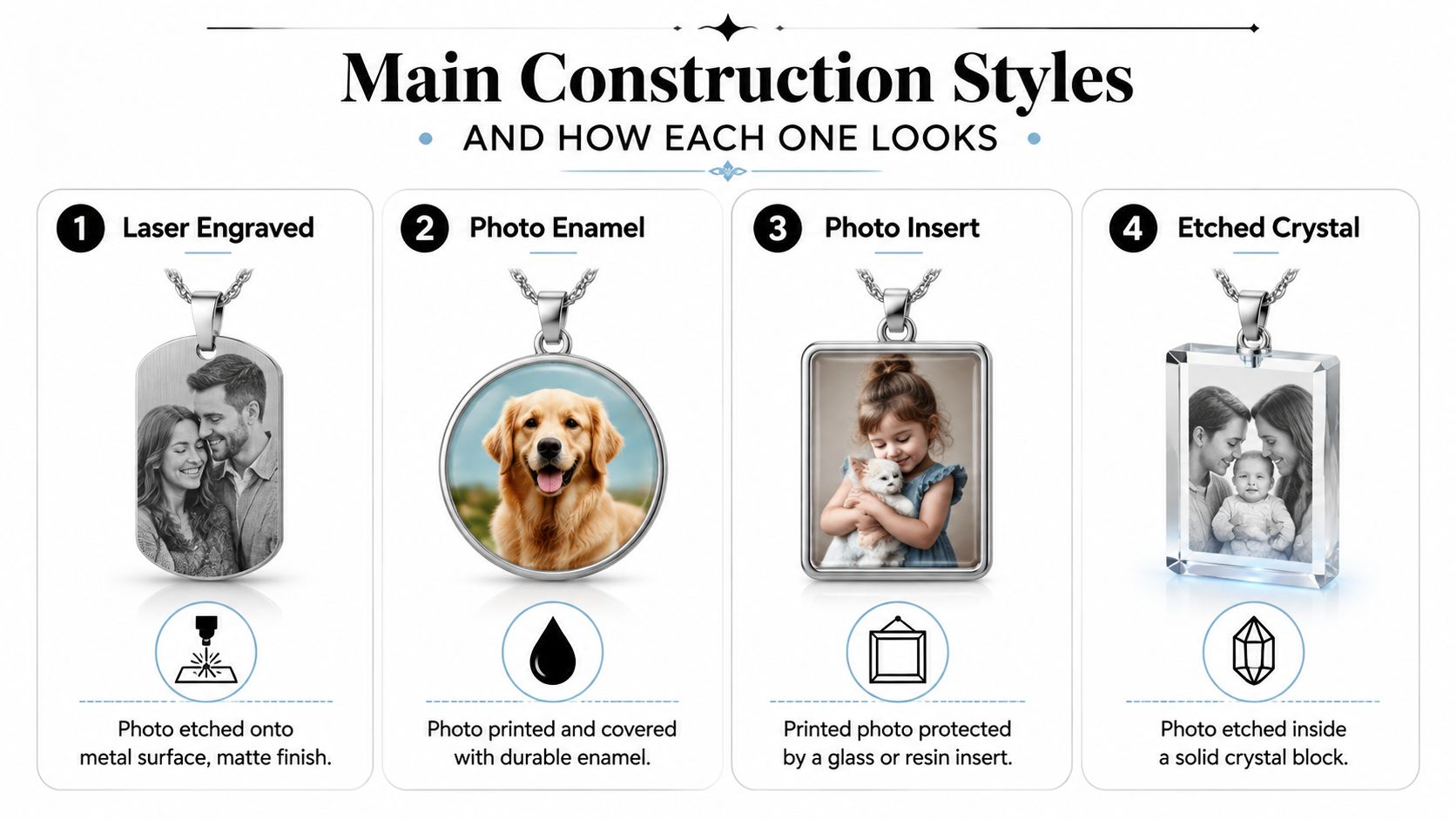
A good way to compare pendant styles is to think of them as four different photo frames. Each one protects the image in a different way, and each one changes what the viewer notices first.
Traditional lockets keep the photo hidden until opened
A hinged locket is the most familiar design. The photo sits inside a compartment, so the front can be plain, engraved, or decorative while the image stays private. That makes lockets especially good for gift givers who want a sentimental piece that feels personal without broadcasting the photo all day.
Projection-style pieces work differently. The image is hidden inside the pendant and only appears when you look through the center or shine a phone flashlight through it, which makes the experience feel more like a reveal than a display. For someone who likes privacy or novelty, that can be the most appealing format.
Some styles are meant to be read at a glance, others are meant to be discovered.
Engraved and resin styles turn the photo into the surface
Laser-engraved photo pendants turn an image into a dot-matrix reproduction on metal. One documented method uses a diamond-tipped punch to create a pattern that reads through contrast and reflective movement, producing a holographic-like effect when the pendant catches light, as described by Photo Pendant UK.
Resin-sealed and photo-insert styles behave more like miniature picture frames. The photo is printed and protected under a clear layer, so the face tends to look more literal and recognizable than an engraved version. That can be useful for buyers who want the image to look like a photograph rather than a graphic rendering.
Matching style to the person wearing it
The choice usually comes down to use case. Lockets and projection styles often suit people who like emotional meaning or privacy. Engraved and resin styles fit better when the photo itself is the main visual feature. If the wearer likes a polished, more decorative look, the resin or crystal-like formats tend to feel brighter and more obvious.
A side note on construction matters too. Modern custom photo pendants can be traditional lockets, laser-engraved pieces, resin-sealed images, or projection pendants, and the variety explains why one product name can describe very different objects, as outlined in this picture pendant guide.
Materials, Sizes, and What They Mean for Wear
A spec sheet can look simple until you try to wear the piece every day. At pendant scale, a small change in size affects comfort, chain tension, and how clearly the image reads from arm's length.
Size affects recognition more than people expect
One common template uses a 1" × 1" pendant face, while another engraved format is 1.06" wide × 1.8" high with a 24" chain. At that scale, the image has to stay simple, because the pendant face is too small for crowded scenes or tiny background detail, according to Printify's custom cut photo pendant template. A near-square crop usually gives the image the best chance to survive reduction without looking cramped.
The weight difference can be just as important. Published custom-photo pendant specs show a range from about 23.5 g for a 1.25" small circle pendant to 119 g for a 2.7" large circle version, based on GLD's 3D photo pendant specifications. That is why size does not just change appearance, it changes how the pendant hangs.
Wearability rule: If the pendant gets larger, the chain choice starts carrying more of the daily comfort burden.
Materials shape both feel and resale logic
Sterling silver, stainless steel, gold, and platinum each signal a different use case. Silver and stainless steel are often chosen for everyday wear and practical durability, while gold and platinum are typically considered when the buyer wants a more premium precious-metal profile. A separate guide to 14k versus 18k gold helps compare warmth, purity, and budget if the pendant is meant to be kept, documented, or later resold.
The premium builds also change the optical effect. Some custom-photo pendants use 316L stainless-steel chains for corrosion resistance, brass or silver bases with gold plating, and 4.0 mm stones or CZ/moissanite settings to create a brighter, more reflective finish. Chamber-style lockets add a different layer of construction, using compact bodies with gasket-sealed screw closures for air- and water-tight sealing.
Common Custom Photo Pendant Formats at a Glance | |||
|---|---|---|---|
Format | Typical Face Size | Approximate Weight | Best For |
Small circle pendant | 1.25" | 23.5 g | Lighter daily wear and smaller photos |
Large circle pendant | 2.7" | 119 g | Bigger visual impact and bolder styling |
Square template style | 1" × 1" | Not specified in source | Simple, centered portraits |
Vertical engraved style | 1.06" wide × 1.8" high | Not specified in source | Portrait-oriented images |
If you are comparing metal choices for a specific occasion, the better question is not what looks nicest. It is what the wearer will put on often, and whether the piece needs to stay comfortable, keep its finish, and still make sense if it is ever appraised or sold later.
Preparing the Photo for a Clean Final Result
The photo decides whether the pendant feels intimate or blurry. The pendant format only magnifies that difference, because a small face area punishes clutter and weak focus.
Start with the source file, not a screenshot
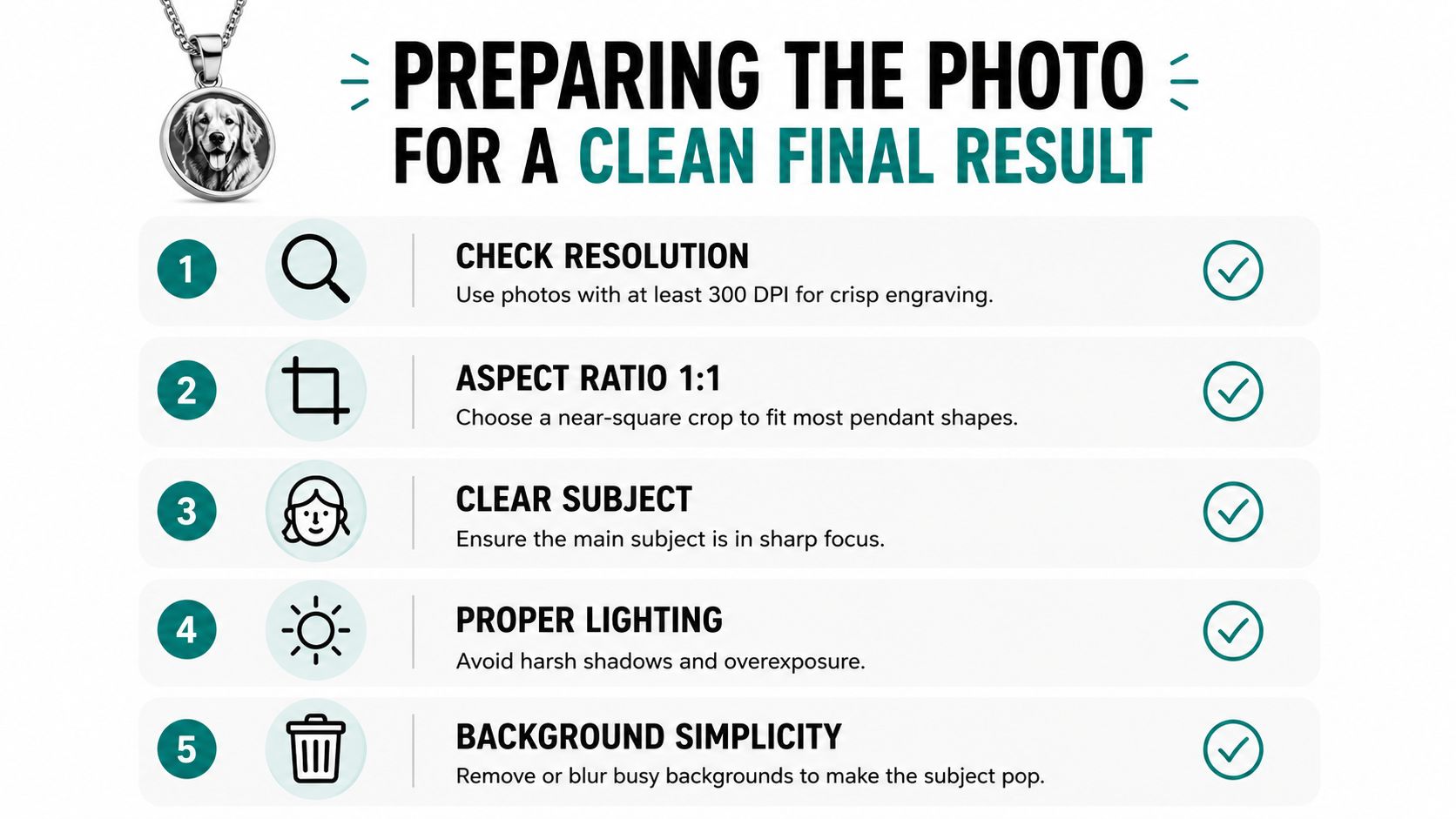
Vendors often recommend the original camera or smartphone file rather than a screenshot or a message-app copy, because compressed images lose detail before the pendant is made, as noted by Hidden Forever's custom photo pendant guidance. That difference is easy to miss on a phone screen and obvious once the image has been miniaturized.
The crop matters too. A pendant face usually works best when the main subject is centered and the framing is close to square. Wide shots lose too much facial presence, while tight portraits hold up better because the eye has less empty space to process.
Keep the scene simple
A photo with one or two close subjects is usually stronger than a crowded group shot. That is not because group photos are bad, it is because pendant scale rewards legibility. When the image gets reduced, small gaps between faces, busy backgrounds, and extra objects start to blur together.
For more on framing and capture angles, this jewelry photography guide is useful if you want cleaner source images before uploading. Even a basic review, face sharp, background calm, crop centered, can save disappointment later.
A quick checklist helps:
Use the original file. Avoid screenshots and compressed shares.
Crop near square. Keep the subject centered.
Favor one or two subjects. More people means less clarity.
Check facial sharpness. If the face is soft on a phone, it will be softer on the pendant.
Simplify the background. Busy scenes compete with the subject.
A photo pendant is small enough that every pixel has a job. If the source image is disciplined, the final piece feels intentional instead of crowded.
What Affects Resale Value and What Owners Should Save
A custom photo pendant can have sentimental value first and market value second. If you ever decide to sell, buyers will focus less on the memory and more on the parts they can evaluate.
What buyers can resell and what they usually cannot
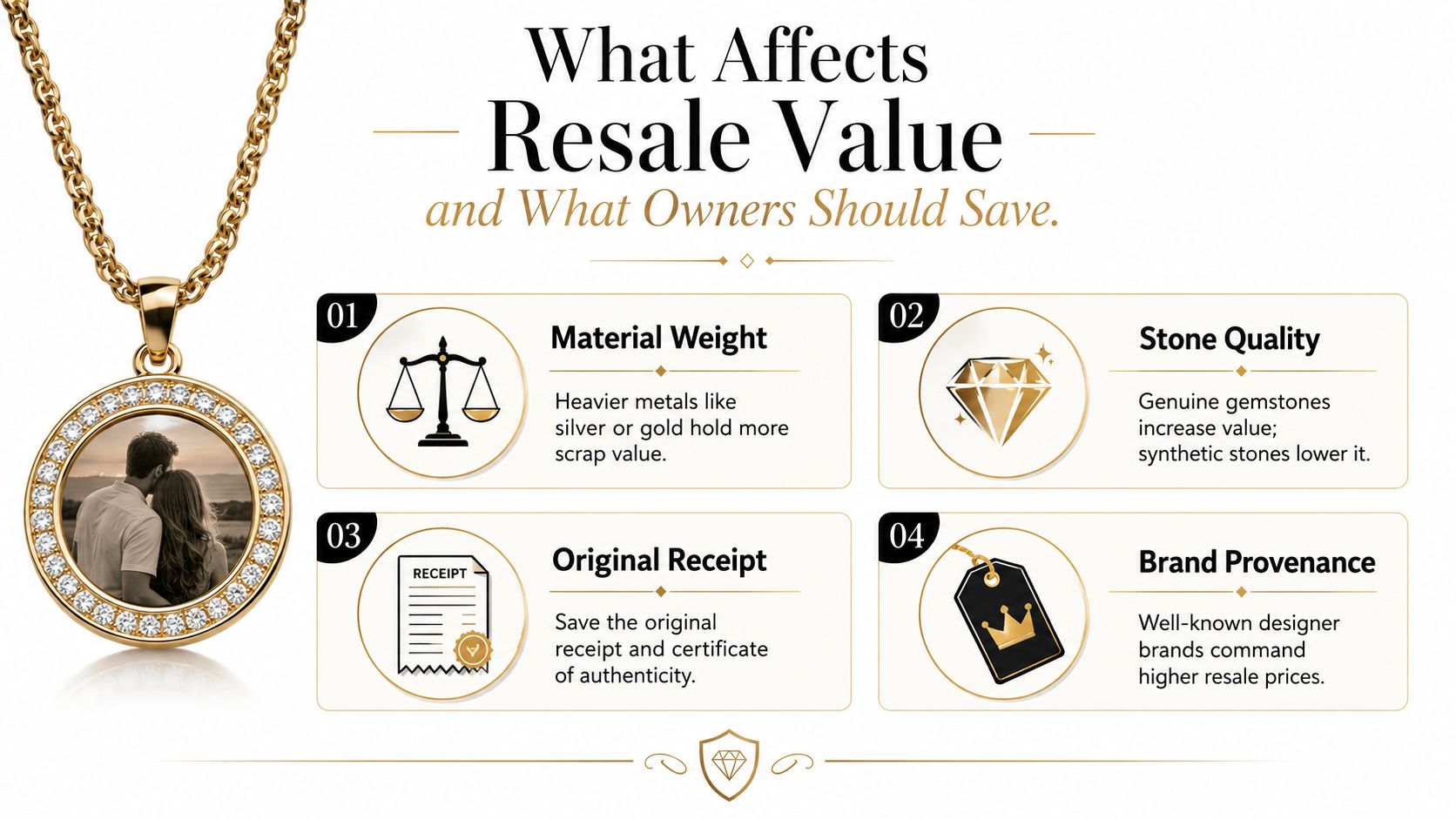
Resale value depends on the metal, the craftsmanship, any stones, the maker, the condition, and the paperwork that proves what the piece is made of. If the pendant is mostly precious metal and the photo element can be removed, a buyer may view it more like a jewelry item with reclaimable value. If the custom image is permanent and very personal, the market often treats it more like a sentimental piece with limited secondary demand.
That is why the construction style matters again. A pendant that can be melted, reset, or repurposed has a broader resale path than one that is locked to a specific portrait. If the piece includes genuine stones or a known maker's mark, those details may help a buyer evaluate it more confidently.
What to keep in a file now
Owners should save the original receipt, maker paperwork, any hallmark or grading documentation, clear photos of the front and back, and notes about chain and packaging condition. A simple folder on your phone or computer is enough. The point is not to build an archive, it is to make future identification easier.
Save the paper trail while you still have it. The easiest time to document jewelry is before life gets busy and the box disappears into storage.
If you want a broader sense of how jewelers assess pieces, this appraisal guide helps explain why condition and documentation carry real weight. A custom pendant is no different in that respect. Even if the image is personal, the buyer still needs objective details.
For owners thinking about a future sale, one more practical habit helps. Photograph the pendant in good light while it is still in your possession, because clear images make later conversations about condition much easier. If you cannot show what was there, you make it harder for a buyer to compare before and after.
Getting a Fair Offer Without the Runaround
A respectful sale process should feel organized from the start. The buyer reviews the piece, explains the criteria, and gives you a clear choice without pressure.
A typical first step is a free online evaluation using photos and any documentation you already have. If you are local, you can then book a private in-person appointment. For remote clients, insured shipping is the safer route when a physical review is needed.
The evaluation itself should focus on the same practical factors every time, metal purity, craftsmanship, stones, weight, brand, condition, and current resale demand. From there, the buyer presents a no-obligation offer with no hidden fees. If you accept, the finish should be simple, with payment by cash or secure transfer depending on the transaction setup.
That same process works for clients near Atlanta, Buckhead, Sandy Springs, Alpharetta, Roswell, and Brookhaven, and it extends to other U.S. locations served through remote intake. For readers comparing where to sell, where to sell fine jewelry is a useful reference for the decision framework. Antwerp Diamond Store is one trusted local option for this kind of review, especially when a seller wants a private, straightforward conversation instead of a rushed quote.
Care Basics and a Quick Recap for the Road
Take the pendant off before showering, swimming, exercising, or applying lotions and perfume. Store it in a soft pouch away from harder jewelry, then wipe it gently with a soft cloth after wear.
The main buying lesson is simple, choose a style that matches the photo and the person. The main ownership lesson is just as important, keep the receipt, notes, and clear photos so you can identify the piece later. If the time ever comes to sell, that paperwork and condition record make the conversation much easier.
Frequently asked questions
How long does production usually take? It depends on the maker and the style, so ask before ordering.
Can the photo be updated later? Some styles allow changes, but many do not, especially permanent engraved or sealed pieces.
Can engraved pieces be re-engraved? Sometimes, but only if the metal, depth, and layout allow it.
Do projection pendants work with every phone? They usually need a light source or compatible viewing setup, so it's smart to check the product instructions first.
If you want a careful, no-pressure review of a custom photo pendant, Antwerp Diamond can help you understand the piece, its condition, and its resale context. Visit Antwerp Diamond to request an evaluation or plan an in-person visit when you're ready.