

You're probably staring at a tennis chain and wondering two things at once, what it's really made of, and whether it's worth selling now. A tennis chain is a flexible row of individually set stones, usually diamonds or diamond alternatives, and its value depends far more on metal weight, stone type, condition, and proof than on sparkle alone.
If you're trying to sell, appraise, or understand one, the details matter. A chain that looks similar in photos can bring a very different offer once a specialist checks the setting, tests the stones, weighs the metal, and reviews any paperwork.
Table of Contents
What Tennis Chain Jewelry Actually Is
A tennis chain is a necklace or bracelet made from a continuous line of individually set stones linked together so the piece bends naturally. The easiest way to think about it is like a train, each stone is its own car, each link is its own coupler, and the whole line moves smoothly without rigid joints.
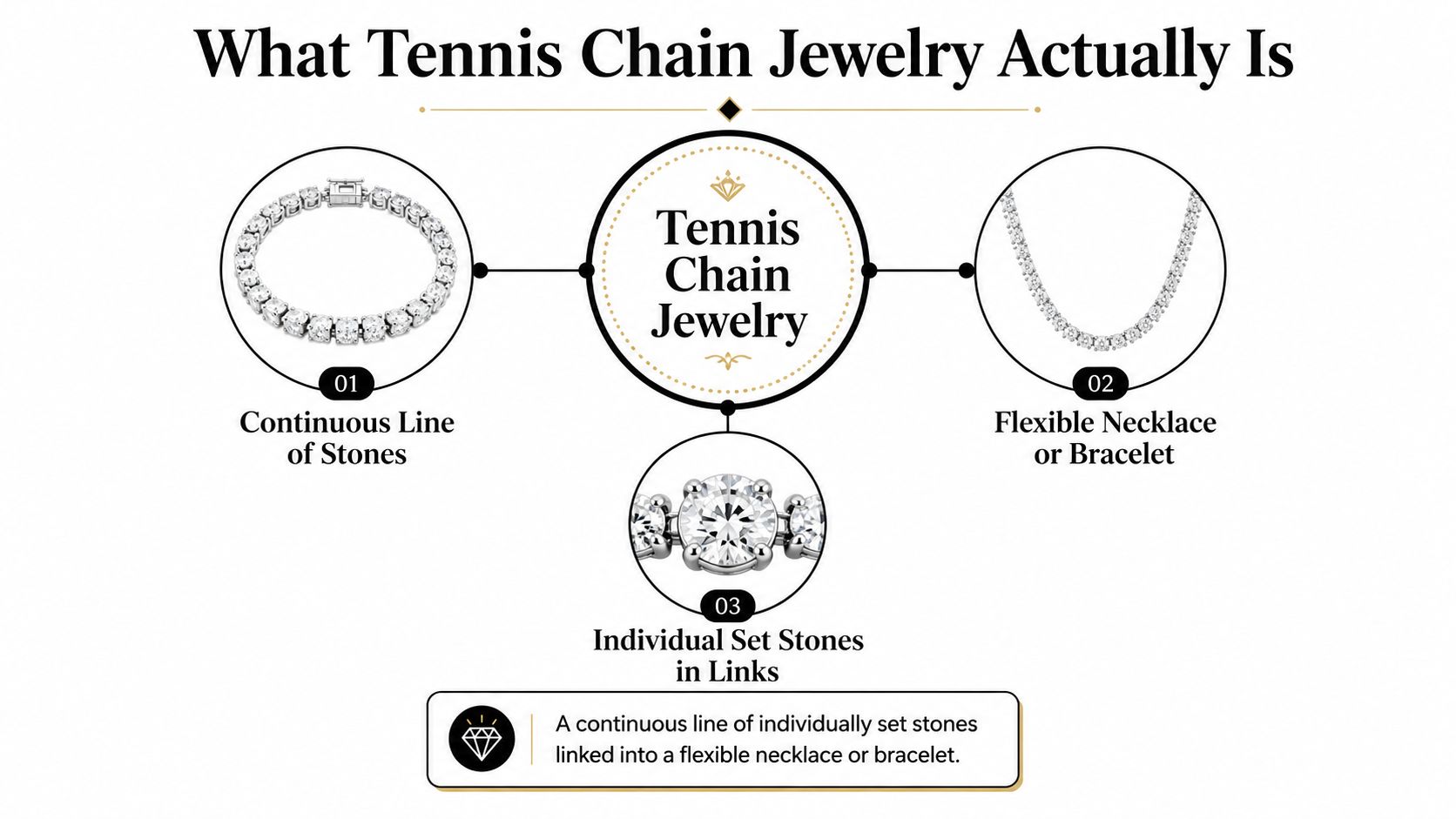
The design is different from a solitaire pendant, where one stone hangs from a single point, or from a cluster necklace, where smaller stones form a grouped shape. With tennis chain jewelry, the visual idea is continuity, one matched stone after another, all meant to read like a single sparkling line.
What to picture when you're holding one
For everyday wear, tennis necklaces are commonly seen in 16 to 18 inch lengths and often fall in the 2 to 5 carat total weight range when they're designed for comfortable use. That helps explain why some pieces feel easy to wear while others sit heavy on the neck or start twisting more often.
Practical rule: if the necklace feels stiff in the hand, it'll usually feel stiffer on the body too.
The term itself can be confusing because buyers often use “tennis chain” and “tennis necklace” interchangeably. The style sits in the same family as tennis bracelets, and a useful background explanation of the original bracelet format is the history of tennis bracelets.
For anyone comparing chain styles while shopping or selling, it also helps to think about the metal underneath the stones. A separate guide on buying gold chains is useful if you're trying to judge whether the base metal itself has meaningful weight and quality.
How Tennis Chains Got Their Name
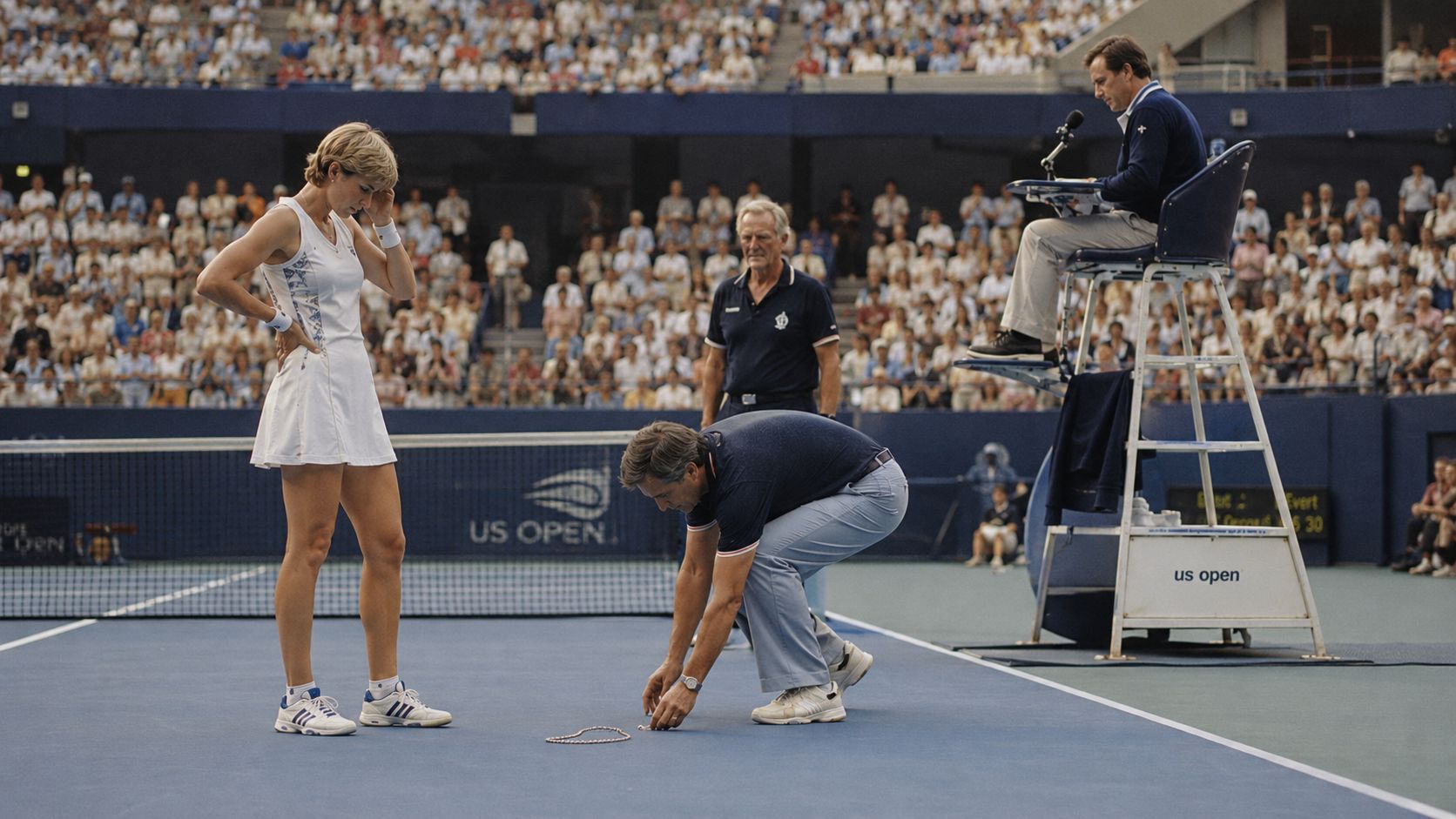
The modern name comes from a very public moment in 1978, when Chris Evert lost her diamond line bracelet during a match at the US Open. Officials paused play so she could recover it, and that incident pushed the style into mainstream awareness as both a tennis bracelet and, later, the chain version people now call a tennis chain.
Before that, the same continuous-row idea was commonly known as an eternity bracelet and had been around since the 1920s, when matched stones were already being worn as symbols of enduring love. The name changed because the public story changed, not because the design suddenly became new.
How the style moved from niche to mainstream
The leap from fine-jewelry curiosity to widely worn fashion piece happened later, when tennis chains became broadly popular in the late 1980s and early 1990s and then gained even more visibility through hip-hop fashion in the 1990s and 2000s. That shift matters because it explains why today's market includes everything from delicate diamond lines to louder, more visible statement pieces.
Another clue is the material mix. One industry summary noted that lab-grown diamonds represented about 35% of tennis bracelet sales in 2023 source. That doesn't mean every chain has the same buyer base, but it does show how the category widened beyond traditional natural-diamond luxury.
A seller should read that history carefully. A piece with old-style craftsmanship, heavier gold, and natural stones doesn't belong in the same resale conversation as a fashion-forward lab-grown or moissanite chain, even if the jewelry case label sounds similar.
Settings, Construction, and Everyday Wearability
A tennis chain works because each stone sits in its own small setting, almost like a tiny house with a cavity in the middle and walls or prongs holding the gem in place. That construction gives you the best of both worlds, fluid drape and separate mechanical support for each stone.
How the three main settings behave
Prong settings are the most open. They let in a lot of light, which is why they often look brightest, but the exposed edges also make them more vulnerable to knocks and snags.
Bezel settings wrap metal around the stone's edge. They're usually the most secure and the least fussy to live with, though they can hide a little more of the stone's face.
Channel settings place stones between metal rails. They create a sleek, cleaner look and resist snagging well, which is useful if the wearer is hard on jewelry.
A chain that looks beautiful in a tray can still be annoying in daily life if it flips, twists, or kinks too easily.
That's the part many buyers don't ask about until after the purchase. Link geometry, setting style, and how much metal supports each stone all affect whether the piece lies flat or keeps rolling over.
An example of the design tradeoff appears in bust down chain construction, which is helpful background if you're comparing flash-heavy necklaces with more wearable tennis styles.

What wearability really comes down to
Daily comfort depends on how much material the chain carries. One expert guide recommends under 0.5 grams per inch for comfort, and that point aligns with the practical reality that more weight and more stone size usually mean more neck load and more stiffness source.
For a first-time seller, that matters because a chain that's pleasant to wear often holds up better in inspection too. If the links are bent, the clasp feels loose, or the stones don't sit evenly, buyers notice fast.
Materials, Quality, and What Drives Resale Value
Resale value starts with what the chain is made of, not with how loud it looks in a photo. A classic benchmark for diamond line jewelry is a tennis bracelet built with around 62 diamonds, each about 0.2 carats, for a total of 12.4 carats, often set in 18k white gold weighing about 40 grams source. That bracelet example isn't a necklace, but it gives you a real-world sense of the material scale buyers expect in serious tennis-style jewelry.
The factors that actually move an offer
Metal matters first. Gold purity and metal weight affect recovery value, and a chain with more solid gold content will usually be more interesting to a serious buyer than a light, hollow piece with a heavy look.
Stone type matters just as much. Natural diamonds, lab-grown diamonds, and moissanite may look similar at a glance, but they don't behave the same in resale. Buyers tend to price them differently because they're not interchangeable in the secondary market.
Certification matters too. A GIA report or similar documentation helps reduce uncertainty because it gives the buyer a clear starting point on the stone's cut, color, clarity, and carat. Without that paper trail, the buyer has to spend more time and take more risk.
For a closer look at what different diamond specimens look like in real life, a hand-selected diamond crystal specimen is a useful reference point when you're trying to understand how natural rough or formed material differs from finished jewelry.
A quick comparison for sellers
Factor | What to Look For | Why It Matters |
|---|---|---|
Metal | Solid gold content, visible hallmarks, and actual weight | Heavier, higher-purity metal supports stronger base value |
Stone type | Natural diamond, lab-grown diamond, or moissanite | Buyers price each category differently |
Certification | GIA report or comparable third-party paperwork | Improves confidence and reduces offer friction |
Condition | Straight links, intact prongs, secure clasp, clean finish | Better condition usually means less deduction |
Brand or maker marks | Signed clasp, stamps, or recognizable craftsmanship | Helps a buyer assess origin and market appeal |
A note on the difference between luxury and liquidity
A chain can be gorgeous and still be harder to resell than you expect. The secondary market tends to care about what's recoverable, verifiable, and easy to authenticate, which is why the difference between 14k and 18k gold is worth understanding before you set a price in your head.
Authentication and Common Scams to Watch For
The easiest way to overpay for tennis chain jewelry is to assume the look tells the truth. In reality, the market includes plenty of pieces that are presented more generously than they deserve.
Four red flags that show up often
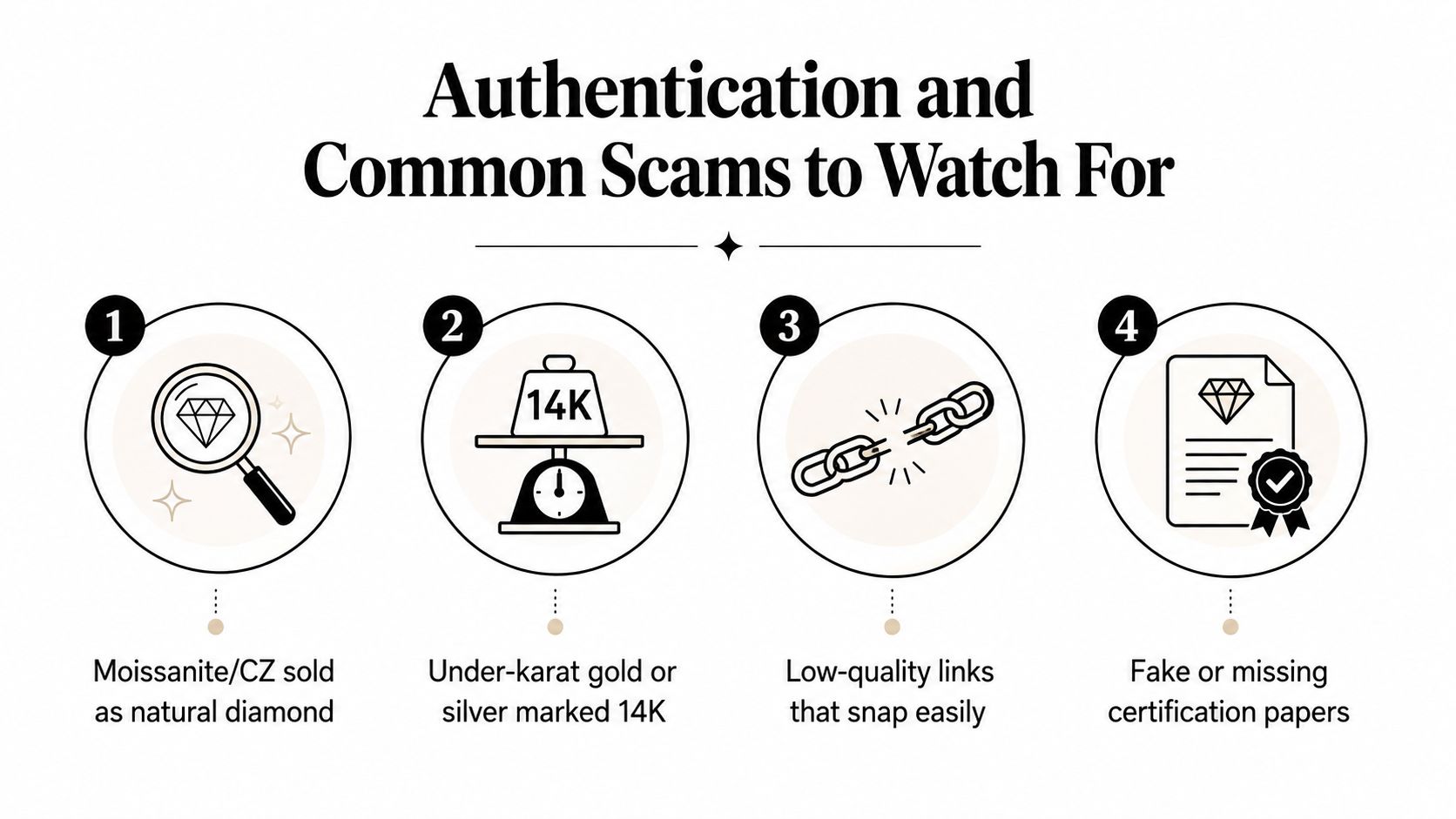
Moissanite or cubic zirconia sold as diamond is the most obvious problem for buyers who don't test stones. A basic tester can help separate materials, but the eye alone can miss the difference, especially in bright retail lighting.
Lab-grown diamonds sold as natural diamonds is another issue. The stones can look excellent, but the resale math changes a lot when a seller claims natural origin without proof.
Hollow or lightweight chains disguised with thick plating can fool someone who's only checking color and shine. A chain that feels too light for its visual size deserves a closer look.
Inflated carat claims are common in fashion listings. Some sellers quote diamond equivalent language instead of actual stone weight, which can make the piece sound more valuable than it is.
If the paperwork is thin, the buyer has to make a cautious offer.
That's why independent verification matters. A real appraisal, weight check against the claimed specs, and magnified inspection of the setting can separate a fair deal from a disappointing one.
A practical explanation of stone authenticity is useful here too, especially if you're trying to decide whether a listing's “diamond” language holds up. The meaning of genuine diamond is clearer once you see how origin, testing, and documentation work together.
Care and Maintenance That Protects Value
A chain in clean, stable condition photographs better, inspects better, and usually sells better. The good news is that basic care doesn't require specialized equipment, just consistency.
What to do at home
Use mild soap, lukewarm water, and a soft brush for routine cleaning. That's enough to lift skin oil and buildup without grinding grit into the metal.
Avoid ultrasonic cleaners if the piece is prong-set or already showing signs of looseness. The vibration can be hard on fragile settings, especially when a stone is already sitting a little loose.
Store the chain flat, in a soft pouch or a lined jewelry box compartment. If it gets tossed into a pile with other jewelry, the stones can scratch metal surfaces or knock into each other.
The small checks that prevent expensive problems
Look at the clasp and prongs every few months. A loose prong is a common reason a stone gets lost, and once a stone is gone, the conversation changes from selling to repairing.
Professional servicing can be worth it when the chain is otherwise strong. Prong retipping helps restore security, and rhodium re-plating can improve the look of white gold when the surface starts to dull.
A seller who brings in a clean, inspected piece usually makes the buyer's job easier, and that tends to help the offer.
The point isn't to make the jewelry perfect. It's to keep it presentable and structurally sound so the buyer sees what's really there, not dust, residue, or avoidable wear.
How to Get a Top Offer When You Sell
A good selling process starts with information, not with pressure. If you have a tennis chain, the fastest path to a fair offer is to gather the basics first, then let a specialist confirm the details.
Start with what you can document
Send clear photos of the front, back, clasp, hallmarks, and any paperwork you still have. Include the weight, length, metal type, stone type, and certification if available.
That first pass helps the buyer decide whether the piece is a strong candidate for direct purchase, a more detailed evaluation, or a chain that needs testing before value can be discussed.
Then choose the evaluation path that fits your situation
For Atlanta-area sellers, a private in-person review at Antwerp Diamond Store in Buckhead gives the clearest picture because the item can be weighed, tested, and inspected in one visit. Sellers from Sandy Springs, Alpharetta, Roswell, Brookhaven, Midtown Atlanta, and the greater Georgia market often use that route when they want a face-to-face answer.
If you're outside the area, an insured shipping option keeps the process practical. The package should be tracked, securely labeled, and received before any offer is finalized.
For a broader look at resale options, the guide on where to sell fine jewelry is a helpful comparison point.
What happens during the review
Expect three checks in order, authentication, condition, and market comparison. A buyer then presents an offer with no obligation, and you decide whether the timing, discretion, and payout method fit your goals.
Payout can be arranged through cash or secure transfer, depending on the transaction setup. For many sellers, speed matters, but so does privacy, because a quiet, straightforward process removes a lot of friction.
Key Takeaways and Next Steps
A tennis chain's resale value comes from the combination of metal weight, stone type, certification, condition, and brand signals, not from sparkle alone. A chain with strong materials and clean paperwork can still outperform a flashier piece that's light, under-documented, or poorly maintained.
Authentication is the biggest safeguard against a bad outcome. If the stones, gold content, or claimed carat weight don't check out, the offer changes quickly, and for good reason.
Care matters too. Clean storage, gentle washing, and timely prong checks help preserve the exact condition a buyer will inspect later.
If you're thinking about selling, take one practical step now. Gather your photos and documentation, then request a free evaluation, book a private appointment in Buckhead, or use insured shipping if you're outside Atlanta.
Antwerp Diamond offers discreet, expert evaluations for tennis chain jewelry and other fine pieces, with clear attention to metal, stones, condition, and market reality. If you're ready to understand what your chain is worth, visit Antwerp Diamond to start with a free evaluation or arrange a private appointment.


