

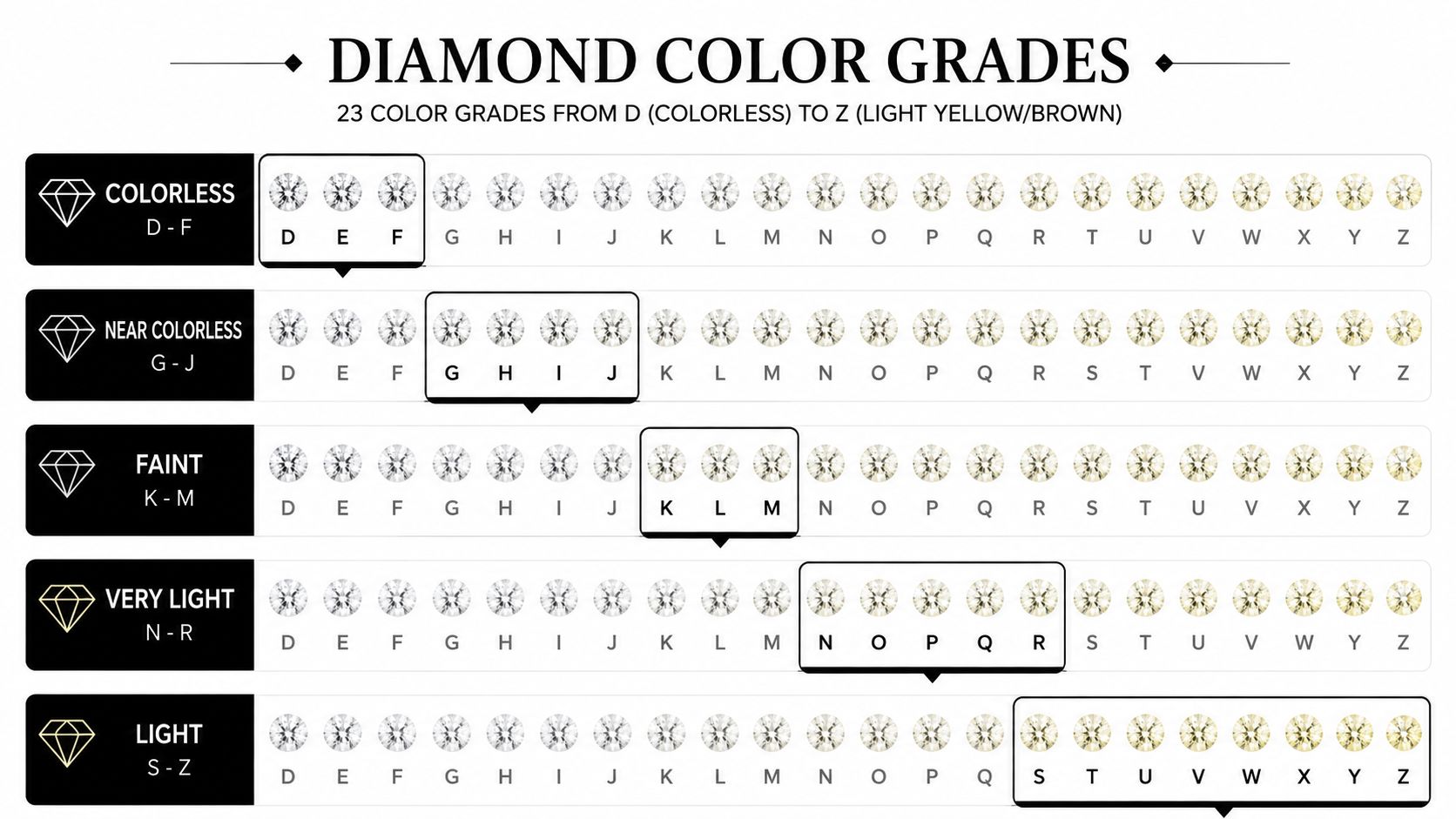
The diamond color grades chart runs from D, colorless, to Z, light yellow or brown, across 23 letter grades grouped into five categories. This GIA scale remains the global standard for grading natural diamonds.
The counterintuitive part is that a higher letter doesn't automatically look better once a diamond is cut, mounted, and viewed in everyday lighting. A well-cut near-colorless diamond can appear remarkably white, while a poorly cut stone with a favorable grade may look warmer than expected. For anyone preparing to sell, borrow against, or appraise a diamond, the chart is the starting language, not the entire valuation.
Table of Contents
Understanding the Diamond Color Grades Chart
The GIA D-to-Z scale gives sellers a consistent way to discuss body color in normal-color diamonds. It replaced older marketplace terms such as “white,” “blue white,” and “AAAA,” which could mean different things to different sellers. The scale applies to diamonds from colorless through light yellow or brown, while fancy-color diamonds follow a separate approach.
The chart contains 23 letter grades, from D through Z, grouped into five categories:
Colorless: D-F
Near-colorless: G-J
Faint: K-M
Very Light: N-R
Light: S-Z
A letter grade records the yellow or brown tint a trained grader detects under controlled conditions. It does not measure sparkle, clarity, carat weight, or cut. Those factors affect how the diamond looks and how buyers may value it at resale.
Why sellers should read the chart first
Color is graded with the diamond face-down. Looking through the pavilion exposes body color more consistently than judging a mounted stone face-up. The method supports comparable results across major grading and trading centers, including Antwerp, New York, Mumbai, and Hong Kong.
For resale, the letter is only one part of the conversation. A strong cut can return enough light to make a near-colorless stone appear bright, while fluorescence may alter how warmth is perceived in some lighting. Shape and setting matter too, since elongated shapes and white metals can make color easier to notice. Lab-grown diamonds also use color grades, but their grading report and market position can change how buyers interpret the same letter.
Practical rule: Use the chart to establish a comparison point, then inspect the diamond, report, cut, fluorescence, and likely buyer demand before setting a selling expectation.
The Five GIA Color Categories and Pricing Tiers
The chart becomes more useful when you stop treating every letter as an isolated ranking. GIA groups the 23 grades into five market-facing categories, and those categories help explain why two diamonds with different letters can still look similar to most buyers. GIA's official diamond color chart provides the category structure used in this comparison.
Category | Grades | Visual description | Relative price impact |
|---|---|---|---|
Colorless | D-F | Little to no detectable body color under grading conditions | Usually carries the strongest premium within the normal-color range |
Near-colorless | G-J | Subtle warmth that may be difficult to notice without comparison | Often offers a practical balance between appearance and cost |
Faint | K-M | A warmer tone becomes easier to detect, especially in larger stones or white-metal settings | May trade at a lower level, while some buyers value the intentional warmth |
Very Light | N-R | Yellow or brown tint is more apparent | Resale depends heavily on shape, design, condition, and buyer taste |
Light | S-Z | Light yellow or brown hue is visibly present | Often appeals to selective buyers rather than the broadest resale audience |
The most important pricing changes often occur at category boundaries. A move from F to G exits the Colorless group, while a move from J to K enters the Faint group. Those transitions can matter more to a buyer than the visual difference between adjacent stones viewed separately.
That doesn't mean a lower grade has no value. A warm K or L diamond can work well in yellow or rose gold, and an antique-style cushion may benefit from visible warmth. Shape matters too. Emerald and Asscher cuts can reveal color more readily because their broad, open facets expose body tone, while a well-cut round brilliant may disguise subtle warmth in the G-J range.
Setting a realistic reserve price
A laboratory grade isn't a guaranteed resale price. Buyers also examine carat weight, cut precision, clarity, fluorescence, symmetry, polish, proportions, mounting, brand context, paperwork, and current demand. A GIA report gives the market a dependable color reference, but it doesn't determine what a buyer must pay.
For a useful second opinion, sellers can review guidance on a GIA-certified engagement ring, then compare the actual stone in person rather than relying on a chart viewed on a screen.
How Gemologists Assign a Color Grade
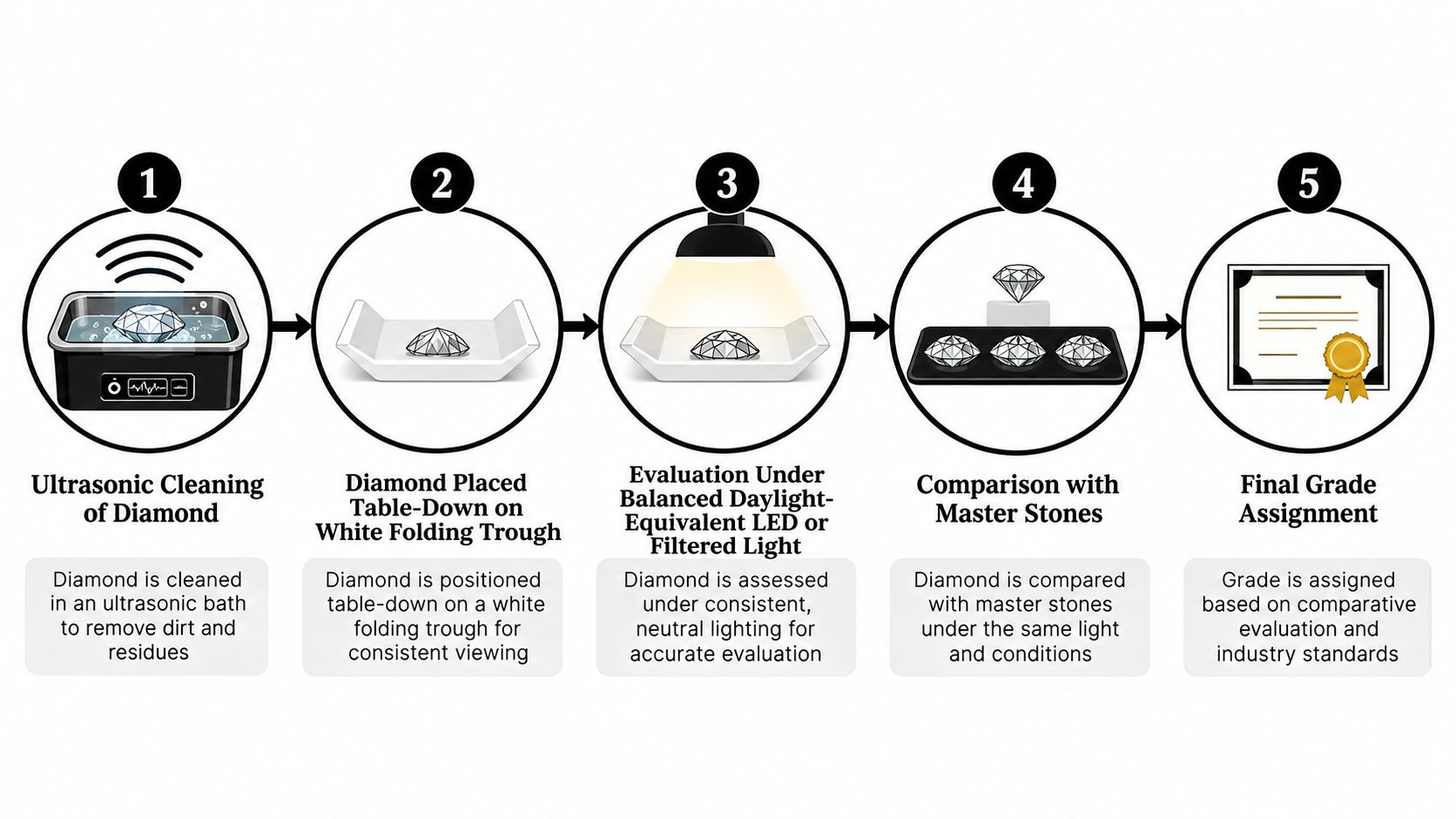
A dependable color grade requires controlled handling. The procedure isolates the diamond's body color from reflections, residue, surrounding metal, and room lighting, so the result can be compared consistently with the D-to-Z chart.
The grading sequence
The stone is cleaned. Oil, lotion, dust, and other residue can affect observation. The diamond is cleaned before examination.
The grader places it table-down. It rests in a white folding trough, providing a neutral background while the observer examines color through the pavilion.
The light source is controlled. Laboratories use balanced, daylight-equivalent illumination instead of ordinary retail lighting. Consistent lighting makes comparisons more repeatable.
The stone is compared with master references. The grader compares the diamond pavilion-to-pavilion with master stones representing established color positions. Rocking the stones helps average localized tint and reflections.
The final grade is assigned. Borderline stones receive careful review, and laboratory procedures seek agreement before a report is issued.
Fluorescence is evaluated separately. GIA describes it as a characteristic rather than part of the color grade, and explains that its visible effect can vary between diamonds. The GIA's explanation of diamond fluorescence belongs alongside the report, not in place of the assigned color grade. For resale, that distinction matters because fluorescence can influence how buyers assess a particular stone without changing its D-to-Z letter.
A warm household bulb can also create a different impression from a laboratory examination. Background color, lamp quality, viewing angle, cleanliness, and observer fatigue all affect perception. A professional jewelry appraisal process should document those conditions before a seller relies on the chart or sets an asking price.
When Color Grades Do Not Tell the Whole Story
A report might say G, H, I, or M, but the wearer sees the diamond face-up, usually in a setting and under changing light. Those are different viewing conditions from the face-down laboratory comparison used to assign the letter.
Cut quality is often the first practical adjustment. A well-proportioned round brilliant returns strong light to the viewer and can make subtle warmth less obvious. A diamond with weaker light return may reveal more body color, even when its report carries the same grade.
Fluorescence requires inspection, not assumptions
Blue fluorescence can affect the appearance of some diamonds in daylight or ultraviolet-rich conditions. GIA research found that strong or very strong fluorescence doesn't have a broadly perceptible effect on color in laboratory grading, and that it can make a diamond look slightly better in some table-up viewing conditions. Trade discussion of fluorescence and face-up appearance
That doesn't justify automatically paying more for fluorescence or treating it as a defect. A stone with noticeable haziness, unusual appearance, or an awkward interaction between fluorescence and cut should be inspected directly. Rapaport reported that GIA planned to add report language to reduce confusion around fluorescent diamonds, which shows that consumer interpretation remains unsettled. Rapaport's report on fluorescent diamond disclosures

Metal color changes the visual context as well. Yellow and rose gold can harmonize with a warmer diamond, while a white-metal setting may make tint easier to notice. That can create a sensible value opportunity for a seller or buyer who prioritizes overall design instead of chasing the highest letter.
A favorable color grade also doesn't compensate for distracting inclusions, poor proportions, damaged girdle areas, or weak brilliance. Review the stone, the report, and the mounting as one asset. Understanding diamond inclusions helps explain why clarity and visible appearance remain relevant during resale.
Natural Versus Lab-Grown Diamond Color Grading
The same D-to-Z letters don't carry identical resale meaning across natural and lab-grown diamonds. Natural diamonds still use the traditional D-to-Z system, while GIA announced that, from October 1, 2025, it would stop using the traditional 4Cs grading system for lab-grown diamonds and instead issue Premium, Standard, or no grade. Coverage of GIA's lab-grown grading change
IGI continues to use 4Cs grading for lab-grown diamonds, creating a market in which a lab-grown report may show a familiar D or F while another grading pathway uses different terminology. The report's laboratory, issue date, treatment disclosures, and stone identification therefore matter as much as the letter.
Color grade | Natural diamond resale behavior | Lab-grown diamond resale behavior |
|---|---|---|
D-F | Usually supports strong comparison with other high-color natural stones, subject to cut and clarity | The same letter doesn't create the same scarcity premium as it does for natural diamonds |
G-J | Often provides a practical balance for buyers who want a white appearance | May compare closely in appearance with higher grades, while resale pricing remains a separate market question |
K-M | Warmth can be acceptable in suitable shapes and settings, but buyer preference becomes more important | Face-up undertones and report format deserve close inspection |
N-Z | Visible warmth narrows the audience for normal-color resale | The letter alone offers limited guidance about marketability or future offer levels |
CVD and HPHT are growth methods, not color grades. A CVD stone may show brownish or grayish undertones, while an HPHT stone may show blue or green traces. The certificate remains important, but an in-person review can reveal nuances that a letter doesn't communicate.
For a broader asset comparison, sellers can review lab-grown versus natural diamond considerations before assuming that matching color grades mean matching resale value.
Preparing Your Diamond for Appraisal or Sale
Preparation won't transform a diamond's grade, but it can prevent avoidable uncertainty during an evaluation. The buyer needs to see the stone clearly and verify that the item being offered matches the documentation.
A practical seller checklist
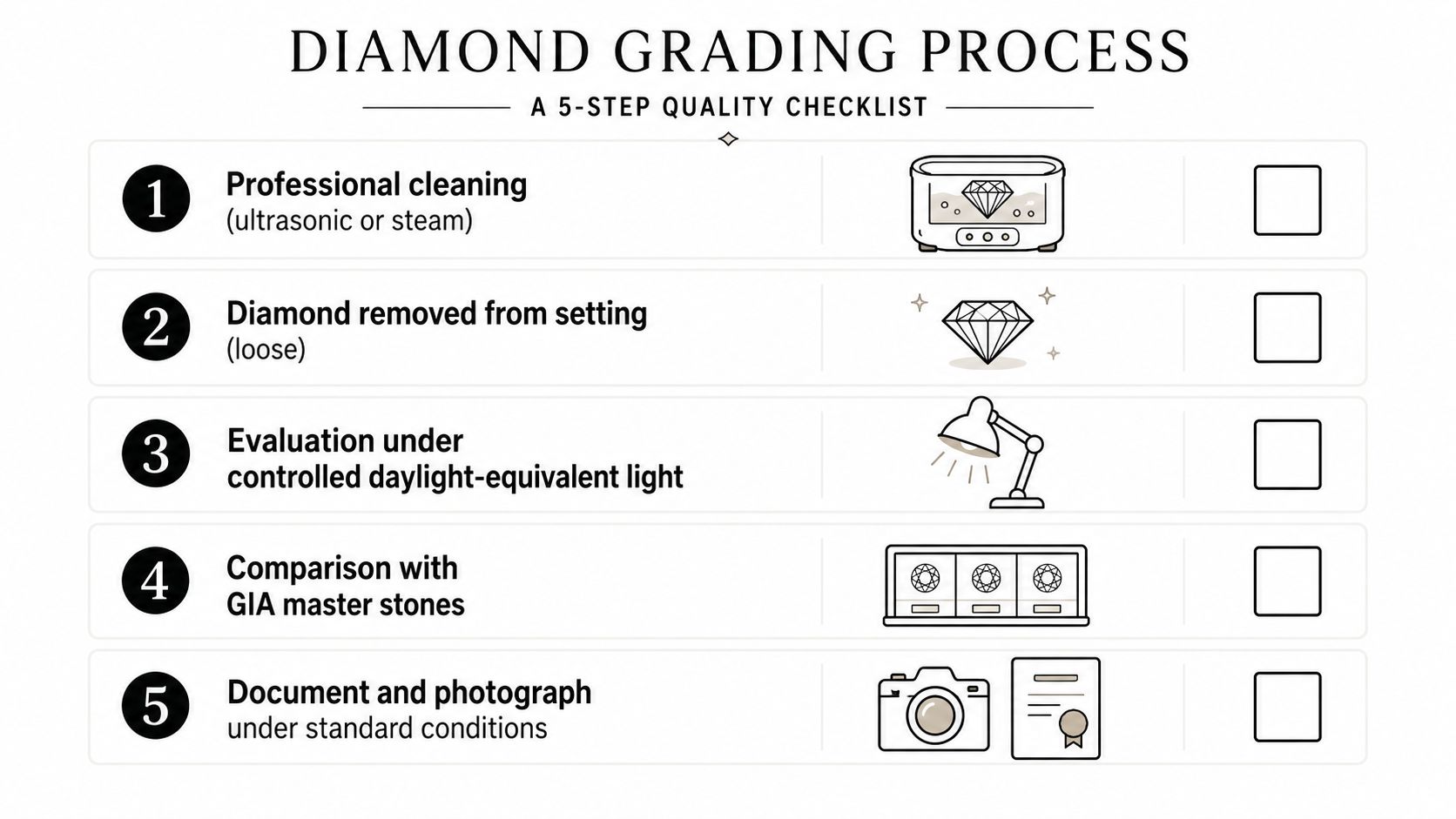
Clean the jewelry professionally: Oil, lotion, and dust can reduce brilliance and make the diamond appear dull or warmer.
Gather every document: Bring the GIA or other laboratory report, purchase receipt, prior appraisal, repair records, and any insurance paperwork you have.
Confirm identification: Report numbers, inscriptions, photographs, and setting details help connect the loose stone to its paperwork.
Ask about removal from the setting: Precise color assessment is easier when the diamond is loose. Discuss whether unmounting is appropriate before authorizing work.
Record the item condition: Photograph the ring or jewelry in neutral daylight, including the setting, prongs, side stones, and any visible wear.
Use secure transport: If shipping is necessary, follow the evaluator's insured-mail instructions and confirm how the package should be valued for transit.
A report can remove much of the guesswork, but it doesn't eliminate the need to inspect the actual item. The final offer can reflect condition, mounting quality, demand for the shape, marketability of the laboratory report, and whether the buyer expects to resell the diamond as a loose stone or finished jewelry.
The 2026 jewelry appraisal tips are useful for organizing documentation and questions before an appointment. If you're considering a loan or pawn transaction rather than an outright sale, ask for the terms in writing and review repayment obligations carefully. An appraisal value isn't the same thing as an offer or a loan amount.
How Antwerp Diamond Evaluates and Buys Diamonds
Antwerp Diamond uses the GIA-aligned D-to-Z framework as one reference point, then examines the factors that influence a real resale decision. In an Atlanta showroom evaluation, a senior gemologist reviews the diamond under controlled lighting and compares its appearance with calibrated references. A remote seller can ask about the available insured mail-in process before sending an item.
The assessment goes beyond the letter on the report. The evaluator considers fluorescence, cut precision, clarity, carat weight, condition, documentation, mounting, and current wholesale demand. The seller receives a written explanation of how those factors contribute to the proposed valuation, with no obligation to accept it.
That distinction matters for a D-color round and an M-color cushion alike. The first may appeal to buyers seeking a high-color natural stone, while the second may suit a warm-metal design or a narrower collector audience. Neither outcome can be determined responsibly from the color letter alone.
Owners in Buckhead, Sandy Springs, Alpharetta, Roswell, Brookhaven, Midtown Atlanta, and across Georgia can arrange an in-person review or ask about remote evaluation options. The same preparation principles apply whether you're selling a loose diamond, an engagement ring, or a larger jewelry collection.
Frequently Asked Questions About Diamond Color
Does one color grade affect resale value?
It can, especially near boundaries such as F to G or J to K. The impact depends on cut, shape, clarity, fluorescence, documentation, and buyer demand, so a letter difference isn't a standalone price formula.
Can fluorescence make a diamond look whiter?
Sometimes. Strong fluorescence may improve face-up appearance in certain lighting, but it can also create an appearance that some buyers dislike. Inspect the actual stone rather than assuming fluorescence is automatically positive or negative.
Should I trust an older certificate?
Treat an older report as useful documentation, not the entire valuation. Confirm the report with the issuing laboratory when possible, compare the stone to its identifying details, and ask whether a current independent review would improve buyer confidence.
Which color grade offers the best balance?
The answer depends on shape, setting metal, and personal preference. Near-colorless grades can offer a white appearance without requiring the highest color category, while warmer grades may work well in yellow or rose gold. Compare stones side by side before deciding.
Does the D-to-Z chart apply to every diamond?
It applies to normal-color diamonds, including the traditional framework for natural stones. Lab-grown reporting changed in the market after GIA's announced policy, and colored diamonds use a different approach focused on hue, tone, and saturation.
If you have a loose diamond, engagement ring, or diamond jewelry in the Atlanta or greater Georgia area, bring the item and its documentation to Antwerp Diamond for a confidential evaluation. You can ask how the color grade, cut, fluorescence, condition, and current resale demand affect the assessment before deciding whether to sell.