

You may have a diamond ring in a drawer, a signed bracelet you no longer wear, or a luxury watch you're ready to convert into cash. The safest way to sell jewelry online is to document the item, establish a defensible value, choose a channel that matches its quality and urgency, and protect the transaction from authentication, shipping, and payment risks.
Jewelry buyers can't inspect a piece through a screen, so trust signals, accurate descriptions, condition evidence, and secure custody directly affect the offer. Before you list anything, decide whether you're selling the complete piece, its gold or silver content, its gemstones, or access to a specialist buyer who can evaluate the item in person.
Table of Contents
Understanding the Online Jewelry Resale Market
Online jewelry selling is no longer a niche behavior. One market report estimates that 55% of U.S. consumers bought jewelry products online in 2022, while the U.S. online jewelry and watch sales industry is estimated at $17.0 billion in 2025 after a five-year CAGR of 5.9%. The same source estimates 35,109 businesses operate in the category, with business count growing 6.4% annually from 2020 to 2025. See the online jewelry market data for the underlying estimates.
That scale creates opportunity, but it also creates noise. Buyers compare unverified listings, incomplete descriptions, unclear return terms, and optimistic asking prices. A polished listing can attract attention, but an independent appraisal, a recognized grading report, clear hallmarks, and a credible chain of custody help convert attention into a serious offer.
The global trajectory is equally significant. One industry dataset estimates global online jewelry sales increased from $48.1 billion in 2017 to $105.6 billion in 2024, with a projection of $166.0 billion by 2029. Separate forecasts estimate the global online jewelry market at $11.30 billion in 2025, rising to $19.80 billion by 2033, and project an increase of $69.68 billion from 2025 to 2030. These estimates use different market definitions, so they shouldn't be combined as one precise market total, but they point to the same conclusion: online jewelry resale is structurally important and increasingly competitive. The figures appear in this online jewelry market forecast.
Retail price is not resale value
The price paid at a boutique usually includes brand positioning, retail overhead, design costs, marketing, sales commissions, and taxes. A resale buyer focuses on what the market can support today, after accounting for authentication, refurbishment, inventory risk, and the buyer's own margin.
Brand and model matter. A desirable Rolex, Cartier piece, or Hermès bag may attract strong secondary-market interest because buyers recognize the name and understand the category. An unsigned or mass-produced item can lose much more of its retail positioning after purchase, even when the materials remain valuable.
Category | Typical resale range | Key value drivers |
|---|---|---|
Signed fine jewelry | Varies by item and market | Brand, design, condition, documentation, demand |
Natural diamond jewelry | Varies by stone and setting | Grading, proportions, treatment, fluorescence, metal, brand |
Gold and silver jewelry | Closely tied to material value | Purity, weight, craftsmanship, current buyer demand |
Luxury watches | Varies widely by reference | Brand, model, originality, service history, box and papers |
Designer handbags | Varies by model and condition | Brand, collection, color, condition, authenticity, completeness |
Unbranded fashion jewelry | Often more limited | Style, condition, materials, presentation, buyer interest |
The category also has a conversion problem. Reported jewelry site conversion benchmarks range from 0.71% to 1.5%, compared with roughly 2.7% for all ecommerce, and one benchmark set places jewelry cart abandonment at 81.4%. Those figures come from jewelry ecommerce benchmarks. The practical lesson is simple: traffic alone won't sell a high-value piece. The buyer must feel confident about authenticity, condition, shipping, returns, and price.
Practical rule: Don't spend hours building a listing before deciding whether the item belongs on a marketplace, with an auction house, or in front of a specialist buyer.
Preparing Your Jewelry for a Successful Sale
Preparation affects both buyer confidence and valuation. Gather every document before you ask for an offer, and keep the original paperwork separate from any package you ship.
Build the evidence file
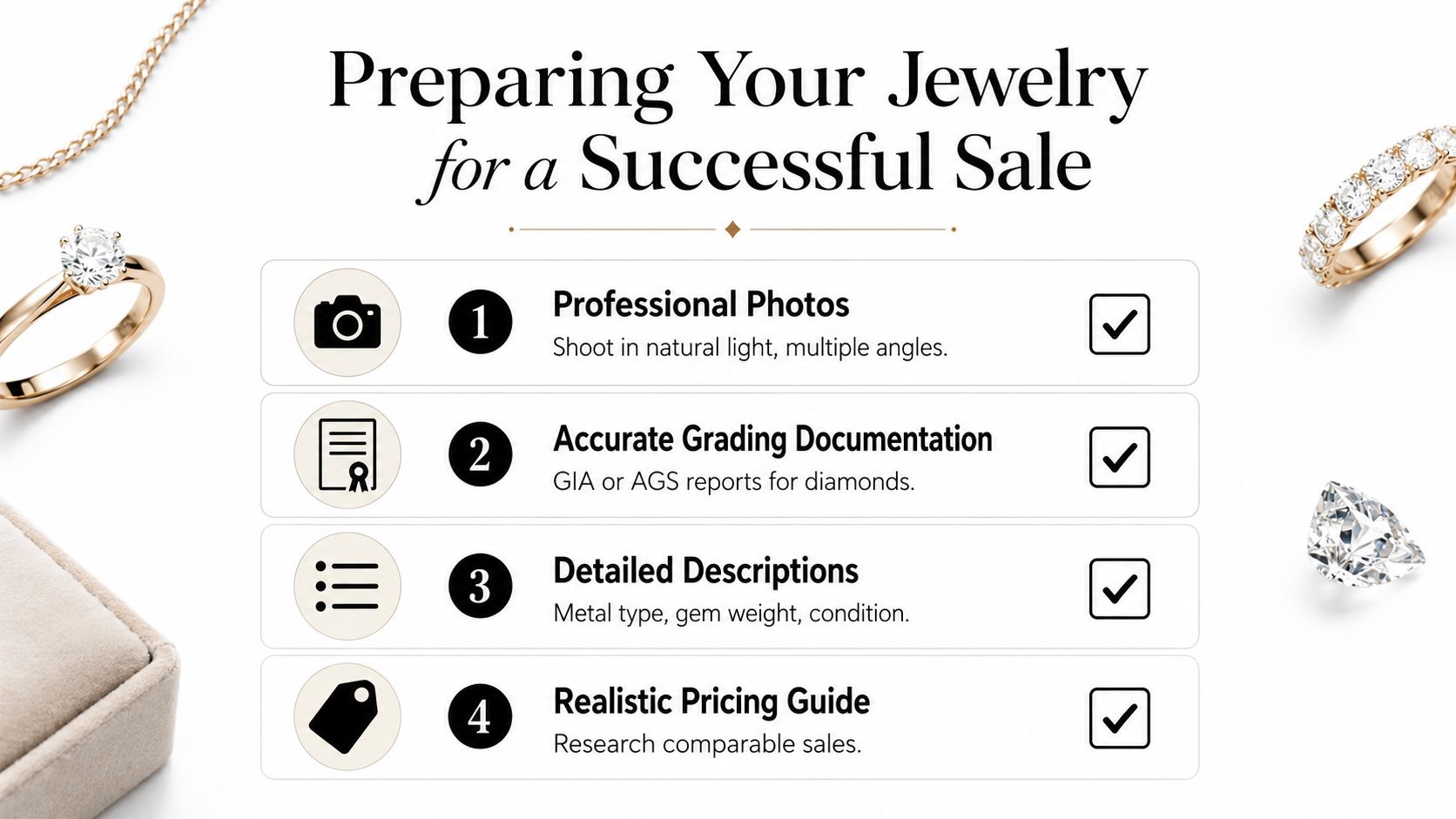
Start with the original receipt, certificates, grading reports, branded boxes, warranty cards, service records, and prior appraisals. For diamonds, a recognized grading report from GIA or AGS can give buyers a clearer basis for comparison. Don't describe a stone as certified unless you have the report and can provide its details accurately.
An independent appraisal should be more than a single value written on a page. Professional documentation standards call for a description, photograph, value, sales taxes, and laser inscription or plotting details where applicable. Use this professional appraisal documentation guidance to check whether your records contain the information a buyer may need.
Jewelers of America recommends choosing a professional jewelry appraiser who belongs to a respected national appraisal organization, such as the National Association of Jewelry Appraisers. Its appraisal guidance for jewelry owners provides a useful credential check.
Clean carefully and photograph honestly
Remove surface dust with a soft, lint-free cloth. Avoid aggressive polishing on antique or vintage pieces because scratches, patina, and original finishes can contribute to the item's character. Ultrasonic cleaning can be useful for appropriate jewelry, but stones, settings, treatments, and construction determine whether it's safe. Read about ultrasonic cleaning technology before using a machine or approving professional cleaning.
Take photographs in soft natural light against a neutral background. Include the front, back, side profile, clasp, prongs, hallmarks, serial numbers, engravings, certificate, and any visible wear. Use close-up images for stones and markings, but don't edit scratches or discoloration out of the listing.
For a practical photography workflow, use this guide to photograph jewelry for online sale.
Decide whether to sell the piece intact
A signed ring, matching set, or complete luxury watch usually deserves an intact valuation first. Separating gemstones from a designer setting can destroy the value created by the brand, craftsmanship, matching design, and buyer confidence.
Material liquidation may make sense when the piece is damaged, mismatched, heavily worn, or unlikely to attract a collector. Ask a buyer to evaluate both scenarios: the complete item and its component materials. Don't assume the weight of the gold or the presence of a diamond automatically determines the best outcome.
Use this checklist before contacting a buyer:
Documents: Collect receipts, grading reports, appraisals, warranty records, boxes, and service papers.
Identity details: Record hallmarks, model references, serial numbers, inscriptions, and stone plots.
Condition record: Photograph wear, repairs, chips, loose stones, stretched links, and missing components.
Presentation: Clean only when appropriate, then capture clear images from multiple angles.
Valuation options: Request an intact-piece assessment and a materials-based assessment when the distinction matters.
Choosing the Right Selling Channel for Your Items
A rare diamond sent through an unverified peer-to-peer listing can lose value before it reaches a qualified buyer. The right channel depends on the asset, required selling speed, willingness to negotiate, and the authentication and custody controls available. A lower-value fashion piece may suit a marketplace. A branded watch, signed jewel, or complex diamond item needs a channel that can verify identity, document possession, and protect the payout.
Match the channel to the asset
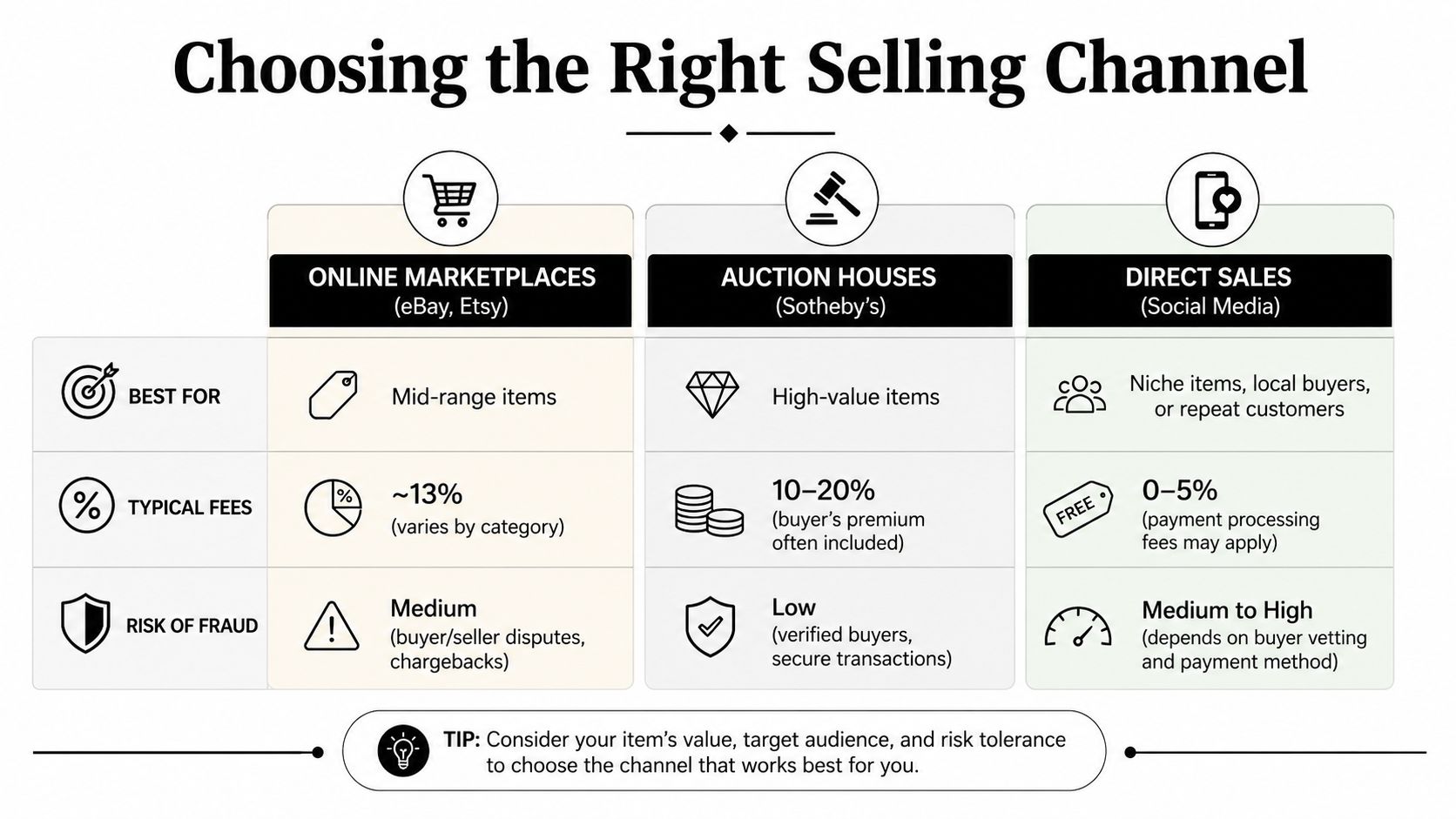
Online marketplaces provide reach and control over the listing. You also carry the operational burden: buyer questions, payment problems, returns, shipping, disputes, and evidence that the item matched its description. A large audience does not guarantee informed or financially qualified buyers. Review this comparison of where to sell jewelry online before selecting a platform.
Auction houses can place exceptional jewelry, watches, and handbags in front of collectors who understand the category. Consignment terms, seller commissions, reserve decisions, photography standards, and delayed payment can reduce the practical appeal. Confirm those terms in writing, and record the item's condition and handoff before transferring possession.
Specialist marketplaces such as 1stDibs and Chrono24 reach more targeted buyers. They still require precise descriptions, reliable photographs, authentication procedures, and a clear record of fees and payment timing. Keep copies of every message, condition statement, shipping document, and authentication result. That chain of custody matters if a buyer disputes authenticity or condition.
Direct specialist buyers offer a faster decision and fewer transaction steps. Their offer reflects authentication work, inventory holding costs, resale risk, and the possibility of returns. Choose this route when a controlled process and predictable timing matter more than testing a public asking price. Ask whether the buyer is valuing the item as a complete piece or pricing its gold, gemstones, and other materials separately.
For broader listing and transaction considerations, read this Baslon Digital on selling online.
Channel | Best suited to | Main advantage | Main concern |
|---|---|---|---|
Online marketplace | Mid-range or easily described items | Broad audience and seller control | Disputes, fraud exposure, and seller workload |
Auction house | Rare, high-value, collector-focused pieces | Specialist audience and competitive bidding | Consignment terms, timing, and commissions |
Luxury marketplace | Recognized brands with strong category demand | Targeted buyers | Listing requirements and platform fees |
Direct specialist buyer | Sellers who value speed and controlled custody | Fewer transaction steps | Offer reflects resale risk and operating costs |
Local appointment | High-value items requiring inspection | No shipping risk and direct evaluation | Requires scheduling and travel |
Calculate the real fee, not just the headline price
A high sale price can produce a weak payout after commission, shipping, insurance, authentication, repairs, and return exposure. Worthy's published fee structure shows why the headline result needs scrutiny: 18% for sales under $5,000, 14% above $5,000 to $15,000, 12% above $15,000 to $30,000, and 10% above $30,000. The figures are documented in this Worthy fee review.
Get answers in writing before sending the piece:
Who authenticates it, and who pays for that work?
When does insurance begin and end?
Who carries the risk of a disputed return?
What repairs or alterations may the buyer authorize?
Which fees are deducted before payment?
When do cleared funds reach you?
Sellers in Atlanta, Buckhead, Sandy Springs, Alpharetta, Roswell, Brookhaven, Midtown Atlanta, and the wider Georgia market should consider an in-person appointment for high-value pieces when shipping risk or identity verification is a concern. A local evaluation also lets you compare an intact-item offer with a materials-based offer before choosing the route.
Setting a Realistic and Competitive Price
Original retail price is a reference point, not a resale valuation. Buyers care about the item's current market position, and they'll discount for missing documents, visible wear, uncertain authenticity, repairs, weak demand, and the cost of reselling it.
Start with the strongest evidence available. For a branded piece, identify the exact model, collection, metal, gemstone details, size, condition, and included accessories. For a watch, record the reference, serial information, movement, service history, bracelet condition, and whether the box and papers are present. For a diamond, use the grading report rather than a verbal description.
Use a three-part valuation test
First, establish the intact-piece value. Search completed sales and auction archives for comparable items. Don't compare a current retail listing with a completed sale, and don't compare a heavily worn example with a near-complete one.
Second, establish the material floor. Determine whether the gold, silver, platinum, and gemstones have meaningful liquidation value. This isn't automatically the best selling route, but it gives you a reference point when a piece has damage or limited brand demand.
Third, calculate the net payout. Subtract commissions, shipping, insurance, authentication, repair costs, and any other documented deduction from the expected sale price. A lower headline offer can be stronger if it produces a faster, cleaner, and more certain payout.
Value factor | Impact on price | Seller action |
|---|---|---|
Brand and model | Can materially influence demand | Identify exact signatures, references, and collection |
Condition | Affects buyer confidence and resale work | Photograph flaws and disclose repairs |
Documentation | Reduces authentication uncertainty | Provide certificates, receipts, and service records |
Completeness | Supports buyer confidence | Include original boxes, papers, tags, and accessories |
Stone quality | Shapes the value of diamond and gemstone jewelry | Use a recognized report and accurate measurements |
Current demand | Determines how quickly a buyer can resell | Compare recent sold examples, not optimistic listings |
Material content | Establishes a possible liquidation reference | Confirm purity, weight, and whether stones are included |
A formal appraisal can clarify description and replacement value, but replacement value isn't the same as a guaranteed resale offer. Use this jewelry appraisal guide to organize the information a professional evaluator will need.
Choose between maximum upside and a clean exit
If you can wait, list with reasonable negotiation room and define your minimum acceptable net payout before discussions begin. If you need funds quickly, prioritize a written offer with transparent deductions, a clear inspection process, and a defined payment method.
Don't accept a dramatic discount merely because a buyer creates urgency. At the same time, don't reject a fair offer because it falls below the original retail price. The correct comparison is between your realistic net proceeds, the time and risk of another channel, and the value of keeping control of the item longer.
Managing Secure Shipping and Insurance
Shipping high-value jewelry is a chain-of-custody operation. The package needs a documented condition, a known handoff, appropriate insurance, tracking, and proof that the intended recipient accepted it.
Before packing, photograph the item beside its identifying details. Write a condition description that includes serial numbers, hallmarks, stone characteristics, and existing damage. Store copies of certificates and images separately from the parcel so a lost package doesn't also destroy your evidence.
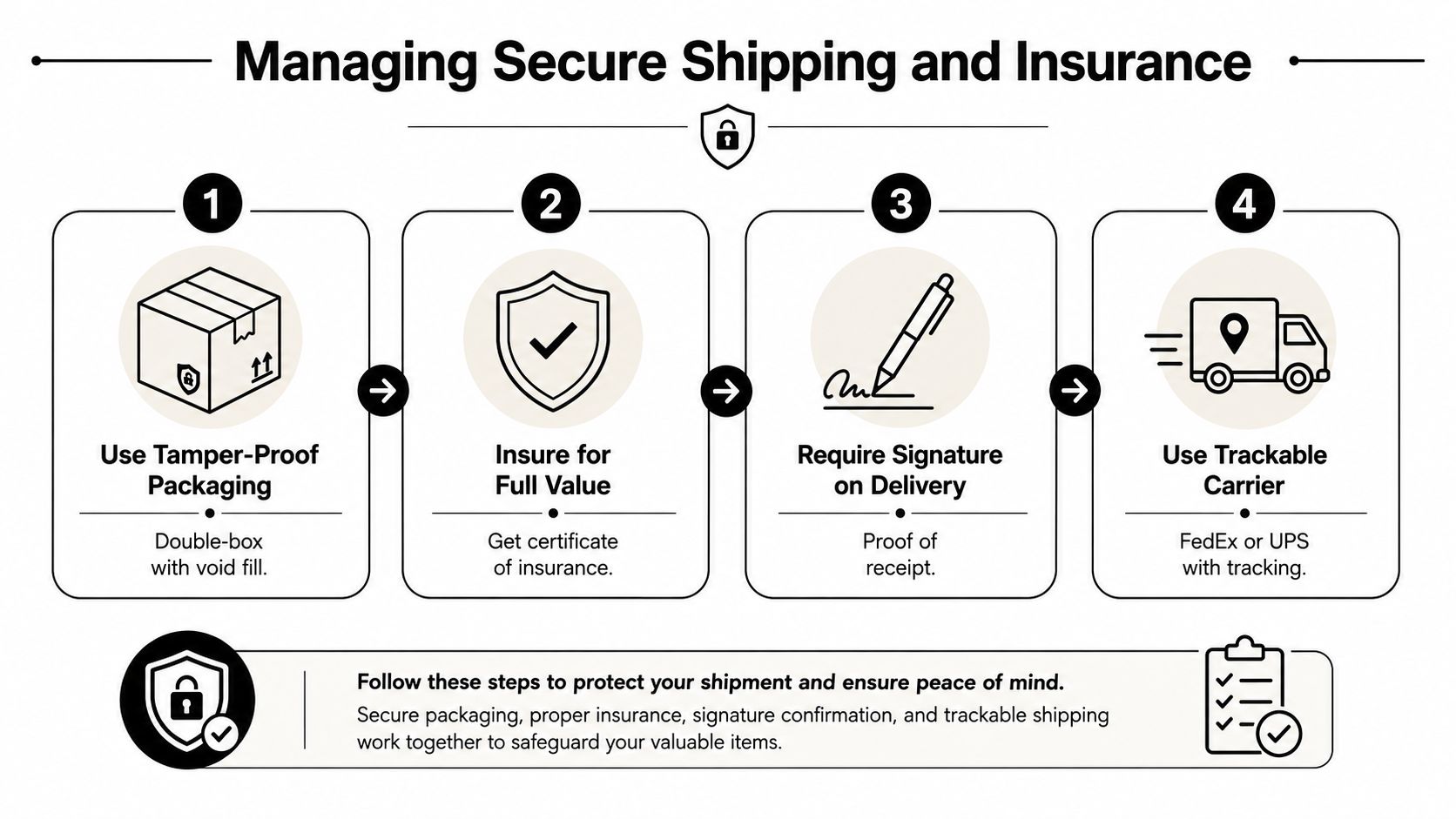
Use discreet, tamper-resistant packaging and double-box the item with internal padding that prevents movement. Photograph the sealed inner package, outer package, shipping label, tracking receipt, and handoff. Don't place original certificates in the box unless the receiving party specifically requires them and you've retained complete copies.
Verify the insurance terms
Insured transit should cover the actual risk from handoff through delivery or return. One seller agreement states that goods are insured from the moment they enter the buyer's possession until delivery or return, demonstrating how a transaction can define custody and insurance responsibility in writing. Review the insured jewelry seller terms before shipping.
Carrier coverage, declared value, and a separate jewelry policy aren't interchangeable. Ask who underwrites the shipment, what evidence a claim requires, whether the policy covers loss during return transit, and whether the carrier excludes jewelry or limits certain services. Never assume a shipping label alone provides full-value protection.
Use a trackable service with signature confirmation, and confirm the delivery address through an independently verified contact method. For a high-value item, an in-person appointment in Atlanta may be the safer option because it removes the shipping leg entirely.
Follow this sequence:
Document: Photograph the item, package, seals, and paperwork.
Confirm: Get written insurance and custody terms before dispatch.
Pack: Double-box discreetly and prevent internal movement.
Track: Retain the receipt, tracking record, and signature confirmation.
Reconcile: Match the delivered item against your photographs and description.
For additional preparation, review this guidance on insured shipping for jewelry.
Avoiding Scams and Closing the Deal Safely
A buyer who sounds confident isn't necessarily a safe buyer. The most dangerous transactions are designed to make you skip verification because the offer appears urgent, unusually generous, or unusually complicated.
Common traps include a buyer claiming that a diamond was switched after delivery, an overpayment supported by a fraudulent cashier's check, and artificial urgency intended to stop you from seeking another opinion. Consignment arrangements create a different risk: the buyer holds the item, delays the sale, and makes returning it difficult.
Protect yourself before possession changes hands
Require written terms that identify the item, condition, agreed price, deductions, inspection period, payment method, and return obligations. Don't release jewelry because you received a screenshot of a transfer, a payment confirmation email, or a check. Verify cleared funds directly through your financial institution before shipping or handing over the piece.
An independent appraisal at the point of sale can help counter a bait-and-switch claim. Photograph identifying features, including hallmarks, stone plots, serial numbers, and distinctive scratches. Keep communications on the platform where possible, and save all messages, documents, tracking records, and receipts.
Payment rule: A promise to pay is not payment. Treat funds as received only after your bank confirms that they've cleared.
Refuse a transaction when the buyer:
Demands secrecy: They want you to bypass the platform, written terms, or normal verification.
Uses pressure: They claim the offer expires before you can obtain another evaluation.
Rejects documentation: They won't identify the buyer, transaction terms, or custody process.
Overpays: They send more than the agreed amount and ask you to refund the difference.
Attacks without evidence: They call the item fake but won't provide credentials or a documented basis.
The closing process should be deliberately boring. Confirm the final written offer, sign the purchase agreement or platform record, verify cleared payment, transfer possession through the agreed method, and retain the complete paper trail. If the transaction has tax, estate, insurance, or lending implications, consult an appropriate professional rather than relying on an online buyer's explanation.
This online jewelry buyer guide can help you prepare questions before requesting an evaluation.
The following video provides another visual reminder of common online transaction risks.
For sellers who prefer to avoid remote custody, an in-person evaluation lets both parties inspect the item, review documentation, and discuss whether the piece should be sold intact or valued by its materials. That can be especially useful for diamond jewelry, gold, silver, luxury watches, and designer pieces in Atlanta and the greater Georgia market.
Antwerp Diamond provides online preliminary evaluations and secure options for selling fine jewelry, diamonds, luxury watches, designer handbags, gold, and silver, with in-person appointments available in Buckhead and Roswell for sellers who prefer direct inspection. Visit Antwerp Diamond to request an evaluation, review your selling options, and bring your item in for a confidential assessment.