
You have a loose stone in a safe, an engagement ring from a previous relationship, or an inherited diamond you're finally ready to evaluate. If you're searching for where to sell diamonds in Houston, start with documentation, obtain a clear assessment, compare credible offers, and confirm every payment and release term before handing over the item. A Houston sale can happen through a local appointment, an online evaluation, or insured shipping, but the safest route depends on the stone's documentation, your timing, and your comfort with each channel.
Table of Contents
A Practical Selling Roadmap for Houston Diamond Owners
Houston sellers often begin with the same uncertainty: should they visit several jewelers, request an online estimate, or mail the diamond to a buyer? The answer usually becomes clearer once you separate the emotional history of the item from the information a buyer needs. Sentimental importance may explain why a diamond matters to you, but carat weight, grading, condition, origin, documentation, and current resale demand determine how a buyer assesses it.
Houston has a concentrated jewelry trade. The Jewelry District around Downtown and the Galleria-area trade bring together dealers, buyers, watch specialists, and craftsmen. The Jewelry Building presents itself as a marketplace of independent jewelers, diamond dealers, watch specialists, and master craftsmen under one secure roof, which gives local sellers a practical setting for comparing evaluations and asking technical questions (The Jewelry Building).
Follow the sequence
Identify the item. Determine whether you're selling a loose diamond, a mounted ring, an estate piece, or a diamond with a lab-grown origin. Find the report, receipt, appraisal, photographs, box, and any repair records.
Create a basic item record. Write down the stated carat, color, clarity, cut, measurements, fluorescence, report number, metal, brand, and visible condition. Don't rely on memory or a verbal description if the paperwork is available.
Request an evaluation. An online estimate can help screen the next step, especially when you're remote or short on time. A physical inspection remains important because the buyer must examine the actual stone, setting, condition, and report.
Compare credible offers. Ask at least two buyers when practical. A meaningful comparison requires more than the headline amount. Review payment method, timing, fees, inspection conditions, shipping responsibility, and whether the offer can change after examination.
Complete the transaction with records. Confirm the item description and final terms in writing. Keep tracking details, copies of documentation, the receipt, and proof of payment.
Practical rule: Treat an insurance document as evidence about the item, not as a guaranteed cash price.
The most productive seller usually prepares before contacting a buyer. Bring identification to an in-person appointment, disclose repairs or alterations, and ask how the stone will be authenticated. If you choose shipping, use only the buyer's specified insured process and verify how the package will be received and reviewed.
A retail receipt, insurance appraisal, or family valuation can provide useful background, but none automatically controls the resale offer. The buyer is pricing the item for a secondary market, where liquidity, dealer demand, condition, and buyer confidence matter more than the original emotional or retail context.
Choosing Where to Sell Diamonds in Houston
The right selling channel depends on the item and the seller's priorities. A local diamond dealer may provide direct discussion and physical inspection, while an online or mail-in program may be more convenient for someone outside Houston. Neither route should be accepted without clear terms.
Houston's jewelry concentration makes local comparison practical. A seller with a certified loose stone may be able to speak with multiple trade buyers in one market, while an owner of an inherited ring may benefit from a private appointment that considers both the diamond and its mounting. Online evaluations can narrow the field before you travel, but a preliminary estimate isn't the same as a final purchase offer.
Antwerp Diamond offers a free online evaluation and private in-person appointments in Houston. It's one local option to consider alongside other credible buyers, especially if you want to begin by uploading photographs and item details before arranging an appointment. The business is independent and isn't affiliated with the luxury brands it references.
For broader preparation, this guide on where to sell jewelry for cash can help you compare the practical differences between local and remote routes.
Diamond selling options compared
Option | What to expect | Questions to ask |
|---|---|---|
Local diamond dealer or jeweler | Physical review of the stone, report, setting, and condition, followed by an offer or further evaluation | Who examines the diamond, what market information supports the offer, and is payment made after authentication? |
Private buyer or appointment-based specialist | A more discreet meeting with focused discussion of the item and transaction terms | What identification is required, how is privacy handled, and what written receipt will I receive? |
Estate sale or consignment route | The item may be marketed to end buyers over time, with proceeds dependent on a completed sale | When is payment made, what fees apply, and who controls the listing price? |
Online or mail-in program | Initial photographs and information support a preliminary estimate, followed by physical inspection if shipped | Who pays for insured shipping, what happens if the final evaluation differs, and can I decline the offer? |
Consider four questions before choosing:
Item type: A loose certified diamond may be easier to describe online than a damaged or heavily altered ring.
Documentation: A grading report can reduce uncertainty, while missing paperwork may require more physical examination.
Urgency: A direct buyer may provide a faster decision than consignment, which depends on finding an end customer.
Privacy and shipping comfort: A private Houston appointment suits some sellers, while insured shipping may suit someone outside the area.
Convenience matters, but it shouldn't replace transparency. Ask every buyer to explain what they need, what they can determine remotely, and what remains subject to in-person inspection.
Understanding Diamond Valuation Before You Sell
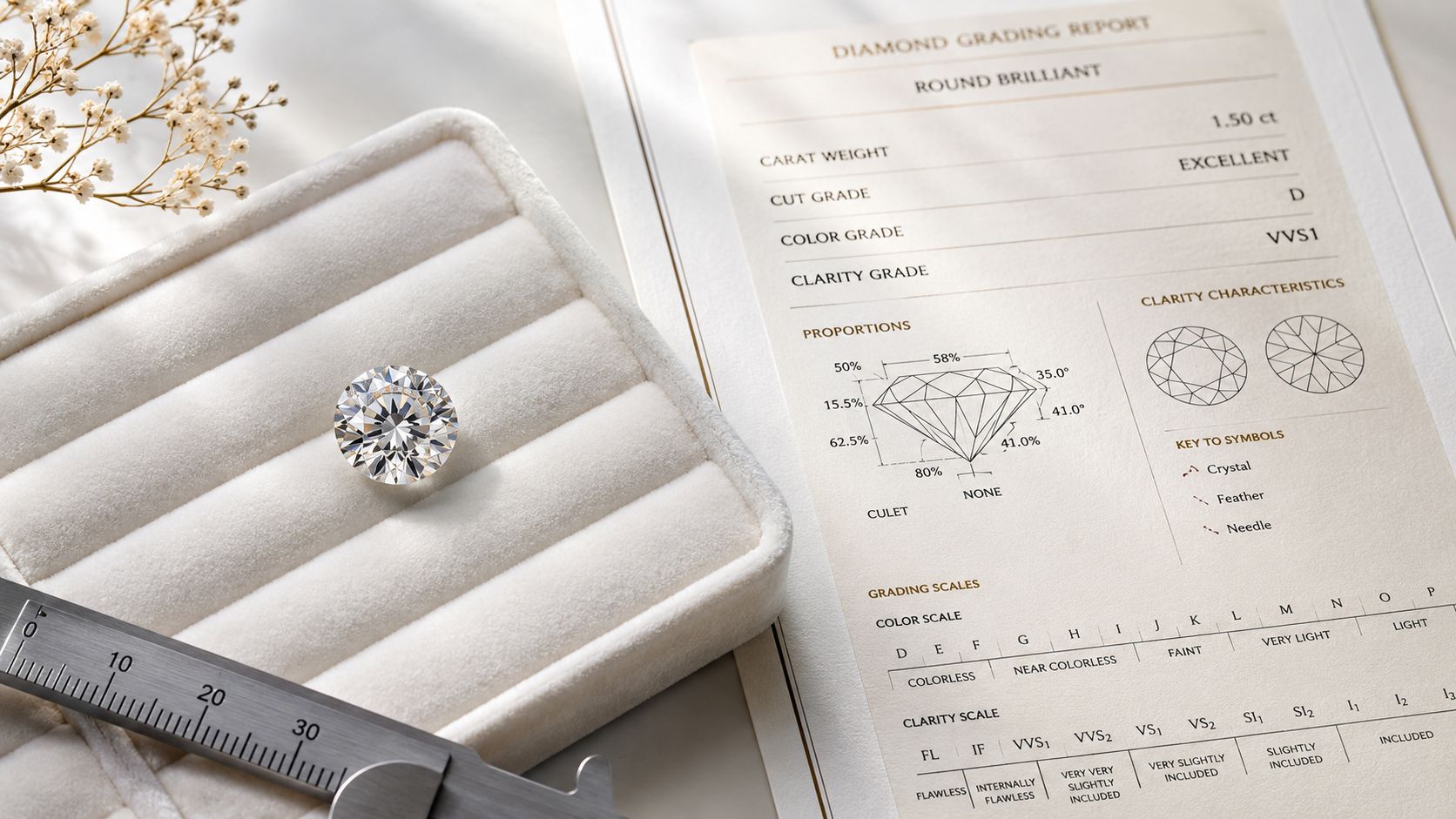
A buyer doesn't value a diamond from carat weight alone. The assessment combines the stone's 4Cs, additional characteristics, condition, paperwork, mounting, and current demand. Your job as a seller is to make that information easy to verify and then ask how it affects the offer.
What the buyer examines
Carat weight: The measured weight affects the stone's category and marketability. A mounted diamond may need to be removed or assessed with specialized equipment if the weight isn't documented.
Cut: Cut quality influences brightness, proportions, symmetry, polish, and overall buyer appeal, particularly for round brilliant stones.
Color: The stated color grade affects how the stone appears and how trade buyers compare it with other inventory.
Clarity: Inclusions, blemishes, location, and visibility influence desirability. Two stones with the same stated clarity can still present differently.
Fluorescence: Fluorescence can affect appearance and buyer demand depending on the stone's color and strength.
Measurements: Length, width, depth, and proportions help the buyer confirm whether the stone matches the report.
Condition: Chips, abrasions, loose prongs, worn settings, repairs, and alterations can change the cost and risk of resale.
Origin and report status: Natural and lab-grown diamonds follow different resale dynamics. A grading report also gives the buyer a documented basis for authentication and comparison.
A grading report is not a promised sale price. It describes the stone's characteristics, but the buyer still has to account for market demand, inventory needs, authentication, and the cost of reselling it. Grading also isn't perfectly reproducible. Independent gemology guidance cited in the Houston selling market notes that laboratory color and clarity results can vary by roughly half to one grade, and adjacent grades can carry materially different pricing, including a cited 37% gap between D-IF and D-VVS1 stones (Sherman's Diamonds).
Build a simple item sheet
Before requesting an offer, create one page with:
Stone type and whether it's loose or mounted.
Stated carat, cut, color, clarity, fluorescence, and measurements.
Lab name and report number.
Metal type and approximate setting details.
Brand or designer information, if relevant.
Visible damage, repairs, resizing, or alterations.
Documents included with the item.
Keep the original report safe and send a copy or clear photographs first. If the diamond forms part of an estate, a separate resource explaining how to navigate Texas estate appraisals may help you understand the broader valuation context, though an estate valuation and a buyer's cash offer serve different purposes.
For a plain-language discussion of pricing inputs, review this explanation of how to calculate diamond price. Use it to prepare questions, not to assume an online formula can replace a physical evaluation.
Insurance Appraisals and Realistic Resale Expectations
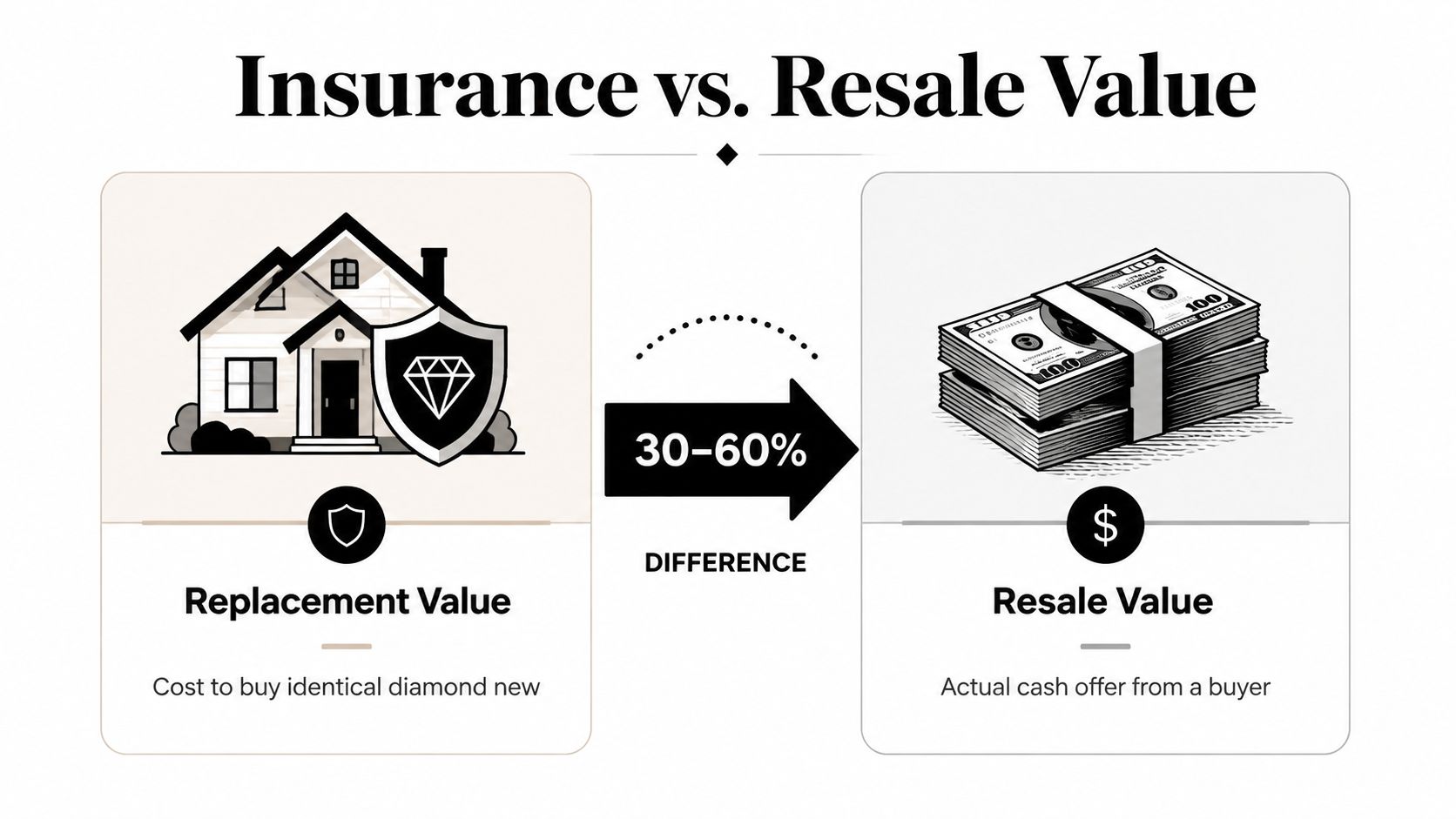
The number on an insurance appraisal often surprises sellers because it answers a different question from the one a buyer is answering. Replacement value estimates what it may cost to replace a comparable item with a new piece at current retail pricing. That figure can include expenses such as shipping, taxes, and installation, depending on the appraisal approach (Hodinkee's explanation of jewelry insurance appraisals).
A resale buyer asks a narrower question: how marketable is this specific item in the current secondary market, and what amount allows the buyer to resell it while managing authentication, overhead, and demand risk? Those figures are usually different. Professional appraisal guidance also distinguishes replacement value new, replacement value comparable, and replacement value reproduction, so the wording on the document matters (Jewelry Appraisers of America valuation guidance).
Why resale is compressed
An independent 2026 benchmark report estimates typical diamond resale at about 30% to 50% of original retail across common sizes. The same report places 1.0 ct stones often around $1,500 to $5,500 and 2.0 ct stones around $5,500 to $20,000, while emphasizing that actual results depend on documentation, grade, condition, and demand (Brilliant Buyback's 2026 diamond resale report).
Another independent valuation guide describes jewelry resale as about 20% to 50% of insurance replacement cost, with some market summaries placing diamond resale around 20% to 40% of original retail (Worthy's jewelry valuation guidance). These ranges aren't promises for an individual stone. They're reminders that a retail or insurance figure shouldn't become your expected cash amount.
The gap can be wider or narrower depending on the item. Larger, well-documented natural diamonds with strong grades may attract more trade interest. A branded setting may add buyer confidence when it's authentic and in good condition, while a damaged mounting may be valued mainly for its metal and the recoverable stone.
Natural and lab-grown diamonds
Origin deserves separate attention. Recent industry coverage describes lab-grown diamonds as facing minimal resale value because of oversupply, with one estimate placing 1-carat lab-grown resale at 30% to 50% of retail (Accio's 2025 diamond industry coverage). Natural diamonds, particularly high-color, high-clarity stones and rare fancy colors, may retain stronger buyer interest, but no origin guarantees a particular offer.
Watch the video below for a visual explanation of the difference between insurance value and resale value.
If you want an independent perspective before selling, this guide to an independent jewelry appraiser can help you distinguish a documentation-focused appraisal from a purchase evaluation.
How to Get and Compare Diamond Offers
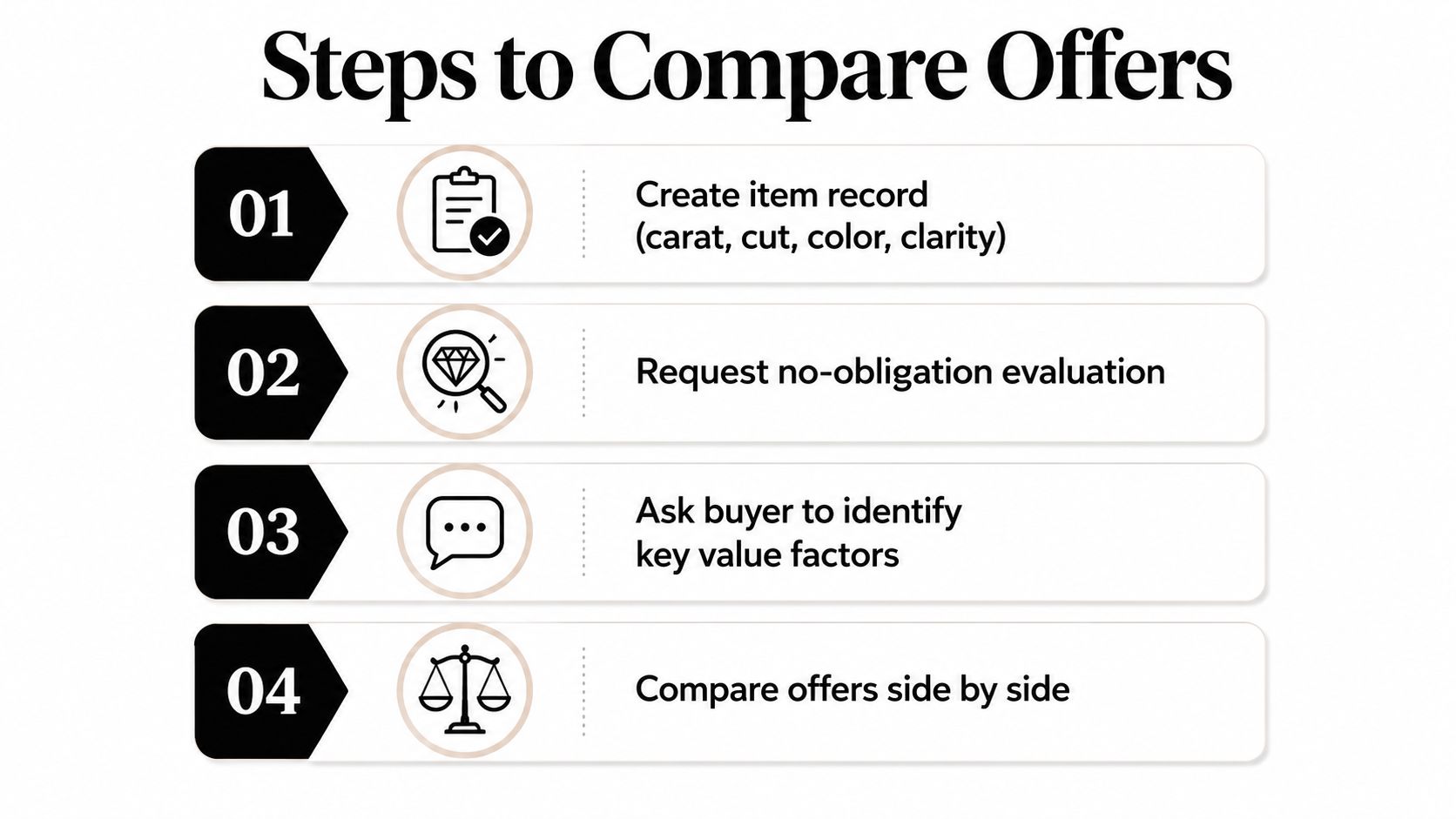
A good offer comparison starts with consistency. Send each buyer the same report photographs, item description, condition notes, and setting information. If one buyer receives a clear report and another receives only a carat estimate, the resulting offers won't be comparable.
Use a seller-side offer sheet
Record each response in a simple table or note:
Comparison point | What to record |
|---|---|
Item identity | Loose stone, ring, estate jewelry, natural or lab-grown |
Technical details | Carat, cut, color, clarity, fluorescence, measurements |
Documentation | Lab report, report number, receipt, appraisal, service records |
Offer amount | Preliminary estimate or final purchase offer |
Net proceeds | Amount after any stated fees or deductions |
Payment | Cash, secure transfer, or another documented method |
Timing | When payment is made and whether inspection comes first |
Conditions | Authentication, return terms, shipping, or offer changes |
A free evaluation is useful because it helps you understand whether a buyer sees enough information to proceed. It isn't automatically binding, particularly when photographs don't show condition clearly or when the item must be inspected in person. Ask whether the quoted amount is preliminary, what could change it, and how the buyer will notify you.
Ask questions that expose the reasoning
A buyer should be able to identify the item and explain the main value drivers. Ask:
Which report details support the offer?
How does fluorescence affect this stone's marketability?
Are condition or setting repairs reducing the amount?
Is the offer based on a natural or lab-grown classification?
What current resale evidence or comparable inventory informs the bid?
Are there fees, shipping deductions, or authentication conditions?
What happens if the physical inspection differs from the online description?
Consider two sellers with very different information. One has a documented natural diamond with a matching report and clear photographs. The other has a lab-grown stone without an accessible report and a worn setting. The first seller may receive stronger buyer interest because the buyer can verify the item more efficiently. The second may face more uncertainty, not necessarily because the stone lacks visual appeal, but because origin, grading, condition, and resale demand remain less certain.
Negotiation works better when you discuss the buyer's reasoning rather than insisting on the original receipt. If the buyer identifies a report mismatch, repair cost, weak demand, or missing documentation, ask whether supplying additional evidence changes the evaluation. Your timing matters too. A lower offer with clear terms may suit someone who values speed and privacy, while another seller may prefer to keep comparing offers.
For sellers considering a remote route, this resource on how to sell a diamond ring online provides a useful starting point for organizing photos and item details.
Houston Appointments and Insured Shipping Options
A Houston appointment and an insured shipping process solve different practical problems. In person, you can bring the stone, report, setting, and identification together and ask questions while the buyer examines the item. By mail, you can begin remotely and avoid travel, but you'll need to follow the receiving and insurance instructions precisely.
Preparing for a private appointment
Bring the original grading report if available, along with a receipt, prior appraisal, service records, box, and photographs. Tell the buyer about resizing, repairs, chipped areas, loose prongs, or alterations before the examination begins. Ask how the item will be recorded, whether the stone will be tested in the setting, and when the final offer is determined.
Antwerp Diamond provides a free online evaluation, private in-person appointments at its Houston location, and insured shipping options for remote clients. Its Houston office is listed at 6222 Richmond Ave, Houston, TX 77057, and the company states that it purchases diamonds through that office. It's an independent business, not an authorized affiliate of brands such as Cartier, Tiffany & Co., Rolex, or Hermès.
Houston and remote selling checklist
Selling path | Prepare | Confirm |
|---|---|---|
Private Houston appointment | Identification, report, receipts, appraisal, item history, and questions | Examination process, final-offer timing, payment method, receipt, and privacy terms |
Online evaluation first | Clear photographs, report images, measurements, condition notes, and contact details | Whether the estimate is preliminary and what physical inspection may change |
Insured shipping | Follow the buyer's packing and shipping instructions, retain tracking, and document the package | Insurance responsibility, receiving confirmation, inspection process, and return or release terms |
For a remote transaction, don't improvise the shipping method. Use the specified insured carrier or service, keep tracking information, and confirm that the buyer has received the package. Before shipping, ask what happens if the physical evaluation differs from the preliminary estimate and whether you can decline the final offer.
This overview of insured jewelry shipping can help you prepare questions about packaging, tracking, and transaction conditions. The goal isn't just to get the item to a buyer. It's to maintain a clear record from the moment you send it until the evaluation and payment are complete.
Completing the Sale Safely and Getting Paid
Before releasing a diamond, verify the final item description, offer amount, payment method, payment timing, inspection condition, and receipt. Don't rely on a verbal promise if the buyer can provide written terms. Ask whether the offer is final or subject to authentication and what happens if the physical review differs from the preliminary estimate.
Payment may be made by cash or secure transfer, depending on the buyer and transaction. Don't assume a particular processing time or payment method without confirming it in advance. If you're shipping, understand any return, release, or decline terms before the package leaves your possession.
Keep copies of the grading report, photographs, correspondence, tracking information, signed receipt, and proof of payment. Transport valuable items discreetly, avoid discussing the transaction publicly, and schedule an appointment only through verified contact details.
Houston diamond selling FAQs
What should I bring to a Houston diamond appointment?
Bring identification, the grading report, receipt, previous appraisal, service records, box, and any information about repairs or alterations.
Does an insurance appraisal tell me what I'll receive in cash?
No. Insurance appraisal language generally addresses replacement value, while a purchase offer reflects current secondary-market demand and the buyer's resale considerations.
Do natural and lab-grown diamonds resell the same way?
No. Origin affects buyer interest and expectations. A buyer will also consider grading, condition, documentation, and current demand.
Should I choose an appointment or shipping?
Choose an appointment if you want to discuss the item and terms face to face. Shipping may suit remote sellers, but use the buyer's specified insured method and confirm the inspection process first.
Antwerp Diamond offers free online evaluations, private Houston appointments, and insured shipping options for sellers who want a documented review before deciding. Visit Antwerp Diamond to submit your item details or arrange a confidential appointment, then compare the evaluation with your goals and other credible offers.