

Most sellers start with the wrong question: “What percentage of retail is my watch worth?” Retail price and resale price often have little relationship. Your watch's actual value depends on its exact reference, production status, originality, condition, completeness, provenance, and what comparable watches are selling for now.
A professional buyer won't price the dial alone. They'll authenticate the watch, inspect its parts and service history, compare it with recent transactions, and distinguish a realistic resale offer from an insurance replacement figure.
Table of Contents
Identifying Your Exact Watch Reference and Production Details
Researching Recent Sales and Using Valuation Tools Effectively
Why Brand Name Alone Does Not Determine Your Watch Value
A Rolex, Patek Philippe, or Audemars Piguet name can create demand, but it doesn't guarantee a strong resale price. The exact reference matters more than the logo. Two watches from the same manufacturer can follow completely different price paths because one may be common and readily available, while the other may be discontinued, scarce, or unusually sought after by collectors.
The broader market makes that reality clear. The global luxury watch market reached $47.72 billion in 2024, according to Grand View Research's luxury watch market analysis. A separate industry report valued the broader luxury watch market at $75 billion, with preowned sales reaching $22 billion in 2021, nearly one-third of total market activity, as summarized in the same market reference. That secondary-market activity gives buyers transaction history, pricing benchmarks, and liquidity signals.
Independent resale research found that only 3 of 21 major brands returned more than one dollar for every dollar spent at retail. Patek Philippe returned $1.51, Rolex returned $1.29, and Audemars Piguet returned $1.19, while 63% of watches traded below retail in that dataset. Retail price is therefore a poor shortcut for answering how much your watch is worth.
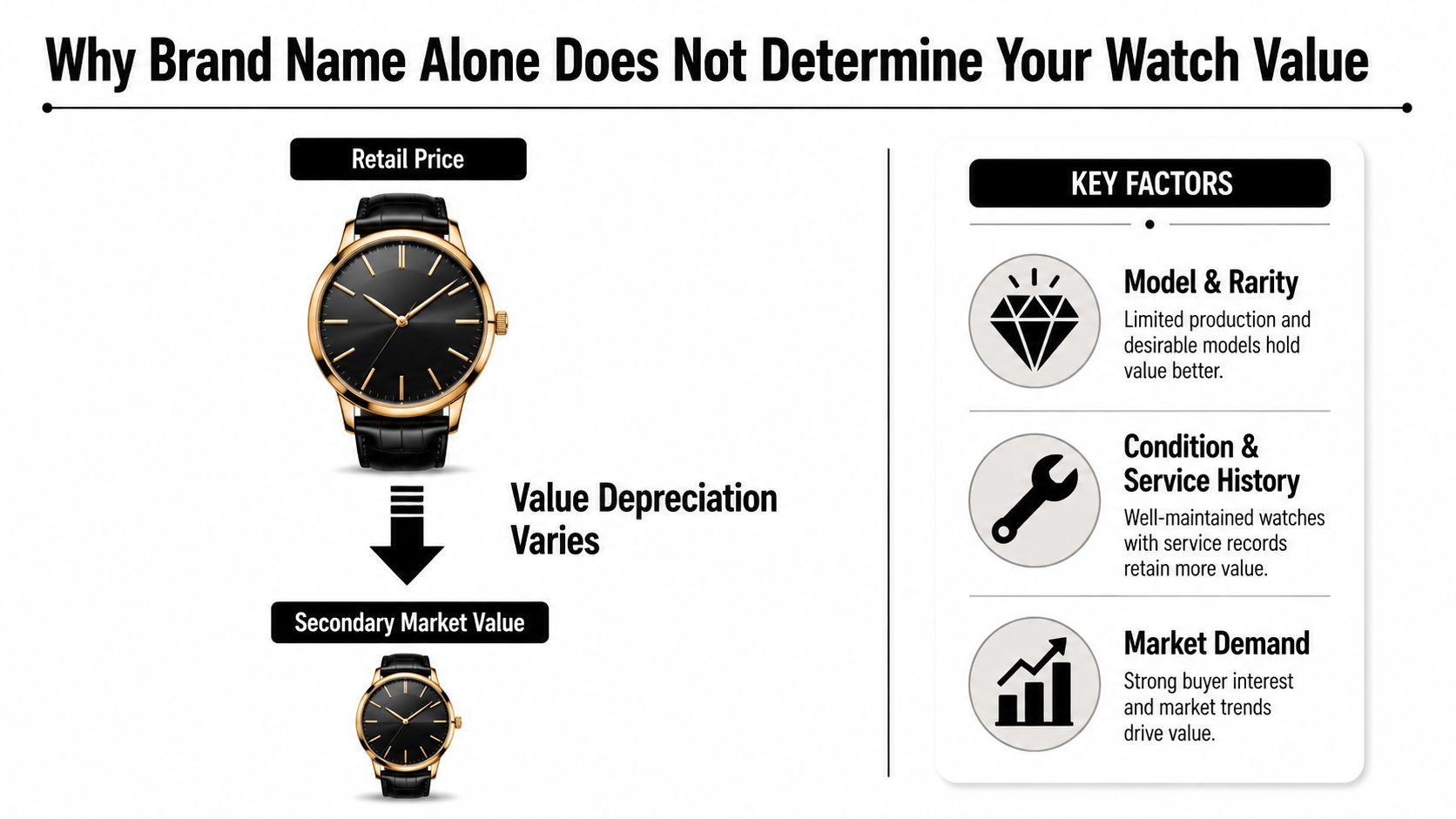
The factors buyers actually prioritize
A serious valuation begins with the following questions:
What is the exact reference? The model family, such as a Datejust or Nautilus, isn't enough.
Is the reference still in production? A discontinued model can attract a premium when demand remains strong.
How liquid is the watch? Widely traded references are easier to benchmark than obscure pieces.
What condition is it in? Case geometry, dial, crystal, bracelet, clasp, and movement all matter.
Is every important part original? Aftermarket or replacement components can reduce buyer confidence.
Is the set complete? Box, warranty card, papers, accessories, and service records support authenticity and history.
For a useful example of how model-specific demand changes the outcome, compare your piece with the guidance in this guide to Rolex resale value. The point isn't that every Rolex performs well. The point is that reference-level demand and market liquidity set the baseline, while condition and documentation determine where your watch lands within that range.
Identifying Your Exact Watch Reference and Production Details
Before you search a single listing, identify the watch precisely. “Rolex Submariner,” “Cartier Tank,” or “Patek Philippe Calatrava” describes a family of watches, not a market-ready comparable. Buyers need the reference number, case material, dial configuration, bracelet or strap, movement, production era, and any meaningful variation.
Start with the paperwork. Look for the reference and serial numbers on the warranty card, purchase documents, service invoices, and prior appraisal records. Check whether the numbers match the watch. A mismatch doesn't automatically prove wrongdoing, but it does require explanation and can affect confidence in the transaction.
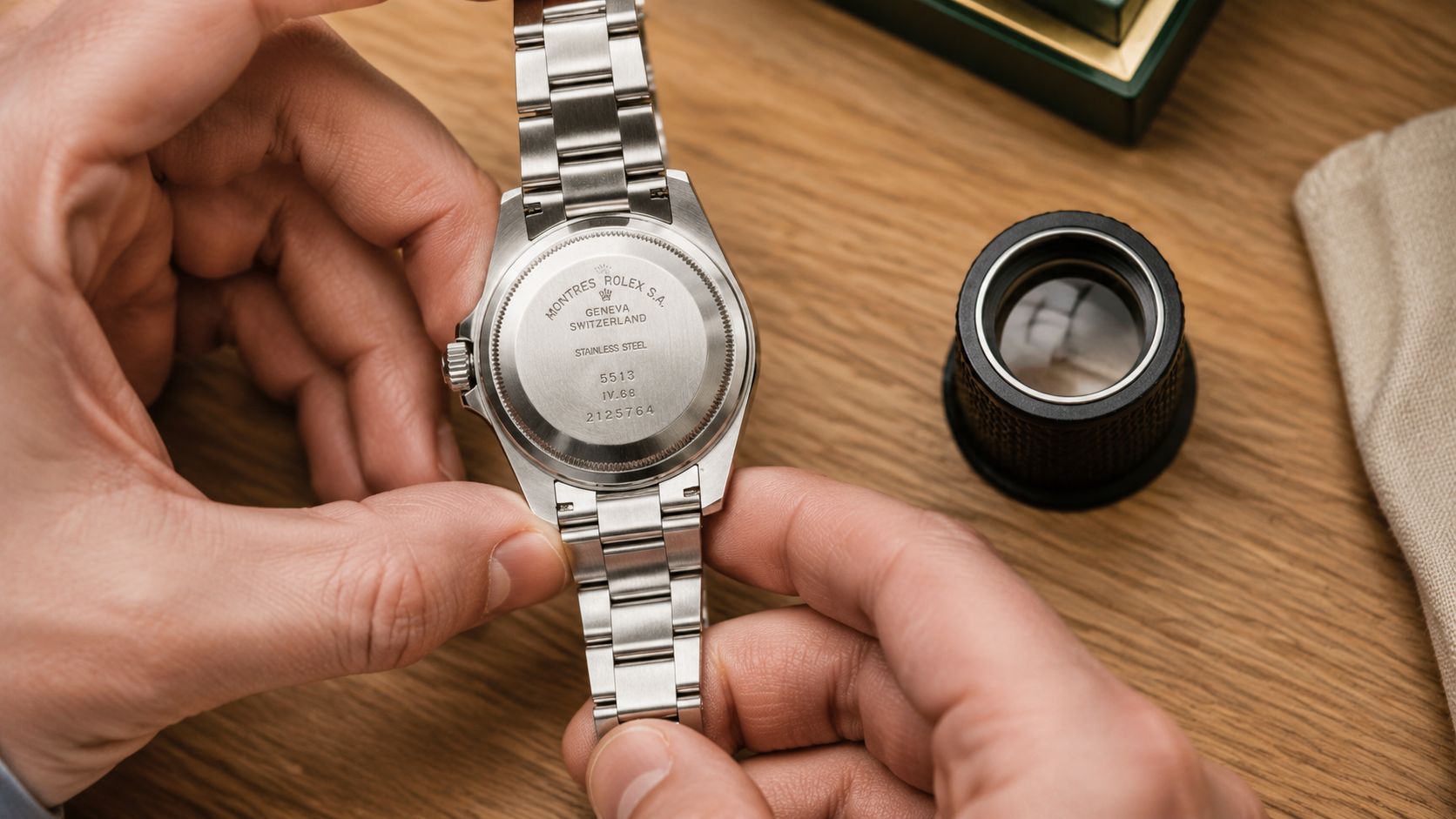
Where to look on the watch
Rolex often places the reference and serial engravings between the lugs, where the bracelet attaches. Removing a bracelet can expose those markings, but don't force the job with an unsuitable tool. A jeweler can remove it without damaging the case or lugs.
Cartier identification may involve case-back engravings, reference markings, serial information, and model-specific paperwork. Patek Philippe documentation is especially important because the original papers may provide identity details that aren't obvious from the exterior. The placement and format vary by model and period, so use this watch serial number lookup guide as a starting point, not as a substitute for inspection.
Record the details in a simple identity profile:
Brand and model family
Exact reference number
Serial number
Case metal and dimensions
Dial color, markers, and wording
Bezel and bracelet configuration
Movement or caliber information
Known production or service details
Small distinctions can change the comparable set entirely. A different bezel, dial variant, case material, bracelet, or production-era detail may place the watch in a different pricing category. Don't rely on a photograph that looks similar. Match the reference first, then compare the configuration.
How Condition and Completeness Change the Final Offer
Condition isn't a cosmetic footnote. It directly affects what a buyer can resell, how quickly the watch can move, and how much uncertainty the buyer must absorb.
Inspect the case, crystal, dial, hands, bezel, bracelet, clasp, crown, and movement. Buyers look for dents, deep scratches, moisture damage, bracelet stretch, chipped crystals, replaced hands, refinished dials, and softened case edges caused by polishing. A watch that appears shiny may still be less desirable than a worn example with crisp original geometry.
Over-polishing deserves particular attention. Polishing can remove factory-defined edges and alter the proportions that collectors expect. A professional buyer will also ask whether the dial, hands, bezel insert, crown, and bracelet are original to the watch or later replacements.
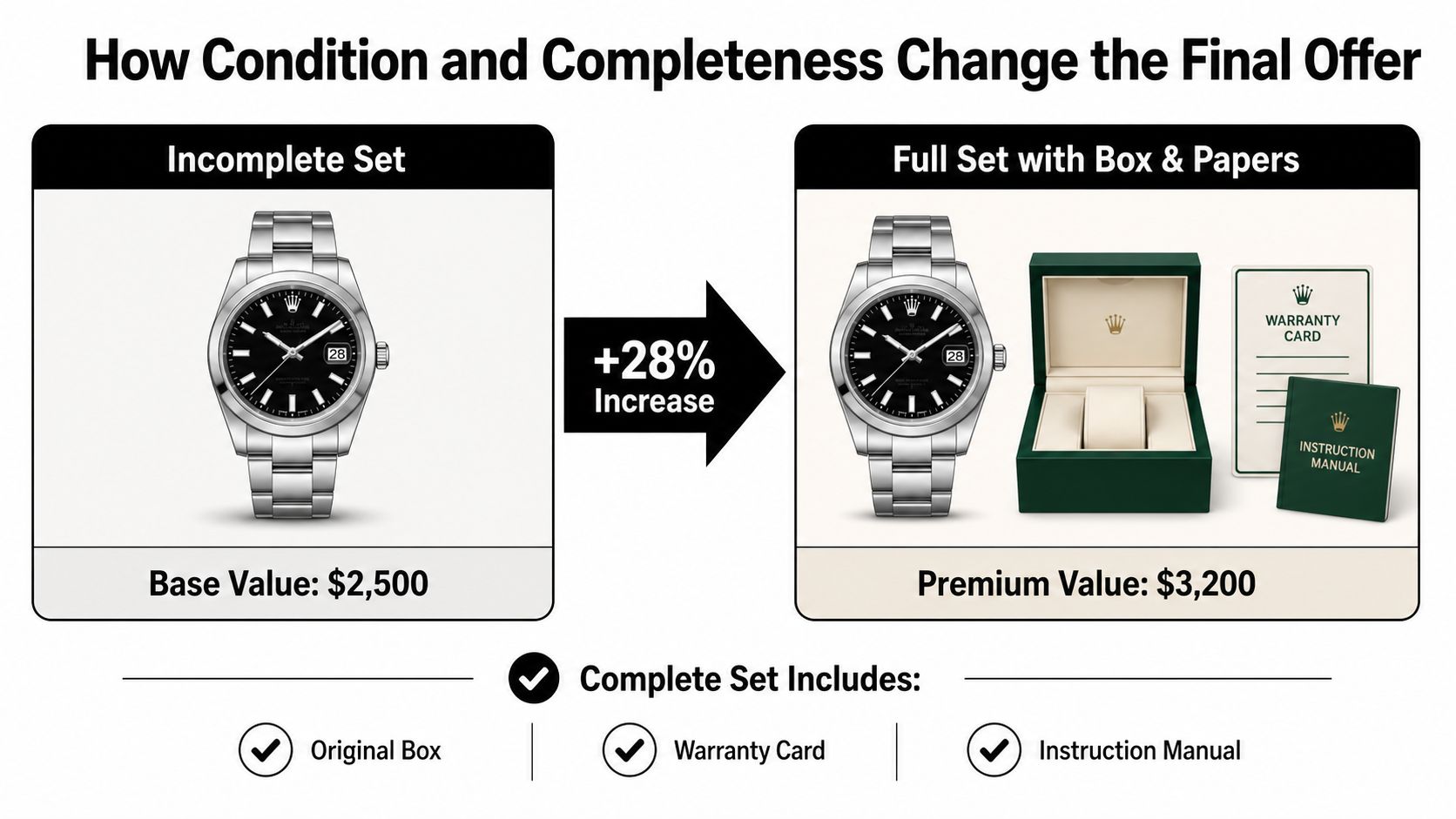
Why the full set matters
Independent valuation guides report that a complete set of original box, warranty card, papers, booklets, and accessories typically adds about 5% to 15% over a watch-only sale, as detailed in this guide to box and papers value. Other specialist sources place the uplift at 10% to 25% for modern pre-owned pieces, and 20% to 50% for top-tier brands such as Rolex and Patek Philippe. Rare vintage watches may see a 25% to 100% or greater increase when sold as a full set, according to the same valuation reference.
These ranges aren't automatic add-ons. The effect depends on the reference, the quality of the documents, whether serial numbers match, and how collectors view that particular configuration.
Service records also matter. They can show maintenance, support authenticity, and help a buyer judge whether immediate mechanical work may be needed. However, servicing a vintage watch with non-original cosmetic parts can create a different problem. New service components may improve function while reducing collector appeal if they replace historically important original parts.
Practical rule: Never authorize polishing or parts replacement before understanding whether originality or appearance matters more for your specific reference.
Authentication is another hidden value filter. In 2025, the online trading platform Bezel reported rejecting 27% of the watches it inspected, with most failures involving Rolex or alleged Rolex pieces, as reported by HODINKEE. Non-authentic parts and Frankenwatches can turn an apparent luxury asset into a difficult or rejected transaction. If you're considering polishing, review the practical issues in this watch polishing cost guide before taking action.
Researching Recent Sales and Using Valuation Tools Effectively
Online listings are useful, but they aren't proof of market value. An asking price shows what a seller hopes to receive. A completed sale shows what a buyer accepted.
Start with recent auction results and completed marketplace transactions. Then review live asking prices to understand the current competitive environment. Filter for the exact reference, comparable condition, matching materials, similar production details, and the same level of completeness.
Use three data streams
A sound valuation triangulates:
Sold prices, which provide the strongest evidence of actual market behavior.
Live asking prices, which show current seller expectations and available competition.
Your watch's condition and history, which determine whether it belongs near the top, middle, or bottom of the comparable range.
One expert methodology uses a 60/40 weighted blend of sold prices and asking prices, because completed transactions provide a stronger signal. It also removes statistical outliers using interquartile-range filtering, converts prices to USD, and assigns a confidence score based on comparable-sale volume and agreement across sources, as explained in this luxury watch valuation methodology.

Build a reliable comparable set
Don't use the highest listing you can find. Remove comparisons with different metals, aftermarket parts, missing bracelets, materially different dials, or substantially different condition. A rare reference may have too few sales to support a precise estimate, so the valuation should carry lower confidence rather than false precision.
Keep three separate numbers in your notes:
Figure | What it means |
|---|---|
Recent sold range | The prices comparable watches actually achieved |
Current asking range | The prices sellers are requesting, not necessarily receiving |
Likely dealer offer | A purchase offer that reflects authentication, resale risk, operating costs, and margin |
Timing matters too. A 2025 market index reported a 3% quarterly decline and a 23.9% drop from the 2022 peak, according to the Gray & Sons industry report summary. That doesn't tell you what your particular watch will sell for, but it does show why an old price screenshot shouldn't control today's expectation.
For an unusual or vintage piece, use a specialist approach. Vintage watch valuation guidance can help you organize the research, but a physical examination remains essential when originality, patina, or restoration history drives the premium.
Choosing Between Appraisal, Private Sale, and Dealer Offer
Your best selling path depends on the outcome you need. An insurance appraisal, private sale, and dealer offer answer different questions, so comparing their figures directly can create confusion.
An insurance appraisal generally describes what it may cost to replace the item through a retail channel. That figure can exceed realistic resale value because replacement pricing includes sourcing an equivalent item, not the amount a buyer would pay for your preowned watch today. A resale valuation focuses on current market transactions.
Factor | Formal Appraisal | Private Sale | Dealer Offer |
|---|---|---|---|
Primary purpose | Insurance, estate, or documentation needs | Maximize direct-market proceeds | Convert the watch into a direct transaction |
Price basis | Replacement or stated appraisal purpose | Negotiated market price | Current resale demand and buyer risk |
Speed | Depends on the appraiser | Often slower and unpredictable | Usually more direct |
Seller responsibility | Provide accurate item information | Authentication, photography, negotiation, payment, and shipping | Present the watch and supporting documents |
Fees and risk | May involve an appraisal fee | Platform, payment, shipping, and transaction risks may apply | Offer reflects the buyer's costs and margin |
Best fit | You need written documentation | You have time and can manage the process | You want a clear, private sale route |
Pick the route that matches your goal
Choose a formal appraisal when you need documentation for insurance, estate planning, or another defined purpose. Choose a private sale when you have the time, security procedures, and market knowledge to manage the transaction yourself.
A dealer offer is usually more practical when you value privacy, simplicity, and a direct assessment. Ask how the buyer will authenticate the watch, whether the offer is conditional on further inspection, what documents they need, and how payment will be handled.
Sellers in Atlanta, Buckhead, Sandy Springs, Alpharetta, Roswell, Brookhaven, Midtown Atlanta, and the greater Georgia market may prefer an in-person review rather than shipping a valuable timepiece. Antwerp Diamond Store offers private evaluations for sellers who want to discuss a watch face to face. If distance makes an appointment inconvenient, online watch appraisal guidance can help you prepare the photographs and identifying information a buyer needs for an initial review.
Your Next Steps to Get a Confident Valuation
Use this checklist before requesting an offer:
Identify the watch completely. Record the brand, model family, reference, serial number, case metal, dial, bezel, bracelet, and movement details.
Gather the complete set. Bring the original box, warranty card, papers, booklets, accessories, purchase records, and service invoices.
Inspect without altering it. Photograph the case, lugs, dial, clasp, bracelet, case back, and serial markings. Don't polish or replace parts before evaluation.
Separate value types. Keep insurance replacement value, private-sale expectations, and dealer-offer value in different categories.
Compare true comparables. Use sold results first, then live listings, while adjusting for originality, condition, completeness, and timing.
Ask for an authentication-based review. A buyer should examine the actual watch, not rely solely on a model name or online calculator.
The strongest answer to “how much is my watch worth” is rarely a single number pulled from a search result. It's a defensible market range supported by the exact reference, physical inspection, documentation, provenance, and current comparable sales.
Antwerp Diamond offers confidential watch evaluations based on identification, authentication, condition, completeness, and current resale demand. Visit Antwerp Diamond to start with an online evaluation or arrange a private appointment in Buckhead, Roswell, or another available U.S. location.