

Louis Vuitton bags average about 92% retail value retention on the secondary market, but that figure is only a starting point. Your actual cash payout depends heavily on the model, condition, authentication evidence, and selling channel.
A Neverfull, Speedy, Alma BB, or Pochette Métis can attract strong buyer interest, yet the number printed on a resale guide isn't automatically the amount you'll receive. A listing price, a consignment estimate, a negotiated sale, and an immediate buyout are different numbers. If you're trying to understand your Louis Vuitton bag value, focus on the price a qualified buyer can realistically clear today.
Table of Contents
Understanding Louis Vuitton Resale Value Basics
A Louis Vuitton bag may retain about 92% of its retail value, yet that percentage does not equal your cash payout. Core models commonly resell in the $700 to $2,500 range, according to this Louis Vuitton resale value guide. Use that range as an opening benchmark, not as a price quote.
The difference comes from market friction. A resale guide may describe completed sales or broad performance, while a buyer must account for authentication, inventory time, negotiation, and the risk of finding the next customer. Your model, material, size, colorway, age, condition, and documentation then determine where your bag sits within the range.
Retail retention is not cash in hand
Suppose a bag originally retailed at about $2,620. An 88% retention rate implies a resale price near $2,306, based on the same guide. That arithmetic establishes a reference point. It does not subtract negotiation, authentication work, holding costs, or the margin required by a direct buyer.
The same issue applies to a Speedy 25 that retailed at $1,730. An 82% retention rate implies roughly $1,419 in resale value, but a buyer offering immediate payment may quote less. That discount pays for speed and transfers the work of marketing and reselling the bag to the buyer.
Practical rule: Treat retention percentages as market benchmarks, not promises. The buyer's verified, current offer is the figure that matters.
Separate these four figures before judging any valuation:
Original retail price: What the bag cost when new.
Advertised resale price: What a seller hopes to receive.
Realistic sold-market value: What comparable bags consistently sell for.
Immediate payout: What a buyer offers after pricing in risk, labor, and speed.
The gap between the third and fourth figures is often the point sellers overlook. A Chanel bag resale value guide makes the same broader point: resale value depends on the individual item and transaction conditions, not the logo alone.
Why the same bag gets different offers
Two identical Louis Vuitton bags can receive different offers. One may have clean corners, firm structure, complete accessories, and clear provenance. The other may show rubbed piping, interior odor, or uncertain repairs. A buyer also considers whether that configuration has an active audience or could sit in inventory.
Judge your bag against realistic sold prices, not the highest online listing. Then choose the route that matches your priority: immediate cash, privacy, or the possibility of higher proceeds through a slower sale.
How Model and Rarity Shape Your Bag's Price
The model sets the first major pricing split. Buyers know the Neverfull, Speedy, Pochette Métis, and Alma BB, which makes these silhouettes easier to compare, authenticate, and sell. That recognition creates a broader buyer pool, but it does not guarantee a premium. A popular bag with weak condition or an unpopular configuration can still receive a modest offer.
The Neverfull shows why retail history and resale demand must be separated. One market summary reports that the monogram canvas Neverfull sold for about $750 around 2010 and reached about $2,130 by April 2025, after roughly 12 documented price hikes, an increase of about 184%. The same summary recorded pre-owned examples selling for about $3,200 to $3,500, above then-current retail, when demand was particularly strong. Review the Louis Vuitton resale report on long-term value for that context.
That performance does not apply to every Neverfull, and it does not prove that every Louis Vuitton bag appreciates. Discontinued designs, unusual colorways, limited editions, and collaborations can behave differently because the boutique no longer offers the same configuration. Scarcity raises attention only when buyers want the item.
Model benchmarks worth using
Retention figures give you a useful comparison point, but they do not predict your cash payout:
Model | Retention Rate | Typical Resale Range |
|---|---|---|
Neverfull MM | About 92% | Core models commonly fall within the brand's broader $700 to $2,500 resale range |
Pochette Métis | Near 88% | Core models commonly fall within the brand's broader $700 to $2,500 resale range |
Alma BB | Around 85% | Core models commonly fall within the brand's broader $700 to $2,500 resale range |
Speedy 25 | Around 82% | Core models commonly fall within the brand's broader $700 to $2,500 resale range |
These figures are benchmarks, not guaranteed offers. A Pochette Métis near 88% retention may appear stronger than an Alma BB around 85%, yet the final dollar amount still depends on material, size, condition, provenance, and selling channel. A quoted percentage often describes a resale market position, while a buyer's offer also deducts for authentication, inventory time, negotiation, and risk. That difference is the market friction many valuation guides leave out.
Rarity can help, but only when buyers want it
A discontinued bag is not automatically valuable. Rarity helps when it combines with recognizable design, desirable construction, strong condition, and active collector interest. A hard-to-find print with weak demand can sit unsold, while a familiar classic in an uncommon but tasteful configuration may attract attention faster.
Use sold comparables rather than the highest active listing. Then judge whether the unusual feature improves desirability or merely narrows the audience. If your collection also includes an older Gucci piece, this guide to vintage Gucci bags provides a useful comparison. Across designer handbags, age matters less than demand, authentication confidence, and the condition visible to buyers.
Condition and Hardware Inspection Checklist
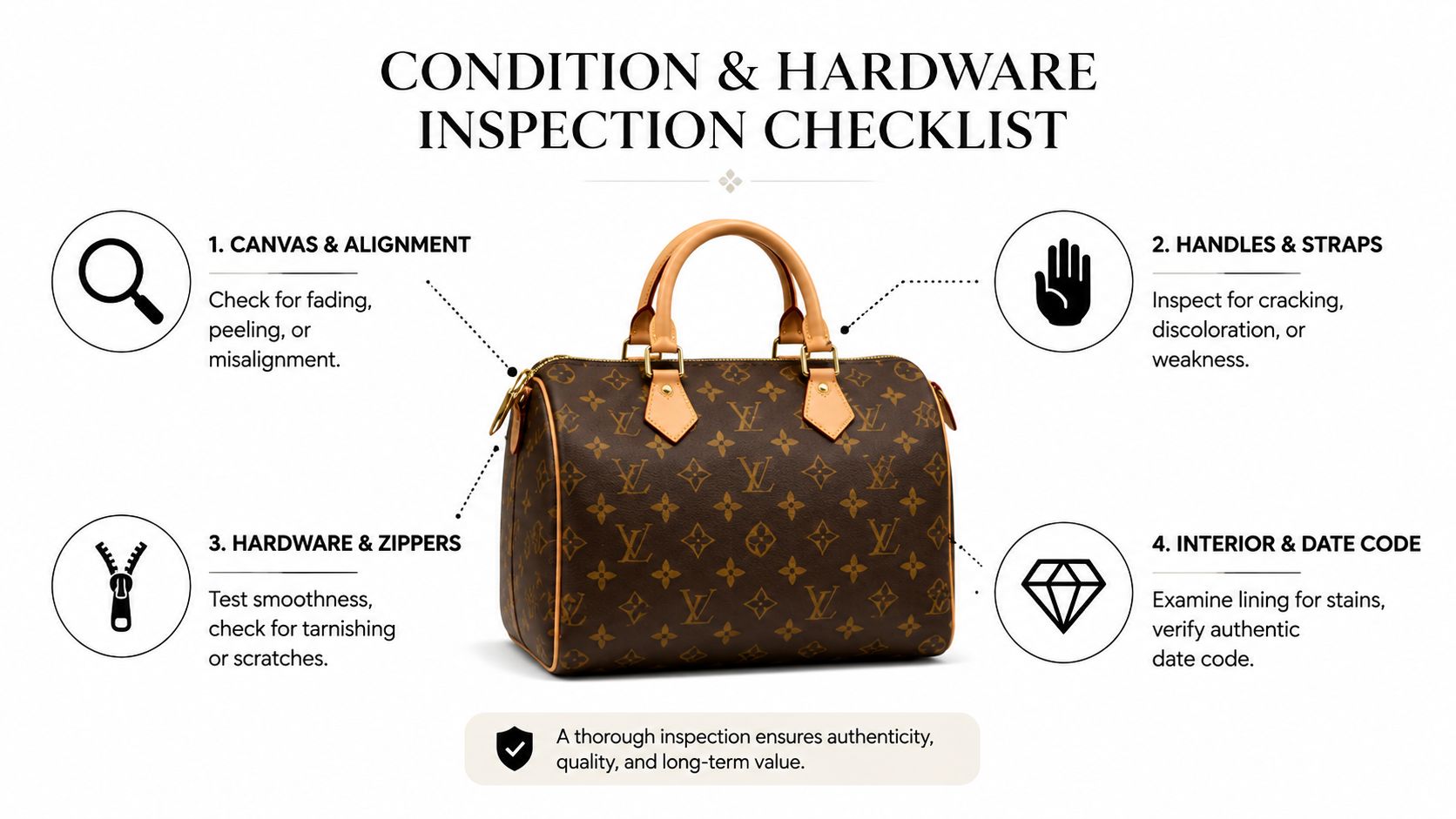
Condition often determines whether a quoted resale percentage becomes real cash. Buyers inspect the areas that show contact first, including handles, straps, corners, piping, seams, zippers, and hardware. Damage in these zones signals restoration expense and greater resale risk.
Start with the exterior structure
Use bright, even light and inspect the bag without concealing flaws. Check these areas:
Vachetta leather: Even honey patina is generally acceptable. Cracking, peeling, or heavy darkening can reduce value by roughly $100 to $300, according to this Speedy value guide.
Canvas: Examine the monogram surface for peeling, brittleness, fading, separated seams, and corner cracks. Even minor peeling can reduce the offer because it may indicate structural failure.
Corners and piping: Rub-through, exposed edges, and cracking matter more than ordinary surface marks. These areas support the bag's shape and reveal how much wear it can withstand.
Handles and straps: Look for dryness, weakness, discoloration, splitting, and uneven darkening. Visible handle wear is expensive for buyers to overlook.
Interior cleanliness cannot offset a failing seam or damaged corner. Buyers price these defects aggressively because they affect restoration costs, future durability, and the likelihood of complaints.
Test function, then inspect the lining
Open and close every zipper slowly. Test snaps, buckles, clasps, and strap attachments. Tarnish and light scratches may remain cosmetic, but a catching zipper or failed clasp makes the bag partly unusable and lowers the offer.
Inspect the lining with equal honesty. Check for ink, makeup, stains, sticky surfaces, odors, water damage, and pocket separation. Photograph the base, pockets, corners, handles, hardware, and every visible flaw before requesting an evaluation.
Do not use aggressive cleaners or attempt a home repair. Mismatched dye, adhesive residue, or an altered edge can create a larger authentication and restoration problem than the original wear. Before contacting a buyer, review this guidance on selling high-end handbags. Clear documentation helps buyers separate ordinary wear from defects that justify a lower cash offer.
The Gap Between Quoted Value and Actual Payout
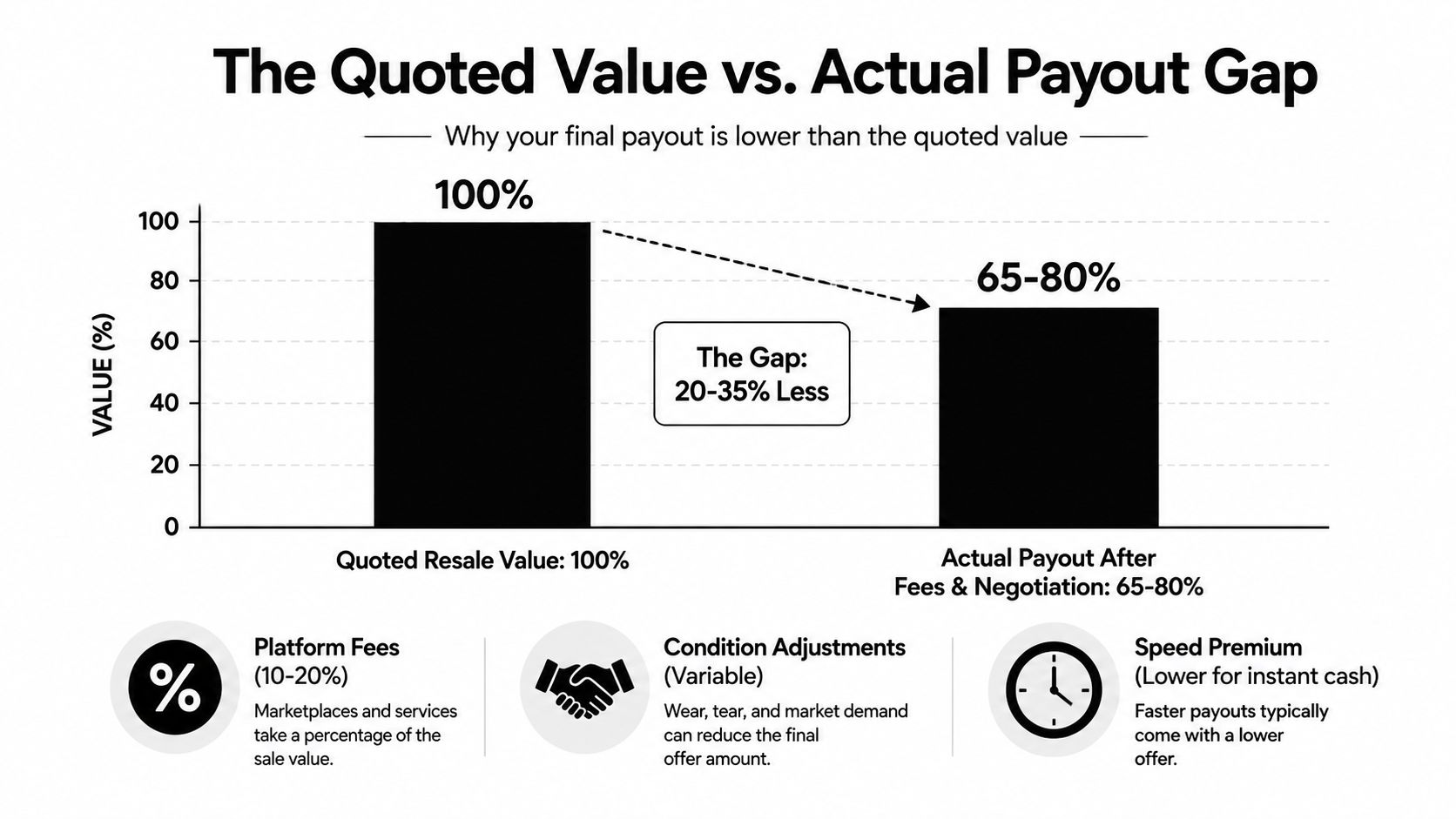
The most misleading number in luxury resale is often the advertised price. A 2026 study of 198 verified listings found Louis Vuitton had a 39% median discount to sold-market value, the widest median discount among the major brands examined. It also reported a median Louis Vuitton sold-market value of $1,281, with a $515 median discount below market, as detailed in the Louis Vuitton market spread data.
That finding changes how you should read online listings. A seller can list a bag high, wait for interest, accept offers, or eventually reduce the price. Until the transaction closes, the listing isn't proof of value.
Four prices can exist for one handbag
An asking price reflects the seller's target. A sold price reflects what a buyer accepted. A consignment estimate anticipates a future sale and may depend on presentation, timing, and platform reach. An immediate buyout offer values certainty and speed, so it can be lower than a successful direct-to-consumer sale.
The selling channel determines who handles photography, authentication, customer questions, shipping, returns, and inventory risk. A platform may expose the bag to more shoppers, but the seller may wait longer and absorb fees or negotiation. A direct buyer can simplify the transaction, but that convenience is reflected in the offer.
The price on the page is a possibility. The completed transaction is evidence.
Don't use the highest visible listing as your benchmark. Compare sold examples with the same model, size, material, colorway, age, and condition. Then ask whether you want to wait for a theoretical maximum or accept a clear offer today.
For a broader view of authentication, fees, payout speed, and selling procedures, use this guide to compare top platforms for selling handbags.
Authentication Markers and Documentation Requirements
Authentication determines whether a buyer can make an offer. Louis Vuitton changed its bag identification system in 2021. Bags made before March 2021 typically carry a visible date code, while bags made after that date generally use an embedded microchip with no visible date code, according to this Louis Vuitton authentication guide.
A visible date code on a post-2021 bag is a major warning sign. A code alone does not prove an older bag is genuine. Buyers assess the full construction, including the heat stamp, typography, stitching, glazing, canvas, hardware, lining, proportions, and provenance. Sellers can review how to spot fake designer bags to understand the markers that receive close scrutiny.
Organize proof before the evaluation
Gather every record and accessory connected to the purchase:
Purchase documentation: Keep the original receipt or order record if available.
Packaging: Include the box, dust bag, tags, strap, and pouch supplied with the bag.
Ownership history: State where and when you acquired it, particularly for vintage or pre-owned pieces.
Detailed photographs: Photograph applicable older date-code areas, interior stamps, corners, seams, hardware, and every accessory.
Service records: Disclose repairs or restoration so the buyer can assess alterations directly.
Missing packaging does not make an authentic bag worthless. It can lower confidence or delay review, especially when the construction, provenance, or condition already raises questions. The impact depends on the model and age.
Online code searches and one photograph are weak evidence. Request a professional evaluation when the bag has been repaired, customized, heavily worn, purchased from an unfamiliar source, or made around the transition to embedded identification. Authentication matters twice: it confirms whether the bag can enter the resale market, and it prevents a quoted resale percentage from being mistaken for cash in hand. A buyer still sets the payout after reviewing the evidence.
Comparing Selling Channels and Valuation Services
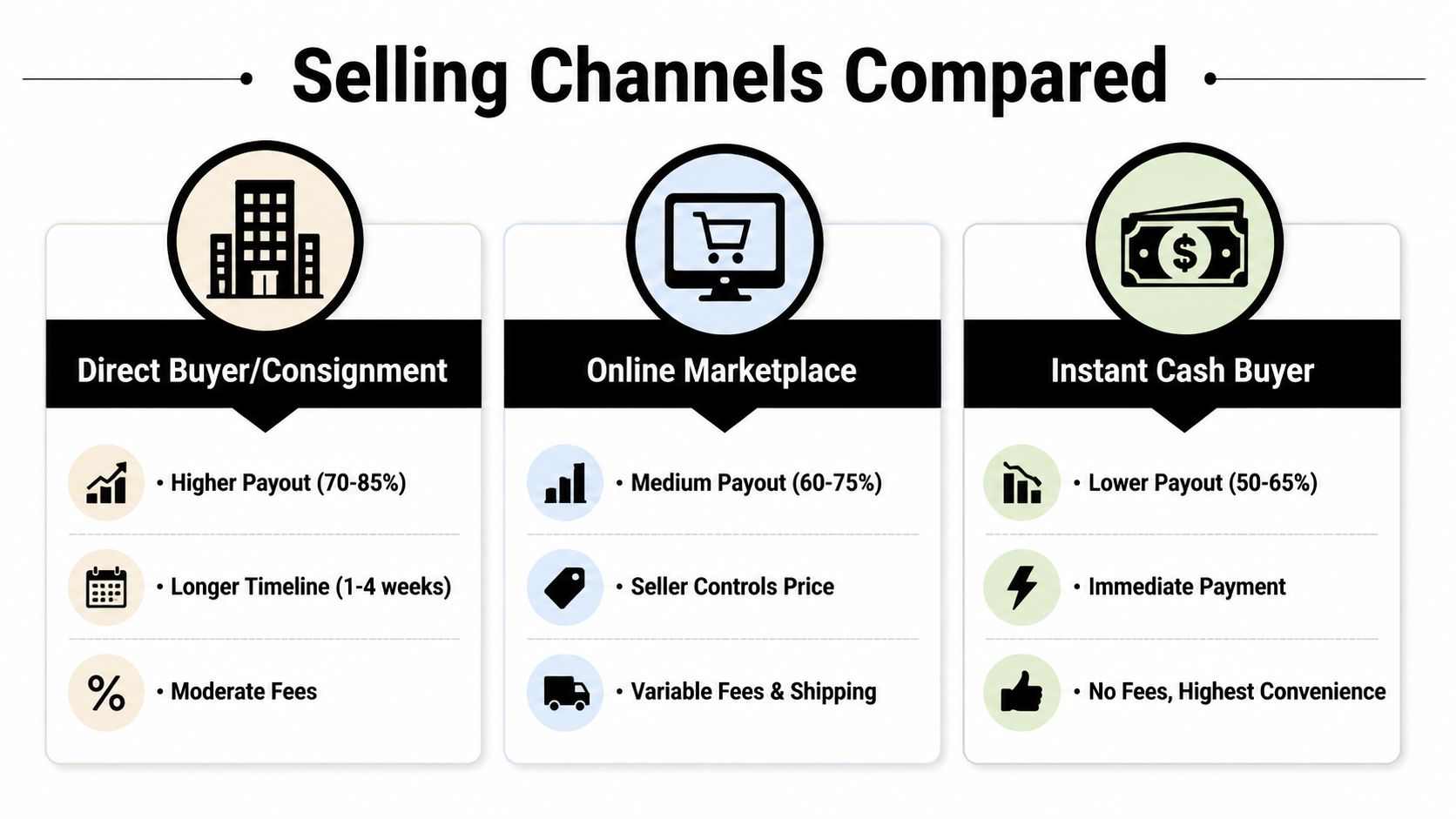
Choose the selling route based on your priority. Direct buyers emphasize speed and certainty. Consignment services pursue a retail buyer and may produce a stronger gross result, but you wait for the sale and accept the service's fee structure. Online marketplaces give you more control, while also placing more responsibility on you.
Match the channel to the outcome you want
Selling channel | Main advantage | Main trade-off |
|---|---|---|
Direct buyer | Faster decision and simpler transaction | Offer reflects buyer inventory and resale risk |
Consignment | Potential access to retail shoppers | Payment depends on the eventual sale and agreement |
Online marketplace | Seller controls presentation and asking price | Seller handles inquiries, shipping, fees, and buyer disputes |
Auction house | Useful for unusual or collectible pieces | Timing, eligibility, and auction costs can vary |
Local evaluation | In-person inspection and direct discussion | Results depend on the evaluator's market and buying criteria |
Ask every service how it establishes the price, what happens if authentication raises questions, whether repairs are deducted, and when payment occurs. Don't send a valuable handbag without understanding shipping responsibility, insurance, return terms, and ownership transfer.
A local evaluation suits sellers who want to discuss condition face to face. In the Atlanta area, that can be practical for owners in Buckhead, Sandy Springs, Alpharetta, Roswell, Brookhaven, Midtown Atlanta, and the greater Georgia market. Antwerp Diamond Store offers evaluations for luxury handbags through local appointments and remote review options, making it one route to consider alongside online resale and consignment.
Collectors comparing authentication-sensitive markets can also evaluate PSA graded card listings. The comparison is useful because both handbags and graded collectibles require buyers to weigh condition, verification, provenance, and liquidity rather than relying on an asking price alone.
Getting a Professional Evaluation for Your Bag
A professional evaluation should turn uncertainty into a documented conversation about model, condition, authenticity, demand, and selling route. Bring the bag clean but unaltered, include its accessories and paperwork, and disclose repairs, odors, stains, or purchases from secondary sources.
Before accepting an offer, ask:
Is the figure a direct purchase offer, a consignment estimate, or an appraisal?
Which condition issues affected the valuation?
Has the bag been authenticated, and what happens if additional review is needed?
Are there deductions, service charges, shipping costs, or other transaction terms?
When and how would payment be made?
An appraisal can serve an insurance, estate, or documentation purpose, while a purchase offer reflects what a buyer is prepared to pay for the item under current market conditions. Don't confuse the two, and don't treat a general online estimate as a substitute for examining the actual bag.
The right preparation is simple: photograph the model and date code area when applicable, record measurements and accessories, note visible wear, and gather proof of purchase. That gives the evaluator a clearer starting point and helps you compare offers fairly.
Bring your Louis Vuitton bag to Antwerp Diamond for a confidential evaluation focused on authenticity, condition, provenance, and current resale demand. You can request an online review or arrange an in-person appointment in Atlanta, then decide whether a clear, no-obligation offer fits your goals.