

Counterfeit designer bags are a massive global business, and that's why how to spot fake designer bags matters for anyone buying, selling, or appraising luxury pieces. The scale is real, the fakes are getting better, and the safest approach is to inspect more than one detail before you decide.
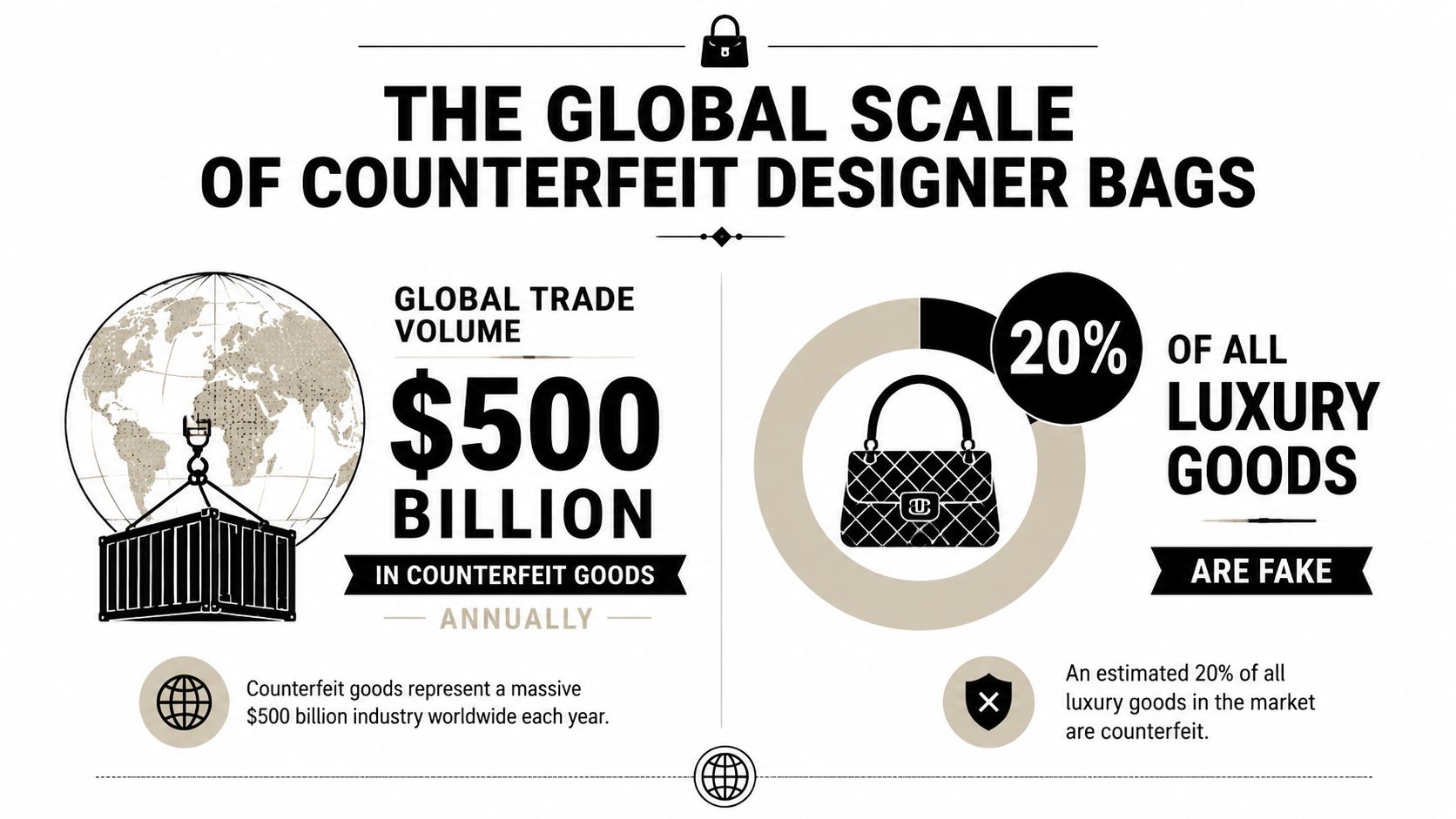
Table of Contents
Why Counterfeit Designer Bags Are Everywhere
The counterfeit market is not a niche problem, it's a scale problem. The OECD reported that counterfeit and pirated goods accounted for up to 2.5% of world trade in 2019, and the 2021 Global Brand Counterfeiting Report estimated counterfeit trade at about US$1.8 trillion by 2020. For handbag buyers, that macro number turns into a very local risk, because FashionUnited cited estimates that up to 10% of all designer goods sold may be fake and that 80% of people have unknowingly purchased counterfeit items at some point in their lives. FashionUnited's expert report on fake designer handbags
The reason fake bags are so hard to avoid is simple, counterfeiters don't need to fool everyone, they just need to fool enough buyers at a glance. That's why luxury names like Louis Vuitton, Chanel, Hermès, Prada, Gucci, Fendi, and Dior get copied so often, especially in resale-heavy markets where demand stays strong and “superfakes” move fast.
What experienced authenticators actually check
The first mistake most buyers make is focusing on one obvious tell, like a logo, a dust bag, or a serial sticker. That doesn't work reliably. Authenticators look for a cluster of high-friction details that are harder to fake consistently, including stitching density, hardware weight and engraving, logo spacing, interior lining quality, and date-code or serial formatting.
Practical rule: if three small details are off, the bag deserves a much closer review, even if the logo looks perfect.
That matters in markets like the U.S. and Europe, where high resale demand rewards good counterfeiters. In those channels, the bag may look right from a few feet away, but still fail under close handling.
For readers comparing a bag against resale value or deciding whether to list it, the safest first stop is a trusted local evaluation process, such as the one outlined in this guide to the best place to sell handbags. You can't authenticate a luxury bag with a glance, because counterfeiters know how to imitate the easy parts.
The Five-Part Physical Inspection Sequence
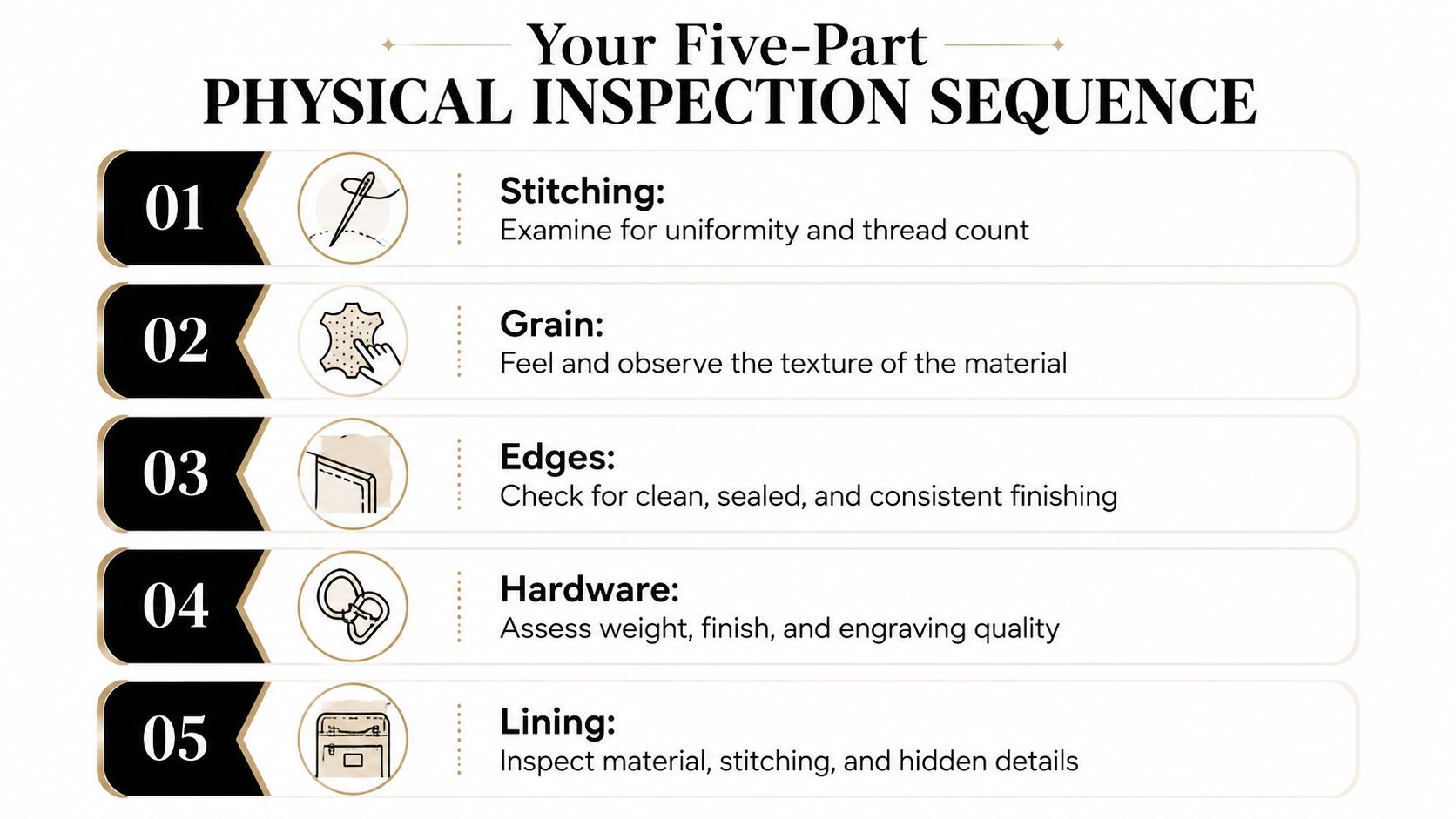
The most reliable way to inspect a handbag is to do it in order, not randomly. Start with stitching, then move to grain, edges, hardware, and lining. That sequence works because it combines visual, tactile, and functional checks, and counterfeiters tend to cut corners in the construction details before they get the brand marks right.
A good inspection starts in natural light, with clean hands and no assumptions. If you're using a phone light indoors, keep it angled, not direct, so surface flaws and texture differences stay visible. The goal is to see whether the bag feels engineered or assembled.
1. Stitching comes first
Run a fingernail along the seam lines and look for saddle-stitch consistency, even spacing, and straight transitions around corners. Loose ends, tension changes, and uneven back-stitching usually show where a replica factory saved time. A real bag should look deliberate, not merely neat.
2. Grain tells you how the material was finished
Examine leather or coated canvas under daylight for repeating mechanical patterns, shine that looks too uniform, or texture that feels flat. Real material has variation, while counterfeit surfaces often repeat in a way your eye can catch once you slow down. Touch matters as much as sight.
3. Edges reveal rushed finishing
Pinch handles and look at the edge paint or glazing. If the edges lift, crack, or feel too soft in one spot, that's a warning sign. Clean edge finishing is one of the easiest places to spot a short-cut.
4. Hardware should feel weighty and work cleanly
Test clasps, zippers, feet, and chain links. Solid hardware should feel substantial, not hollow or plasticky, and it should close with proper resistance instead of wobbling or snagging. The wrong finish, especially metal that looks overly shiny or too light, is a common counterfeit flaw.
5. Lining often gives the bag away
Check interior corners, stitch terminations, and pocket openings for uneven tension or loose ends. Fakes often look acceptable from the outside, then fall apart inside where the seams are hidden.
The most useful outside resource I've seen on the practical side of inspection is tips from AI Video Detector, because it reinforces the value of checking structure and consistency rather than trusting one obvious marker. For anyone comparing a bag against selling options, this seller-focused handbag guide is a useful next read.
Brand-Specific Authentication Markers
Generic advice only gets you so far. A Chanel, Louis Vuitton, or Hermès bag has to be judged against the exact model, production era, and construction standard, not just the brand name. That's where a lot of casual authentication fails, because details change over time and counterfeiters often copy the current look without understanding the older formats.
Chanel, Louis Vuitton, and Hermès don't follow one universal rule
Chanel is the clearest example of era-based checking. Its date-code system was introduced in 2000, then the brand shifted to embedded microchips in 2021. That means the correct code format has to match the bag's production period, or the identification logic falls apart. Louis Vuitton also requires era matching, especially for monogram alignment, date-code location, and hardware specifications. Hermès depends on precise stamping, blind stamps, and craftsman marks that need to fit the item's model and age.
Brand | Key Markers | Era Variations |
|---|---|---|
Chanel | Date code or microchip, quilting, CC logo, chain construction | Date codes used from 2000, microchips from 2021 |
Louis Vuitton | Monogram alignment, date code, hardware finish, heat stamp clarity | Date-code formats and placement vary by era |
Hermès | Stamping, blind stamps, craftsman marks, saddle stitching, leather quality | Mark placement and code style depend on model and year |
A legitimate bag should also match dimensions, typography, engraving depth, and hardware finish against official references. If the proportions are off, or the hardware feels wrong for the model, the logo alone doesn't matter.
Why model-level comparison beats brand-level guessing
Many buyers make a bad assumption. They compare a bag to the brand in general instead of the exact version. A bag can have the right logo and still be wrong for that year's production layout, lining, or interior marking.
For deeper resale context on one of the most closely watched luxury houses, see this Chanel bag resale value guide. If you're also checking other premium collectibles, the logic is similar to pricing vintage Puma sneakers, where era, condition, and exact model matter more than the label alone.
Practical rule: verify the model first, then the era, then the details. Reversing that order is how people get fooled.
The Superfake Problem and Advanced Verification
“Superfake” is not marketing slang, it's the reason basic checks no longer solve every case. Mainstream advice still leans on stitching, logos, smell, hardware weight, and serial codes, but counterfeit quality has advanced enough that many of those surface cues can pass on first inspection. That's why a bag can look convincing and still be wrong.
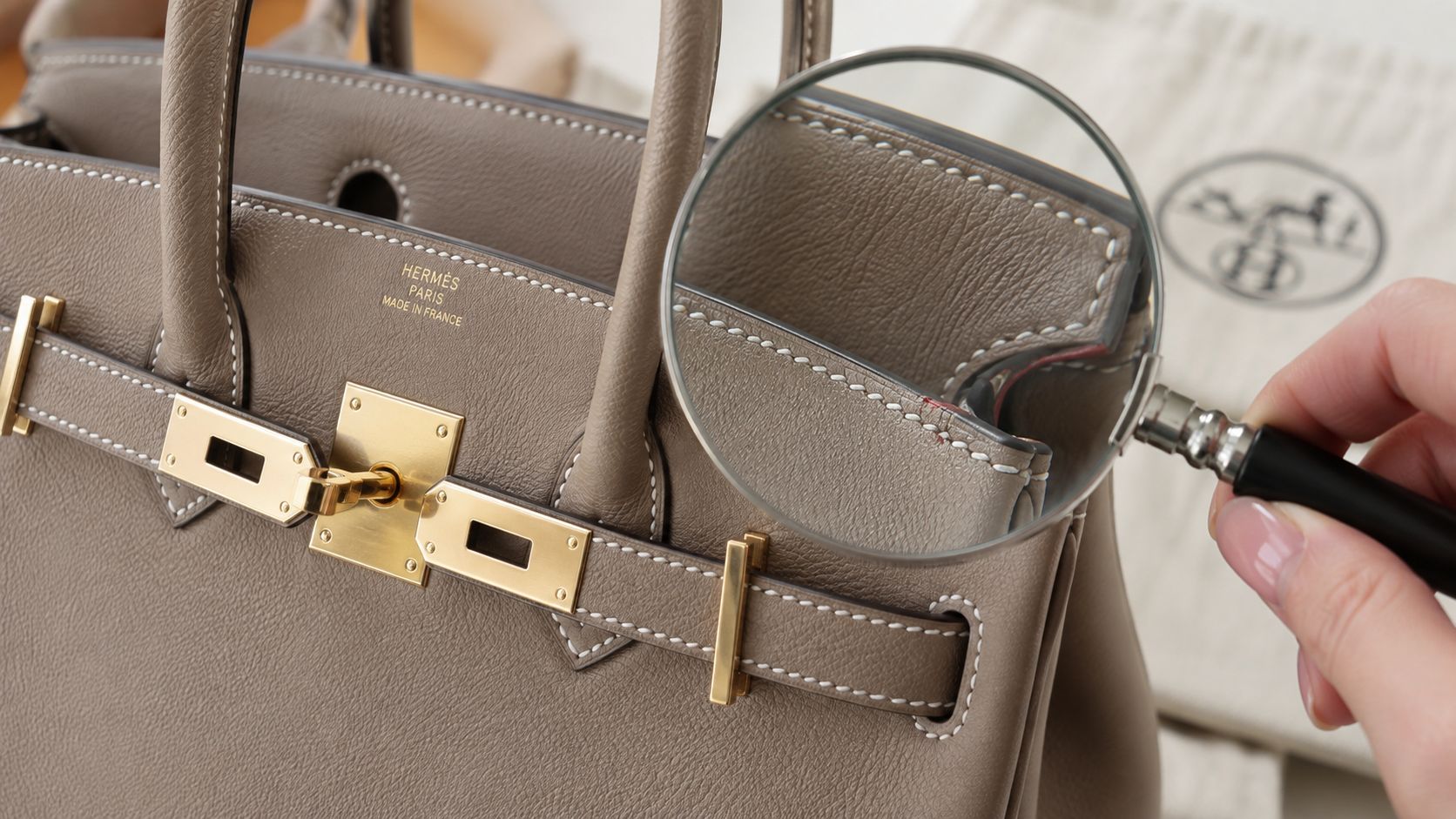
The best way to beat a superfake is to move from “looks real” to evidence-based comparison. That means checking the exact model against authenticated references, measuring dimensions, reviewing typography, and looking closely at engraving depth, embossing, and spacing. If a logo font is correct but the engraving is too shallow, the bag still fails.
What still gets copied, and what usually gives the game away
Counterfeiters can often reproduce a brand mark, a serial label, or a dust bag closely enough to pass a casual glance. They struggle more with consistency across the whole item. A fake may have the right outer look, but the hardware finish, interior formatting, and construction tolerances drift just enough to expose it.
A bad habit is over-weighting a single detail. A serial number by itself doesn't prove anything, and packaging definitely doesn't. Industry guidance notes that fake sellers can reproduce boxes, cards, and dust bags, so those pieces should be treated as support, not proof.
Better verification methods for high-risk purchases
When the bag is expensive, rare, or coming from a questionable channel, the smarter path is to use more advanced verification steps:
Video proof: ask for a live walkthrough that shows all angles, pockets, zippers, and interior marks.
Model-by-model comparison: match the bag against authenticated examples of the same version, not just the same brand.
Measurement checks: compare dimensions and proportions to official product references.
Typography review: inspect font shapes, spacing, and alignment on stamps and interior markings.
Third-party authentication: bring in a specialist if the bag is high value or still leaves doubt.
For sellers comparing selling platforms, authentication fees, and payout speed, this detailed handbag platform comparison is worth reading before you commit to a channel. The core idea is simple, superfakes beat lazy checking, but they don't beat disciplined comparison.
When to Seek Professional Authentication
If a bag produces mixed signals, stop treating the problem as a confidence test. Professional review is the right move when multiple details disagree, when the bag came from a risky source, or when the financial downside of a mistake is high. That's especially true for vintage pieces, where provenance is unclear and era-specific details matter.
The most obvious red flags are inconsistent serial numbers, poor-quality materials, suspicious pricing, unusual seller behavior, and missing provenance. A bag that seems cheap, feels off in the hand, or comes from a source that won't answer direct questions deserves a second set of eyes. That applies even when the logo looks clean.
What experts check that most buyers don't
Professional authenticators often go beyond the standard visual review. They may use magnification to study stitching and embossing, UV light to look at hidden markings, and database cross-referencing to compare the bag with known examples or brand formats. They're not just looking for one flaw, they're checking whether the item behaves like a genuine bag from that model and era.
If the item survives your inspection but still doesn't feel right, don't force a verdict.
That caution matters because cost and risk don't scale evenly. A small authentication fee can make sense on a modest purchase, but it becomes much more important when you're dealing with a rare Chanel, Hermès, or Louis Vuitton piece, or anything you plan to resell later.
What to ask before you pay for a service
Choose a service that gives you a clear written result, explains what it reviewed, and doesn't hide behind vague language. Ask whether the review includes photographs, magnified inspection, and model-specific comparison. For a broader view of what an independent professional appraisal process can look like, this guide to independent jewelry appraisal is a useful reference point, even if your item is a handbag rather than a ring or watch.
When the bag is valuable, uncertainty is expensive. Professional authentication is the safer decision when the evidence isn't clean.
Selling Authenticated Designer Bags with Confidence
Authentication doesn't just protect buyers, it also improves the selling process. A bag that's properly checked, well documented, and presented with clear condition details earns more trust from serious buyers. That trust matters because buyers pay for confidence, not just brand names.
Condition still drives the offer, so scratches, corner wear, hardware loss, and interior damage all affect resale. Documentation helps too, especially when it supports the model, era, and provenance. The cleaner the history, the easier it is for a buyer to evaluate the bag without hesitation.
Trusted buyers make the process simpler by combining authentication verification with a market-based offer. For owners in Atlanta, Buckhead, Sandy Springs, Alpharetta, Roswell, Brookhaven, Midtown Atlanta, and across Georgia, an in-person review can be the fastest way to get clarity on what the bag is worth. Remote clients can also benefit from secure mail-in options when they can't visit locally.
If you're planning to sell an authenticated designer bag, the best outcome usually comes from transparency, not pressure. A professional evaluation, clear condition notes, and a buyer who understands current resale demand will usually produce a smoother transaction than a quick private listing.
Antwerp Diamond Store offers that kind of evaluation process for luxury handbags and other high-value pieces. If you want a discreet review of a Chanel, Hermès, Louis Vuitton, or another designer bag, bring it in for an in-person assessment or request a remote evaluation. Visit Antwerp Diamond to start with a confidential consultation and get a professional opinion before you sell.


