

You've inherited a ring, found an old chain in a drawer, or received a gold offer that seems lower than expected. The first step in determining gold purity is reading the hallmark, but a stamp alone doesn't prove that the entire item is solid gold. For a dependable answer, compare the mark with a careful physical inspection, use home tests only for screening, and escalate valuable, unusual, plated, hollow, or disputed pieces to professional testing.
Table of Contents
Understanding Karat and Fineness
Karat divides gold into 24 parts. Fineness expresses gold content in parts per thousand. The two systems describe the same material in different formats, so a reliable purity check starts by converting the mark into a percentage.
Karat | Fineness mark | Gold content | Typical trade use |
|---|---|---|---|
24K | 999 or 1000 | 99.9% to effectively pure gold | Bullion and high-purity pieces |
22K | 916 | About 91.6% gold | High-purity jewelry and coins |
20K | 833 | About 83.3% gold | Recognized jewelry fineness |
18K | 750 | 75.0% gold | Fine jewelry, settings, and luxury watches |
14K | 585 or 583 | About 58.3% to 58.5% gold | Durable everyday jewelry |
9K | 375 | 37.5% gold | Lower-karat jewelry in markets where recognized |
The World Gold Council's guide to gold jewelry purity lists widely recognized levels including 9K, 14K, 20K, and 24K. In India, BIS formally permits hallmarking for six common levels, including 14K, 18K, 20K, 22K, 23K, and 24KS. In trade conversations, people often use fineness and purity interchangeably, although fineness is technically the marking system and purity is the gold proportion.
Pure gold is rarely chosen for prongs, clasps, hinges, or thin chains because it's comparatively soft. Manufacturers mix gold with metals such as copper, silver, zinc, or nickel to improve hardness, durability, color, and workability.
Practical rule: Treat the hallmark as your starting benchmark, not your final conclusion.
A mark can also be rounded or subject to local legal tolerances. If you're comparing a stamped 14K piece with an XRF result that isn't exactly the same figure, the difference needs interpretation rather than an immediate accusation of fraud. For a useful explanation of how karat levels affect jewelry, see this guide to the difference between 14K and 18K gold.
Reading Hallmarks and Stamps Correctly
That 14K stamp on a chain does not prove every link is solid. Start with bright light and a loupe or phone macro setting, then inspect the places where manufacturers usually hide marks while keeping them accessible:
Rings: Check inside the band.
Chains and bracelets: Examine the clasp, end tab, and nearby links.
Earrings: Inspect the posts and backs.
Watches: Look inside the case, around the bezel, on the bracelet clasp, and on removable links.
Numbers such as 375, 585, 750, 916, and 999 indicate fineness. A separate maker's mark may identify the manufacturer or sponsor. Formal Commonwealth-style hallmarks can also include an assay office mark and a date letter, although systems vary by country and period.
A stamped 14K or 18K mark is useful evidence, not forensic proof. Counterfeit punches are readily available, and a plated item can carry a genuine-looking mark while exposing base metal at worn edges, clasp components, or other high-friction areas. A hollow piece may also bear a legitimate karat stamp while containing far less gold by weight than a solid piece.
Gold-filled construction requires separate judgment. It has a bonded gold layer but is not solid gold throughout. A hallmarked item with plating, hollow sections, or alloyed components can therefore pass a visual inspection while failing a test on the underlying metal. DIY results become unreliable when the mark and the construction do not agree, so a specialist should examine it before you rely on the stamp.
Even a well-marked 14K solid gold Figaro chain deserves inspection at the clasp and links. Solder, repairs, hollow sections, and replacement components may test differently from the chain's main body.
At-Home Tests Compared
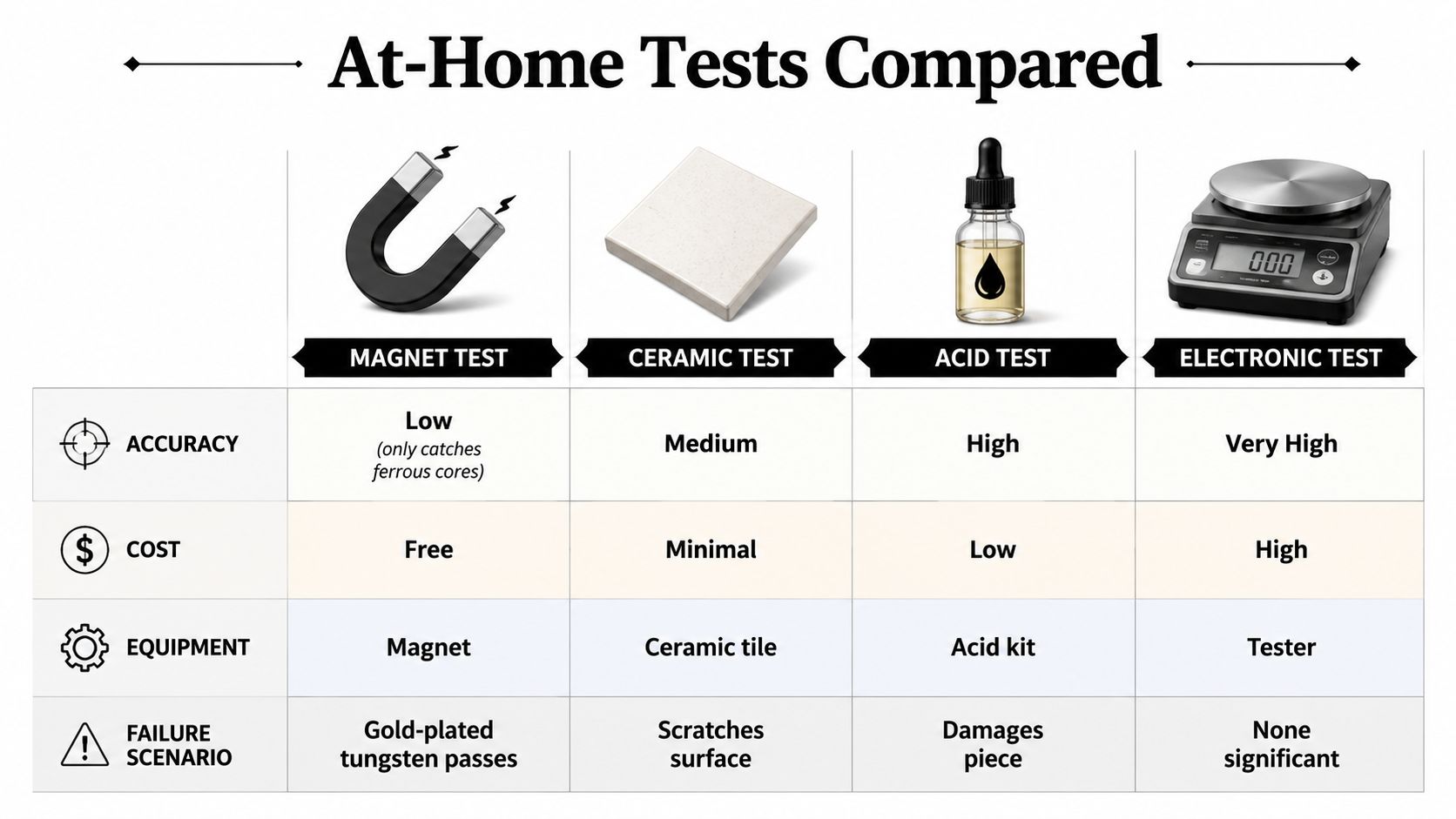
Home tests answer different questions, and each has a clear failure point. A magnet may expose a ferrous core, while acid can estimate karat only where the metal is tested. Neither method confirms that a complicated piece is solid, genuine throughout, or uniformly alloyed.
Magnet and float tests
Gold does not attract an ordinary magnet, making this a quick first screen. A strong reaction suggests iron or another magnetic core. The result remains only a warning. Gold-plated tungsten can pass the magnet test, and many non-gold metals are nonmagnetic. Plating can therefore hide a magnetic base beneath a gold-colored surface.
The float test provides another rough signal. Pure gold sinks in water, but tungsten-filled pieces can sink as well. Sink-or-float testing cannot provide a karat reading, identify plating thickness, or reveal hollow construction. Use it to question an item, not to confirm it.
Ceramic and density checks
Rubbing metal across an unglazed ceramic tile can leave a streak. Real gold generally leaves little or no dark mark, although soft, lower-karat alloys can smudge and make the result difficult to interpret. The tile also scratches the item, so avoid it on finished jewelry, heirlooms, or delicate surfaces. Plated pieces create another failure point because the streak may reflect the exposed layer rather than the core.
Specific gravity offers more information when the item is simple, solid, and free of stones. Weigh it in air, weigh it while submerged, and compare the calculation with gold's known density of about 19.3 g/cm³. Published ranges include roughly 19.13 to 19.51 for 24K, 17.45 to 18.24 for 22K, 14.84 to 16.12 for 18K, and 12.91 to 14.44 for 14K in APMEX's specific gravity reference.
Hollow chains, mounted gemstones, porous material, trapped air, and inaccurate scales can distort the calculation. A hollow piece may show a lower density even when its outer surface resembles high-karat gold. Layered or filled construction is a clear reason to seek specialist verification.
Acid testing
For many uncomplicated items, touchstone testing is the most useful DIY option. Scratch the item on a testing stone, then apply acid matched to the target karat to the streak. If the mark remains gold-colored, the tested spot is at least that karat. If it dissolves or changes color, it is below the acid level used, as explained in this practical gold acid test guide.
The trade-off is damage and risk. Nitric acid is corrosive and requires suitable eye and skin protection. It also damages the scratch point. Thick plating can produce a false positive if the scratch does not reach the lower-value core, while solder, repairs, and alloyed components may react differently from the main body. Do not apply acid casually to finished jewelry or pieces you intend to preserve.
DIY testing suits preliminary sorting when an item is plainly marked, simple, solid-looking, and low risk. Stop relying on home results when tests disagree, the piece is valuable, or its construction is hollow, plated, layered, or set with gemstones, enamel, or pearls. A marked 24-carat gold ring should not be scratched or exposed to acid merely to confirm what professional equipment can assess more carefully.
Professional Methods for Accurate Purity
Professional verification relies mainly on X-ray fluorescence, or XRF, and fire assay. BIS guidance identifies both methods, and describes XRF as useful for rapid, nondestructive analysis while warning that it measures the surface and may not represent the average purity of the whole article. BIS guidance on testing old gold is particularly relevant when an item is old, unhallmarked, repaired, or being evaluated for trade.
XRF screening
An XRF analyzer reads the elemental response from the area examined. The operator should clean and flatten the test area where possible, then take readings at multiple locations. The method works best when the item is large and uniform enough for surface analysis.
Portable XRF was typically within 0.1% to 0.2% of fire assay for large, flat gold items, while small or irregular samples were reported as better than 0.5 percentage points in controlled comparisons, according to Thermo Fisher's comparison of portable XRF and fire assay. Curved surfaces, plating, soldered clasps, and layered construction can compromise the reading because the instrument sees only a thin surface layer.
Fire assay confirmation
Fire assay is destructive, but it measures bulk metal. The sample is weighed, processed through cupellation so base metals are removed, separated chemically, and weighed again as a gold bead. A technical explanation from the University of Technology Sydney describes why this bulk measurement is more suitable than XRF for certification or refinery disputes.
Fire assay remains the reference benchmark for gold analysis and is tied to ISO 11426:1997. Its accuracy is around 2 to 3 parts per ten thousand, or about 0.02%, under suitable conditions. That precision matters when a small purity difference changes the value of a bullion lot or a serious commercial transaction.
Method | Accuracy | Destructive? | Typical turnaround | Best use case |
|---|---|---|---|---|
Portable XRF | Strong for suitable, uniform surfaces, weaker for plated or irregular items | No | Rapid screening | Jewelry intake and multiple-point checks |
Fire assay | Reference method, around 0.02% under good conditions | Yes | Laboratory process | Certification and disputed bulk purity |
Acid touchstone | Useful spot estimate | Yes, at the scratch | Immediate | Simple, lower-risk screening |
Specific gravity | Useful when the item is solid and uncomplicated | No | Immediate | Plain pieces without stones or hollow sections |
A single documented laboratory confirmation can outweigh a series of informal home tests. If you need an independent jewelry appraiser, ask what testing method will be used and whether the result will be recorded in writing.
When DIY Stops Being Enough
The decision to seek professional help isn't only about the test itself. It's about whether an uncertain result could change the selling price, loan decision, insurance record, or ownership decision.
A practical trigger is intrinsic value. If one item may contain more than roughly $500 in melt value, or a collection may exceed $2,000, professional testing costs of roughly $25 to $150 per piece can be proportionate to the uncertainty. Those figures and thresholds are planning benchmarks, not guarantees of what a laboratory or buyer will charge.
Ambiguous results are another clear warning. Suppose an acid reaction suggests the item is at least 18K but another reaction fails at a different point, or an XRF reading varies sharply between the clasp and the body. That range is too broad for confident pricing, especially when the item might be sold as jewelry rather than scrap.
Certain construction types defeat consumer testing repeatedly:
Plated base metal: It may pass magnet and float tests because the core isn't magnetic and the exterior is dense.
Hollow chains: Air inside the structure can distort specific gravity.
Gold-filled jewelry: A substantial surface layer may pass a streak test without making the item solid gold.
Unfamiliar coins or bars: A mark from an unknown mint deserves independent verification before you rely on it.
Professional escalation also protects fairness. A specialist can separate purity, weight, gemstone value, condition, design, and market demand instead of treating every item as anonymous scrap. That distinction matters when you're selling, considering a collateral transaction, or comparing a cash offer with an online listing.
For residents of Atlanta, Buckhead, Sandy Springs, Alpharetta, Roswell, Brookhaven, Midtown Atlanta, and the wider Georgia market, a private appointment can also offer more discretion than evaluating valuable jewelry in a crowded public setting. Ask for the testing basis and calculation before deciding.
Practical Tips Before You Sell
Preparation prevents avoidable deductions and confusion. Begin by sorting pieces according to their stamped karat, then weigh each group separately. Mixing lower- and higher-karat jewelry makes it harder to understand the buyer's calculation and can obscure which pieces contribute most to the offer.
Photograph every hallmark before cleaning or polishing. Aggressive polishing can soften or erase a mark that helps establish authenticity, especially on antique jewelry. Keep receipts, certificates, earlier appraisals, and original box paperwork together. Signed pieces and named makers can have value above melt, so provenance may matter even when the metal content is already known.
Check a recognized live market feed before the appointment rather than relying on memory. The ECI Jewelers guide to gold market trends offers useful context for understanding why gold prices move and why the timing of a quote matters.
Use caution with testing:
Protect finished jewelry: Don't use acid on stones, pearls, enamel, or a piece you plan to keep.
Separate documentation: Bring copies or photographs where possible, and retain original records.
Request transparency: Ask the buyer to state purity, weight, deductions, and the calculation behind the offer.
Compare intelligently: Seek more than one specialist opinion when the item is valuable, unusual, signed, or disputed.
Avoid rushed decisions: Give yourself time to review the offer, particularly when a buyer proposes a loan or collateral transaction rather than an outright purchase.
The purpose of preparation isn't to force a particular price. It's to make sure you understand what's being tested and what portion of the value comes from metal, craftsmanship, stones, brand, or resale demand.
Getting a Fair and Confidential Appraisal
A credible appraisal verifies more than a karat stamp. Ask the specialist to document the metal type, fineness, gross and net weight, gemstones, maker's marks, condition, and construction, including whether the item is solid, hollow, filled, or plated. The report should also identify the testing basis, valuation date, and the type of value being stated.
For insurance, you generally need a replacement-value appraisal. For a sale or collateral discussion, request a realistic cash-value figure instead. These are different purposes, and a document prepared for one shouldn't automatically be used for another.
Before the appointment, photograph the item, record its approximate weight at home, and bring receipts, certificates, or prior valuations. Those documents help establish history, but they don't independently prove authenticity. Don't surrender an original document while the item is out of sight, and avoid sharing personal information that isn't necessary for the evaluation.
Antwerp Diamond can provide a confidential evaluation, but major financial decisions deserve comparison with an independent appraiser or second buyer. A trustworthy appointment should leave you with a written description, an explanation of deductions, and enough time to decide. Purity matters, but resale value also reflects weight, condition, design, brand, demand, and transaction costs. More detail on the process is available in this guide to how to appraise jewelry.
Bring your gold, jewelry, diamonds, or other luxury items to Antwerp Diamond for a confidential evaluation that considers purity, condition, authenticity, weight, and current resale demand. You can request an initial review or arrange a private Atlanta-area appointment, then decide whether a transparent offer suits your needs.