

Cartier watches generally retain about 60% to 90% of their original retail price, with most models trading around 65% to 75% of retail on the secondary market. The exact Cartier watch resale value depends far more on the reference, movement, material, condition, documentation, and selling venue than on the Cartier name alone.
You may be holding an inherited Tank, considering insurance for a Santos, or wondering whether a recent purchase will sell for enough to justify listing it. The retail price on your receipt isn't the number a dealer, auction house, or private buyer will use. Secondary-market buyers price the specific watch in front of them, including its originality, wear, service history, and proof of authenticity.
Cartier is a jewelry-house brand with serious horological heritage, but it doesn't behave exactly like Rolex or Patek Philippe. Its strongest resale pieces usually combine a recognizable design with broad wearability, mechanical appeal, and a large pool of willing buyers. The model matters first, then the configuration and condition.
If you're deciding whether to sell, insure, borrow against, or understand your watch, start with a realistic market range rather than an optimistic retail comparison. The broader question of whether luxury watches make sensible long-term purchases is also addressed in this guide to watches as investments.
Table of Contents
Setting the Stage for Cartier Watch Resale Value
A useful starting point is the brand-level picture. One WatchCharts market snapshot cited by Bob's Watches in its Cartier resale analysis placed Cartier's overall value retention at about minus 25% versus retail, which means the average watch traded at roughly 75% of its retail price. The same source describes a broader range of approximately 60% to 90%, depending on the model and condition.
That range is wide for a reason. A steel Santos with a mechanical movement attracts a different buyer from a small quartz Tank or a heavily jeweled fashion-oriented reference. A discontinued watch with an original dial and complete documentation can also command a very different offer from an identical-looking piece with replacement parts and no papers.
The five questions that establish value
Before you ask for an offer, identify:
The exact reference: Cartier collections contain multiple generations that look similar but trade differently.
The material: Steel, two-tone, gold, platinum, and gem-set configurations serve different buyer groups.
The movement: Mechanical watches generally have stronger collector liquidity than quartz entry models.
The condition: Case edges, crystal, bracelet, dial, and movement condition all affect buyer confidence.
The sales venue: A private sale may produce a higher gross price, while a dealer sale usually provides greater speed and simplicity.
Broad market data from Luxurist Hub's Cartier resale overview places typical Cartier resale around 75% of retail, with core steel dress and sports references often around 65% to 75% over a three-to-five-year hold. Quartz entry models can fall closer to 55% to 65%, largely because they compete with jewelry and fashion purchases rather than attracting the same mechanical-watch collector demand.
Practical rule: Treat the Cartier name as a foundation for liquidity, not as a guarantee that every reference will appreciate.
The right working framework is simple: verify the model, grade the watch accurately, assemble the documentation, check current comparables, and choose the venue based on your priorities. That approach produces a defensible estimate, whether you're preparing an insurance file or deciding whether to accept a dealer's offer.
Which Cartier Models Hold Value Best
The best Cartier resale performers usually aren't the most expensive pieces. They're the references with the broadest buyer appeal and the clearest identity.
Santos de Cartier leads the modern conversation, particularly in steel and mechanically powered configurations. The design is immediately recognizable, the watch works as a daily piece, and buyers understand its place in Cartier's history. Vintage and discontinued Santos Galbée references can also attract strong interest when the case, bracelet, and dial remain original.
The Tank Louis Cartier and Tank Cintrée occupy a more specialized position. Precious-metal Tank references appeal to dress-watch collectors who value proportion, design history, and rarity. They may not have the same everyday liquidity as a steel Santos, but an uncommon, well-preserved, discontinued reference can outperform a more ordinary current-production model.
A practical retention ranking
Collection / Reference | Typical Configuration | Retention vs. Retail |
|---|---|---|
Santos de Cartier, Santos Galbée | Steel, mechanical | Often among the stronger Cartier configurations |
Tank Louis Cartier, Tank Cintrée | Precious metal, mechanical or specialized references | Strong collector interest, reference-specific |
Pasha | Steel or precious metal, mechanical | Generally solid, with condition and size important |
Ballon Bleu de Cartier | Larger steel, mechanical | Steady demand, usually a modest discount |
Tank Must | Steel, often quartz | Recognizable and liquid, but typically discounted |
Entry quartz and fashion-driven pieces | Smaller sizes, quartz, decorative configurations | More depreciation and a narrower collector pool |
These are qualitative tiers, not promises for an individual watch. The market data cited by Luxurist Hub places steel Santos and Pasha models around 65% to 75% of retail over a three-to-five-year hold, while quartz entry models are often closer to 55% to 65%. Movement architecture and demand liquidity explain much of that gap.
Material deserves careful interpretation. Steel and platinum often perform better on a percentage basis because they reach more buyers, while solid gold can still command a higher absolute price despite a wider discount to retail. Limited editions, discontinued references, the Tank Cintrée Platinum, Calibre de Cartier models, and Cartier Paris Collection Privée pieces can carry meaningful premiums when authenticity and originality are beyond question.
The Ballon Bleu de Cartier remains easier to sell in larger steel sizes than in less common configurations. The Tank Must holds steady because the design is globally familiar, but quartz construction limits its appeal to serious mechanical-watch collectors. For owners researching inventory before a sale, used luxury watches for sale can provide useful context on how sellers present comparable Cartier pieces.
Cartier Resale Pricing Examples by Reference
Reference-level pricing gives a clearer resale picture than a brand-wide average. Separate retail prices, online asking prices, and completed private sales before setting an expectation. An advertised price shows what a seller wants, not what a buyer has paid.
The Tank Must large quartz on a strap makes the distinction clear. An August 2026 market guide from Enthuster lists a market price of about $3,009, versus roughly $4,400 retail. It also notes Chrono24 asking prices around $3,200 and a wider range of $2,600 to $4,000. Condition, completeness, seller reputation, and transaction type account for much of that spread.
WatchCharts Cartier market listings provide a second reference point. Cartier Tank private-sale prices typically range from about $2,021 to $10,203, while the broader Cartier resale market ranges from about $2,127 to $48,212. A Tank Must, a rare precious-metal Tank, and a limited reference belong to different pricing groups, so applying one formula will produce a poor estimate.
Cartier resale pricing by reference
Reference / Model | Approx. Retail (USD) | Typical Resale Range (USD) |
|---|---|---|
Tank Must large quartz on strap | Roughly $4,400 | About $2,600 to $4,000 |
Tank Must large quartz, cited market snapshot | Roughly $4,400 | About $3,009 market price |
Cartier Tank, private-sale market | Varies by reference | About $2,021 to $10,203 |
Cartier watches, broader resale market | Varies by collection | About $2,127 to $48,212 |
Use the figures as orientation, not as a valuation for your watch. Reference, material, dial, movement, and condition can place two watches from the same collection at opposite ends of the market. A desirable mechanical caliber, original dial, sharp case geometry, and complete papers support stronger buyer confidence. Quartz construction, heavy polishing, modifications, or missing documentation narrow the audience.
For a real sale, match the exact reference and configuration. Check completed examples where possible, then request offers from both dealers and private buyers. A dealer prices in authentication time, servicing exposure, acquisition risk, and the margin needed for resale. That offer is usually below a patient private-sale target because it pays for speed and certainty. A private sale can produce more money when the watch is desirable, well documented, and you can manage secure payment, authentication, and insured shipping. Choose the dealer offer when reducing risk and waiting time matters more than the maximum possible price.
How Condition, Provenance, and Servicing Move the Price
A strong reference can still receive a weak offer if the watch has been over-polished, modified, poorly serviced, or separated from its supporting documentation. Buyers pay for confidence. Every unresolved question creates a negotiation advantage for the buyer.
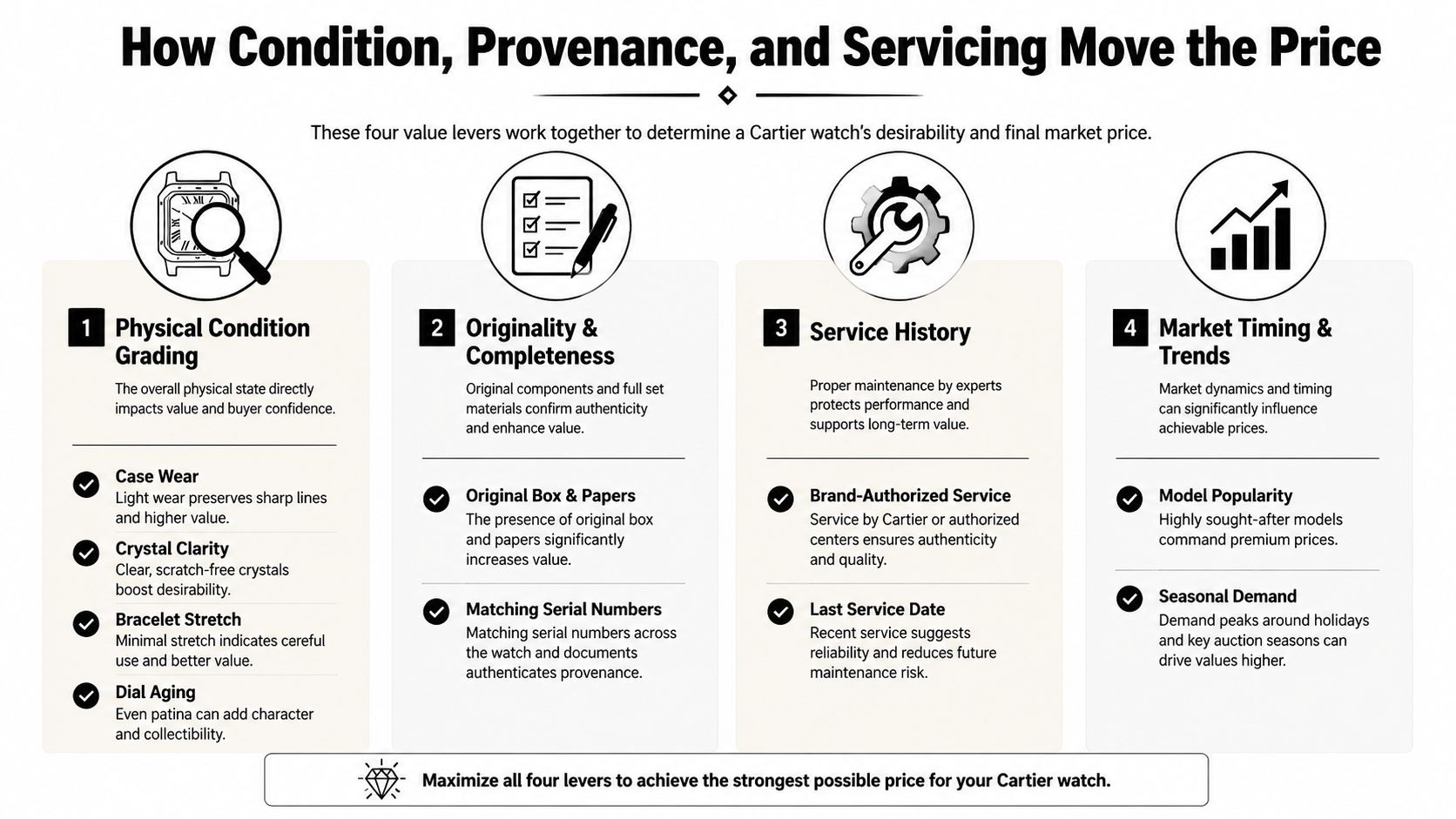
Four value levers to inspect
Physical condition comes first. Inspect the case for deep scratches and softened edges, the crystal for chips or haze, the bracelet for stretch, and the dial for moisture damage or aging. A clean, original case usually appeals more than a freshly polished case with rounded geometry.
Originality and completeness matter just as much. Correct hands, a period-appropriate dial, matching serial numbers, the original bracelet, spare links, box, warranty card, and service documents all make authentication easier. A watch-only Cartier can still sell, but it won't be evaluated the same way as a well-documented full set.
Service history reduces uncertainty. A recent Cartier service record or credible watchmaker documentation gives a buyer evidence that the movement has been inspected. Missing service history isn't automatically fatal, but a wet movement, damaged caliber, or unexplained repair can materially reduce an offer.
Provenance and market timing can help at the margin. A clear purchase record, single-owner history, or boutique documentation can support buyer confidence, but provenance only adds value when it can be verified. Do not pay for a story that cannot be documented.
Prepare the watch before requesting offers
Use this checklist:
Photograph the dial, caseback, clasp, crown, bracelet, and every visible mark.
Record the reference, serial number, caliber, case material, and approximate case size.
Gather the original box, warranty card, purchase receipt, extra links, and repair records.
State whether the watch has been polished, modified, refinished, or fitted with replacement parts.
Ask whether the prospective buyer will authenticate and inspect the movement before finalizing an offer.
Avoid polishing the watch just to improve its appearance in photos. The guide to watch polishing costs explains why cosmetic work should be considered carefully, especially when it changes original case geometry.
Collector advice: Original wear is usually easier to explain than an aggressive polish that removes the lines buyers expect to see.
Condition, originality, papers, and service history compound rather than operate independently. A documented Santos Galbée with a sharp case and correct bracelet can sit in a much stronger position than an undocumented example with the same reference engraved on the caseback.
How to Estimate Your Cartier's Current Resale Value
Start by identifying the watch precisely. Look for the reference and serial information on the case and paperwork, then record the caliber, case material, bracelet or strap configuration, dial color, and case size. Similar-looking Cartier watches can have materially different market positions, so a collection name alone isn't enough.
Next, build a comparable set. Use completed or sold listings where possible, then compare the exact reference in similar condition. Chrono24 asking prices can show the current retail environment, while WatchCharts, eBay sold data, and auction archives from Phillips, Christie's, and Sotheby's can help reveal how different venues position comparable pieces.
A disciplined pricing process
Identify the exact watch: Match reference, caliber, material, dial, bracelet, and production details.
Check authenticity indicators: Review weight, hallmarks, movement caliber, serial number, and engraving quality.
Compare similar pieces: Separate full sets from watch-only examples and polished watches from original-condition examples.
Adjust for the selling channel: A dealer offer, private-sale target, consignment estimate, and auction result aren't interchangeable.
Set a net figure: Deduct expected seller costs, negotiation room, servicing exposure, shipping, and the buyer's margin where applicable.
The commonly used formula is:
Comparable average minus condition adjustment minus seller margin equals realistic net value.
For a steel Santos medium, your worksheet might look like this:
Factor | Example (Steel Santos Medium) | Adjustment |
|---|---|---|
Reference match | Exact medium steel Santos | Establishes the comparison group |
Condition | Light wear, sharp case, clear crystal | Positive relative to heavily worn examples |
Completeness | Box, papers, links, and receipts | Supports buyer confidence |
Service | Documented recent service | Reduces maintenance uncertainty |
Selling venue | Dealer, consignment, auction, or private sale | Changes speed, risk, and net proceeds |
Market conditions change, so don't rely on an old purchase price or a single listing. A professional appraisal is especially useful for insurance, estate documentation, or a precious-metal Pasha or Ballon Bleu where material, movement, and authenticity require close inspection. For a practical reference check, use this Cartier watch serial number lookup guide, then have a qualified buyer or horological appraiser verify the result.
Best Places to Sell a Cartier Watch
The right venue depends on what you value most. If you need funds quickly, accept that speed and convenience usually reduce your negotiating power. If you want the maximum possible price, prepare for more buyer screening, longer timelines, and greater transaction responsibility.
Venue | Typical Net Proceeds | Speed | Best For |
|---|---|---|---|
Independent watch dealer | Direct market offer, reduced by dealer margin | Fast | Owners prioritizing convenience |
Auction house | Gross result less commission and expenses | Slower | Rare, vintage, or highly collectible references |
Online consignment platform | Market-dependent, less direct control | Moderate | Sellers seeking broad reach |
Private sale | Potentially highest gross price | Variable | Patient sellers with trusted buyers |
Luxury asset buyer or collateral lender | Usually lower percentage for immediate liquidity | Very fast | Urgent cash needs, subject to terms |
Authorized Cartier boutiques generally aren't the normal destination for a pre-owned cash sale. They may be relevant when you're discussing a new purchase or a trade-in pathway, but an independent luxury watch buyer is typically more directly suited to evaluating a used Cartier.
An independent dealer offers a clear advantage: you can complete the transaction without creating a listing, managing messages, arranging escrow, or waiting for a buyer to trust an unfamiliar seller. The trade-off is that the dealer must leave room for authentication, service, inventory carrying costs, and resale profit.
When private sale makes sense
A private sale can beat a dealer offer when the watch has strong demand, excellent documentation, and a seller who can manage the process safely. You'll need to verify the buyer, use a reputable escrow arrangement, protect personal information, and document the watch's condition before shipment or handover.
Auction houses can be appropriate for rare Tank Cintrée, unusual vintage Santos, or other references with a collector audience. They also bring commissions and timing considerations, so a high hammer price doesn't automatically mean a higher net result.
For owners weighing a direct offer against consignment or private listing, this guide to selling high-end watches provides a useful framework. In Atlanta, Buckhead, Sandy Springs, Alpharetta, Roswell, Brookhaven, and Midtown Atlanta, an in-person evaluation can also reduce uncertainty around condition and authenticity. Greater Georgia sellers should choose a venue that explains the offer rather than presenting a number.
Common Misconceptions and Final Takeaways
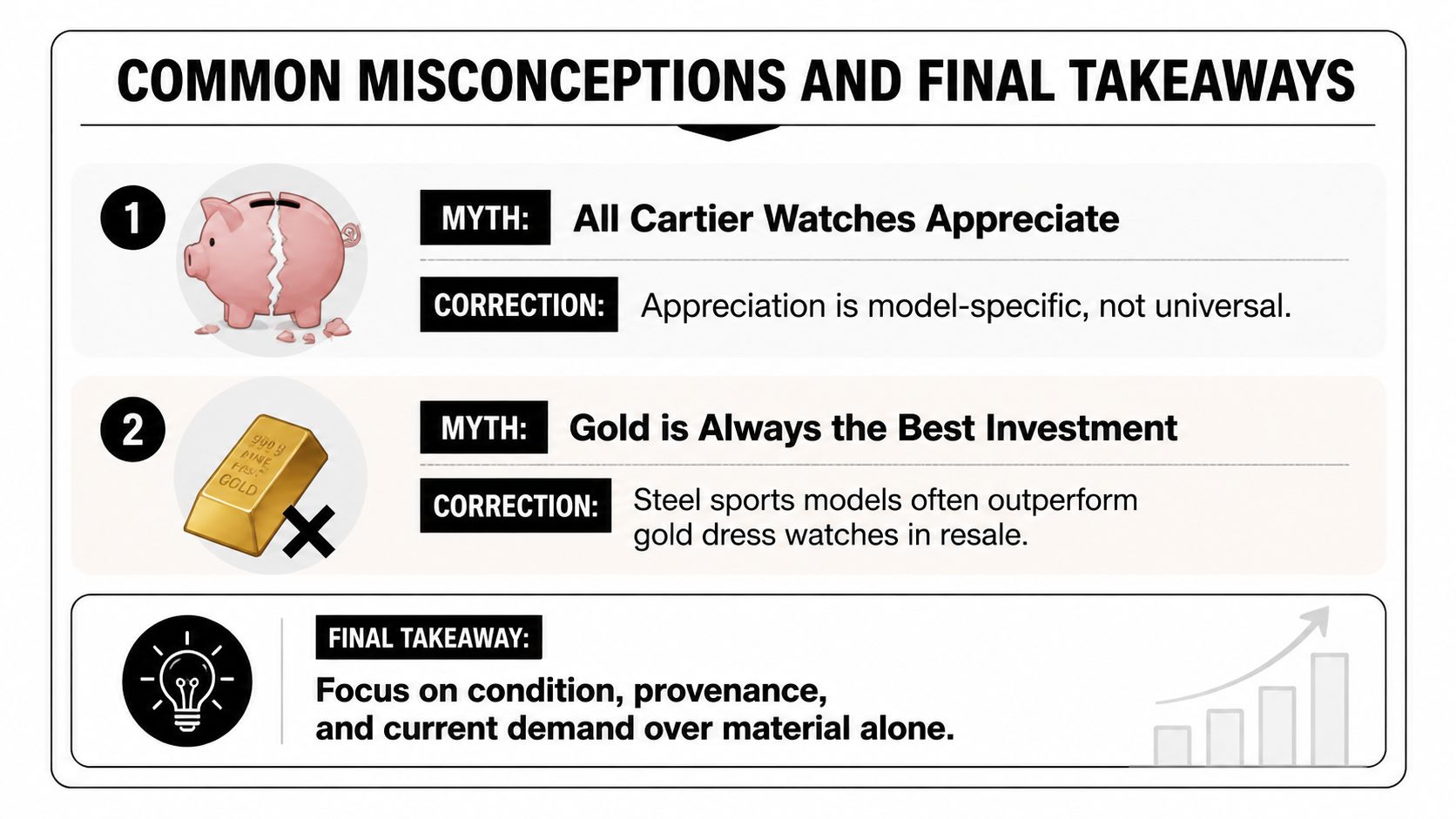
Cartier watches don't all appreciate. The brand's overall retention can be strong, but the result is reference-specific. A mechanically powered Santos or an unusual Tank may attract a deeper buyer pool than a small quartz piece, while a less sought-after configuration can sell at a substantial discount even when the watch is genuine and attractive.
Gold isn't automatically the better investment. Precious metal can support a higher absolute price, but steel mechanical models often have broader market liquidity and stronger percentage retention. Gold dress watches appeal to a narrower group, so buyers may negotiate more aggressively.
A full set helps, but it doesn't transform an ordinary reference into a rare one. Box and papers improve confidence and presentation, especially when serials and purchase records match, but the watch's reference, condition, originality, and demand remain the primary drivers.
Limited editions also require discipline. Scarcity can help, but a limited-production Cartier isn't automatically desirable. Collector interest depends on the design, production history, condition, and whether the piece has a credible market of buyers.
The final pre-sale checklist
Before listing or accepting an offer, verify the exact reference, movement, material, and serial number. Gather the box, papers, links, receipts, and service records, then compare the watch with recent sales of the same configuration. Photograph the condition accurately and disclose polishing, refinishing, replacement parts, or damage.
Use current demand to choose your timing, but don't chase hype. A clean, authentic watch with a defensible market comparison will usually outperform an inflated listing that ignores condition and asks buyers to accept unsupported claims.
Authentication protects both sides of the transaction. Modified dials, incorrect hands, replacement bezels, and counterfeit movements can create disputes after payment, so a professional inspection is worthwhile whenever the watch's history is unclear. If you're selling in the Atlanta area or elsewhere in Georgia, an in-person review can also help establish whether a direct sale, consignment arrangement, or private transaction fits your priorities.
Antwerp Diamond evaluates Cartier watches and other luxury assets by reviewing authenticity, reference, condition, documentation, and current resale demand, with options for online or in-person review. Visit Antwerp Diamond to request an evaluation or arrange a confidential appointment in the Atlanta area.