
A watch serial number lookup helps identify a watch's production history and is a key step in authentication. You'll usually find the serial engraved on the caseback, between the lugs, or on the movement itself.
Individuals often start looking up a watch serial number when they're trying to answer a practical question: Is this watch real, how old is it, what model is it, and what is it worth if I sell or appraise it? That's the right instinct. The mistake is assuming the serial number alone will give a complete answer.
In practice, a serial lookup is a filter, not a verdict. It can narrow the production era, help match a watch to known brand patterns, and flag inconsistencies. It can also send you in the wrong direction if you read the wrong engraving, rely on a weak database, or try to date a modern luxury watch whose serial no longer follows an old pattern.
Table of Contents
How to Find Your Watch's Serial Number
The first failure point in any watch serial number lookup is simple: people use the wrong number. On many watches, you may see a reference number, a case number, a movement number, or service markings. They are not interchangeable.
Start with the easy places
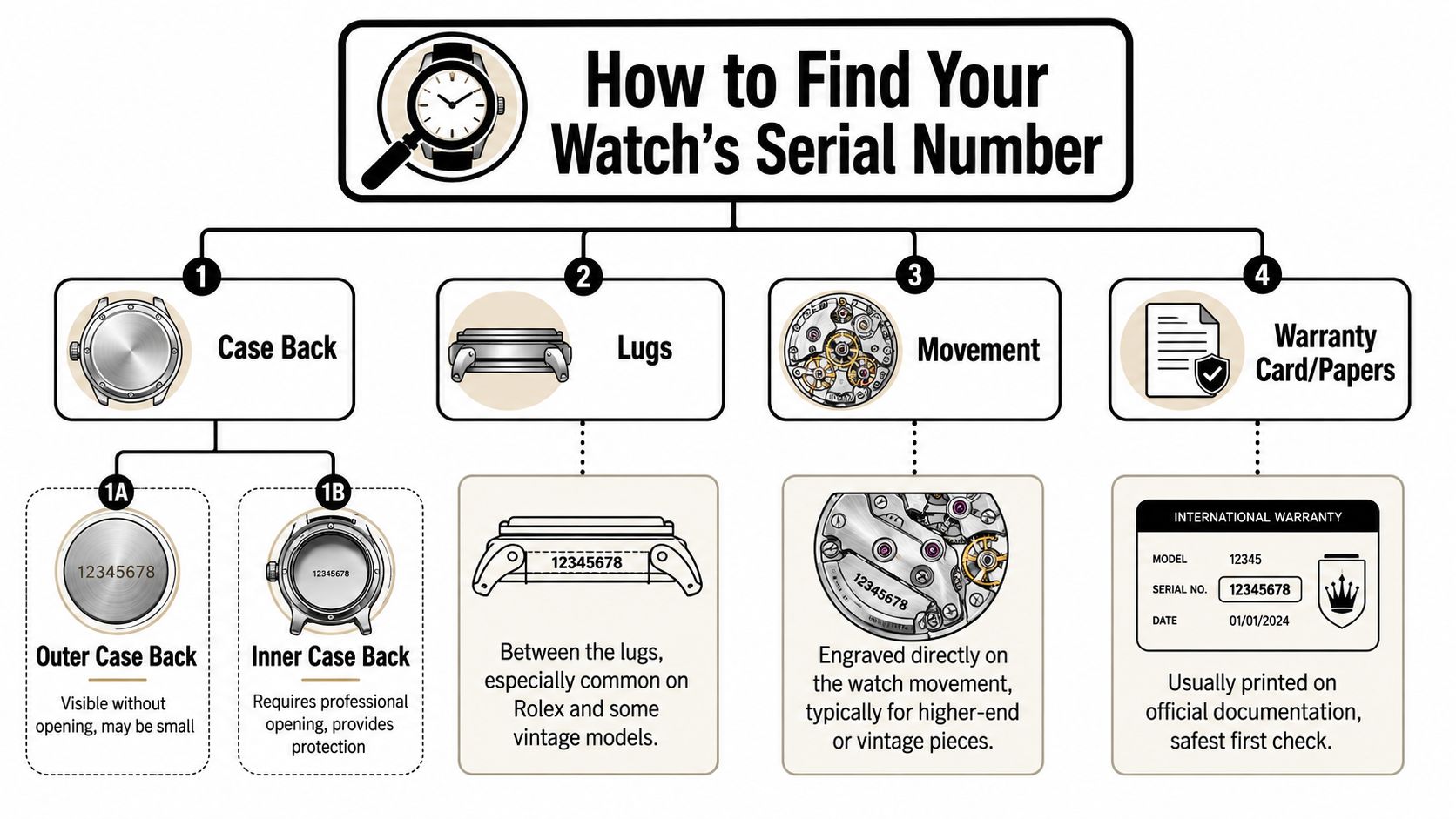
Check these locations first:
Caseback exterior: Many watches place identifying marks on the outside caseback. This is the safest first look because you don't need tools.
Between the lugs: This is especially important for Rolex and some vintage wristwatches. You may need to remove the bracelet to see the engraving clearly.
Rehaut or inner bezel area: On modern Rolex watches, the serial is often on the rehaut, the inner rim between the dial and crystal.
Movement: Older and higher-end watches often carry the most useful serial on the movement itself, which means the case has to be opened.
Warranty card or original papers: These can give you a clean first record to compare against the watch.
For modern Rolex, the placement matters. Rolex serial numbers are typically 4 to 8 digits, and for watches made in 2005 or newer, the serial is often engraved on the rehaut, while older watches usually place it between the lugs at the 6 o'clock side, as outlined in Bob's Watches Rolex serial number guide.
If you're checking a Rolex and want a broader authentication framework beyond the serial, this guide on how to know if your Rolex is real is a useful companion.
Practical rule: Write down every number you find before deciding which one matters. A good lookup starts with documentation, not assumptions.
Know the difference between case and movement numbers
At this point, people lose accuracy.
A case serial identifies the case. A movement serial identifies the movement. On vintage pieces, those numbers can both matter because one helps place the case and the other helps place the mechanism. If they point to different eras or don't line up with the expected brand pattern, that's a signal to slow down.
Use this quick field guide:
Marking type | Where you may find it | What it helps with |
|---|---|---|
Serial number | Case, lugs, rehaut, movement | Production identification, dating in some cases |
Reference number | Caseback, between lugs, papers | Model identification |
Movement number | On movement plates or bridges | Movement attribution, vintage verification |
Service marks | Inside caseback | Repair history clues, not primary serial data |
Collectors in Buckhead, Sandy Springs, and Alpharetta often bring in watches after trying to inspect them at home with improvised tools. That's risky. A scratched lug, bent spring bar, or slipped case knife can reduce buyer confidence fast, especially on vintage pieces where originality and case condition matter as much as the serial itself.
Using Online Databases and Brand Resources Safely
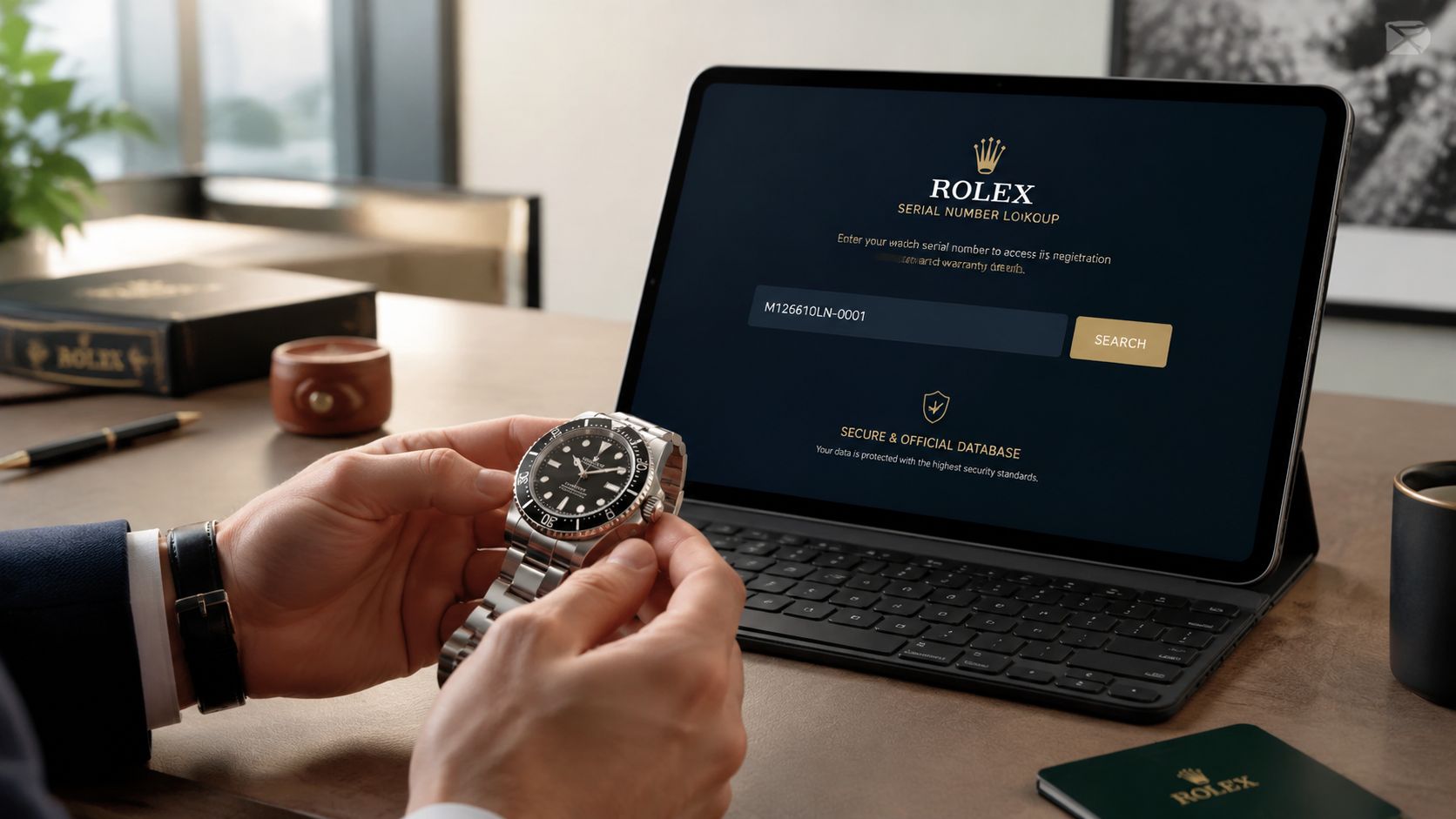
A watch serial number lookup only works if the source is reliable and the data entry is clean. The internet is full of pages that look authoritative but don't explain what their database can verify.
Which lookup tools are actually useful
There are two categories worth separating.
First, brand resources. If a manufacturer will help through customer service, archives, or service centers, that is usually the most authoritative route. It won't always be quick, and many brands won't disclose everything from a serial alone, but it's still the cleanest starting point.
Second, specialized third-party databases. These can be useful when they have a defined scope, especially for antique American watches and theft or registry checks. The issue isn't that third-party tools are always bad. The issue is that many general lookup sites don't explain their data source, match logic, or limitations.
A practical screen for trustworthiness:
Defined watch category: The site should state whether it covers modern luxury watches, antique pocket watches, or stolen-watch registration.
Transparent input rules: Good databases tell you how to enter the number.
No exaggerated promises: If a site implies it can prove authenticity from one quick search alone, be skeptical.
Clear identity matching limits: A responsible tool explains that multiple identifiers may be needed.
If you're comparing selling routes after your research, this overview of online watch buyers helps frame how lookup information fits into a real-world sale.
How formatting mistakes ruin lookup results
One of the most overlooked issues is data normalization. The Watch Register specifically requires users to enter each unique number in a separate field and omit prefixes such as “No.”, “Case”, or “Movement” so its system can match records correctly across identifier types, as explained on The Watch Register search page.
That sounds minor. It isn't.
If you combine a case number and movement number into one line, or copy the engraving exactly with prefixes and punctuation that the system doesn't use, you can miss a valid match. That's why a careful workflow beats a rushed one.
Enter every visible identifier separately, then compare the results. Single-number lookups often miss the strongest cross-check.
Before you submit anything, clean your notes this way:
Record the number exactly as seen in a photo.
Create a second plain-text version with prefixes removed.
Separate case, movement, and reference numbers.
Keep your bracelet, caseback, and movement observations together so you can compare the full picture later.
What a Serial Number Reveals (And What It Does Not)
A serial number can be powerful. It can also be overvalued. That's where many owners, especially first-time sellers, get tripped up.
What a serial can tell you
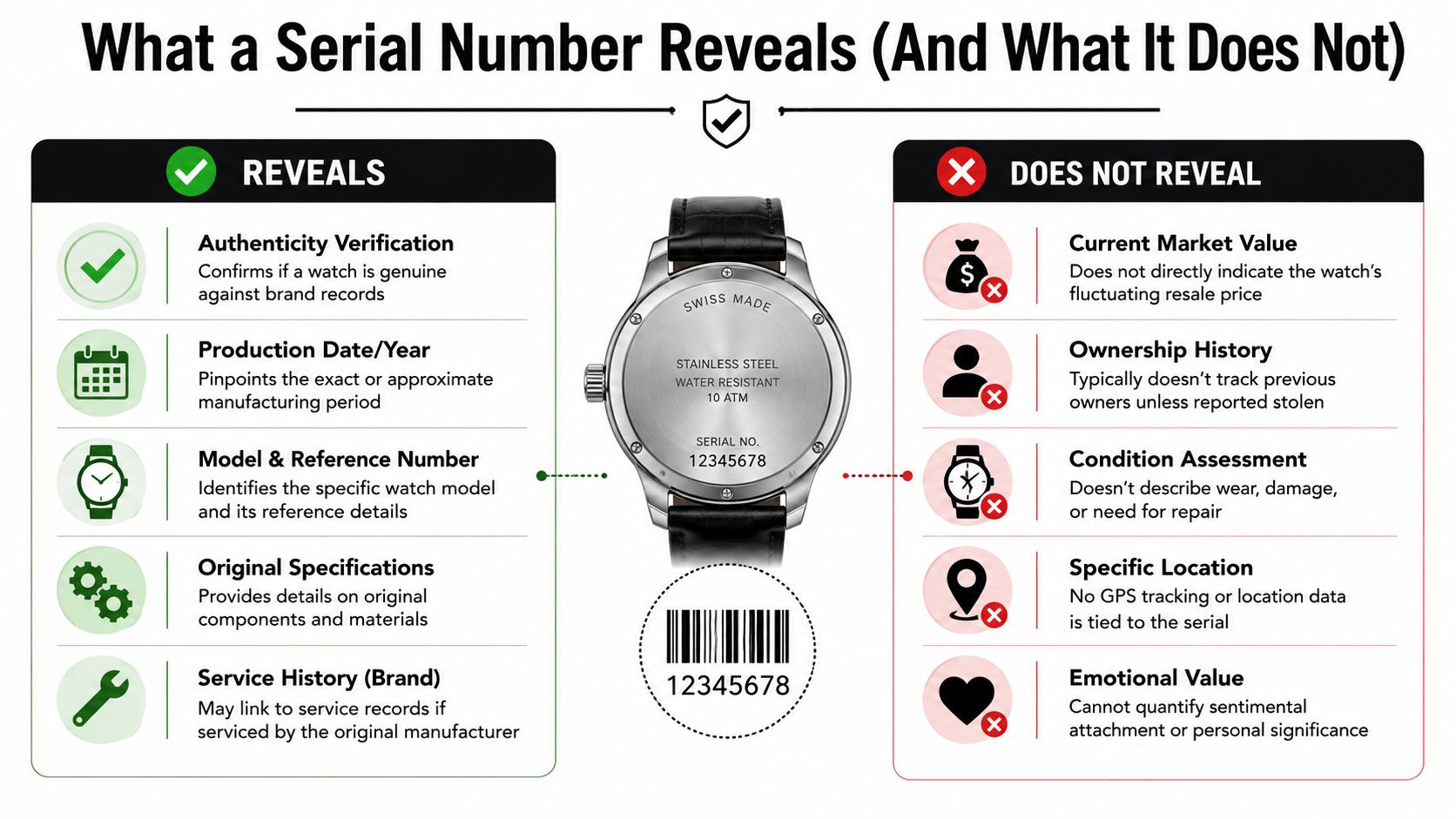
On the right watch, a serial lookup can help you establish:
Production era: This is especially useful on brands and periods where serials still map to known runs.
Consistency: The serial can support whether the watch, case, and movement appear period-correct.
Authentication support: It gives one more point of comparison during inspection.
Valuation context: Dating a watch correctly helps place it in the right resale lane.
For inventory shoppers and collectors, browsing used luxury watches for sale can also sharpen your eye for how production era, condition, and completeness affect pricing language in the market.
Where buyers get misled
The biggest modern misunderstanding involves Rolex. Since 2010, Rolex has used randomized serial numbers for new watches, making it impossible to date them by serial lookup alone. Verified industry reporting also notes a 40% increase in consumer queries about whether luxury watches can still be dated by serial number, which helps explain why this confusion keeps surfacing.
That means a serial may still identify a unique watch, but it no longer functions like an old date code. Many online guides still blur that distinction, and that leads owners to false confidence.
A matching serial is helpful. It is not a certificate of authenticity.
A serial number also does not tell you current market value by itself. It doesn't grade the dial, reveal polishing, confirm original hands, or show whether the bracelet is stretched or replaced. In Buckhead, Midtown Atlanta, and the greater Georgia resale market, those physical details can change buyer confidence more than the serial alone.
Special Considerations for Vintage and Antique Watches
Vintage watches don't follow the modern script. That's why so many owners of inherited watches get stuck at the first step.
Why older watches are harder to inspect
A family heirloom often arrives with a simple question: can you look up the serial number? Sometimes the honest answer is, not until the watch is opened safely.
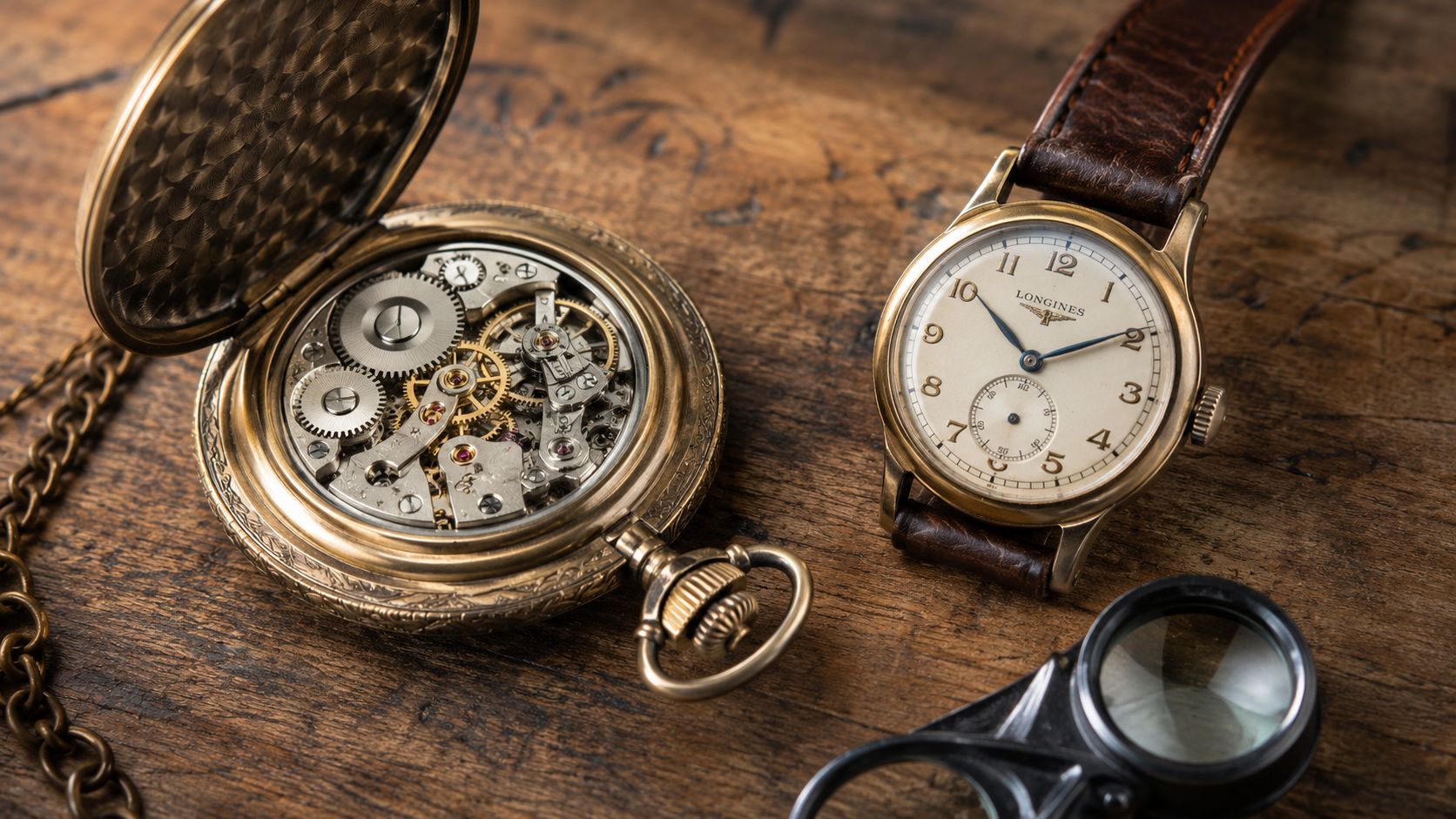
Verified horology community data notes that 60% of hard-to-find serial queries relate to vintage Omega and English watches, which reflects a real pattern in the trade. On many pre-1980 pieces, the useful serial isn't on the outside at all. It may be inside the case or engraved on the top plate of the movement.
That changes the workflow completely:
External inspection may not be enough
The watch may need professional opening
Movement and case identifiers may both matter
A phone flashlight won't replace a proper bench setup
Trying to pry open an older snap-back case without the right blade or support can scar the case, distort the back, or crack a crystal.
Older watches often hide their best identifying marks where untrained hands can do the most damage.
Collectors around Roswell, Brookhaven, and Atlanta regularly discover that the serial they found on the outside was only a case reference, not the number needed for a meaningful vintage lookup.
Pocket watches and hidden serial systems
Antique pocket watches are one area where serial lookup has become much more structured. The Pocket Watch Database aggregates serial information for American antique pocket watches including Elgin and Illinois, and horology discussions describe some archives as running to over 820,000 entries. That scale is why a loose movement can often be turned into a more clearly dated and attributable object.
Still, the same caution applies. A database result is only as good as the number entered and the part identified. If the movement is swapped, the case is recased, or the dial has been altered, the lookup is useful but not final.
If you're working with an heirloom or older collector piece, a dedicated guide to vintage watch valuation helps connect serial information to condition, originality, and resale context.
Next Steps After Your Serial Number Lookup
A successful watch serial number lookup gives you a starting point. It does not finish the job.
Turn lookup results into a real evaluation
Once you have the serial, bring together the rest of the facts that matter:
Reference and model details
Case, bracelet, and clasp condition
Dial originality
Movement condition and service signs
Box, papers, and warranty card
Current market appetite for that brand and configuration
That bundle is what an appraiser or buyer uses. The serial helps anchor the watch in time or at least in identity. The physical inspection decides how much confidence the market will place on it.
A useful outside comparison is this overview of the watch appraisal process in NYC, because the same core principles apply whether you're in Buckhead, Sandy Springs, Alpharetta, or elsewhere in Georgia.
When to stop researching and get hands-on help
If any of these apply, an in-person evaluation is the practical next step:
Situation | Why research alone falls short |
|---|---|
Hidden or internal serial | The watch may need safe opening |
Modern luxury watch with random serial | Dating can't rely on serial alone |
Mismatch between papers and watch | Physical review is needed |
Vintage heirloom with multiple numbers | Case and movement must be reconciled |
Planned sale or loan inquiry | Value depends on condition and originality |
That's usually the point where online searching stops being efficient. A trained set of eyes can tell whether the serial supports the story the watch is telling, or whether the story needs to be questioned.
Frequently Asked Questions About Watch Serial Numbers
Is the serial number the same as the reference number
No. The serial number identifies an individual watch or movement. The reference number identifies the model or configuration. You need both for a strong evaluation.
Should you share your watch serial number online
Be selective. Sharing it with a reputable service provider or evaluator is normal. Posting full serial details publicly on random forums or marketplaces isn't always wise, especially if you haven't verified the platform.
Does a matching serial number prove a watch is authentic
No. It supports authentication, but it doesn't complete it. A convincing fake can copy a plausible serial, and an authentic watch can still have replaced or incorrect parts.
Can pocket watches be looked up by serial number
Often, yes. In antique pocket watch collecting, serial lookup has become highly organized. The Pocket Watch Database covers American makers such as Elgin and Illinois, and some historical archives run to over 820,000 entries, which is why serial-based identification is especially useful in that segment.
Can I date any Rolex by serial number
Not every Rolex. Older examples may be dated by serial patterns, but newer ones can't always be dated that way because modern Rolex serials were randomized starting in 2010.
What if I find more than one number on the watch
That's common. Record them all, then separate them by location. A number on the case, inside the caseback, and on the movement may each serve a different purpose.
Is opening a vintage watch at home a good idea
Usually not. Many vintage watches hide the relevant serial inside the case, but opening them without proper tools can damage the case, crystal, or movement.
Does the serial number tell me how much my watch is worth
No. Value comes from a combination of identification, condition, originality, service history, and current buyer demand.
If you've reached the point where the serial number gave you part of the story but not the full answer, Antwerp Diamond is a practical next stop. Their team can review your watch in person or through a remote evaluation, help document the correct identifiers, and place the serial data in the context that matters for appraisal, resale, or a confidential offer.