

You're about to sell a diamond ring, luxury watch, or designer handbag, and the buyer asks for photographs, serial numbers, receipts, and shipping details. That paperwork is more than an administrative formality. Chain of custody documentation creates a time-stamped record showing what happened to the item, who handled it, where it went, and whether its condition changed.
If a buyer later claims that a ring arrived damaged, a watch was exchanged, or a handbag wasn't authentic, a clear record gives both sides something objective to review. Without it, the dispute may depend on memory and conflicting descriptions.
Table of Contents
A Realistic Custody Timeline From First Contact to Final Sale
Frequently Asked Questions About Chain of Custody Documentation
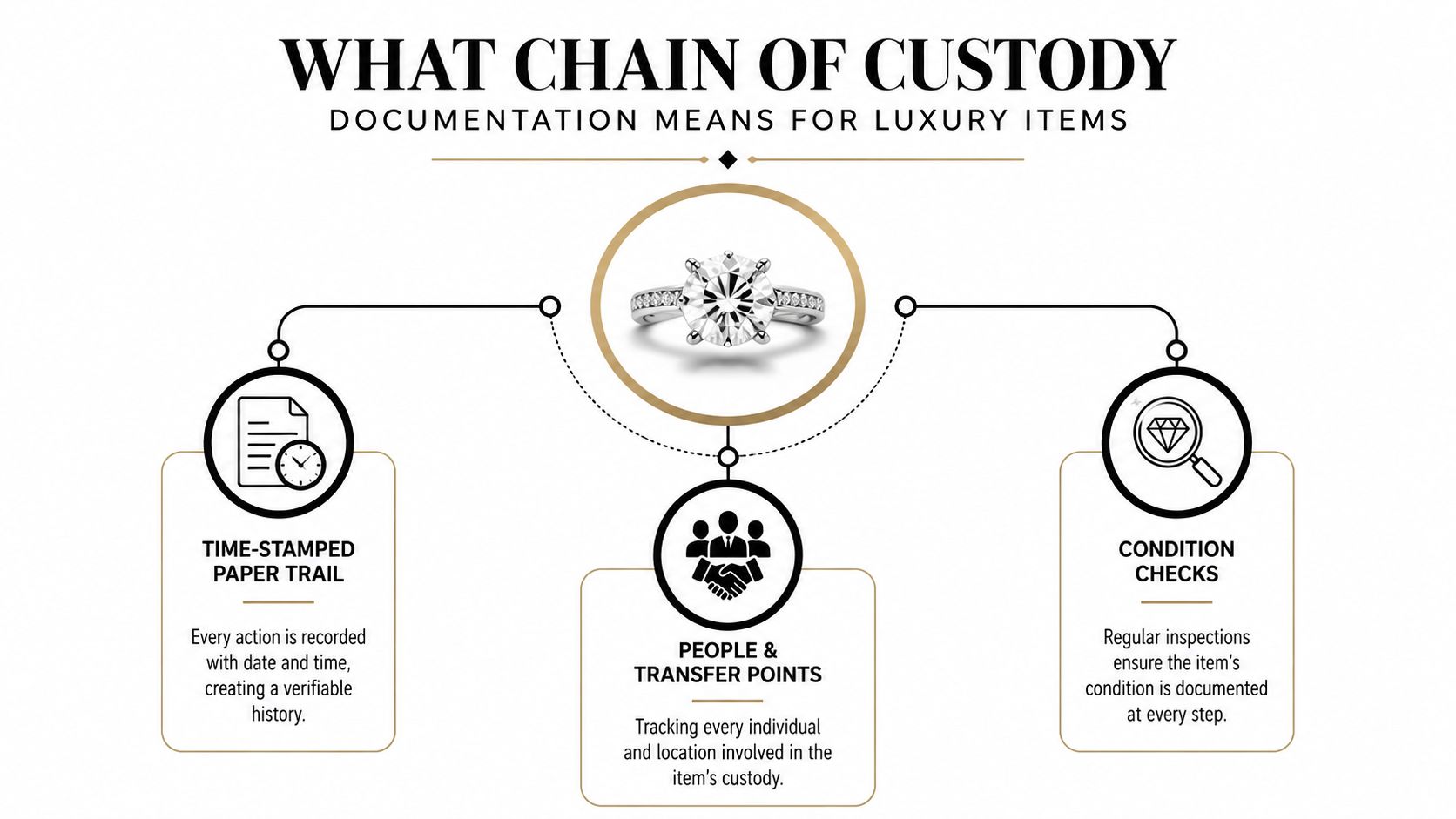
What Chain of Custody Documentation Means for Luxury Items
Chain of custody documentation is a chronological record of an item's identity, condition, location, handlers, transfers, and final disposition. Courts developed the concept for physical and electronic evidence because they need to know whether an item presented later is the same item collected earlier and whether anyone could have altered or substituted it. The National Institute of Justice describes it as the recorded way to verify where evidence traveled and who handled it before trial, beginning with details such as recovery location, date, time, description, condition, markings, packaging, and sealing. National Institute of Justice guidance on chain of custody
The same logic applies to a valuable ring, watch, or handbag. A 2-carat diamond ring can be identified by its grading report number, measurements, setting, hallmarks, and photographs. A Rolex can be tied to its serial number, reference, bracelet, dial, and condition notes. An Hermès handbag may be documented through its model, size, stamp, materials, hardware, accessories, and authentication records.
Why the record protects the seller
Suppose you mail a diamond ring to a buyer. You photograph the ring before packing it, note its condition, record the grading report number, use an insured carrier, and obtain a signed delivery confirmation. The buyer later says the ring arrived with a damaged prong.
Your record doesn't automatically decide the dispute, but it clarifies the timeline. It can show the ring's condition before shipment, the package details, the carrier transfer, delivery, and the point at which the buyer took possession. Without those entries, you may have no reliable way to separate pre-existing wear, shipping damage, handling damage, or an identification problem.
The chain should track the item from initial receipt through final disposition. Authoritative forensic guidance identifies details such as the evidence description, unique case identifier, collection location, storage location, custody holder, transfer purpose, actions performed, and dates and times. Forensic chain of custody principles
The overlooked custody window
Sellers often document the beginning and end but ignore the period in between. An item may sit in a reception area, move from a shipping desk to a vault, wait for intake, or pass between departments without a formal entry. Those temporary states can create the hardest questions if condition or authenticity is later challenged.
A useful shipping reference is this proof of delivery guide, which helps distinguish delivery confirmation from a complete custody record. Proof of delivery shows that a package reached a destination. Chain of custody documentation explains the broader journey.
Core Components of a Strong Custody Record
A strong record connects individual facts into one traceable file. A receipt identifies a transaction. A custody file identifies the item, documents its movement, and preserves evidence of its condition at each meaningful stage.
Take a 1.02-carat diamond ring submitted for evaluation. Its file might include the seller's name, a unique reference code, the GIA report number if one exists, photographs of the diamond and setting, the collection location, the ring's condition, the person receiving it, and the time of receipt. If the ring is shipped, the file should also connect the carrier label and tracking number to that same reference.
For a Rolex Datejust, the record may include the serial number, model or reference, dial and bracelet details, hallmarks where applicable, service documentation, box, papers, and photographs of visible wear. A handbag file may use the brand, model, material, size, date or production code where applicable, accessories, condition, and authentication documentation.
The fields that matter most
Field | What It Captures | Example (1.02ct Diamond Ring) |
|---|---|---|
Item identifier | The details that distinguish the item from similar pieces | Seller reference code, GIA report number, setting description |
Description | The item's physical characteristics | Round diamond in a white-metal solitaire setting |
Origin and location | Where the item was found or released | Seller's stated location and collection point |
Custodian | Who accepted or released the item | Seller and named receiving specialist |
Date and time | When collection, transfer, receipt, and inspection occurred | Recorded at each custody event |
Condition | Visible state before and after handling | Prongs, shank, stone, scratches, loose parts |
Packaging | How the item was preserved and sealed | Box, pouch, tamper-evident packaging, package identifier |
Transfer method | How the item moved between parties | In-person handoff or insured carrier with tracking |
Supporting documents | Provenance and valuation material | Receipt, appraisal, grading report, service invoice |
The record becomes useful when each line leads to the next. The photograph matches the identifier. The identifier matches the intake form. The intake form matches the purchase or evaluation paperwork. The shipping record matches the package and delivery event.
A related discussion of documented custody controls appears in this resource on legal requirements for ITAD. Although IT asset disposition involves different property, its central lesson transfers well to luxury goods: broad descriptions are weaker than item-specific records.
Keep appraisals, invoices, boxes, service records, and provenance letters together rather than scattering them across email accounts and drawers. For additional context on valuation paperwork, see how to appraise jewelry.
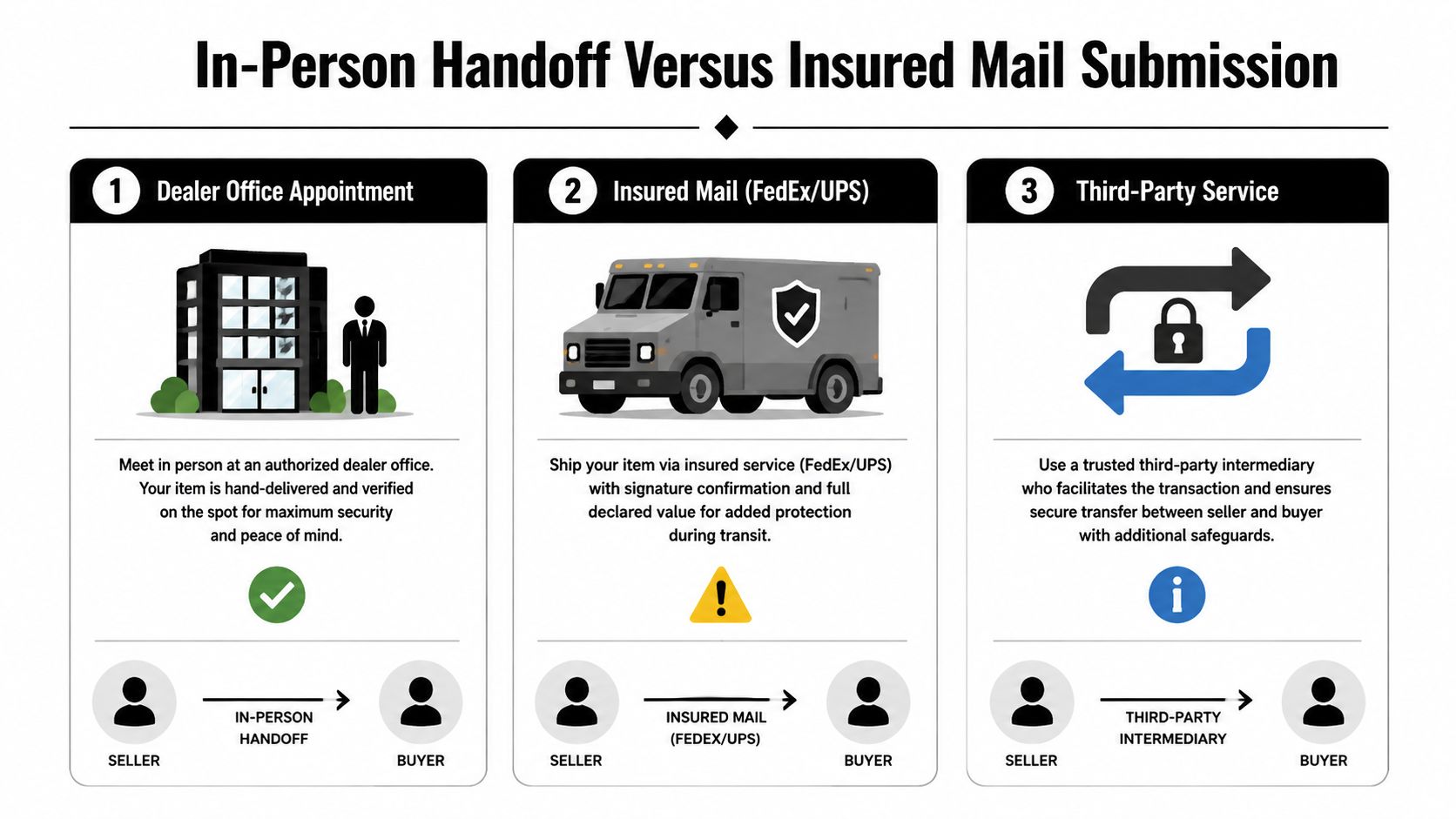
In-Person Handoff Versus Insured Mail Submission
The best transfer method depends on the item, the distance, its fragility, and the receiving party's process. No method creates a complete chain by itself. The documentation around the method determines whether the transfer is easy to reconstruct.
Dealer office appointment
An in-person appointment usually offers the clearest physical handoff. The seller brings the item, the receiving specialist examines it, and both parties can confirm the item description and condition at the same location.
The common gap is a missing acknowledgment. A seller may hand over a watch at a desk, leave with a verbal promise of follow-up, and never receive a dated intake confirmation. The record should identify the item, the person accepting it, the location, the time, and the purpose of the transfer.
Insured mail through FedEx or UPS
Insured shipping creates a useful external trail through the label, tracking history, package details, and delivery signature. EPA sample forms illustrate the mechanics of formal custody records, including date and time, releasing and receiving parties, signatures, storage conditions, and laboratory receipt. EPA sample chain of custody form
Shipping still introduces more custody points. The seller packages the item, a carrier accepts it, drivers and facilities may handle it, and the recipient signs for it. Unclear package contents, missing photographs, mismatched declared value, or a delivery record that doesn't identify the receiving person can weaken the file.
Third-party logistics services
Auction houses and other intermediaries may use specialized couriers or logistics providers. These services can be appropriate for complex movements, but sellers should ask whether every handler and temporary storage point appears in the record. A third party who physically handles the item but never appears in the documentation creates an unexplained window.
Practical rule: The more valuable, fragile, or dispute-sensitive the item, the more important it is to identify each transfer rather than relying on one final delivery receipt.
Use an in-person appointment when location is convenient and immediate inspection matters. Choose insured mail when distance makes an appointment impractical, but verify packaging, declared value, signatures, and intake confirmation. For a detailed preparation checklist, review this guide to insured shipping for jewelry.
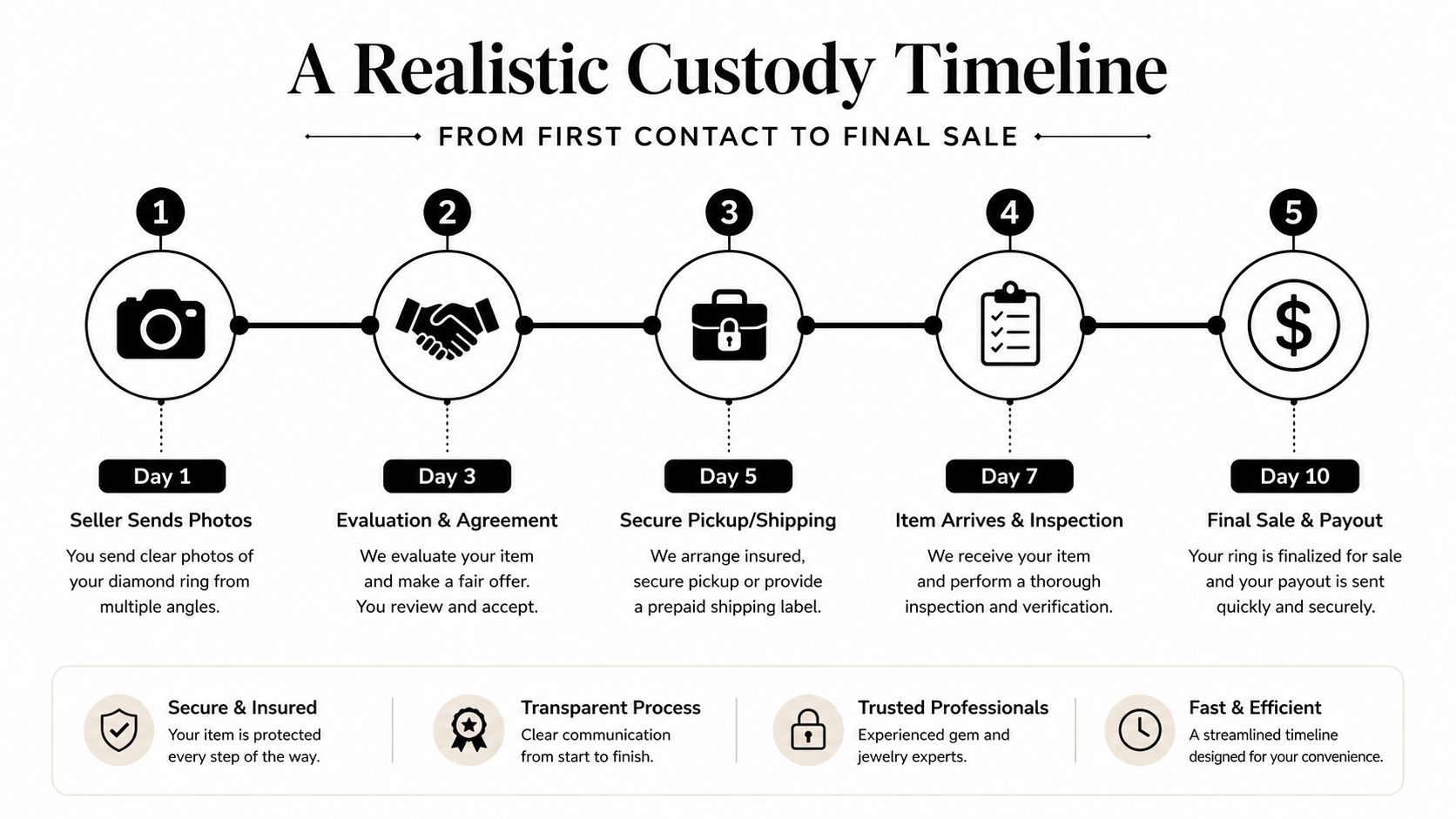
A Realistic Custody Timeline From First Contact to Final Sale
Consider a seller with an engagement diamond ring who is evaluating a sale remotely. The item's chain begins before a carrier collects the parcel. It begins when the seller first creates an identifiable record of what will be transferred.
The record grows with each event
On Day 1, the seller sends photographs, the ring description, and the available grading report number. The inquiry log should preserve the date and time, the seller's reference code, the images exchanged, and the documents attached.
On Day 3, the parties agree on the evaluation or purchase terms. A signed purchase order or written agreement records the item description, identifying information, agreed process, and any conditions that must be satisfied after inspection. It shouldn't replace the custody record. It should connect to it.
On Day 5, the seller hands the sealed package to the courier or carrier. The custody entry identifies the person releasing it, the person or carrier receiving it, the date and time, the package identifier, the tracking number, and the shipping method. The seller keeps photographs of the sealed parcel, label, and packaging.
On Day 7, the item arrives for intake. The receiving party records the package condition, opens it under controlled procedures, weighs and photographs the ring, and compares it with the original description. The intake form should note any discrepancy, including a damaged seal, changed condition, missing accessory, or mismatch between the item and its supporting report.
Inspection and completion
The internal grading or evaluation report follows. It documents the specialist's observations, including condition, authenticity indicators, gemstone characteristics, metal details, brand or model information where relevant, and any limitations on the examination.
If the buyer approves the item, a transfer authorization records the change from evaluation custody to sale custody. The settlement receipt then closes the commercial portion of the record by identifying the item, the recipient, the payment method, and the completion date.
This type of row-by-row chronology helps a seller understand where the record starts, where custody changes, and which document closes each stage. The guide to selling jewelry online offers related preparation ideas for sellers who begin the process remotely.
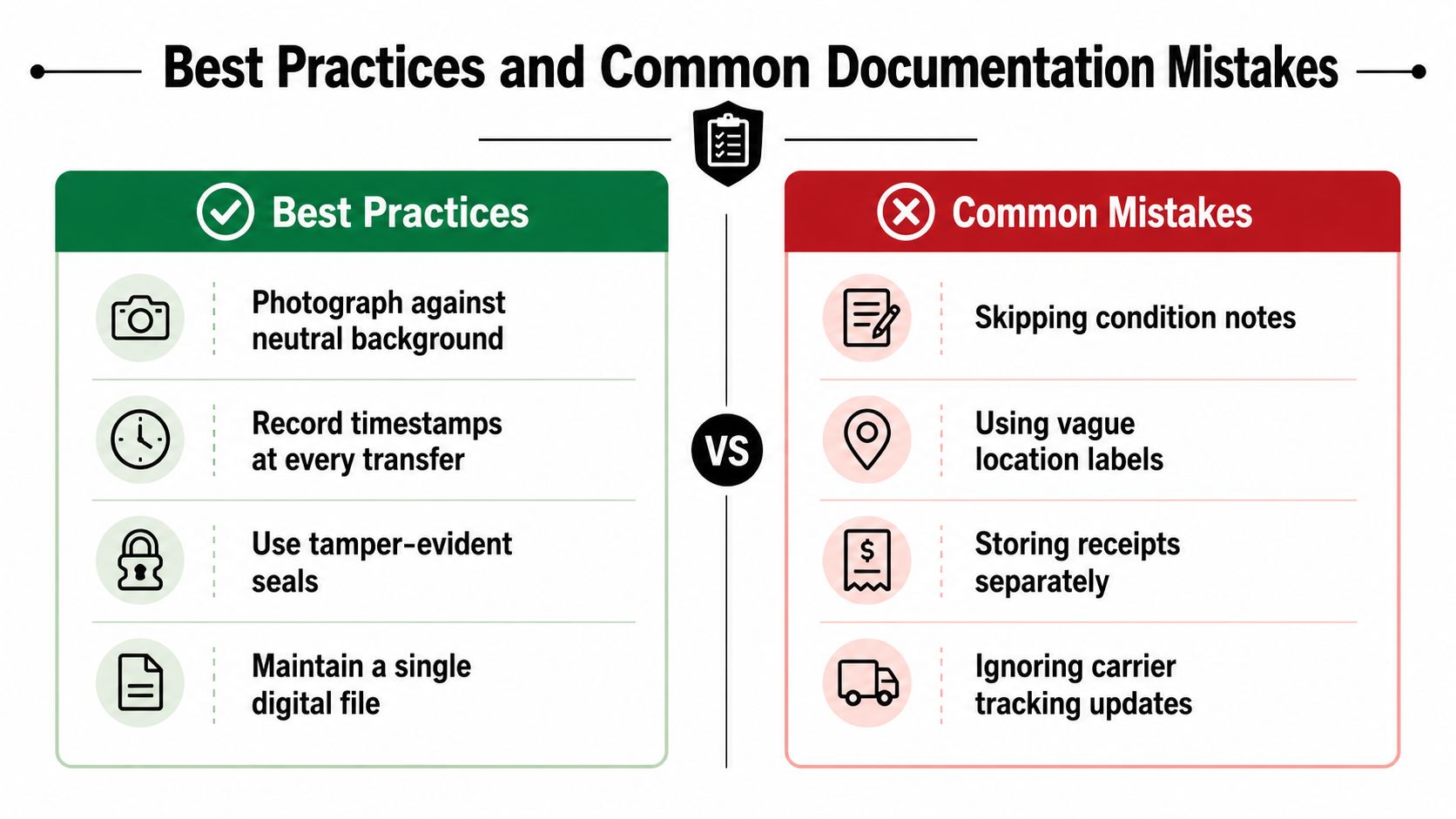
Best Practices and Common Documentation Mistakes
A seller doesn't need a complicated legal form to create a useful custody file. The seller needs specific identifiers, consistent condition records, and a documented entry whenever responsibility changes.
A practical preparation checklist
Photograph the item clearly: Use a neutral background and capture the full item, identifying marks, hallmarks, serial numbers where visible, gemstone details, and existing wear.
Write down identifiers: Record the diamond report number, watch serial and reference details, handbag codes where applicable, metal marks, measurements, and distinctive features.
Record condition before movement: Note scratches, loose stones, worn edges, missing accessories, bracelet sizing, clasp condition, and any existing repair.
Use controlled packaging: Seal the package in a way that makes interference easier to detect, and retain photographs of the sealed parcel.
Confirm every handoff: Record the releasing person, receiving person, location, date, time, package identifier, and purpose of transfer.
Keep a single digital file: Store scans, photographs, receipts, tracking information, intake confirmations, and messages under the same reference code.
Reconcile value descriptions: Check that the carrier's declared value and the transaction paperwork describe the same item and agreed value basis.
Mistakes that create avoidable gaps
A verbal description such as “gold watch with papers” won't distinguish one watch from another. A missing time zone can make a timestamp harder to interpret when parties operate in different locations. A photograph that shows the item but not its serial number or condition may prove possession without proving identity.
Letting a third party repackage the parcel creates another risk. If the package changes hands without a new entry, the record may not show who had access or whether the packaging changed. Similarly, storing the receipt in one folder, photographs in a phone, and shipping details in an email account makes reconstruction slower and more vulnerable to omission.
A recoverable error: A missing detail may be clarified by a prompt, dated follow-up message that links the correction to the original item.
A serious gap: An unexplained period during which the item's identity, location, or condition can't be established may remain unresolved.
For broader guidance on documenting valuables during transport, this TLC Moving & Storage insurance guide provides useful context on keeping records connected to the property and coverage. Sellers photographing jewelry before transfer can also use this jewelry photography guide.
How Antwerp Diamond Reviews and Accepts Documentation
When a luxury buyer reviews an item, the paperwork supports the physical evaluation. The specialist still needs to inspect the piece, authenticate it, assess condition, and consider current resale demand. Documents help the specialist establish what the item is and compare the physical piece with the seller's description.
For a loose diamond or diamond ring, the buying desk may review a GIA or comparable grading report, the report number, photographs, purchase records, prior appraisals, and repair or setting documentation. A report number can be checked against the grading record, and the physical diamond should correspond to the report's identifying characteristics.
For a luxury watch, the relevant file may include the serial number, reference, model details, service invoices, warranty or authenticity materials, box, papers, and photographs of the dial, case, clasp, bracelet, and visible wear. For a designer handbag, useful supporting materials can include authenticity cards where supplied by the brand, receipts, box or dust bag, model information, accessories, and photographs of stamps, hardware, lining, and condition.
What photographs should show
Photographs should make the item identifiable, not merely attractive. Include the full piece, close views of marks and serial numbers where appropriate, the seller's reference code, and any flaw that could affect the evaluation. A watch photographed only from the front may not document bracelet stretch or case wear. A handbag photographed only from the exterior may not show the interior, stamp, corners, or included accessories.
Antwerp Diamond's stated process includes reviewing luxury watches, fine jewelry, designer handbags, and precious materials through evaluations that consider authenticity, condition, brand, model, documentation, demand, and current resale pricing. Sellers preparing a loose stone can review how to appraise my diamond before gathering their records.
The receiving business should also document what it accepted into the file. That can include the item description, photographs, identifiers, attached reports, condition notes, and the date and time of intake. Sellers should ask what confirmation they'll receive after delivery and how the business handles discrepancies before sending an item.
Frequently Asked Questions About Chain of Custody Documentation
Can digital photographs and PDFs replace paper documents?
Digital files can support a custody record when they're identifiable, dated, preserved, and connected to the same item reference. A photograph of a diamond ring should connect to its report number or seller code, while a PDF appraisal should retain its original context. Keep the original files, not only compressed screenshots, and store them with shipping and intake records.
What if the original receipt or appraisal is missing?
A missing original doesn't prevent an evaluation, but it removes one piece of provenance support. Record that the document is unavailable, then provide other evidence such as photographs, report numbers, service invoices, brand packaging, seller correspondence, or a written ownership history. A buyer can still rely on physical inspection and authentication procedures, but the documentation file will be less complete.
What should I do if the item is disputed during shipment?
Preserve the package, photographs, tracking history, messages, and condition records before making assumptions about responsibility. Ask the recipient to photograph the outer packaging, seals, label, and item without altering anything further. Notify the carrier and the relevant buyer or dealer promptly, and keep every communication attached to the same custody reference.
Are notarized documents required?
A notarized document generally isn't the defining feature of a custody record. The essential record is the chronological trail showing the item's identity, handlers, transfers, locations, actions, and condition. A particular transaction, insurer, court, or jurisdiction may impose separate requirements, so sellers should ask the relevant professional rather than assuming notarization is necessary.
How long should I keep the records after a sale?
Keep the custody file for as long as it could help resolve ownership, condition, payment, insurance, tax, or authenticity questions. That includes photographs, receipts, reports, messages, shipping records, intake confirmations, and settlement paperwork. Retention needs vary by transaction and jurisdiction, so this is not legal or tax advice. If a dispute, claim, or formal review exists, preserve the records until it's resolved.
Does chain of custody apply to handbags and watches?
Yes, the principle applies to any high-value item whose identity, condition, authenticity, or location could be disputed. A Rolex, Cartier watch, Hermès handbag, Chanel bag, or diamond ring can each receive an item-specific file. The identifiers differ, but the record still follows the item from release through inspection, transfer, sale, and final payment.
Antwerp Diamond offers evaluations for diamonds, fine jewelry, luxury watches, designer handbags, and other precious materials, with options for online review, insured shipping, and private appointments in the Atlanta area. Bring your item and supporting records to Antwerp Diamond so its identity, condition, documentation, and resale potential can be reviewed together.