

Gold vs. Silver: Which Precious Metal Fits Your Goals?
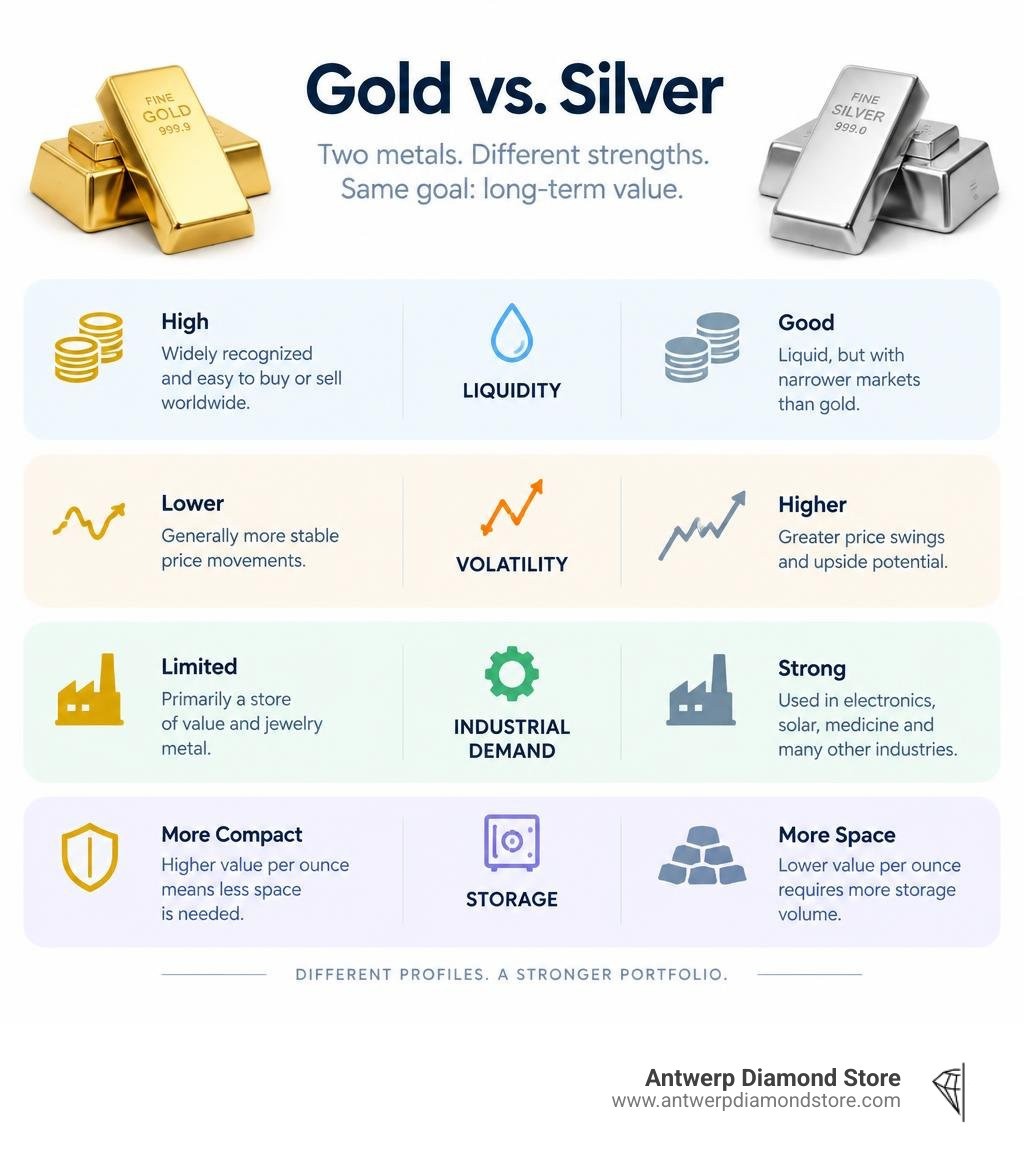
Gold and silver can both protect wealth and add diversification, but they serve different roles. Gold is usually the steadier, more liquid store of value. Silver often has greater upside and sharper price swings because it is both an investment metal and an industrial material. For an investor focused on preserving substantial wealth, gold may deserve the larger allocation; silver can add growth potential at a lower price per ounce.
As of September 2026, both metals have moved sharply with interest-rate expectations, Treasury yields, the US dollar, oil-market disruption, and geopolitical risk. Recent trading has put gold above $4,000 per ounce and silver above $57 per ounce, illustrating why timing, premiums, and resale terms matter as much as the headline spot price.
For buyers and sellers alike, the useful comparison is simple:
Choose gold for compact value, strong global liquidity, and lower volatility.
Choose silver for affordability, industrial-demand exposure, and potentially larger percentage moves.
Compare the all-in price, including the dealer premium, shipping, payment fees, storage, and the price a buyer will actually pay when you sell.
Use physical bullion for direct ownership and consider ETFs or mining stocks only if you accept their market and counterparty risks.
For owners of fine jewelry, watches, or precious-metal items who need fast liquidity, understanding gold and silver values also helps separate an honest offer from one built around hidden spreads or vague pricing.
Understanding Live Market Spot Prices for Gold and Silver
Precious metals operate in a continuous, 24-hour global trading ecosystem. Market spot prices reflect the real-time baseline for raw, unminted metal before fabrication markups, shipping fees, or dealer profit margins are added. Spot discovery runs across primary exchanges like the Commodity Exchange (COMEX) in New York, which trades nearly around the clock, and the London Bullion Market Association (LBMA), which establishes daily pricing benchmarks during its European trading windows.
In September 2026, volatility has remained heightened across all major trading hubs. Investors tracking the live precious metal market overview have seen spot gold climb to recent marks such as $4,368.71 per ounce, while silver reached $65.45 per ounce. Staying updated on fluctuating metrics through regular tracking of the gold silver price is essential for timing entry and exit points effectively.
Price discovery relies on a bid-ask mechanism:
Spot Price: The blended, real-time benchmark derived from global futures, spot desks, and exchange volume.
Bid Price: The highest dollar amount a dealer or institution will pay to buy metal from you.
Ask Price: The retail price at which a dealer will sell that metal to you.
The spread between the bid and ask prices represents the primary liquidity cost of doing business. Wider spreads typically occur during illiquid market hours or in highly fragmented retail channels, whereas narrower spreads reflect robust two-way market depth.
Macroeconomic Drivers Behind Gold and Silver Price Shifts
Both monetary metals respond dynamically to real interest rates, bond yields, and currency valuation shifts. When central banks signal tightening cycles, yields on interest-bearing assets like 10-year US Treasuries tend to rise. Higher yields increase the opportunity cost of holding non-yielding physical metals, which can trigger short-term price pullbacks.
Recent economic events illustrate this relationship. As detailed in a Kitco market report on payrolls and rate hikes, stronger-than-anticipated employment data quickly revived Federal Reserve rate-hike projections, sparking rapid intraday selloffs where spot gold traded down near $4,402.40 and silver dipped to $65.590. Similar market slides were observed earlier in the summer when rate-hike risks capped haven demand as gold tested $4,031.00 and silver hovered near $57.19.

However, headline monetary policy is only one piece of the puzzle. Geopolitical disruptions—such as supply pipeline shutdowns or regional trade friction—often introduce immediate safe-haven bids while driving energy costs higher. High crude oil prices feed into persistent consumer inflation. When markets begin to suspect that inflation will outpace bond yields, real yields turn negative, prompting gold and silver to rebound sharply even in higher-rate environments.
Technical Levels and the Gold-to-Silver Ratio
Technical analysis provides valuable structure for navigating volatile trading sessions. Chartists monitor distinct support floors—where dip-buying consistently emerges—and resistance ceilings, where institutional profit-taking caps upward momentum. In current markets, gold maintains technical support zones around $4,304 and $4,263 while facing resistance levels near $4,422 and $4,465. Silver has established support around $65.26 and $63.80, with resistance bands forming at $67.21 and $68.74.
The gold-to-silver ratio (calculated by dividing the current spot price of gold by the spot price of silver) measures how many ounces of silver are required to purchase one single ounce of gold.
Historically, this ratio averaged roughly 15:1 to 16:1 during periods of statutory bimetallism, but floated between 65:1 and 85:1 throughout modern free-floating regimes. When the ratio reaches elevated territory above 80:1, value-focused investors often favor silver, anticipating an eventual reversion toward historical norms. When the ratio drops below 60:1, gold often regains preference as a more stable store of value.
Gold vs Silver: Fundamental Asset Comparison
While gold and silver share a heritage as durable monetary anchors, their physical and economic fundamentals diverge significantly.
Metric / Characteristic | Gold (Au) | Silver (Ag) |
|---|---|---|
Atomic Density | 19.3 g/cm³ (comparable to tungsten) | 10.49 g/cm³ |
Industrial Usage Share | ~10% of global annual output | ~58% of global annual output |
Jewelry & Art Usage | ~50% of global annual output | ~20% of global annual output |
Investment / Central Bank | ~40% of global annual output | ~22% of global annual output |
Above-Ground Global Stock | ~201,296 metric tonnes | Exhaustible due to industrial loss |
Annual Price Volatility | Moderate / Low-beta safe haven | High / High-beta hybrid asset |
Storage Value Density | High (tens of thousands per ounce/bar) | Lower (requires bulk storage volume) |
Gold is an exceptionally dense, non-reactive element forged in cosmic events like neutron-star collisions and distributed via geological activity, as outlined in the scientific properties and history of gold. Because central banks retain it as an unencumbered tier-one reserve asset, gold functions primarily as a balance-sheet hedge against currency debasement. Physical bullion in standard investment channels is refined to pure gold 24 k (99.9% or 99.99% purity) to ensure international acceptability.
Industrial Utility and Structural Supply Deficits
Silver behaves very differently than gold due to its extensive industrial utility. Silver possesses the highest electrical and thermal conductivity of any known element, making it indispensable in high-growth manufacturing sectors.
Approximately 58% of global annual silver demand originates from industrial fabrication:
Photovoltaic Cells: Advanced solar panels consume hundreds of millions of ounces of silver annually.
Automotive and 5G Infrastructure: Electric vehicles utilize significantly more silver contact points than traditional internal combustion engines.
Consumer Electronics: Circuit boards, micro-switches, and precision relays require silver for seamless conductivity.
Because silver is consumed in small quantities across millions of finished products, a large portion of it is never economically recycled. This has contributed to persistent multi-year structural supply deficits, where mine production—primarily from secondary lead, zinc, and copper mining—fails to match combined industrial and investment demand. When manufacturing surges alongside safe-haven buying, silver often delivers stronger percentage gains than gold, though it carries greater downside risk when global economic growth slows.
Physical Characteristics and Metal Purity
Both metals demand careful authentication to verify purity and prevent counterfeiting. Gold’s remarkable density of 19.3 g/cm³ means that a cubic meter would weigh over 19,000 kilograms. This high density makes genuine gold difficult to replicate using cheap base metals, although tungsten (density 19.25 g/cm³) is occasionally used in counterfeit attempts.
Silver has a distinct white metallic luster and is naturally prone to surface oxidation or tarnishing when exposed to sulfur compounds in the air, requiring specialized care and low-humidity storage.
To guarantee authenticity, reputable mints stamp physical items with official hallmarks indicating millesimal fineness (e.g., .999, .9999, or .925 for sterling silver). Professional appraisers verify these markings using non-destructive X-ray fluorescence (XRF) spectrometry, specific gravity testing, and ultrasonic thickness verification. Familiarizing yourself with standard procedures on how to determine gold purity helps ensure you buy and sell genuine precious metals at their true intrinsic value.
Physical Bullion vs Paper Precious Metal Assets

Investors can access the precious metals market through either direct physical bullion ownership or paper-based financial derivatives. Each approach carries distinct trade-offs in risk, liquidity, and cost structure.
Physical Coins, Rounds, and Bars
Physical ownership provides complete freedom from intermediary and systemic banking risks:
Government Sovereign Coins: Minted by official sovereign entities (such as American Eagles, Canadian Maple Leafs, and South African Krugerrands), these carry legal-tender status and strictly regulated purity standards. They trade at modest retail premiums above spot but offer excellent worldwide resale liquidity.
Private Mint Rounds: Non-denominated, disc-shaped bullion produced by private mints. They closely track spot prices with lower initial premiums than sovereign coins, making them an efficient choice for pure weight accumulation.
Cast and Minted Bars: Available in sizes ranging from 1 gram up to 100-ounce silver bars or 1-kilogram gold bricks. Bars feature the lowest manufacturing markups per ounce, making them the standard choice for high-volume institutional and private storage.
ETFs, Mining Stocks, and Paper Contracts
Paper precious metal vehicles include exchange-traded funds (such as physical-backed trusts), futures contracts, and publicly traded mining equities.
ETFs: Offer low frictional transaction costs and simple execution through standard brokerage accounts. However, retail ETF shareholders rarely hold the right to redeem their shares for physical bars, meaning their investment remains tied to the solvency of custodians, brokerages, and clearinghouses.
Mining Equities: Provide operational leverage to metal prices—if a mining company's extraction costs remain stable while spot prices surge, profit margins can expand dramatically. However, mining stocks expose investors to corporate management errors, permitting challenges, political expropriation risks, and general equity market selloffs.
Buying and Storing Physical Precious Metals Cost-Effectively
Acquiring physical bullion efficiently requires managing the complete cost structure of each purchase:
Retail Premiums: The percentage charged above spot to cover casting, minting, assaying, and dealer operational costs.
Payment Method Surcharges: Credit cards and payment apps often incur 3% to 4% convenience fees, whereas ACH transfers, bank wires, or personal checks help you secure cash discount tiers.
Shipping and Handling: Secure, fully insured transport is mandatory for physical delivery; buying in larger batch sizes helps eliminate freight charges.
Storage Infrastructure: Home storage requires investment in high-security, fire-rated safes, while commercial depositories charge annual percentage-based custodial fees (typically 0.3% to 0.7% of asset value annually).
Practical Buying Strategies for Gold and Silver Bullion
To minimize acquisition overhead and maximize net returns:
Take Advantage of Tiered Volume Pricing: Reputable dealers offer declining per-unit premiums when buying multiple units of the same item (such as 10-ounce silver bars or full tubes of 1-ounce coins).
Focus on Standard Bullion Over Numismatics: Avoid high-markup collector or commemorative coins unless you possess specialized numismatic expertise. Standard bullion allows you to buy more pure metal per dollar invested.
Employ Dollar-Cost Averaging (DCA): Allocate a set capital amount on a regular monthly or quarterly schedule to smooth out market volatility, rather than trying to time market tops and bottoms.
Review Order Terms Carefully: Always confirm inventory availability, delivery timelines, and order cancellation terms to avoid unexpected administrative fees.
Tax Considerations and Capital Gains
Precious metals are treated as capital assets, and their sale can trigger tax responsibilities. In the United States, the Internal Revenue Service (IRS) classifies physical gold and silver bullion as collectibles under Section 408(m) of the Internal Revenue Code.
When held for longer than one year, profits generated from physical metal sales are subject to a maximum federal long-term collectibles capital gains tax rate of 28%, rather than standard long-term capital gains rates. Short-term gains on assets held under 12 months are taxed at ordinary income tax rates. Additionally, select states exempt investment-grade bullion from local sales taxes, while others impose sales tax on orders below specific dollar thresholds. Reviewing detailed guidelines on capital gains on gold with a licensed tax professional ensures full compliance with reporting rules.
Best Practices for Liquidating Your Precious Metals

Liquidating precious metals safely and profitably requires a strategic approach. High-street pawn shops and transient hotel buyers often offer deep discounts to spot (sometimes 20% to 40% below melt value), relying on seller convenience or lack of information.
By contrast, professional buyers calculate their purchase offers using live spot prices, certified scales, and accurate metal purity assays. When preparing to sell silver and gold, compile any available original mint packaging, assay certificates, or purchase receipts. If you hold vintage flatware, decorative items, or estate bullion, our comprehensive old silver selling guide 2026 explains how to distinguish scrap metal value from collectible maker marks before requesting an appraisal.
Evaluating Fine Jewelry and Scrap Metal
Unlike standard bullion bars, fine jewelry requires a two-tier valuation process:
Intrinsic Precious Metal Content: The item's weight is multiplied by its tested purity (such as 10k, 14k, 18k, or platinum) and current spot value to establish its baseline melt value.
Added Value Elements: Premium designer jewelry (such as signed pieces from Cartier, Van Cleef & Arpels, or Tiffany & Co.), high-grade natural diamonds, and rare gemstones carry value far beyond simple scrap weight.
When you sell gold jewelry for cash, ensure your appraiser evaluates both the precious metal content and any embedded diamonds or designer hallmarks, rather than simply tossing the piece onto a scrap scale.
Navigating Private Sales vs Professional Dealers
While peer-to-peer online classifieds or public auction platforms may promise higher sale prices, they expose sellers to serious chargeback disputes, high platform commission fees, shipping insurance limitations, and physical security risks.
Working with established estate buyers provides a safer, streamlined alternative. At Antwerp Diamond Store in Atlanta, GA, we conduct luxury valuations in private, appointment-only offices. We offer free professional evaluations across fine jewelry, high-end watches, and physical bullion, providing transparent market-based offers and immediate payouts without hidden fees or appraisal charges.
Frequently Asked Questions About Precious Metals
What is the difference between spot price, bid price, and ask price?
The spot price is the current market clearing benchmark for raw, wholesale precious metal. The ask price is the retail rate a dealer charges when selling bullion to an investor (spot price plus fabrication and distribution premium). The bid price is the rate an institutional dealer or buyer will pay to purchase that metal back from an investor.
Is gold or silver a better hedge against inflation?
Both metals have preserved purchasing power across multi-century horizons, but they serve different risk profiles:
Gold is an ideal defensive hedge during severe macroeconomic crises and currency debasement due to its low volatility and central-bank backing.
Silver can outpace consumer inflation by wider margins during industrial growth periods, though it experiences larger price drawdowns during economic contractions.
How do dealer premiums impact total investment returns?
Dealer premiums are the markups paid above the spot value of the raw metal. If you purchase a one-ounce silver coin at a 15% retail premium over spot, the market price of silver must rise by at least 15% before your investment breaks even upon resale (assuming your buyer pays exact spot). Minimizing acquisition premiums through cast bars or tiered volume purchases helps shorten your path to profitability.
Conclusion
Developing a resilient precious metals allocation requires balancing gold’s wealth preservation qualities with silver’s industrial growth potential. By monitoring market spot movements, keeping acquisition premiums low, and choosing direct physical ownership, you can build a balanced portfolio designed to withstand shifting macroeconomic cycles.
When you decide to rebalance your holdings, liquidate estate pieces, or trade luxury items for immediate capital, choosing a trusted, transparent partner is essential. We invite you to schedule a confidential valuation at our Atlanta offices or read our trusted guide on where to sell gold and silver to maximize your returns with clear market pricing and instant payouts.