

You're probably looking at a gold ring, a few bullion coins, or a box of old jewelry and wondering the same thing: if you sell it now, how much tax will you owe? The short answer is that capital gains on gold are taxed on the profit, not the full sale price, and in the U.S. physical gold is usually treated as a collectible, which changes the rate that applies. For many sellers, the surprise isn't the tax form, it's how cost basis, holding period, and whether the gold was inherited or gifted can change the bill.
Table of Contents
How Capital Gains on Gold Work
If you are holding gold from years ago and thinking about selling, the tax question starts with three numbers, not with the tax rate. You need what you received, what you originally paid, and how long you held it. Once those pieces are clear, the gain is simple math, because capital gains are usually just the difference between the sale proceeds and your cost basis.
The three building blocks sellers need
Proceeds are the amount you get when you sell. Cost basis is your original purchase price, plus eligible costs tied to acquiring or selling the asset, such as fees that can be documented. Gain or loss is the result after you subtract basis from proceeds, and that figure is what gets taxed, not the full sale price, as described in U.S. tax guidance on gold bullion gains GoldCore's explanation of capital gains on gold bullion.
Practical rule: If you cannot explain your basis, you cannot confidently explain your tax outcome.
In practice, the hardest part is often not the math. It is proving which dollars belong in the basis figure, especially if the gold came from a family transfer, a gift, or a dealer sale where the final payout depends on assay results, weight, or purity. Sellers working with wholesalers like Antwerp Diamond should keep every purchase receipt, inheritance record, gift valuation note, and settlement sheet before the sale is finalized, because those documents are what turn a rough memory into a defensible tax position.
In the U.S., physical gold is generally taxed as a collectible. That matters because long-term gains on collectibles can face a maximum federal rate of 28%, while short-term gains are generally taxed at ordinary income rates. U.S. tax guidance also notes that this collectible treatment applies to bullion, coins, and many gold-backed funds that hold physical gold, which separates them from ordinary stock holdings and from gold-mining equities that follow standard equity rules Investing News and SmartAsset.
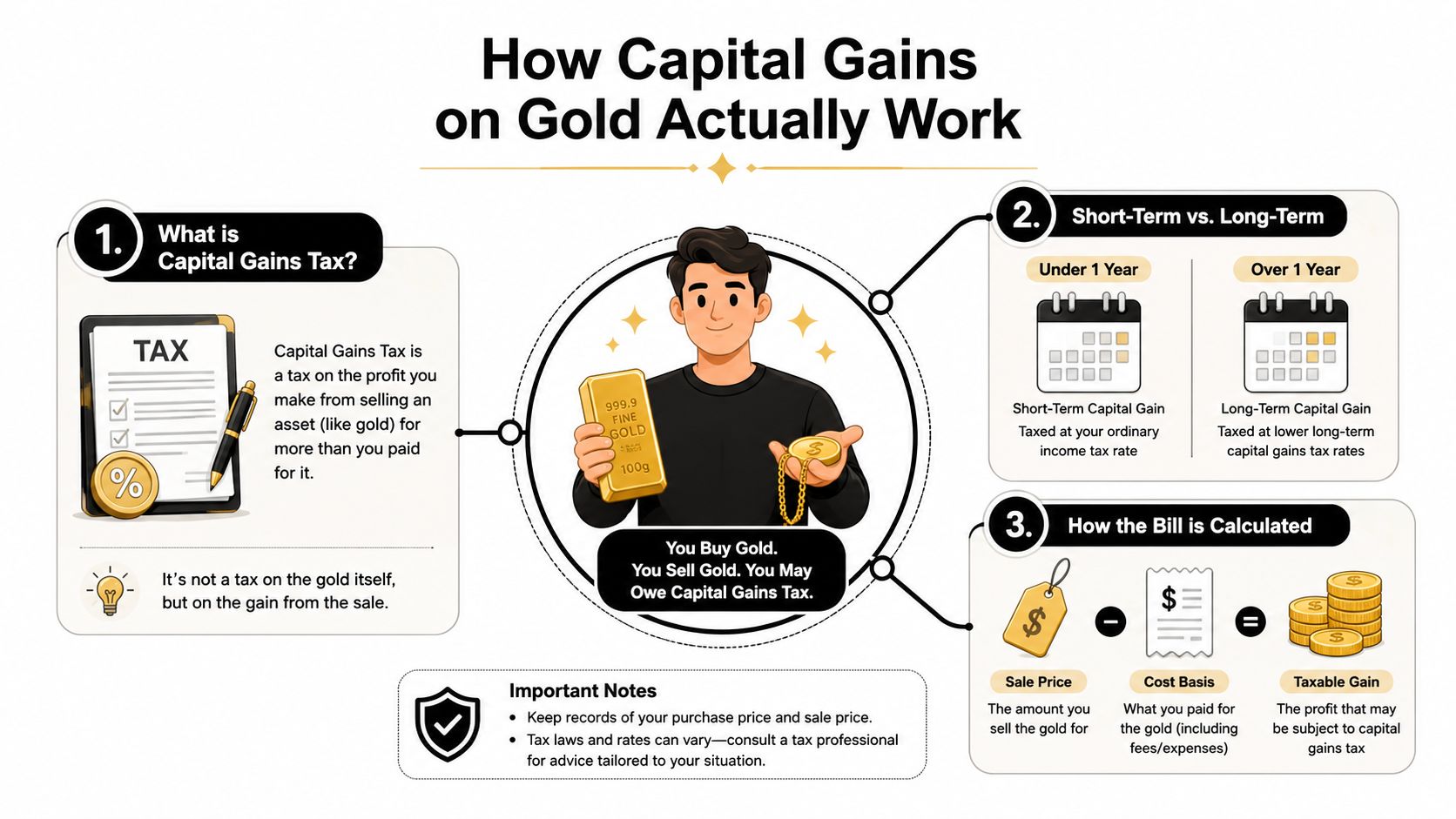
The easiest way to think about it is this. Gold is taxed because you sold it for more than you paid, and the IRS then layers a rate on top of that gain depending on how long you held it and how the asset is classified. A small change in sale price can also come from market movement in the metal itself, which is why sellers often compare a quote against current gold and silver price dynamics before agreeing to a wholesale transaction.
For sellers trying to line up the tax side with the legal side, the same habit helps in other asset sales too. Clear records, clean basis documentation, and a closing statement that matches the actual transaction terms make the filing much easier. A related example of that kind of record discipline appears in tax planning for local real estate owners, where the starting point is also proving what was paid and what was received.
Short-Term Versus Long-Term Capital Gains on Gold
The holding period usually decides the tax result. If you sell gold before you have held it for one year, the profit is generally treated as a short-term capital gain and taxed at ordinary income rates. Once you hold it longer than one year, the gain can move into the long-term collectible category, which is handled differently because physical gold is usually treated as a collectible rather than a standard investment asset.
That difference catches many sellers off guard. The coin, bar, or round can be identical on both sales, yet the tax bill changes because the calendar changed. A dealer quote, a private buyer offer, or a wholesale sale can all produce the same gain, but the holding period determines which tax lane the IRS uses.
Why the one-year line matters so much
A seller who closes in month 11 and another who closes in month 14 may be looking at the same market price, but not the same tax treatment. The asset did not change. The classification did. That is why timing matters more with gold than many people expect, especially when a sale is being negotiated quickly and the final paperwork is still being assembled.
Before a wholesale sale is finalized, it helps to confirm the purchase date, any added acquisition costs, and the exact closing terms in writing. If the seller is working with a buyer such as Antwerp Diamond, the supporting documents should match the deal signed, not just the first quote discussed. That same recordkeeping habit is also the point of tax planning for local real estate owners, where the reported gain depends on the paper trail as much as on the sale price.
Holding Period | Tax Classification | Typical Federal Rate Range | Practical Trigger |
|---|---|---|---|
Under 1 year | Short-term capital gain | ordinary income rates | Sold before the one-year anniversary |
Over 1 year | Long-term collectible gain | up to the collectible ceiling | Sold after the one-year anniversary |
The same holding-period idea shows up in other countries, but the cutoffs can be different. Some tax systems treat gold sold within a shorter window as short-term and give long-term treatment only after a longer ownership period. The exact rule depends on the country, so sellers need to check the local standard before assuming that U.S. timing rules apply everywhere.
For gold received by inheritance or gift, the timeline can be even less intuitive because the holding period and cost basis may not start with the day the item was sold. In those cases, the paperwork that establishes who gave the gold, when it was acquired, and what basis carries over can matter as much as the weight or purity of the metal itself.
A Step-by-Step Example of Calculating the Gain
A simple sale example makes the numbers easier to follow. Suppose you bought a gold bar for a total of $2,200 after including the dealer premium and documented acquisition costs, then later sold it to a dealer for $3,000. Your gain is $800, because the calculation starts with sale proceeds and subtracts cost basis, so the taxable amount is the gain, not the full sale price.
The same sale, two different timelines
If that same sale happened after 11 months, the gain would generally be treated as short-term and taxed at ordinary income rates, which commonly range from 10% to 37% depending on the taxpayer's bracket. If the sale happened after 2 years, the gain would generally be a long-term collectible gain, and the federal rate ceiling could reach 28%.
That still does not mean every long-term sale is taxed at 28%. It means 28% is the ceiling for collectibles in the U.S. A lower rate can still apply depending on the taxpayer's overall situation, but gold does not receive the same long-term treatment as many other assets.
Simple method: write down purchase price, add documented fees, subtract from sale proceeds, then classify the holding period.
Dealer buyback payouts and insured shipping reimbursements both belong on the proceeds side of the calculation when they are part of what you received from the sale. If a buyer pays you cash, bank transfer, or a mailed settlement amount, that figure is the starting point for the gain computation. A practical article on selling a 24-carat gold ring can help when you are translating jewelry into resale value rather than bullion value.
For a seller, the goal is to reconstruct the arithmetic from records alone. If you can identify the purchase documents and the final payout, you can usually see the tax picture clearly before the IRS ever sees the return.
Cost Basis for Purchased, Inherited, and Gifted Gold
A seller can know the sale price and still misread the tax result if the cost basis is wrong. That happens often with gold because the paper trail may include a dealer invoice, a premium, shipping, assay records, or an old appraisal. It happens just as often when the gold came by inheritance or gift, because the number you subtract from the sale proceeds changes depending on how the item was acquired.
Purchased gold is the easiest case
For gold you bought yourself, basis usually starts with what you paid. It can also include related costs when they are documented, such as dealer fees or other direct acquisition costs. If the original receipt is missing, sellers often rebuild basis from dealer records, old bank or credit card statements, appraisals, assay reports, or other transaction evidence. The goal is not a perfect archive. The goal is a reasonable basis estimate that can be supported if a return is questioned.
Inherited gold can change everything
Inherited property often gives the seller the most favorable basis outcome. Tax guidance for U.S. taxpayers says inherited property generally receives a stepped-up basis at fair market value on the date of death, which can reduce the gain or remove it altogether TaxAudit. If a parent bought a piece decades ago and the heir sells it later, the taxable gain may be much smaller than expected because the tax system usually measures from the inheritance date rather than the original purchase date.
Gifted gold usually carries the giver's basis
Gifted property works differently. The recipient typically takes the giver's basis, and in many cases the giver's holding period also matters for classification, according to capital gains guidance Wealth Enhancement. A gift is therefore not the same as an inheritance for tax purposes, even when the item itself is identical.

When records are incomplete, the seller's job is to gather whatever supports the basis story. That may include a jeweler's appraisal, old packaging, assay certificates, shipping receipts, or correspondence showing when the item changed hands. For sellers who need a neutral third-party evaluation before deciding whether to sell, an independent jewelry appraiser can help separate metal value, condition, and documentation issues.
Reporting the Sale on Form 8949 and Schedule D
The tax math doesn't end when you accept the offer. In the U.S., gold sales are usually reported on Form 8949 and summarized on Schedule D. One source notes that even if a dealer doesn't issue a 1099-B, the taxpayer still remains responsible for reporting the profit Yahoo Finance.
What the paperwork usually looks like
Form 8949 is where each sale gets listed individually. Schedule D then rolls those transactions up into the return. If your transaction is short-term, it goes in the short-term section. If it's long-term, it goes in the long-term section. The form choice matters because the tax rate can differ sharply depending on the holding period and whether the gain is treated as ordinary income or a collectible gain.
Keep the paperwork with the item's story, not just with your tax folder.
Before a sale, it helps to gather a clean file. Useful documents include:
Original purchase receipts for bullion, coins, or jewelry
Dealer buyout paperwork showing the final settlement amount
Appraisals or grading documents that support identity and condition
Shipping and insurance records if the item was mailed
Assay or purity certificates for bullion and some jewelry pieces
For sellers in the luxury market, the same habit applies whether the item is gold, a watch, or a diamond piece. If the item is going through a resale channel, the buyer, whether a dealer, wholesaler, or jewelry buyer, will usually want the same evidence trail that supports value and ownership. A practical overview of where to sell gold and silver can help frame those choices before the paperwork is final.
State tax may also matter. Federal reporting is only one layer, and sellers should check how their home state treats capital gains before assuming the final bill is settled.
Strategies That Can Lower the Tax Bill on Gold
A gold sale can create a tax bill that surprises people because the tax result often depends as much on paperwork as on price. The sale price matters, but so does the cost basis, the holding period, and whether the item was bought, inherited, gifted, or sold through a dealer or wholesaler. If those pieces are not clear before the sale closes, the number on the tax return can be harder to defend later.
Practical levers sellers actually use
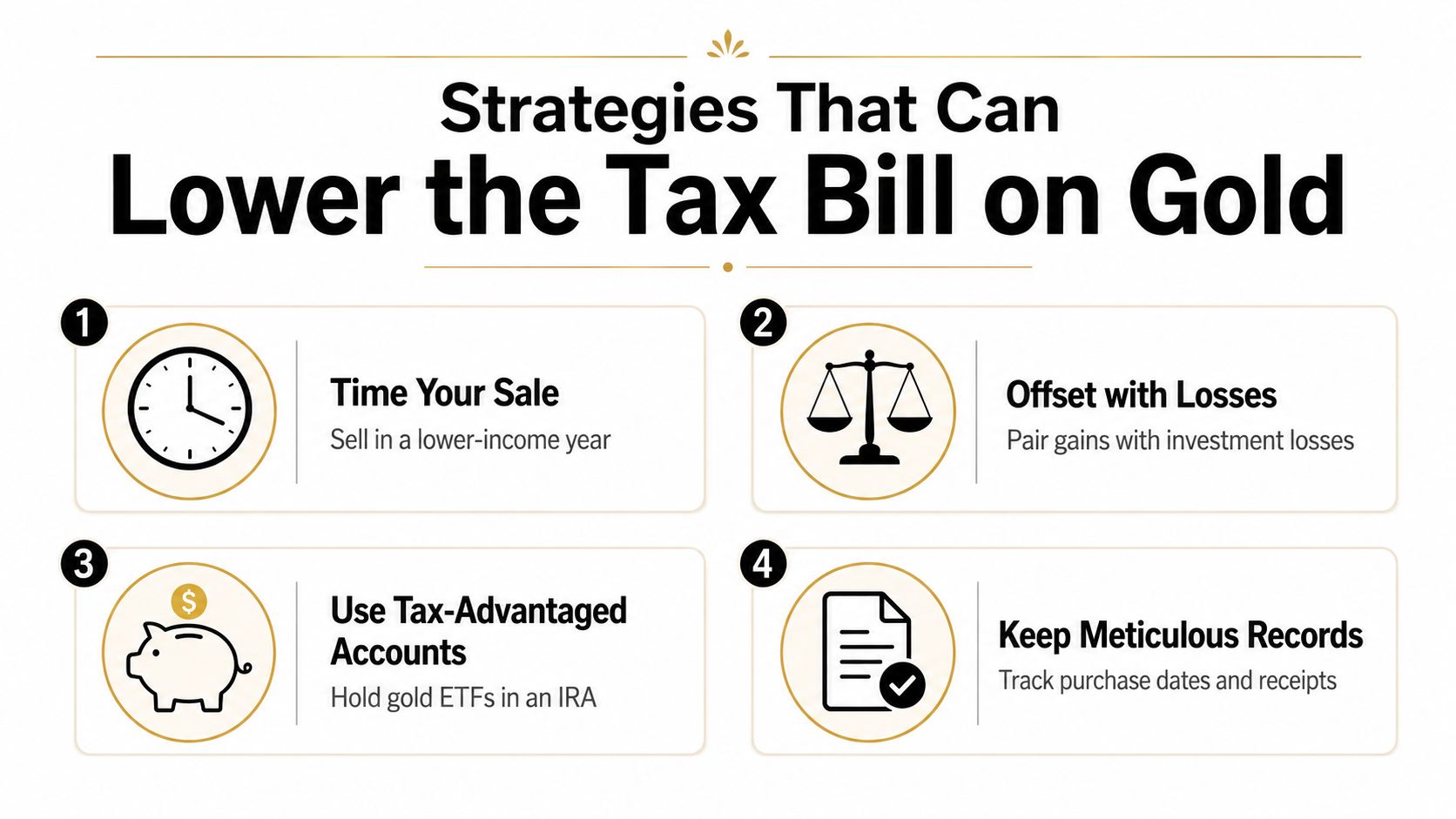
One useful move is timing the sale in a lower-income year, since a lower bracket can change the tax result for short-term gains. Another is tax-loss harvesting, which lets gains from one asset be offset by losses from another. Sellers sometimes hold appreciated gold until they have losses elsewhere they can use against it, much like matching a higher bill with a credit from the other side of the ledger.
Charitable giving and family transfers can also affect the outcome, but only if the basis story is understood first. Gifted property usually keeps the giver's basis, so moving gold to a relative does not wipe out the tax history. Donations to qualified charities work differently because the transfer is not treated like a regular sale.
Retirement accounts create a separate path. Recent U.S. explainers note that IRA structures can be used to defer or avoid current capital gains taxation on certain gold exposures, which is one reason some investors prefer tax-advantaged storage over taxable ownership CNBC.
A seller should also pay attention to what gets documented before the deal is final. If the gold is going to a dealer, wholesaler, or private buyer, the records should show how the item was identified, how the basis was determined, and what amount changed hands. A practical overview of where to sell gold and silver helps frame those choices before the paperwork is closed, especially when the item is being compared across more than one resale channel.
Strategy | What it can help with | Main caution |
|---|---|---|
Sell in a lower-income year | May reduce the rate on short-term gains | Needs income planning |
Offset with losses | Can reduce net gain | Loss rules still matter |
Use tax-advantaged accounts | Can defer current tax | Account rules are specific |
Keep meticulous records | Supports basis and reporting | Missing records cause disputes |
Gold also differs from ordinary long-term assets in a way that often confuses sellers. Even after the one-year mark, some taxpayers may still face a 28% collectible ceiling, while ordinary long-term capital assets can fall under the 0%, 15%, or 20% rates SmartAsset. Waiting longer can help in some cases, but it does not automatically put gold in the same tax bucket as stocks or bonds.
A seller who wants to reduce friction before the sale should treat the transaction like a file review, not just a price negotiation. Keep receipts, inheritance papers, appraisal notes, and any dealer statements together, because those records are what support the basis number if the IRS ever asks for it. That habit matters for inherited gold, gifted gold, and dealer sales alike, where the tax result can turn on details that are easy to overlook in the moment.
Before using any of these strategies, a qualified tax professional should review the numbers, especially when the gold was inherited, gifted, or mixed with other investments. A second set of eyes can also help the seller avoid confusing a collectible gain with an ordinary capital gain, which is a common point of error when gold changes hands quickly.
Practical Checklist Before You Sell Gold in Atlanta or Beyond
Before you walk into a buyer's office in Atlanta, Buckhead, Sandy Springs, Alpharetta, Roswell, Brookhaven, or Midtown Atlanta, assemble the paperwork first. Bring receipts, appraisals, assay papers, inheritance documents if applicable, and any dealer statements that show your basis and sale price. If you're in Georgia, ask how state income tax may affect the transaction so the federal result doesn't surprise you later.
A smart seller also asks three direct questions. How will the sale be documented? Will I get paperwork showing the proceeds? What records should I keep for my tax return? Those answers matter because the IRS still expects you to report the gain even if the buyer doesn't issue a 1099-B.
Confirm your basis: Write down what you paid, or what the inherited basis appears to be.
Separate the pieces: Bullion, coins, and jewelry may need different support files.
Check the holding period: Know whether the sale is before or after the key cutoff.
Keep sale records: Save the final payout, shipping, and insurance details.
Ask about reporting: Make sure you know how the transaction will be reflected.
For sellers who want a private, in-person review, gold buyers in Atlanta can be part of a broader local comparison process before the item changes hands. The best next step is usually simple, bring the item, bring the paperwork, and let the numbers be checked before you accept an offer.
A CTA for Antwerp Diamond.