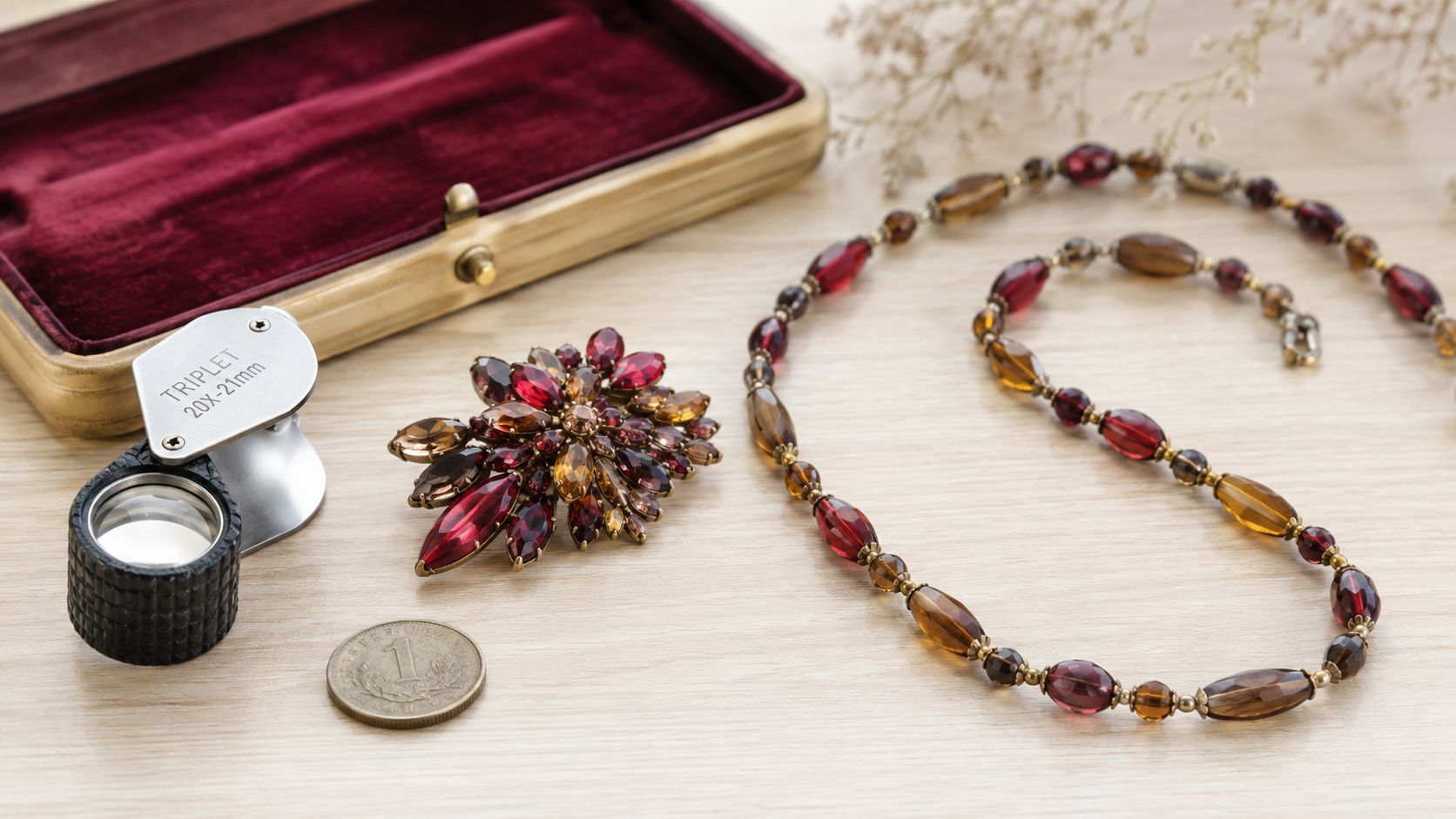
You probably pulled a glittering brooch from a drawer, inherited a necklace with no paperwork, or spotted a tray of costume jewelry at an estate sale and wondered if the old Czech piece in your hand is decorative, collectible, or worth selling. Czechoslovakian jewelry vintage sits in a very specific corner of the market, and the fastest way to judge it is to look at the material, the construction, and the condition before you do anything else.
Owners get the best results when they treat these pieces like small historical objects, not mystery trinkets. A careful read of the back, the clasp, the stones, and the wear pattern often tells you more than a missing box ever could.
Table of Contents
What You Likely Own and Why It Matters

You may be holding a family brooch, a dress clip, a necklace, or a pair of earrings that came out of a box with no labels and no story. That is normal. Most vintage Czech jewelry is identified by observation, not by paperwork, so the first pass should focus on what the piece is, how it feels, and what the construction suggests.
A useful first look starts with three questions. What is it made of? What condition is it in? What does it weigh or feel like in the hand? Those answers shape everything that follows, from how carefully you clean it to whether you should sell it as-is or have it reviewed by a buyer or appraiser.
For a deeper understanding of material categories, see our guide on what constitutes fine jewelry.
A piece can be costume jewelry and still matter a great deal in the market. A brooch with clean metalwork, intact stones, and a recognizable Czech setting style may appeal to collectors, dealers, and heirs who want a fair sale path rather than a casual resale. That distinction matters because the market does not reward every old piece equally, and the gaps between a modest box lot and a stronger example can be wide.
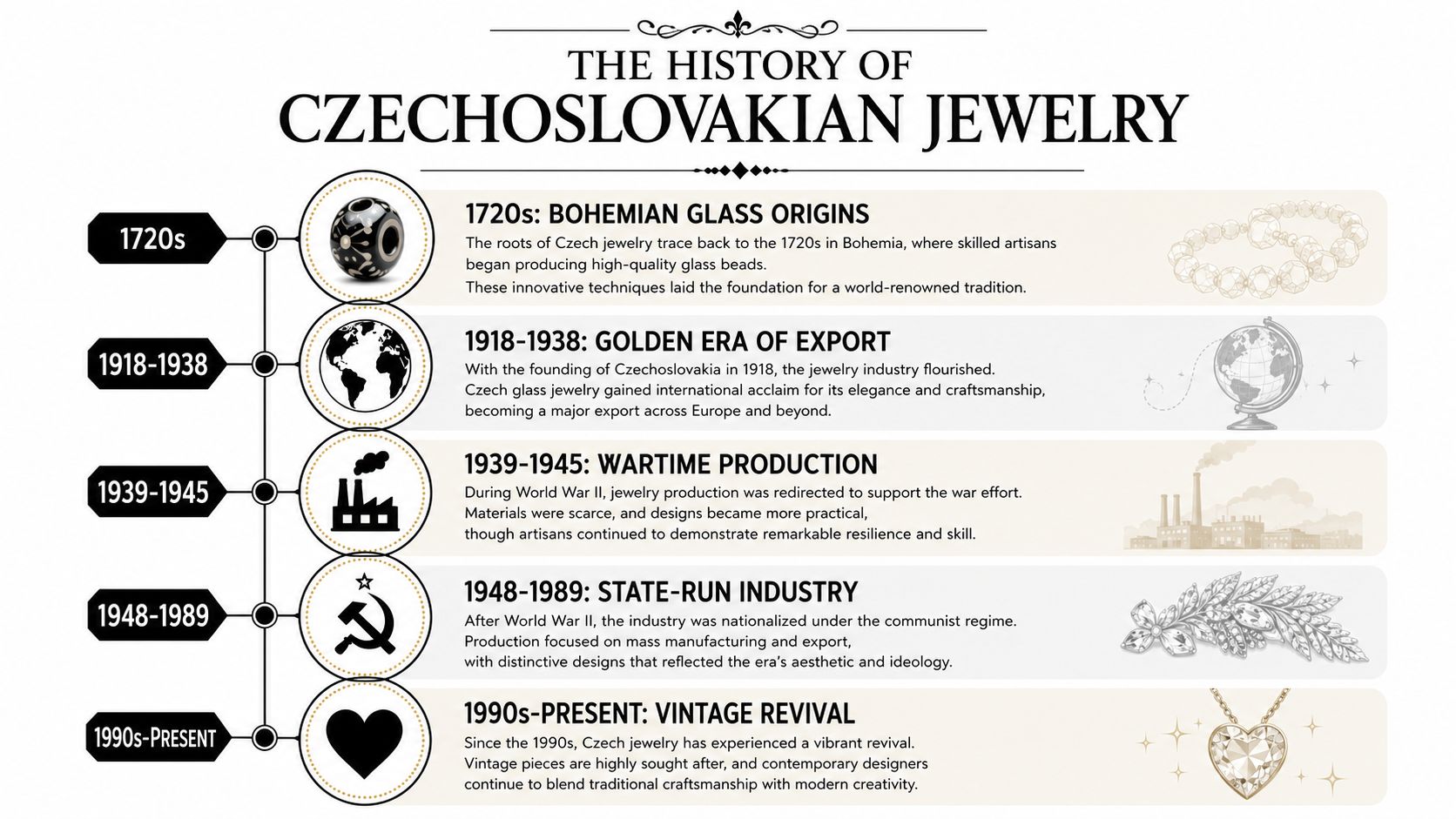
Czechoslovakian costume jewelry became especially important after World War I, when the region's Bohemian glass tradition helped define the look of pressed glass, rhinestones, and decorative components that collectors still seek today Czechoslovakian jewelry history. That history matters because it explains why some pieces feel distinctly industrial and yet still collectible, while others look similar but never draw the same buyer interest.
If you are thinking about resale, inheritance, or insurance, the first job is to separate sentimental value from market value. The same brooch can be a family keepsake, a modest vintage accessory, or a piece that deserves specialist handling because of its construction or condition. That is where a careful look saves time and keeps you from selling too quickly.
A good first-pass rule helps. If the piece feels well-made, shows age-appropriate wear, and uses convincing glass or metal construction, it deserves a closer look. If it feels light, overly shiny, or freshly assembled, it may be a later reproduction or a repaired piece that will not appraise the same way. A guide to vintage photoshoots can also help if you need clear, honest images before you send it out for review or sale.
Practical rule: start with the back of the piece, not the front. The front can still look perfect after repairs, but the back usually reveals the true age story.
The History That Helps You Read the Piece
Bohemian glass and export identity
A brooch or necklace can look ordinary in a drawer and still tell a useful story once you place it in the right period. Czechoslovakian vintage jewelry sits inside a long glassmaking tradition that helped shape the region's costume jewelry trade, and the broad outline of that history is worth keeping in mind when you judge a piece by eye, as discussed in Czechoslovakian jewelry history. The reason matters to buyers, because pressed glass, rhinestones, enamel, and costume-metal settings were produced at scale, and that production style still affects how collectors and dealers read these pieces today.
Jablonec nad Nisou is the name you will hear again and again in serious discussions of Czech glass and costume jewelry. In practical terms, that city name helps explain why so many pieces show regional consistency in cut, sparkle, and assembly. A buyer who recognizes that consistency can often separate a true Czech piece from a generic mid-century lookalike.
The older the piece, the more the story matters. A brooch from the interwar period sits in a different collector lane than a later Czech export item. Even when the look is similar, the market often interprets age, authenticity, and historical placement very differently.
A useful way to sort the timeline is to ask whether the piece feels prewar, wartime, or postwar in its construction. The answer usually shows up in the back, the clasp, and the stone settings before it ever comes from a mark. That is the kind of detail an appraiser checks first when a family piece needs a value range for inheritance, insurance, or sale.
If you are trying to move from ownership to a real offer, read the piece as a market object, not just a keepsake. For a step-by-step selling process, consult our guide on how to sell antique jewelry.
Reading motifs by era
Art Deco geometry often points you toward the interwar period, while folk florals, Gothic arches, and mid-century clusters can signal different production moods and later tastes. That does not make a piece valuable by itself, but it gives context. Collectors pay more attention to pieces that feel anchored to a recognizable design moment than to something that merely looks old.
If you use old jewelry as styling reference, a guide to vintage photoshoots can help you see how these silhouettes sit on clothing and in portraits. It is not an appraisal tool, but it does sharpen your eye for proportion and era styling.
When you describe a piece to a buyer, use era language sparingly and specifically. “Interwar-style geometric brooch with Czech glass” gives a clearer starting point than “old antique pin,” and it usually leads to a better conversation.
Authenticating a Vintage Czech Piece Step by Step
The most reliable authentication process is visual and sequential. Start by identifying the base material, then inspect how the piece was built, then compare the motif and fabrication against period references. That workflow matters because paperwork is rare for costume jewelry, and the piece itself usually has to carry the proof.
Start with the materials
Look first for pressed glass, faceted rhinestones, molded glass stones, enamel over brass, or early costume-metal alloys. Czech work often has a distinct glass character, and the stones may feel heavier and more substantial than plastic substitutes. Under daylight, authentic glass usually shows a livelier internal reflection than modern imitation materials.
Next, check the construction under magnification. Foil backs, prong settings, hinge wear, clasp wear, and plate loss tell you whether the piece has lived a normal life or been heavily restored. A fresh shine on old-looking stones can be a warning sign, especially if the back looks more recent than the front.
Re-tipped prongs, replaced stones, and later re-plating are among the most common reasons a piece gets misread or loses value.
Check the details that repairs can hide
Hallmarks and maker signatures help, but they're not the whole story. A signed piece can still be repaired, and an unsigned piece can still be genuine. That's why you want to read the mechanics first, then the mark, then the style.
Age-appropriate clasps and the back of the piece are especially useful when judging vintage and antique jewelry clasp and back inspection. A clean, modern closure on a piece that otherwise claims age deserves a second look. The same goes for sharp new stones in a setting where the surrounding metal shows long wear.
If you hit the limit of self-assessment, stop there. The moment the piece's value depends on a signature, factory attribution, or repair history, a professional evaluation becomes the better move. A good jewelry appraisal guide can help you understand what a buyer will inspect next.
A simple authentication checklist
Identify the material: Glass, enamel, metal alloy, or a later substitute.
Read the back: Look for wear patterns, clasp age, and repairs.
Inspect the settings: Check for replaced stones, prong work, and looseness.
Compare the design: Match motif and cut style to the likely period.
Pause on repairs: Fresh plating or mismatched components can change value.
What Actually Drives the Value
Value in Czechoslovakian jewelry vintage usually comes down to four things, provenance, materials, craftsmanship, and demand. Buyers rarely pay up just because a piece is old. They pay more when the piece has a clear identity, strong materials, and a condition story that doesn't raise doubts.
Provenance and maker matter more than people expect
A signed or attributable piece generally has a narrower but more serious collector audience than an unsigned lookalike. That's where the premium starts. Two brooches can look nearly identical in a drawer, but the one with a recognizable factory link or credible origin tends to get more attention from a specialist buyer.
Materials and condition set the floor
Genuine Czech glass, intact foil-backed stones, and original metalwork support value better than generic crystal, cloudy replacements, or heavily polished settings. If a necklace has chips, clouding, or uneven repairs, it can still sell, but the offer usually has to account for the visible work it needs. That's especially true when the front looks attractive but the back reveals fatigue.
Craftsmanship creates the confidence premium
A collector-grade piece often feels balanced, tight, and deliberate. Stones sit evenly, enamel is smooth, and the assembly looks coherent from every angle. A similar-looking piece with loose prongs, swapped components, or a fresh plate finish can fall out of collector territory quickly.
Category | Typical Range | Key Driver |
|---|---|---|
Unsigned common brooch | Modest resale interest | Material quality and condition |
Signed or attributable brooch | Higher collector demand | Maker identity and originality |
Necklace with intact glass and settings | Stronger offer potential | Completeness and visual impact |
Heavily repaired piece | Reduced resale appeal | Restoration history and wear |
The honest reality is that most vintage Czech costume jewelry sells in a modest retail band, while standout signed or unusually well-preserved pieces can command meaningful premiums. The difference usually isn't one flashy detail. It's the stack of small positives that tell a buyer the piece is real, original enough, and worth competing for.
Documenting and Photographing for Appraisal or Sale
A lot of sellers lose money before the first offer even comes in. The piece may be fine, but the photos are dark, the description is thin, and the buyer has to guess at size, wear, and authenticity. Good documentation removes that friction quickly.
Capture the details buyers actually use
Shoot the front, back, sides, clasp, and any marks in natural daylight. Add macro shots of the stones, the prongs, and any chips or repairs. If the piece has a box, tag, receipt, or family photo with it, include that too, because provenance and presentation can matter even when the story is partial.
A simple ruler in the frame is useful, and so is a neutral background that doesn't reflect extra color into the stones. For rhinestones, angle the light so the camera doesn't blow out the surface sparkle. You want the buyer to see the stone layout, not just a bright white glare.
If you need a practical visual checklist for photographing jewelry, this jewelry photography guide is a solid reference point for shot order and presentation.
Buyer habit: the best offers often start with the clearest listing. If a buyer can understand the piece in thirty seconds, you've done most of the work already.
Write the description like an appraiser would
Keep it short and factual. Include dimensions, any visible wear, what the piece feels like in hand, and anything you know about where it came from. Avoid guesses you can't defend. A cautious, well-lit listing beats an overconfident description every time.
Packaging matters too. Wrap pieces separately, keep loose stones from knocking against each other, and avoid cleaning with harsh products before a review. Sometimes a buyer wants to see the original surface, not a polished version that hides age.
Where to Get an Accurate Appraisal or Instant Offer
The right sales path depends on timing, confidence, and how unusual the piece is. A common brooch can move differently from a signed statement necklace, so it helps to match the channel to the item instead of treating every evaluation the same way. A serious buyer should be able to explain the offer in plain English, not hide behind a quick number.
Compare the realistic options
Option | Best For | Pros | Cons |
|---|---|---|---|
Free online valuation | First-pass screening | Fast, low friction | Limited by photo quality and context |
Mailed-in formal appraisal | Detailed review from afar | More structured, more precise | Shipping risk and wait time |
In-person appraisal | Higher confidence pieces | Direct inspection and questions | Requires scheduling and travel |
Consignment or auction | Strong signed or rare pieces | Can reach niche collectors | Longer timeline and uncertain outcome |
For owners who want a better sense of how document review works before sending anything, practical PDF parsing can be useful when organizing old receipts, insurance pages, or scanned family records into a usable file set.
When each path makes sense
A free online valuation is a good starting point if you just need a sanity check. Mailed-in review makes more sense when the piece needs expert attention and you're not local. In-person appointments are usually the best fit when condition, repair history, or maker attribution will affect the result.
Antwerp Diamond Store offers evaluations for fine jewelry, gold, silver, loose diamonds, and designer items, with offices in Buckhead, Roswell, Las Vegas by appointment, Fort Lauderdale, and Houston, plus a mail-in option for clients across the U.S. If you're comparing buyers, ask how they reached the offer and whether they can point to the features that moved the number.
For a deeper look at choosing a third-party specialist, this independent jewelry appraiser resource is worth saving. Comparing two or three reputable evaluations is normal, and it's often the cleanest way to separate a strong offer from a rushed one.
Bringing It All Together and Your Next Step
Handle the piece in this order, identify it, inspect the back and the clasp, document it well, then choose the selling path that matches its true quality. Don't let urgency do the appraiser's job for you. The primary drivers are condition, market demand, and documentation, not pressure.
For Atlanta-area owners in Buckhead, Sandy Springs, Alpharetta, Roswell, Brookhaven, or Midtown, a confidential in-person review is a sensible next move, and clients outside Georgia can start with an online evaluation from anywhere in the U.S. If you're also sorting older family albums or wedding images around the same time, browse Atlanta wedding photos for a useful visual reference while you organize the history behind the piece.
A CTA for Antwerp Diamond. If you'd like a careful, no-pressure review of a Czechoslovakian vintage piece, bring it in for an in-person evaluation in Atlanta or start with a free online assessment from anywhere in the U.S.