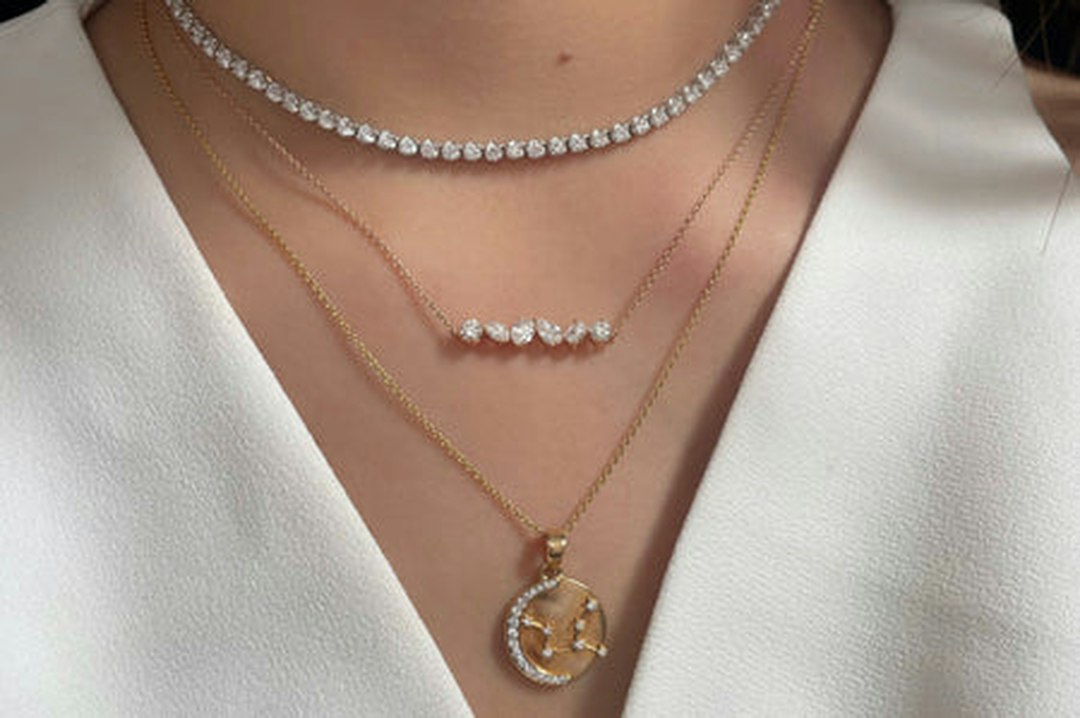

What Is a 14 Karat Gold Ring With Diamonds Worth?
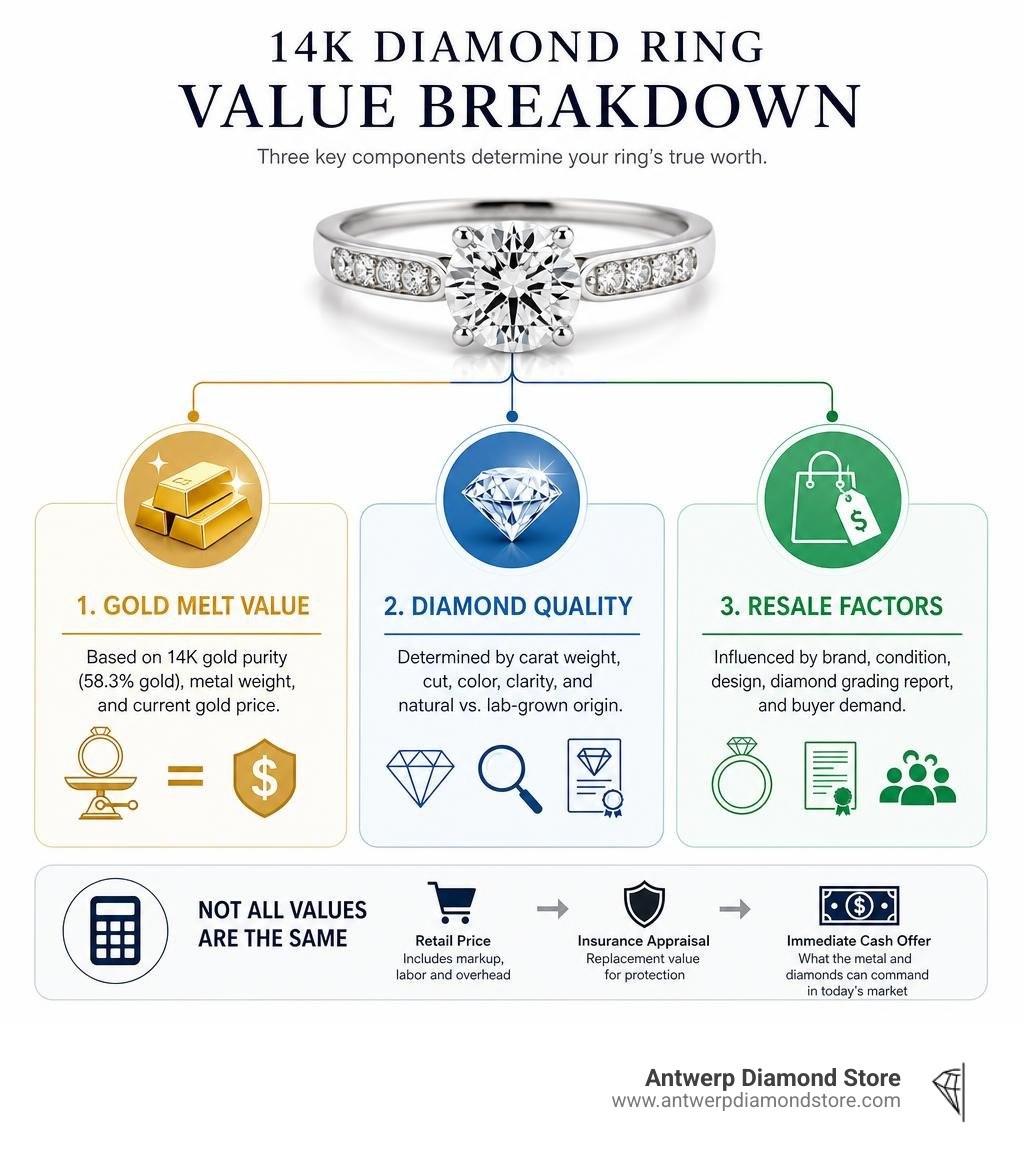
The 14 karat gold ring with diamonds value depends on two separate assets: the gold in the setting and the quality, size, and origin of its diamonds.
Quick answer: At an August 2026 gold spot price of about $4,342 per troy ounce, 14K gold has an estimated melt value of roughly $81.43 per gram. A typical 2-8 gram 14K ring therefore contains about $163-$651 in raw gold value before subtracting diamond weight. Its total cash value may be higher when it has a desirable natural diamond, strong diamond grades, a recognized brand, or exceptional craftsmanship.
Value component | What affects it most |
|---|---|
Gold value | 14K purity (58.3% gold), metal weight, current gold price |
Diamond value | Carat weight, cut, color, clarity, and natural vs. lab-grown origin |
Resale premium | Brand, condition, design, diamond grading report, and buyer demand |
Cash offer | Whether the buyer is purchasing it for resale or only for scrap |
A retail price, insurance appraisal, and immediate cash offer are not the same number. Retail pricing includes labor, overhead, and markup. A fair resale evaluation focuses on what the metal and diamonds can realistically command in today's market.
Core Factors That Impact 14 Karat Gold Ring with Diamonds Value
To understand the 14 karat gold ring with diamonds value, we have to look at the individual components that make up the piece. Fine jewelry is much more than just a lump of metal or a solitary stone. When we evaluate fine items at Antwerp Diamond Store, we analyze the metal purity, overall weight, diamond grades, and design execution to determine true market liquidity. If you've ever wondered what is fine jewelry, it is defined by precious metal alloys paired with genuine gemstones, engineered to last for generations.
Gold purity determines how much pure precious metal exists within the alloy. While 24K gold is 100% pure, it is far too soft for everyday ring settings. Jewelry makers mix pure gold with strengthening metals like silver, copper, nickel, or zinc.
Gold Karat | Pure Gold Percentage | Alloy Percentage | Common Marking Stamps | Main Benefits |
|---|---|---|---|---|
10K | 41.7% | 58.3% | 10K, 417 | Highly durable, budget-friendly, scratch-resistant |
14K | 58.3% (58.5%) | 41.7% | 14K, 14KT, 585 | Ideal balance of durability, gold content, and color |
18K | 75.0% | 25.0% | 18K, 750 | Richer yellow tone, higher luxury status, softer surface |
As shown in the table, 14K gold strikes the sweet spot for engagement rings and fine bands. It contains enough pure gold to hold impressive intrinsic value while retaining sufficient hardness to securely grip diamond prongs over decades of active wear.
Understanding 14K Gold Purity and Melt Weight
In North America and Europe, 14K gold contains 58.3% (often stamped as 585 for 58.5%) pure gold. To estimate the raw intrinsic metal value—frequently referred to as the melt value—we must look at current spot prices. In August 2026, with live spot gold trading near $4,342 per troy ounce (where one troy ounce equals 31.1 grams), 24K pure gold is worth roughly $139.61 per gram.
When we calculate the price gold 14 k holds per gram, we multiply $139.61 by 0.583, yielding approximately $81.43 per gram. You can review live gold metal tracking benchmarks at resources like How Much Is a 14K Gold Ring Worth? — $163–$651 Today and check per-gram melt details on 14K Gold Price – $76.12/g Today | MyGoldCalc.
Women’s 14K gold rings typically weigh between 2 and 4 grams, giving them an underlying metal melt value between $163 and $325. Men’s rings or heavy multi-stone bands generally weigh between 4 and 8 grams, providing a melt value range of $325 to $651. This calculation reflects the metal alone. To get an accurate assessment, we must weigh the gold setting independently from the embedded diamonds.
How the 4Cs Dictate Diamond Worth
While the gold mounting sets the floor price for a ring, the diamonds usually determine its ceiling. To learn how much to value a diamond ring, we rely on the industry-standard 4Cs established by the Gemological Institute of America (GIA):
Carat Weight: Diamond weight is measured in carats (1 carat = 0.20 grams). When evaluating multi-stone rings, pay attention to whether a tag lists center carat weight or total carat weight. Knowing what is ctw (carat total weight) is critical, because one single 1.00-carat diamond is worth significantly more than ten 0.10-carat diamonds combined.
Cut: Cut quality dictates how light refracts through the stone to create brilliance and fire. An Excellent or Very Good cut makes a stone look vibrant and visually larger, whereas a Poor cut leaks light and diminishes value.
Color: Graded on an alphabetical scale from D (colorless) to Z (noticeable yellow/brown tint). Colorless stones (D-F) command high premiums, while near-colorless stones (G-J) represent fantastic consumer value.
Clarity: Measures internal characteristics known as inclusions and surface blemishes. Clarity ranges from Flawless (FL) down to Included (I1-I3). A stone with a minor inclusion in a diamond graded VS1 or VS2 looks eye-clean to the naked eye while costing far less than Flawless grades.
A genuine diamond meaning refers to a natural carbon crystal formed deep within the earth over millions of years. A 14K gold ring featuring a 0.30-carat center diamond may retail for $750 to $1,250, whereas a 14K ring with a 1.00-carat high-quality natural center diamond frequently costs $3,000 to $7,000 or more. Detailed analytical guides such as What Factors Determine the Value of a 14 Karat Gold Diamond Ring? emphasize how small shifts in color or clarity drastically adjust secondary values.
Natural vs. Lab-Grown Diamonds Impact on Resale
The emergence of lab-grown diamonds has shifted the retail and secondary jewelry landscape. Lab-created diamonds share the exact chemical, optical, and physical properties of mined diamonds. However, modern factory production has drastically reduced supply costs.
At retail, choosing a lab-grown stone cuts the total 14 karat gold diamond ring price by 30% to 50% compared to a natural diamond ring of equal visual size. For instance, an oval lab grown diamond ring in 14K gold might cost $1,500 at retail, while its natural counterpart costs $4,000.
However, the resale market treats natural and lab-grown diamonds very differently:
Natural Diamonds: Retain measurable secondary liquidity. While retail markups evaporate upon resale, high-quality natural diamonds preserve substantial intrinsic value based on global wholesale supply and demand.
Lab-Grown Diamonds: Suffer steep secondary depreciation. Because manufacturing costs continue to decline, secondary jewelry buyers and gold refineries pay very little for pre-owned lab-grown diamonds, often valuing the ring primarily for its 14K gold scrap weight.
Whether your ring features a natural or lab-grown diamond, having a recognized grading certificate from an independent laboratory (like a gia certified engagement ring) provides definitive proof of stone origin and grading standards, protecting your total financial value.
Calculating 14 Karat Gold Ring with Diamonds Value at Home
Evaluating your ring's value at home is a straightforward mathematical process. With a few basic tools and live market data, you can calculate a realistic baseline offer before speaking with professional buyers.

Step-by-Step Gold Melt Formula
To calculate the gold melt value of your ring, follow this simple process:
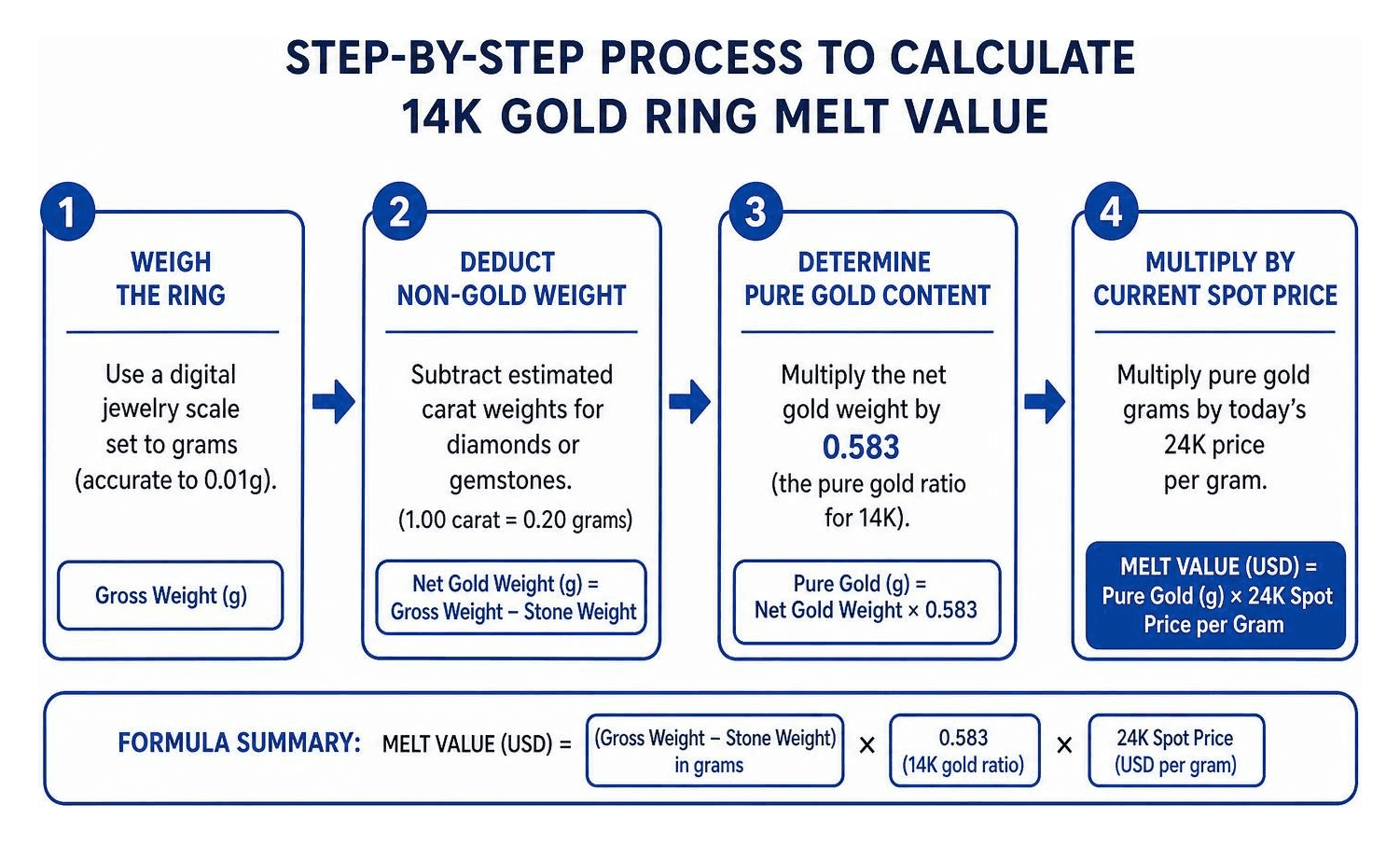
Weigh the ring: Use a digital jewelry scale set to grams (accurate to 0.01g).
Deduct non-gold weight: Subtract estimated carat weights for diamonds or gemstones (1.00 carat = 0.20 grams).
Determine pure gold content: Multiply the net gold weight by 0.583 (the pure gold ratio for 14K).
Multiply by current spot price: Multiply pure gold grams by today’s 24K price per gram.
For example, suppose you have a 14K gold ring that weighs 6.00 grams on a digital scale, mounted with a 0.50ct natural center diamond:
Step 1: Total ring weight = 6.00 grams
Step 2: Deduct diamond weight (0.50ct = 0.10g) = 5.90 grams net gold weight
Step 3: 5.90g x 0.583 = 3.44 grams of pure gold
Step 4: At $139.61/g 24K spot price ($4,342/oz), 3.44g x $139.61 = $480.26 raw gold melt value
To estimate combined secondary offers, you can utilize our online diamond resale value calculator to combine metallic melt totals with current wholesale diamond secondary yields.
Estimating Accent Diamond and Center Stone Value
Once you know your ring’s base metal value, calculate the market value of the stones. Center diamonds and smaller "melee" accent diamonds are appraised using distinct pricing models.
To calculate stone values, we look at:
Melee Accent Diamonds: Small round or baguettes weighing under 0.10 carats each are usually priced collectively per carat ($150–$300 per carat on the secondary wholesale market for natural stones). A pave band with 0.35ctw of accent diamonds adds roughly $50–$105 in wholesale secondary stone value.
Center Diamonds: Single stones weighing 0.50 carats or larger are evaluated individually using wholesale rapaport-style price matrices based on cut, color, and clarity.
To explore current single-stone benchmarks, you can check our guide to calculate diamond price figures or review our general breakdown on how much is a diamond worth across standard carat tiers.
Scrap Value vs. Resale Value: What Can You Expect?
When liquidating a 14K gold diamond ring, you will encounter two primary pricing tiers: scrap value and resale value.
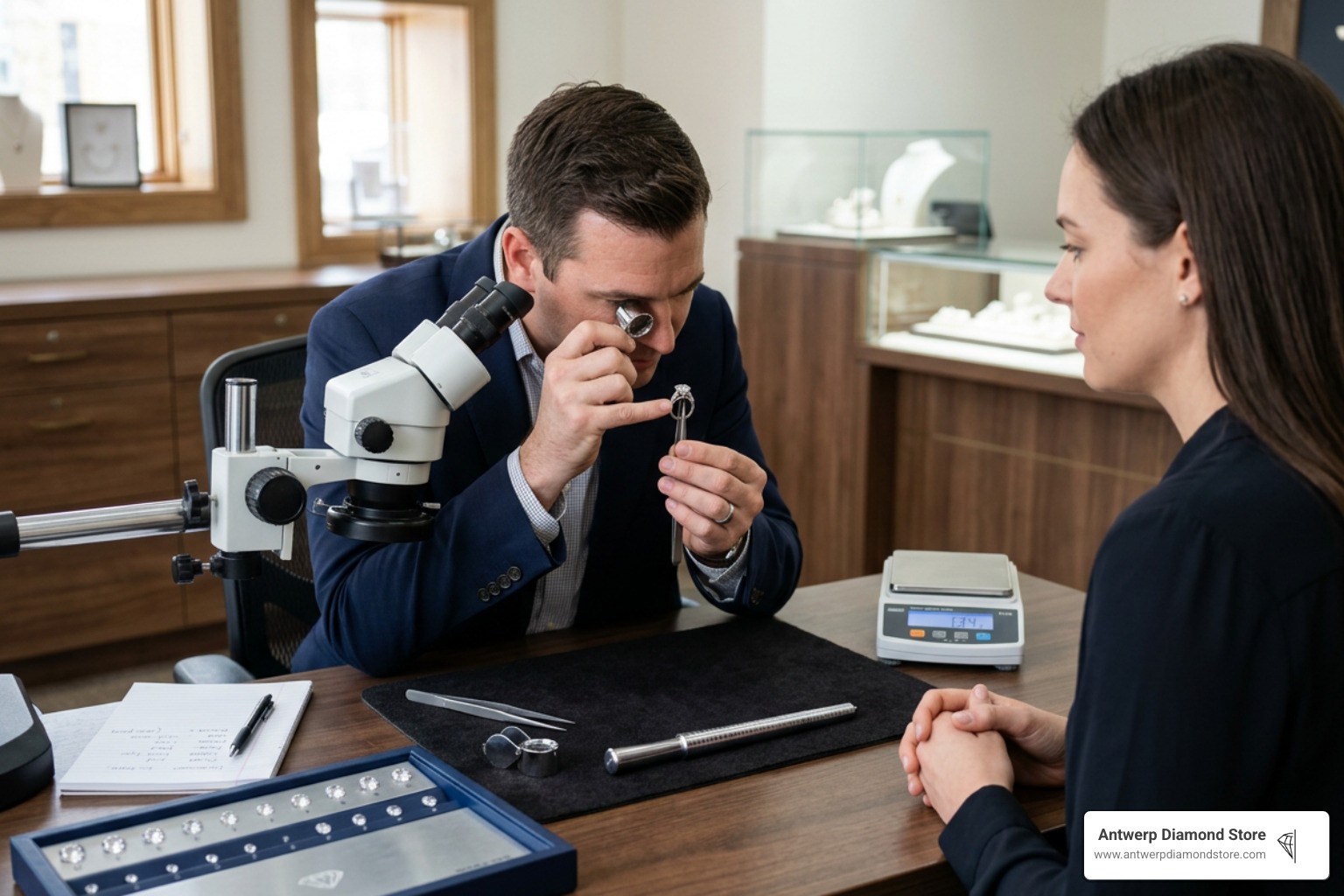
Scrap (Melt) Value: The raw payout offered by scrap metal refineries or pawn brokers who plan to melt down the setting. Scrap buyers typically offer 70% to 80% (or up to 90% from specialized online refineries) of total gold melt value. Diamond value is often ignored or heavily discounted in scrap offers.
Resale (Intact) Value: The price paid by luxury jewelry buyers, estate dealers, or private buyers who intend to resell the piece as fine finished jewelry. This payout factors in gold weight, center diamond quality, designer branding, and secondary consumer demand.
Articles such as How Much Is a 14K Gold Ring Worth: Factors That Affect Its Value highlight that retail jewelry stores routinely apply a 200% to 400% markup to cover manufacturing, distribution, marketing, and store overhead. Consequently, a ring purchased at retail for $3,000 will rarely fetch $3,000 on the secondary market unless gold spot prices have climbed dramatically since purchase.
How Historical Inflation and Gold Spot Prices Affect 14 Karat Gold Ring with Diamonds Value
Gold spot prices have surged over the past several decades. Consider a 14K gold diamond ring purchased in 1992 for $1,000:
In 1992, gold traded at approximately $330 to $350 per troy ounce. Today, in August 2026, spot gold trades near $4,342 per troy ounce—more than a 12-fold increase in raw metal value.
Because of this historic rise in the gold silver price, a heavy 14K gold band bought in 1992 may possess scrap metal value today that rivals or exceeds its original 1992 retail purchase price, effectively neutralizing retail store depreciation.
Brand Name, Custom Design, and Vintage Craftsmanship
In addition to gold weight and stone grades, artistic craftsmanship and brand equity add measurable secondary value:
Signature Luxury Brands: Pre-owned rings from iconic houses like Tiffany & Co., Cartier, or Van Cleef & Arpels hold remarkable premiums. If you are selling tiffany jewelry, the ring will sell far above its simple metal and diamond melt value due to brand prestige.
Vintage and Estate Pieces: Unique Art Deco, Victorian, or Retro pieces are highly sought after by collectors. Knowing how to sell antique jewelry allows you to command a premium for historic artistry rather than scrap rates.
Custom Mounts: Custom settings showcase exceptional bench labor, but unbranded custom mountings rarely retain labor costs on resale unless sold directly to an end consumer.
Where to Sell Your 14K Gold Diamond Ring for Maximum Cash
Choosing the right selling channel is the single most important factor in maximizing your final cash payout.
Top sales channels for 14K gold diamond rings include:
Specialized Estate Jewelry Buyers (e.g., Antwerp Diamond Store): Offer the highest cash payouts for intact fine jewelry because they evaluate natural diamonds, gold weight, and brand value simultaneously.
Online Diamond Buyers: Convenient mail-in options offering competitive payouts, provided you work with reputable, fully insured valuation services.
Local Fine Jewelers: Good local options for trade-in credits or consignment listings.
Pawn Shops: Excellent for fast, emergency cash payouts, but typically offer lower returns (often 50% to 70% of gold melt value with minimal diamond valuation).
Auction Houses: Ideal for high-end luxury pieces, though seller commissions and extended payment timelines apply. Recent auction data for items like a 14k Yellow Gold 1.14cts. Diamond Ring show median hammer prices around $1,400 for 1.14ctw natural pieces depending on diamond clarity.
Online Buyers vs. Local Buyers
Understanding the trade-offs between selling channels ensures a smoother transaction:
Buyer Channel | Expected Payout % | Primary Advantage | Main Disadvantage |
|---|---|---|---|
Pawn Shops | 50% - 70% of melt | Immediate cash on the spot | Lowest overall offers |
Local Gold Buyers | 65% - 80% of melt | Convenient local walk-in | Limited diamond evaluation expertise |
Luxury Estate Buyers | 80% - 92%+ of true value | Maximum payout for gold & diamonds combined | Requires scheduling private evaluation |
Direct Consignment | 70% - 85% of retail | Higher potential final payout | Takes weeks or months to sell |
When evaluating the best place to sell gold or looking to sell diamond ring online, choose buyers who provide transparent weight and diamond grading breakdowns rather than a single lump-sum figure.
Professional Appraisals and Authentication
Before selling an important diamond ring, distinguish between an insurance appraisal and a cash valuation appraisal:
Insurance Appraisals: Detail the estimated cost to replace the item brand-new at a retail store. These figures include retail markups and labor, usually reflecting numbers 100% to 200% higher than immediate cash resale offers.
Cash Resale Valuations: Conducted by an independent jewelry appraiser or certified gemologist to establish liquid fair market value.
Learning how to appraise jewelry ensures you enter negotiations with realistic expectations based on current market dynamics.
Frequently Asked Questions About 14K Gold Diamond Rings
How much is a typical 14K gold ring with small diamonds purchased in 1992 worth today?
A typical 14K gold ring purchased in 1992 for $1,000 weighing roughly 4 grams with small accent "melee" diamonds (0.25ctw) is worth $300 to $550 in immediate cash value today.
Key factors driving this valuation:
Gold Appreciation: Spot gold rose from ~$330/oz in 1992 to ~$4,342/oz in 2026. The 4-gram 14K gold mounting contains ~$190 in raw melt value alone.
Accent Diamond Liquidity: Small accent diamonds carry modest wholesale secondary value ($40–$80 total).
Retail Depreciation Offset: While the original store markup from 1992 is gone, 34 years of gold price inflation fully offsets the initial retail margin loss.
What is the difference in value between 10K, 14K, and 18K gold diamond rings?
The fundamental difference lies in pure gold content:
10K Gold (41.7% pure): Lowest scrap melt value per gram (~$58.21/g at $4,342/oz spot), highly durable.
14K Gold (58.3% pure): Standard fine jewelry balance (~$81.43/g melt value), optimal scratch resistance and rich color.
18K Gold (75.0% pure): Luxury standard (~$104.70/g melt value), softer metal requiring careful prong inspection over time.
For a comprehensive comparison of gold purities and durability, read our detailed guide on what is the difference between 14 k and 18 k gold.
Why is resale value lower than the original store appraisal or purchase price?
Resale values are lower than retail store appraisals because retail prices factor in significant commercial costs:
Jewelry Manufacturing & Labor: Custom casting, gem setting, and polishing costs.
Retail Overhead: Physical storefront rent, sales commissions, marketing, and corporate profits.
Insurance Inflation: Insurance appraisals reflect high-end replacement costs, not immediate secondary liquid cash value.
Understanding how to sell diamonds empowers you to look past artificial appraisal paperwork and focus on wholesale metal and diamond spot realities.
Conclusion
Calculating your 14 karat gold ring with diamonds value requires separating the setting from its gems. With 14K gold commanding approximately $81.43 per gram at current spot prices ($4,342/oz in August 2026), your setting provides a solid, guaranteed financial baseline. Combining that metal value with an accurate assessment of your center stone's 4Cs ensures you get a fair offer.
At Antwerp Diamond Store, we take the stress out of liquidating fine jewelry. Located in Atlanta, GA, we offer private, appointment-only consultations, transparent market-based valuations, and immediate cash payouts with no hidden fees or delays.
Ready to discover the true cash worth of your 14K gold diamond ring? Schedule your free, confidential valuation today through our Private Jewelry Appraisal and Buying Services!