
Diamond Ring Prices: What You Can Expect in 2026
A diamond ring price can range from under $1,000 to well above $15,000. The biggest drivers are the diamond's carat weight, cut, color, clarity, shape, and the metal used for the setting.
For a useful 2026 benchmark:
Ring type | Typical price range |
|---|---|
1-carat lab-grown diamond ring | $900-$1,800 |
1-carat natural diamond ring | $4,000-$7,000 |
2-carat lab-grown diamond ring | $2,000-$4,500 |
2-carat natural diamond ring | $12,000-$20,000 |
The U.S. average engagement ring spend is $5,200, based on The Knot's 2024 Jewelry and Engagement Study. But there is no required number. A smart budget is one that fits your finances and buys the quality details you can actually see.
In 2026, higher gold costs have pushed up setting prices, while lab-grown diamonds remain far less expensive than comparable natural diamonds. Whether you want a simple solitaire, a bold halo, or a certified natural diamond ring, comparing the stone, setting, and full ring price is the clearest way to find real value.
What Determines a Diamond Ring Price in 2026?
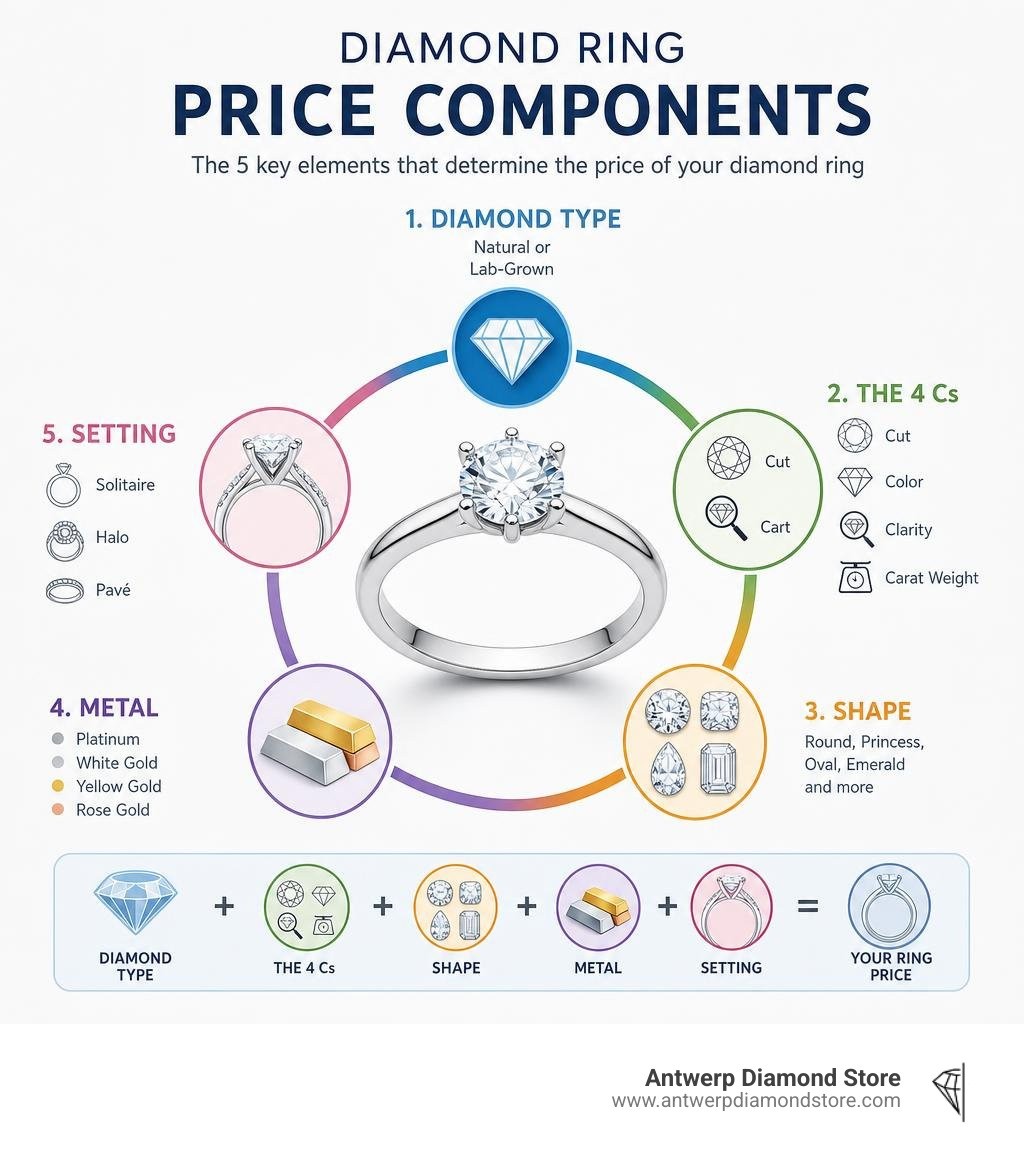
Understanding the market valuation of fine jewelry comes down to stripping away retail hype and looking directly at raw material value, manufacturing labor, and retailer markup. A complete diamond ring consists of two distinct components: the center stone (and any accent gems) and the precious metal mounting. Each is priced according to very different economic rules.
The wholesale diamond trade evaluates loose gems based on global supply dynamics, gemological rarity, and market indices. Meanwhile, mountings reflect fluctuating precious metal commodity prices and jewelry manufacturing labor. When buying directly or evaluating a ring in today's landscape, knowing how these individual elements come together prevents you from overpaying for brand names rather than tangible quality.
The 4 Cs and Diamond Valuations
Every diamond's primary valuation is rooted in the 4 Cs established by the Gemological Institute of America: Cut, Color, Clarity, and Carat Weight.
Cut Grade: Cut precision is the single most important factor determining a diamond's brilliance, fire, and visual scintillation. A masterfully cut diamond reflects light back out through the top facets, making it appear brighter and often larger. An inferior cut leaks light out the sides or bottom, leaving the stone looking dull and lifeless regardless of its size.
Color Grade: Gemologists grade white diamonds on an alphabetical scale from D (completely colorless) down to Z (light yellow or brown). Understanding a diamond color grades chart allows you to find the sweet spot between G and I, which appear completely icy white to the naked eye once set into metal, without paying the steep premium of D–F grades.
Clarity Grade: Clarity measures the presence of natural internal characteristics (inclusions) and surface blemishes. Learning what is an inclusion in a diamond is essential for practical budgeting. Eye-clean diamonds in the VS1 to SI1 ranges look identical to flawless stones under everyday viewing conditions while saving thousands of dollars.
Carat Weight: Diamond prices do not scale in a simple straight line; they jump exponentially at critical weight thresholds (such as 1.00 ct, 1.50 ct, 2.00 ct, and 3.00 ct). A 2-carat stone can cost three to four times more than a 1-carat diamond of equivalent quality because large gem-quality crystals are vastly rarer in nature.
To protect your investment, independent certification is non-negotiable. Knowing what is GIA diamond certification ensures your natural diamond has been rigorously graded by an unbiased laboratory rather than carrying an inflated in-house appraisal.
How Precious Metals Influence Diamond Ring Price
The precious metal chosen for your setting makes up the secondary component of your total ring price. While the diamond usually commands the lion's share of the budget, metal costs have become a far more prominent consideration in 2026.
Gold prices surged to historic highs of around $4,700 per ounce in May 2026, up sharply from $2,700 in early 2025. This macroeconomic run has increased setting prices by 40% to 50% across the fine jewelry industry:
14K Gold (White, Yellow, Rose): Composed of 58.3% pure gold alloyed with durable metals like nickel, copper, or silver. It remains the most popular choice for everyday wear due to its superior scratch resistance and relatively accessible price point.
18K Gold: Containing 75% pure gold, 18K alloys offer a richer, deeper yellow tone and a heavier luxury feel in the hand, though they carry a higher price tag and are slightly softer than 14K.
Platinum (Pt950): Naturally white, dense, and hypoallergenic, platinum does not require periodic rhodium replating. Because platinum is denser and used in higher purity (typically 95%), platinum mountings command an $800 to $1,500 premium over comparable gold settings.
Diamond Shapes and Cutting Waste
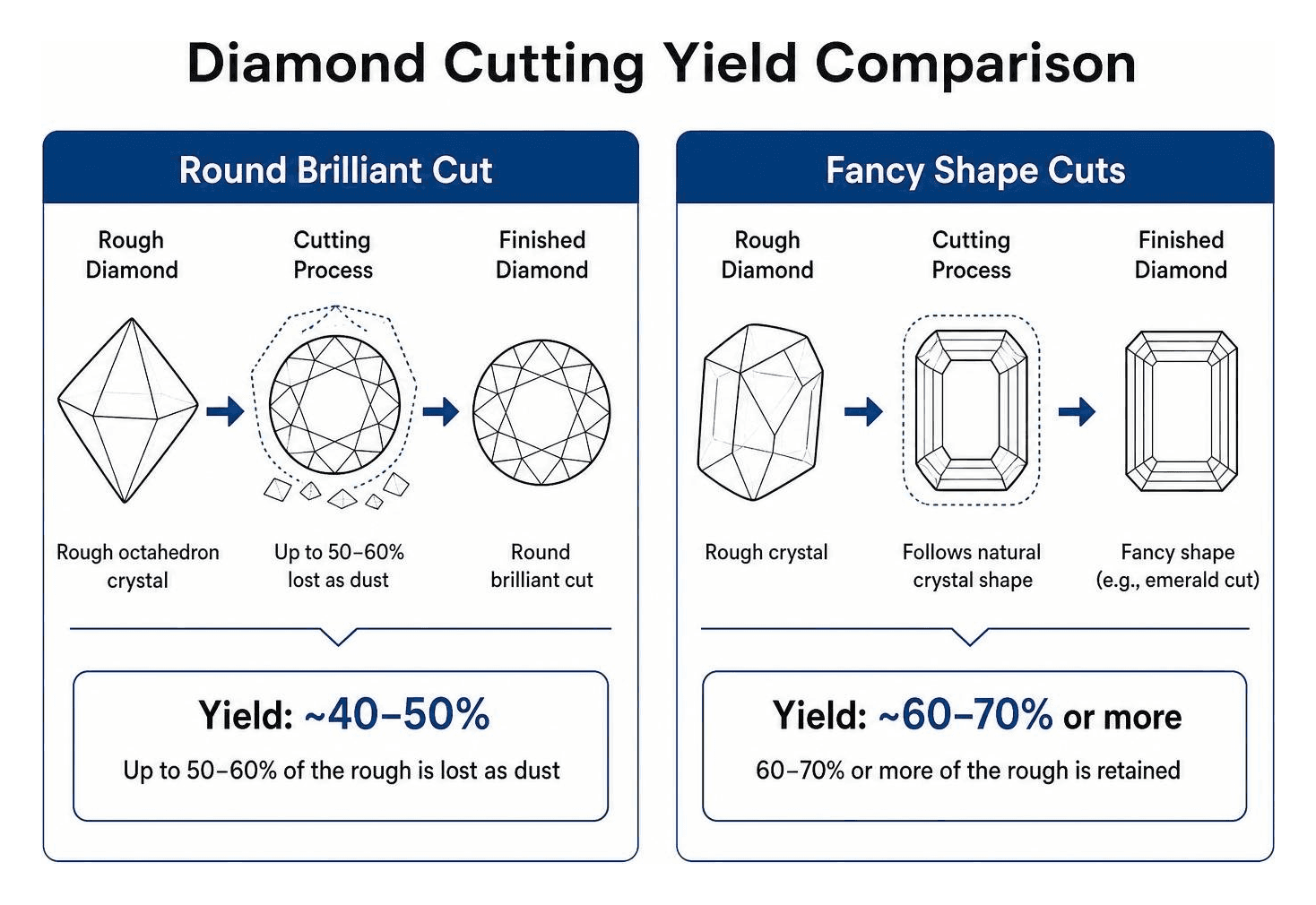
The geometric silhouette of your center stone heavily influences its price per carat. The classic round brilliant cut is the most expensive shape in the diamond market for two reasons: enduring consumer demand and substantial rough crystal loss during cutting.
When diamond polishers fashion a round brilliant stone from rough octahedron crystals, up to 50–60% of the original rough diamond is lost as dust. By contrast, "fancy shapes" such as oval, cushion, emerald, pear, and princess cuts follow the natural crystal growth much more closely, yielding 60–70% or more from the rough diamond.
Consequently, fancy shapes generally cost 15% to 40% less per carat than round brilliants of equivalent weight and quality. Furthermore, elongated fancy cuts like ovals, marquises, and emerald shapes distribute their carat weight across a wider top surface, creating the optical illusion of a larger diamond on the hand for less money.
Lab-Grown vs. Natural Diamonds: Price Comparison and Value
The modern fine jewelry landscape provides buyers with two distinct paths: earth-mined natural diamonds formed over billions of years, and lab-grown diamonds created using advanced High Pressure High Temperature (HPHT) or Chemical Vapor Deposition (CVD) technologies.
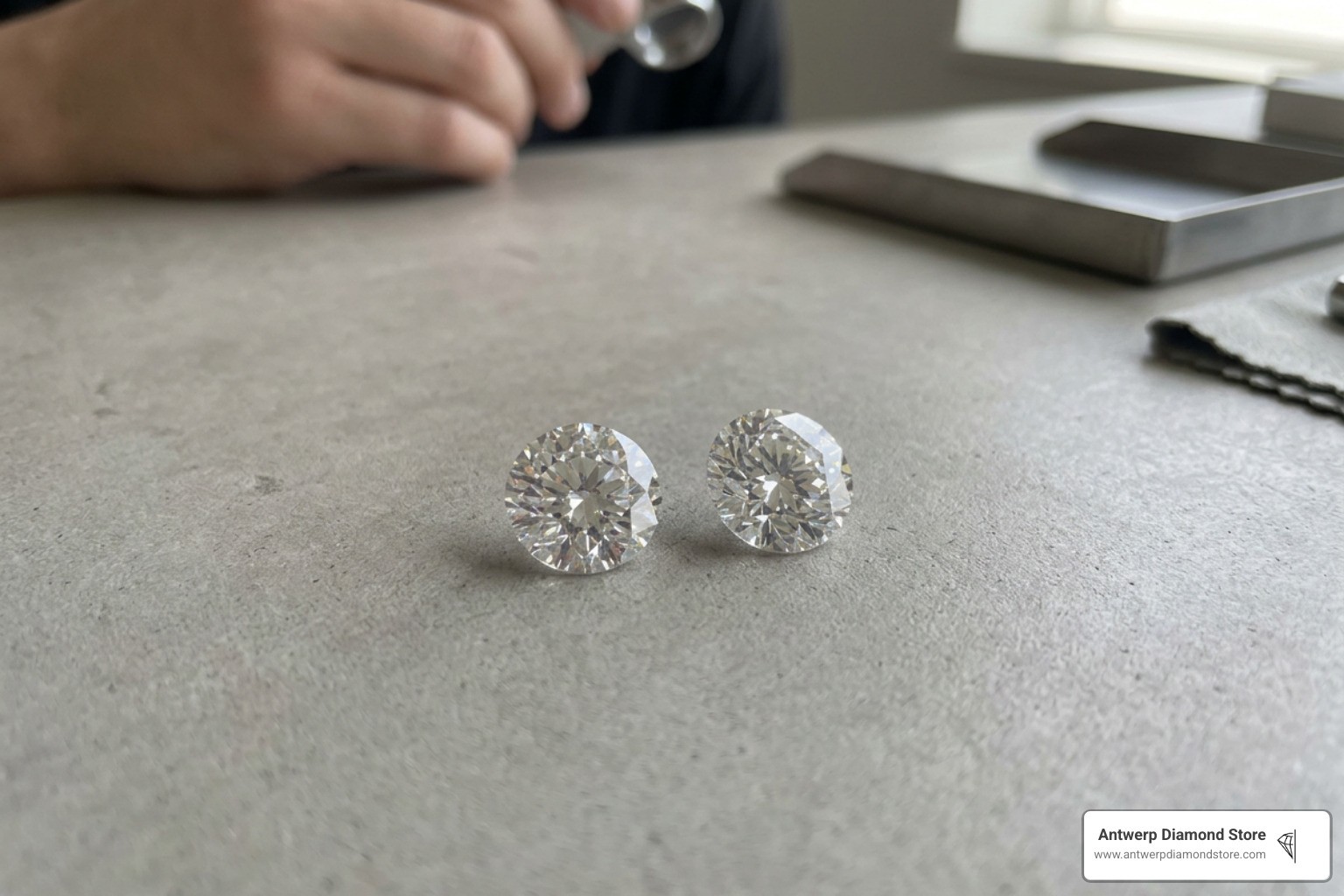
Chemically, physically, and optically, lab-grown diamonds are identical to mined diamonds. However, their market economics are entirely different. Because laboratory production can scale continuously with technological advancements, lab-grown diamond prices have fallen 60% to 75% since 2020. In 2026, lab-grown diamonds typically cost 70% to 80% less than equivalent natural stones.
Average Diamond Ring Price by Carat Weight
To illustrate the vast pricing divergence across origins, here is how complete diamond engagement rings (including an average 14K gold solitaire setting) compare in the 2026 market:
Carat Weight | Lab-Grown Diamond Ring (VS2 / G / Excellent) | Natural Diamond Ring (VS2 / G / Excellent) | Typical Price Difference |
|---|---|---|---|
1.00 Carat | $900 – $1,800 | $4,000 – $7,000 | ~75% Lower |
2.00 Carat | $2,000 – $4,500 | $12,000 – $20,000 | ~78% Lower |
3.00 Carat | $4,500 – $9,000 | $25,000 – $42,000 | ~80% Lower |
For natural diamonds, tracking the 1 carat diamond gold ring price reveals fair market stone valuations between $2,630 and $4,031 (averaging roughly $3,250 for a loose 1 ct round brilliant). Stepping up to larger natural stones shows exponential scaling, where the 3 carat round diamond price routinely exceeds $25,000 solely for the center stone.
Long-Term Value and Resale Retainment
When deciding between natural and lab-grown options, long-term financial retainment is a crucial consideration.
Natural diamonds possess historical rarity and intrinsic secondary market value. If you ever decide to sell or trade up, a quality natural diamond typically retains 40% to 60% of its wholesale baseline value on the secondary market, depending on market conditions and certification. When assessing how much is a diamond worth in pre-owned channels, utilizing a dedicated diamond resale value calculator shows steady support for natural, GIA-certified gems.
In contrast, lab-grown diamonds should be viewed as consumer technology purchases rather than asset-holding fine jewelry. Because manufacturing capabilities expand each year, the wholesale cost of producing synthetic stones continues to decrease. As a result, lab-grown diamonds retain only 10% to 20% of their initial purchase price when resold.
Top Engagement Ring Styles for Every Budget Tier
Choosing a setting style is a balance between personal aesthetics, lifestyle durability, and budget allocation.
Classic Solitaire Settings
The quintessential solitaire setting highlights the center diamond with clean, unadorned elegance. By focusing the eye solely on the center stone, solitaires keep metal labor costs low and direct the maximum share of your budget toward diamond size and quality.
Four-Prong Mountings: Maximize light entry into the stone from all angles, offering an open, airy profile.
Six-Prong Mountings: Offer enhanced structural security for larger diamonds, providing a classic round outline.
Bezel Settings: Encase the diamond's perimeter in a protective rim of precious metal. Bezel designs prevent snagging, protect delicate girdles, and fit active lifestyles perfectly.
Radiant Halo and Side-Stone Designs
For buyers looking to maximize visual presence without purchasing a massively heavy center stone, multi-stone settings deliver exceptional value.
Halo Settings: A perimeter of delicate pavé-set accent diamonds encircles the center stone. A halo can make a 1-carat center diamond appear visually equivalent to a 1.5-carat or 2-carat stone on the hand, saving thousands over buying a larger single diamond.
Hidden Halos: A subtle circle of micro-diamonds sits directly beneath the center stone's girdle, adding sparkle when viewed from the profile.
Three-Stone (Trilogy) Rings: Flanking the center diamond with side stones (such as baguettes, pears, or rounds) spreads brilliance across the entire width of the finger.
Certified Rings Under $3,000
Approximately 33% of couples set their engagement ring budget under $3,000. Within this price bracket, buyers have compelling choices depending on their priorities:
Natural Diamond Solitaire: A budget of $2,000 to $3,000 comfortably secures a beautiful 0.70 ct to 0.85 ct natural, eye-clean diamond in a classic 14K gold band. Seeking a GIA certified engagement ring in this category guarantees you get verified quality without paying retail markups.
Large Lab-Grown Ring: If maximum carat presence is your priority, a $1,500 to $2,500 budget allows for a 1.5 ct to 2.0 ct lab-grown diamond set in an intricate pavé or halo mounting.
Smart Buyer's Guide: How to Maximize Ring Value Without Overspending
Getting the absolute most brilliance out of your budget requires strategic trade-offs across the 4 Cs.
Prioritizing Cut Quality Over Clarity and Color
The single biggest insider rule in diamond buying is simple: never compromise on cut quality. Cut is the engine of a diamond's sparkle. A stone with an Excellent or Ideal cut will mask minor body color and hide faint internal inclusions through high light refraction.
Cut: Insist on "Excellent" (GIA) or "Ideal" (IGI) cut grades.
Color: Stick to the Near-Colorless range (G, H, or I). These stones face up pure white when set in white gold, yellow gold, or platinum.
Clarity: Aim for VS2 or SI1. Always confirm the stone is "eye-clean," meaning no inclusions are visible to the naked eye at a standard viewing distance of 8 to 10 inches.
Carat: Adjust carat weight last once your cut and eye-clean baseline are established.
Learning how gemologists calculate diamond price by evaluating price-per-carat matrices lets you identify diamonds that offer the greatest visual beauty per dollar spent.
Practical Budgeting and Avoiding Costly Mistakes
Buy Shy of Major Carat Marks: Purchase diamonds weighing just below major weight thresholds (e.g., 0.90–0.95 ct instead of a full 1.00 ct, or 1.90 ct instead of 2.00 ct). These "shy" stones offer a 15% to 25% price discount with zero perceptible difference in millimeter diameter.
Select Fancy Shapes: Choose oval, pear, radiant, or cushion shapes to enjoy a 20% to 40% discount per carat compared to round brilliant diamonds.
Bypass Retail Storefront Markups: Traditional brick-and-mortar chain retailers frequently add 100% to 300% markups to cover extensive overhead, advertising, and retail inventory costs. Sourcing directly or purchasing pre-owned luxury pieces delivers far superior value.
Ditch Arbitrary Salary Rules: Old marketing concepts suggesting you spend "two to three months' salary" on a ring are completely obsolete. A realistic, responsible budget is one that avoids high-interest debt and aligns with your overall financial picture.
Frequently Asked Questions About Diamond Ring Prices
What is the national average cost of an engagement ring in 2026?
The national average engagement ring cost in the United States is approximately $5,200 according to industry data from The Knot's Jewelry & Engagement Study. However, actual spending varies widely by region and personal financial goals: roughly 33% of couples spend under $3,000, while approximately 5% invest $15,000 or more.
Why are engagement rings more expensive in 2026?
While natural diamond prices have experienced moderate corrections (with round natural diamonds declining roughly 6.6% over the past year) and lab-grown diamonds have dropped in cost, the prices of precious metals have skyrocketed. Gold climbing toward $4,700 per ounce has driven up the cost of raw ring mountings by 40% to 50%, alongside rising specialized bench-jeweler labor rates.
Can you visually tell the difference between lab-grown and natural diamonds?
No. Even an experienced master jeweler or gemologist cannot tell a lab-grown diamond from an earth-mined diamond using a standard 10x jeweler's loupe or microscope. Because their chemical lattice, refractive index, and hardness are identical, distinguishing between them requires advanced laboratory spectroscopy equipment capable of analyzing microscopic crystal growth patterns and photoluminescence.
Conclusion
Finding the perfect diamond ring comes down to understanding what creates genuine value: precision cut quality, verified independent certification, and honest pricing free from retail inflation. Whether you choose the timeless rarity of an earth-mined diamond or the accessible scale of a lab-grown stone, making an informed purchase ensures your ring remains a treasured symbol for decades to come.
At Antwerp Diamonds, we provide transparent evaluations, fair market insight, and direct purchasing solutions for fine jewelry, luxury watches, and diamonds in Atlanta, GA. If you are evaluating a family heirloom or exploring how much to value a diamond ring on today's secondary market, our team provides discreet, private appointments and immediate payouts based on live global diamond market data.