
3 Carat Round Diamond Price: A Quick 2026 Guide
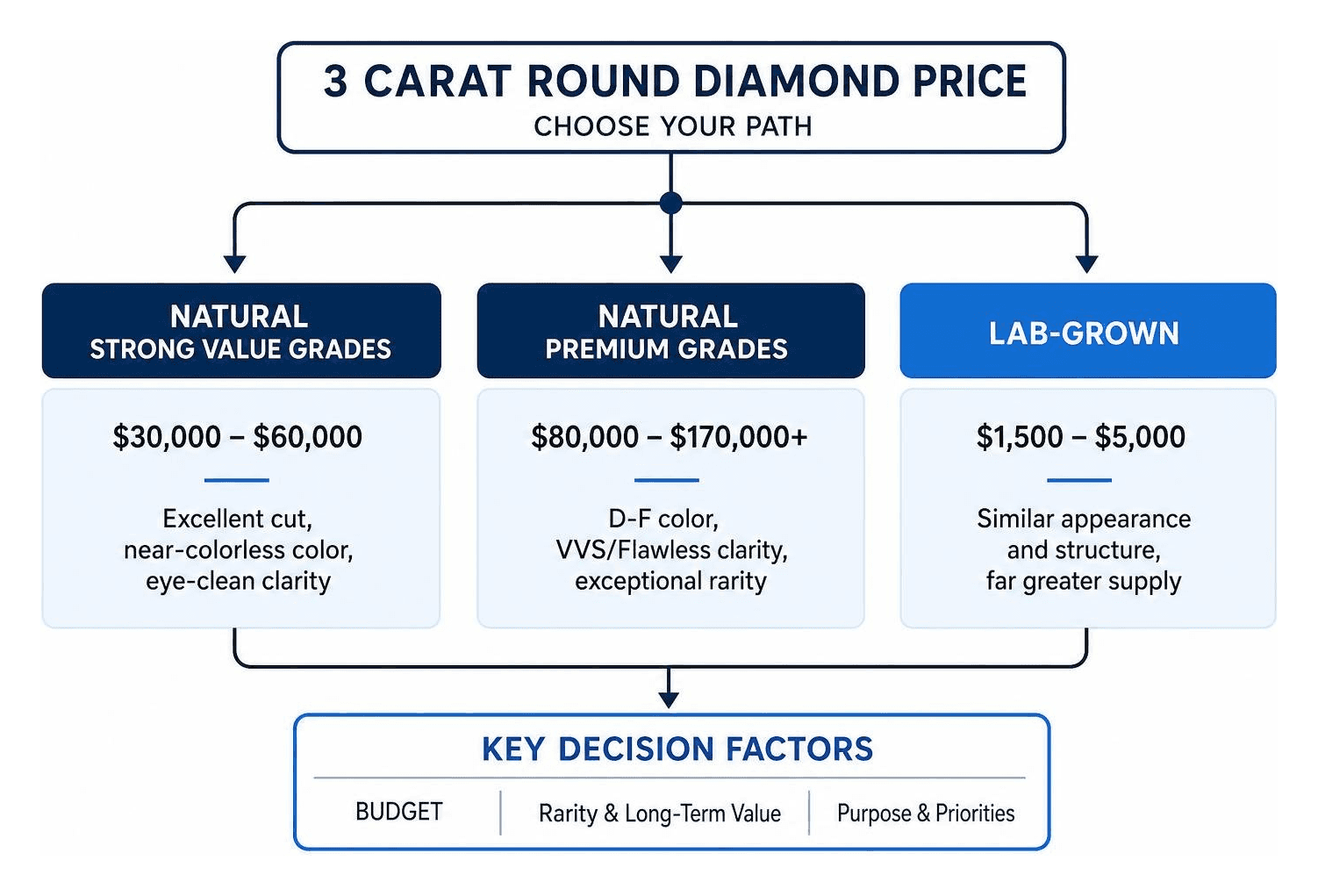
The 3 carat round diamond price in 2026 can range from roughly $20,000 to $170,000 or more for a natural diamond, while a comparable lab-grown diamond often costs about $1,500 to $5,000 as a loose stone.
3 carat round diamond type | Typical 2026 loose-diamond price | What drives the difference |
|---|---|---|
Natural, lower commercial grades | $20,000-$35,000 | Lower color or clarity, less desirable cut details |
Natural, strong value grades | $30,000-$60,000 | Excellent cut, near-colorless color, eye-clean clarity |
Natural, premium grades | $80,000-$170,000+ | D-F color, VVS/Flawless clarity, exceptional rarity |
Lab-grown | $1,500-$5,000 | Similar appearance and structure, far greater supply |
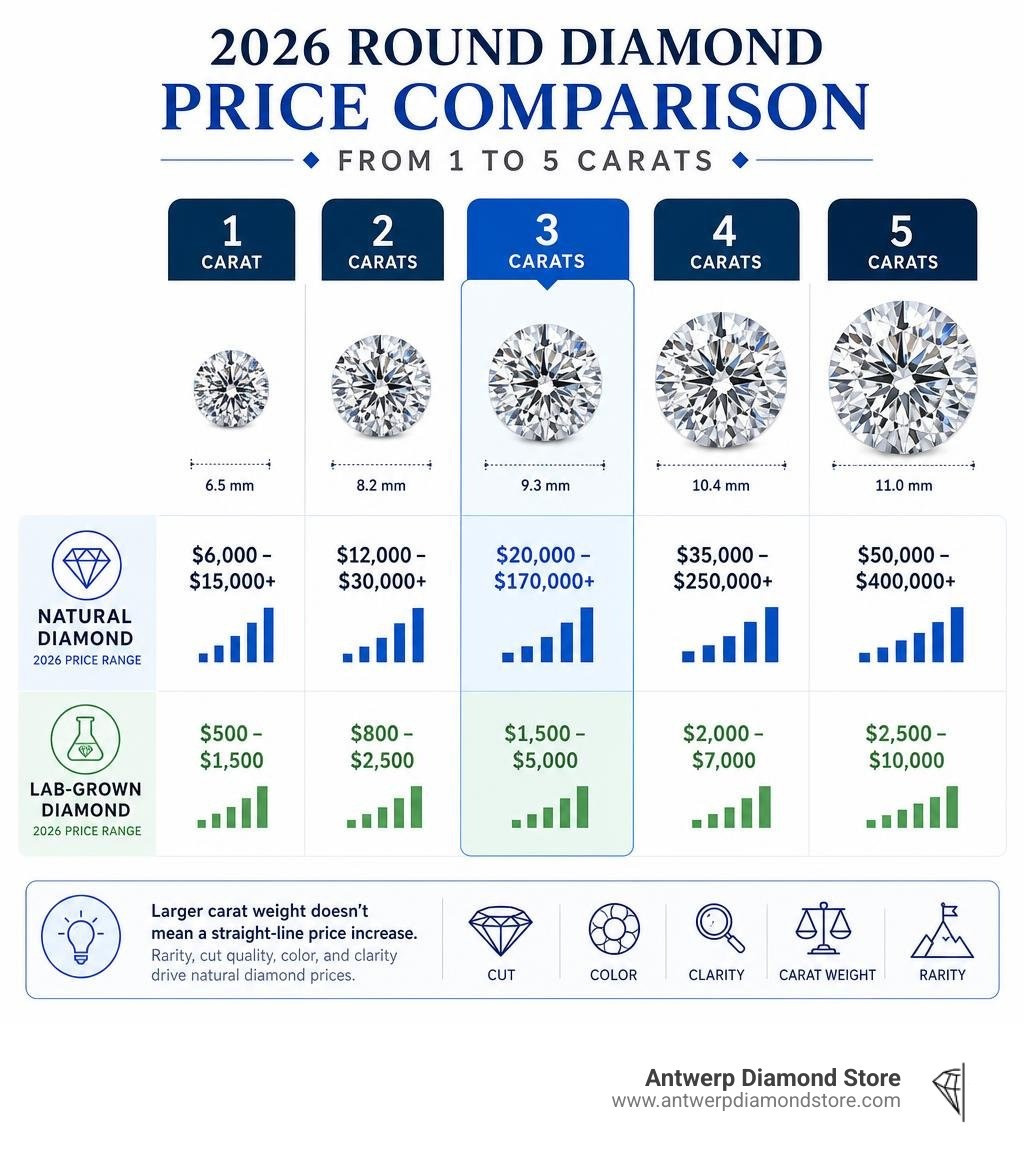
A 3 carat round brilliant is a true statement stone. It measures about 9.3 mm across, making it noticeably larger than a 1 carat round diamond at roughly 6.5 mm. Yet price does not rise in a straight line with carat weight. Large, clean natural rough diamonds are scarce, and round cutting sacrifices more material than many fancy shapes.
This guide compares what round diamonds from 1 to 5 carats can cost, why two diamonds of the same weight may be priced tens of thousands of dollars apart, and how to judge value beyond the label.
Understanding the 3 Carat Round Diamond Price Spectrum in 2026
When you step into luxury diamonds, crossing the 3 carat boundary changes the game completely. At this weight, a diamond is no longer just a classic piece of jewelry—it is a rare gemological achievement. In 2026, the 3 carat round diamond price reflects not only the physical size of the stone but also its extreme scarcity in nature. While a 1 carat diamond is relatively accessible, finding a rough diamond crystal in the earth capable of yielding a flawless 3 carat polished round brilliant happens less than once in a million times.
To give you a clear view of how carat weight impacts cost across both natural and lab-created markets, we have put together a pricing comparison across standard carat weights.
Carat Weight | Natural Round Diamond Range (2026) | Natural "Sweet Spot" Average | Lab-Grown Round Diamond Range (2026) |
|---|---|---|---|
1.00 Carat | $3,500 – $12,000 | $5,000 – $7,500 | $500 – $1,200 |
2.00 Carats | $14,000 – $45,000 | $20,000 – $28,000 | $1,000 – $2,500 |
3.00 Carats | $20,000 – $170,000+ | $39,559 (Overall Avg) / $50,000–$80,000 (Sweet Spot) | $1,500 – $5,000 |
4.00 Carats | $50,000 – $300,000+ | $85,000 – $140,000 | $2,500 – $8,000 |
5.00 Carats | $100,000 – $600,000+ | $180,000 – $320,000 | $4,000 – $12,000 |
As you can see from market data, the average natural 3 carat round diamond sells for roughly $39,559, with baseline commercial stones starting around $12,500 and museum-quality gems climbing well past $170,000. In recent months, natural 3 carat round diamond prices have softened slightly by around 1.67%, opening up excellent opportunities for smart buyers to lock in exceptional value.
Natural vs Lab-Grown 3 Carat Round Diamond Price Comparison
The single largest driver of the 3 carat round diamond price gap today is whether the diamond was mined from the earth or grown in a laboratory.
A natural 3 carat diamond took billions of years to form under intense mantle heat and pressure. Because nature yields so few large rough diamonds, natural stones hold intrinsic asset value. Historically, natural diamonds retain roughly 40% to 50% of their original purchase value on the pre-owned market, making them popular choices for milestone anniversaries, family heirlooms, and generational wealth preservation.
By contrast, lab-grown 3 carat diamonds are produced in controlled high-tech reactors over weeks. Because production facilities can scale manufacturing infinitely, lab-grown prices have dropped significantly, allowing buyers to acquire a 3 carat lab-grown round diamond for between $1,500 and $5,000. However, because supply is unlimited, lab-grown diamonds hold minimal secondary market resale value (typically 10% to 15%).
If you are evaluating your overall budget, reading our deep dive on how much is a diamond can help you decide whether natural long-term value retention or lab-grown upfront savings aligns better with your financial goals.
Key Factors Influencing 3 Carat Round Diamond Price Tiers
Why does a 3 carat round diamond cost so much more than three 1 carat diamonds combined? The answer lies in exponential pricing geometry.
When evaluating diamond costs, prices are calculated on a "per-carat" basis, and that per-carat multiplier jumps drastically at major weight thresholds:
A high-quality 1 carat natural round diamond might cost $6,000 per carat ($6,000 total).
A high-quality 3 carat natural round diamond can easily command $20,000 to $25,000 per carat ($60,000 to $75,000 total).
Furthermore, round cut diamonds carry a distinct price premium over every other shape on the market. Cutting a round brilliant from a rough diamond crystal wastes roughly 50% of the original stone's weight—far more than cutting an oval, cushion, or emerald shape. Combined with global consumer demand for the round brilliant’s unmatched optical symmetry, round diamonds trade at a 10% to 25% premium over fancy cut shapes. For a deeper breakdown on structural pricing tiers, consult the 2026 3 Carat Diamond Cost Guide.
The 4Cs Sweet Spot: Recommended Specs for a 3 Carat Round Diamond
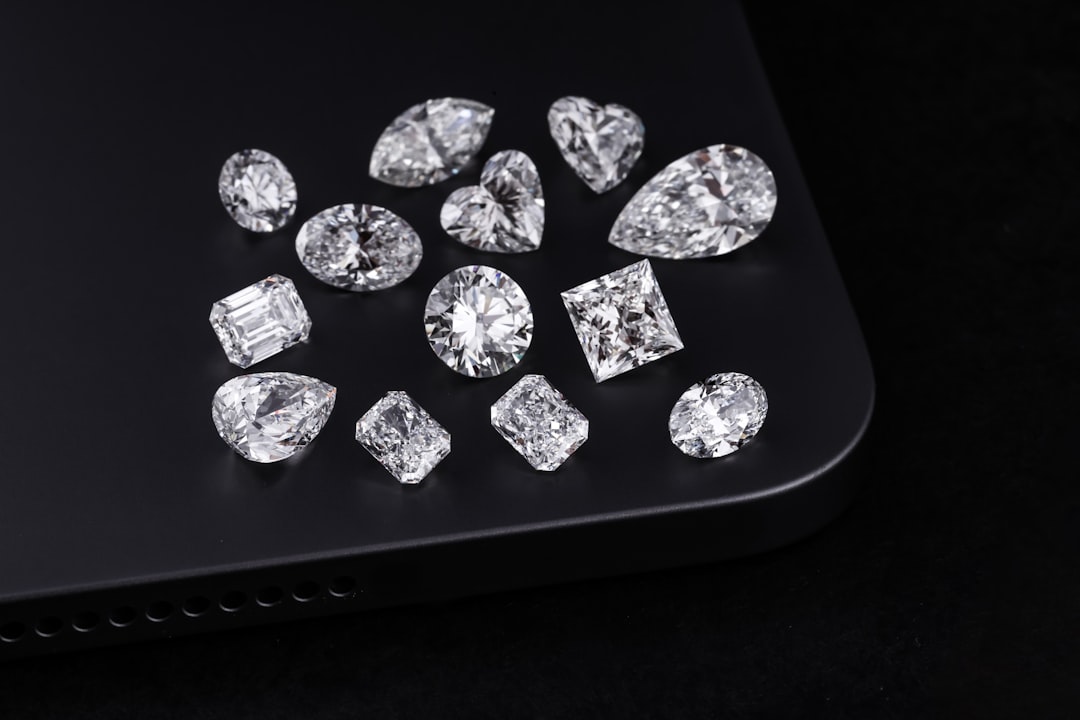
When shopping for a smaller diamond, minor imperfections in cut, color, or clarity are easily hidden by the stone’s small dimensions. At 3 carats, however, the diamond's top surface (the table facet) acts like a magnifying glass. Inclusions and faint color tints that would be invisible on a 1 carat stone become instantly noticeable to the naked eye.
To avoid overpaying for invisible perfection or accidentally buying a lifeless stone, we recommend aiming for the gemological "sweet spot." Always insist on an independent laboratory report from the Gemological Institute of America when investing in a natural stone—you can learn why in our guide to buying a gia certified engagement ring.
Why Cut Quality is Non-Negotiable
If there is one absolute rule when buying a 3 carat round brilliant diamond, it is this: never compromise on cut quality.
Cut quality governs how light enters the diamond, bounces across its internal facets, and bounces back to your eye as white flash (brilliance) and rainbow colors (fire). A 3 carat diamond with poor proportions will look dark, glassy, and smaller than its actual weight.
Cut Grade: Select GIA Excellent only.
Symmetry & Polish: Excellent / Excellent.
Depth Percentage: Ideal between 59.0% and 62.5%.
Table Percentage: Ideal between 54% and 58%.
Length-to-Width Ratio: 1.00 to 1.05 for perfect round symmetry.
When using advanced algorithmic cut scoring tools (such as StoneAlgo's 10-point scale), target a score of 7.5 or higher to ensure maximum optical performance.
Selecting Color and Clarity for Large Round Diamonds
Because a 3 carat round diamond measures approximately 9.3 mm in diameter, body color warmth and internal clarity flaws are far more prominent.
Color (Recommended: G to H): D, E, and F grades represent pure colorlessness but command massive rarity premiums (often adding $20,000 to $40,000 to the price). Drops to G or H color remain completely white to the naked eye, especially when set in platinum or white gold. If you plan to set your diamond in yellow or rose gold, you can comfortably select an I color without seeing any unwanted warm contrast.
Clarity (Recommended: VS1 to VS2): Clarity measures natural internal features. Before deciding on a grade, it helps to understand what is an inclusion in a diamond. While SI1 or SI2 clarity can be acceptable in 1 carat diamonds, a 3 carat table facet is large enough that SI inclusions frequently show face-up without magnification. Choosing VS1 or VS2 clarity guarantees an eye-clean stone while saving you tens of thousands compared to VVS or Flawless grades.
Smart Buying Strategies: Maximizing Value Without Sacrificing Beauty
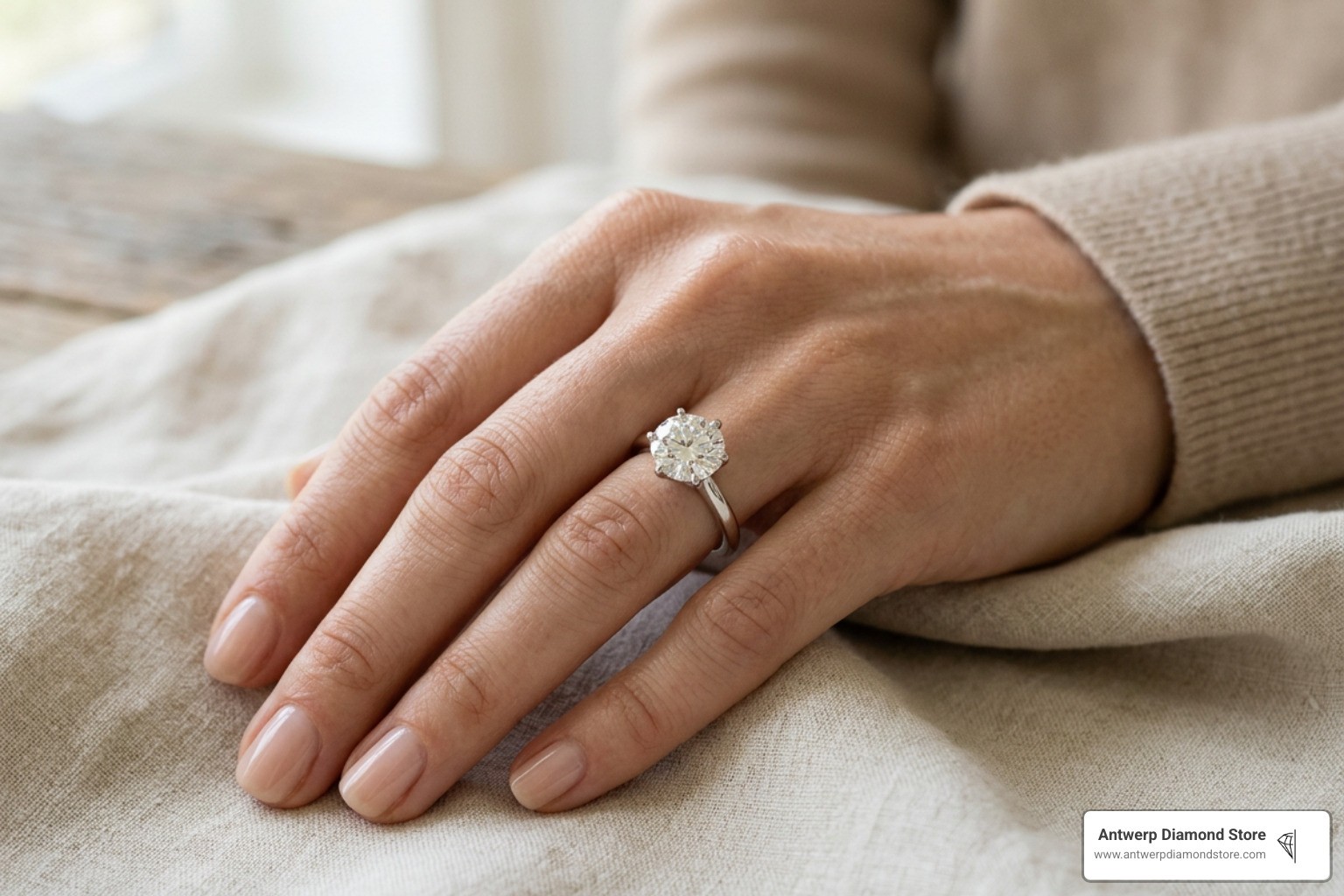
Purchasing a 3 carat round diamond is a significant financial commitment. Fortunately, several proven industry strategies can help you maximize your visual presence and stretch your budget by 15% to 30% without giving up an ounce of brilliance.
The Strategy of Buying Shy
One of the best-kept secrets in diamond buying is the concept of "buying shy." In the diamond industry, round numbers like 1.00, 2.00, and 3.00 carats are considered "magic milestone weights." Retail demand surges at exactly 3.00 carats, driving up per-carat costs exponentially.
By choosing a diamond in the 2.80 to 2.99 carat range, you avoid the steep psychological price jump of the 3.00 carat threshold. A 2.90 carat round diamond measures roughly 9.15 mm across, compared to 9.30 mm for a 3.00 carat stone. To the naked eye on a finger, they look identical—yet you can save between $8,000 and $15,000! You can use our practical tools to calculate diamond price variables across precise weight intervals before buying.
Comparing Round Brilliants to Fancy Shapes
If you want maximum finger coverage per dollar spent, it pays to compare round brilliants to elongated fancy shapes like ovals, marquises, or emerald cuts.
Diamond Shape | Relative Price vs 3ct Round ($41,800 Baseline) | Visual Dimensions (3 Carats) | Perceived Surface Size |
|---|---|---|---|
Round Brilliant | Baseline ($41,800 median) | ~9.3 mm x 9.3 mm | Standard Benchmark |
Oval Cut | 12% to 15% Less (~$36,900) | ~11.5 mm x 7.7 mm | 15% to 20% Larger |
Emerald Cut | 15% to 20% Less (~$33,800) | ~9.5 mm x 7.0 mm | Elegant & Wide |
Princess Cut | 20% to 25% Less (~$31,400) | ~8.1 mm x 8.1 mm | Compact & Deep |
Marquise Cut | Slight Premium / Equivalent (~$46,700) | ~14.0 mm x 7.0 mm | Maximum Length |
Because fancy shapes lose less rough material during cutting, shapes like oval, cushion, and emerald cuts offer lower prices while covering a larger visual percentage of the finger surface.
Settings, Daily Wearability, and Total Ring Costs
A 3 carat round brilliant diamond is a substantial piece of physical real estate on the hand. Measuring over 9 mm across and sitting several millimeters high off the finger, choosing the right mounting is essential for both aesthetic balance and structural security.
When budgeting for a complete engagement ring, you must account for both the center stone and the ring setting. For a comprehensive look at global retail expectations, review the guide on How Much Should You Pay for a 3 Carat Diamond Ring?.
Recommended Settings for Large Diamonds
Because a 3 carat center stone represents a significant investment, structural integrity should be your top priority.
Six-Prong Mountings: While four prongs are common on 1 carat rings, a 6-prong setting (such as a classic Tiffany-style solitaire) provides superior security. If one prong is accidentally snagged or bent during daily activity, five prongs continue to hold the diamond safely in place.
Platinum Prongs for Strength: Platinum is denser and far more durable than gold, making it the ideal metal choice for securing heavy center stones. Even if you choose an 18K yellow or rose gold band, request that the prongs holding the diamond be crafted from platinum.
Low-Profile & Cathedral Designs: High-peg solitaire settings snag easily on clothing, car doors, and purses. A cathedral setting or low-profile basket supports the center stone gracefully, keeping it flush to the hand for everyday comfort.
Complete Engagement Ring Cost Breakdown
To calculate the total cost of a 3 carat engagement ring, combine the loose diamond price with the mounting style and metal choices.
Setting Style | Typical Cost Range | Total Natural Ring Budget (Sweet Spot Diamond) |
|---|---|---|
Simple Solitaire (14K Gold) | $340 – $1,200 | $35,000 – $52,000 |
Platinum Cathedral / 6-Prong | $1,200 – $2,500 | $36,000 – $54,000 |
Pavé Band / Hidden Halo | $1,500 – $3,800 | $37,000 – $56,000 |
Three-Stone / Designer Setting | $3,500 – $8,500+ | $40,000 – $65,000+ |
When shopping for intricate mountings, pay close attention to whether the quoted price includes accent diamonds. Understanding what is ctw (Carat Total Weight) ensures you understand the difference between the weight of the main center diamond and the combined weight of all side accent stones.
Finally, after purchasing your setting and center stone, always obtain an independent gemological appraisal and add the piece to your jewelry insurance policy before daily wear.
Frequently Asked Questions About Round Diamond Prices
Is a 3 carat round diamond too large for everyday wear?
No, a 3 carat round diamond is not too large for daily wear, provided it is set in a well-designed, low-profile mounting. While it makes an unmistakable luxury statement and will attract attention, pairing it with a sturdy six-prong platinum basket or cathedral setting prevents snagging on clothing and keeps it secure during everyday activities.
How much larger does a 3 carat round diamond look compared to 1 or 2 carats?
Visual diameter grows significantly across carat weights, even though the weight triples:
1.00 Carat Round: ~6.5 mm diameter (occupies ~40% of a size 6 finger)
2.00 Carat Round: ~8.2 mm diameter (occupies ~50% of a size 6 finger)
3.00 Carat Round: ~9.3 mm diameter (occupies ~60% of a size 6 finger)
A 3 carat round diamond offers roughly 60% finger coverage on a standard ring size 6, making it visually striking from across a room.
Why do 3 carat diamonds cost significantly more per carat than smaller diamonds?
Natural diamond prices scale exponentially rather than linearly because large, gem-quality rough diamond crystals are exceptionally rare in nature. Mining statistics show that only 1 in 1,000,000 rough diamonds mined is large enough to yield a high-quality polished 3 carat stone. Because supply drops drastically while demand for luxury statement sizes remains high, the cost per carat doubles or triples compared to smaller stones.
Conclusion
Navigating the 3 carat round diamond price landscape requires balancing rarity, cut precision, and personal budget goals. In 2026, a natural 3 carat round brilliant in the sweet-spot quality range (G-H color, VS1-VS2 clarity, Excellent cut) represents an investment of roughly $30,000 to $60,000, while lab-grown alternatives offer an accessible entry point for buyers prioritizing initial savings over resale value retention.
By prioritizing cut quality above all else, targeting eye-clean clarity, and exploring value strategies like "buying shy" at 2.80–2.99 carats, you can secure an extraordinary 3 carat diamond engagement ring that radiates fire and brilliance for a lifetime.
If you already own fine jewelry, high-end timepieces, or luxury assets and want to estimate their current market value, explore our interactive diamond resale value calculator.
At Antwerp Diamond Store in Atlanta, GA, we buy luxury watches, fine jewelry, and designer handbags for cash. We offer free professional evaluations, transparent market-based offers, and instant payouts through private, discreet appointments with zero hidden fees. Contact Antwerp Diamond Store today to schedule your private consultation.