

GIA doesn't certify diamonds. It issues grading reports that describe a stone's characteristics, including the 4Cs, without assigning market value or guaranteeing beauty.
That distinction matters whether you're buying an engagement ring, selling an inherited stone, arranging an appraisal, or seeking a loan secured by jewelry. A GIA report gives buyers and sellers a reliable language for discussing a diamond, but it isn't a price tag, investment guarantee, or promise that every buyer will make the same offer.
Table of Contents
The Truth About GIA Diamond Certification
The phrase “GIA certified diamond” is common in jewelry stores and online listings, but it isn't technically precise. The Gemological Institute of America grades diamonds and issues GIA Diamond Grading Reports. GIA describes a diamond's measurable and observable characteristics, rather than certifying its monetary worth.
GIA's grading system became globally authoritative in 1953, when the institute formalized the International Diamond Grading System, introduced the D-to-Z color scale, and issued its first diamond grading reports. GIA says this system became the international jewelry industry's benchmark and helped standardize diamond evaluation around color, clarity, cut, and carat weight, the 4Cs. You can read the history in GIA's explanation of the development of the 4Cs and the D-to-Z color scale.
The carefully chosen D color grade illustrates the system's purpose. GIA selected D as the top colorless grade so the scale wouldn't inherit a prior market bias. That created a neutral grading language that could be used across major markets, including Atlanta, New York, Antwerp, and other international trading centers.
What a GIA report tells you
A report identifies and describes the stone. Depending on the report type, it can include:
The 4Cs: Color, clarity, cut, and carat weight.
Measurements: The diamond's dimensions and proportions.
Cutting style: The shape and facet arrangement described on the document.
Treatment disclosure: Any known treatment identified during examination.
Clarity plotting: A diagram showing relevant inclusions and blemishes.
Proportions information: A graphic that helps document how the diamond was cut.
GIA's diamond grading service information explains that a grading report is a standardized laboratory document, not a valuation certificate. For loose natural D-to-Z diamonds, GIA issues this report only when the stone weighs 0.15 carats or more.
What it doesn't guarantee
A GIA report doesn't guarantee that a diamond will look beautiful to every person. It doesn't promise a particular resale price, insurance value, loan amount, or investment return. It also doesn't guarantee that one buyer's offer will match another buyer's offer.
Practical rule: Treat the GIA report as the diamond's documented description, then use a separate appraisal or buyer evaluation for economic decisions.
For someone selling in Buckhead, Sandy Springs, Alpharetta, Roswell, Brookhaven, Midtown Atlanta, or elsewhere in Georgia, this distinction prevents a common disappointment. The report can support an offer by confirming what the stone is, but a buyer still considers condition, setting, brand, craftsmanship, demand, inventory needs, and the current resale market.
Breaking Down the GIA Diamond Grading Report
A GIA report works like a technical passport. It doesn't tell you what the diamond is worth, but it gives another professional enough consistent information to identify and compare it.

Start with the 4Cs
Carat weight records the diamond's weight, not how large it looks from above. Two diamonds with the same carat weight can have different face-up appearances because their proportions and cutting styles differ.
Color uses the D-to-Z scale for standard natural diamonds. D represents the top colorless grade, while grades farther down the scale show increasing body color. The color grade is assigned under controlled comparison conditions, not by looking at the stone under ordinary household lighting.
Clarity records the internal inclusions and surface blemishes visible during examination. GIA uses 10× magnification and considers the size, nature, number, position, and relief of those characteristics. Its scale runs from Flawless through Included. For a plain-language explanation of the marks that affect clarity, see what an inclusion is in a diamond.
Cut addresses how successfully a diamond's facets interact with light, rather than the diamond's outline alone. For standard round brilliant diamonds, GIA uses five cut grades: Excellent, Very Good, Good, Fair, and Poor.
Read the diagrams as identification tools
The clarity plot is similar to a map. It shows the location and type of clarity characteristics that GIA observed under magnification. The diagram doesn't mean you'll see every mark easily with your unaided eye. It helps a trained person compare the document with the physical stone.
The proportions graphic records important measurements and relationships within the diamond. Together, the plot and proportions information help distinguish stones that may appear nearly identical in a jewelry case.
The report also includes the report number. If the diamond has a laser inscription, that number may be recorded on the girdle, the narrow outer edge between the crown and pavilion. A loupe or specialized viewing equipment may be needed to inspect it.
Confirm whether the report applies
Before relying on a document, check the stone category and report type. The 0.15-carat threshold applies to loose natural D-to-Z diamonds under the GIA grading service information, and mounted jewelry may follow different submission and documentation practices.
A report's value comes from matching the paper to the stone. The report number, measurements, shape, cutting style, color, clarity, and plotted features should tell one consistent story.
The following video offers another visual introduction to how diamond grading information is presented:
How to Verify a GIA Report Is Authentic
A report number alone isn't enough. Fraudsters can copy a legitimate number onto an inaccurate document, and counterfeit inscriptions can make a different diamond appear to match the paperwork. GIA has publicly warned about fraudulent grading reports and counterfeit inscriptions, so verification deserves the same attention as the 4Cs.
Follow the online check
Begin with GIA's official report verification service. Enter the report number exactly as it appears on the document, then compare the resulting information with the physical diamond and the report in your possession.
Check the following details:
Report number: Confirm that the number produces a GIA record.
Shape and cutting style: Make sure the outline and facet arrangement correspond to the stone.
Measurements: Compare the recorded dimensions with the diamond being examined.
Color and clarity: Confirm that the grades match the report.
Plot and proportions: Compare diagrams with the physical features and measurements.
A matching online record is useful, but it isn't a substitute for inspecting the stone. The number can be copied, while the individual characteristics of the diamond are much harder to duplicate consistently.
Inspect the document and the stone
Genuine GIA documents incorporate security features, including micro-print lines, holograms, and security screens. These features can help identify suspicious paperwork, although a person who has doubts shouldn't rely on visual inspection alone.
Look for the laser inscription on the diamond's girdle when one is expected. A trained evaluator can use magnification to compare the inscription with the report number. The inscription should also correspond to the diamond's physical measurements and characteristics.
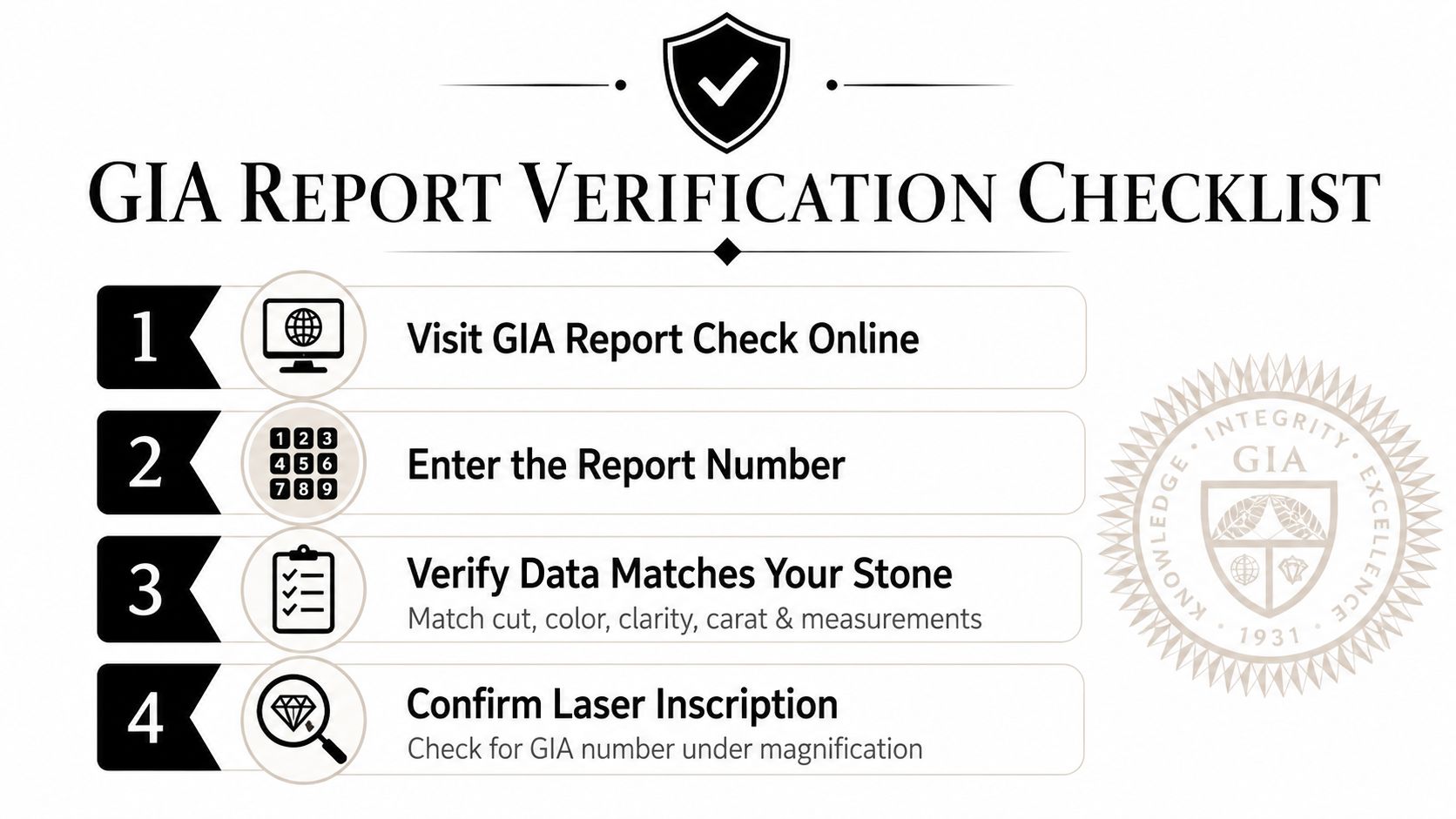
Before a transaction: Verify the report online, compare every listed characteristic, inspect the inscription under magnification, and ask for additional examination if anything conflicts.
If the diamond is part of an estate, has crossed international borders, or is being sold in a secondary-market transaction, document verification becomes especially important. Keep the original report, avoid altering it, and disclose any uncertainty to the buyer or appraiser. An independent jewelry appraiser can help separate report verification from a sales offer or insurance valuation.
Why GIA Grading Matters for Resale Value
A GIA report doesn't set the resale price. It makes the diamond easier to identify and compare, which can reduce uncertainty during an evaluation.
That matters because buyers don't purchase paper alone. They examine the stone, mounting, condition, brand, craftsmanship, market demand, and documentation. A report gives them a common starting point, while the physical inspection determines whether the diamond in front of them matches the description.
How the grades affect an offer
The 4Cs influence how a buyer assesses desirability and marketability. Cut can affect visible brightness and contrast. Color and clarity help position the stone within comparable inventory. Carat weight records the stone's weight, but it doesn't operate independently from proportions, shape, and appearance.
For round brilliants, GIA's cut scale runs from Excellent to Poor, as explained in GIA's diamond grading and sample report materials. Clarity characteristics are evaluated under 10× magnification, and the size, nature, position, color or relief, and quantity of inclusions or blemishes determine the clarity grade. Those documented characteristics can distinguish two diamonds that look similar across a jewelry counter.
GIA Grade Category | What It Measures | Impact on Resale Offer |
|---|---|---|
Carat weight | The diamond's recorded weight | Helps buyers compare size, but proportions and shape also matter |
Color grade | Position on the D-to-Z color scale | Helps place the stone among comparable inventory |
Clarity grade | Internal and surface characteristics evaluated under magnification | Helps buyers understand visible and plotted features |
Cut grade | Light-related cutting performance for standard round brilliants | Can affect visual appeal and buyer demand |
Measurements and diagrams | Physical dimensions, proportions, and clarity locations | Supports identity checks and comparison between stones |
Why a report can't promise more money
A buyer may offer less than the retail price because the buyer must account for resale time, business costs, the setting, demand, and the price at which the item can realistically be sold. Another buyer may reach a different conclusion after considering a different customer base or inventory need.
The report also doesn't describe the condition of the entire ring. A mounted diamond can have worn prongs, metal damage, resizing marks, or a setting that affects the item's overall appeal. A loose diamond has a different evaluation path from a branded engagement ring.
For sellers preparing an offer in Atlanta or the greater Georgia market, the practical advantage is clarity. Bring the report, but expect the evaluator to inspect the stone and jewelry rather than accept the document as a guaranteed price.
Use a diamond resale value calculator as a preparation tool, not as a substitute for an in-person assessment. A calculator can organize information, while an evaluator can examine the actual diamond, report, setting, and current buyer demand.
Lab-Grown Diamonds and Common Certification Confusions
Not every diamond document follows the same terminology. GIA evaluates lab-grown diamonds, but it distinguishes them from natural diamonds and uses different wording in its documentation.
A lab-grown diamond has the same basic crystal identity as a natural diamond, but it was produced through a technological process rather than geological formation. A simulant, such as cubic zirconia, only resembles a diamond and isn't diamond material. Those categories shouldn't be treated as interchangeable during a resale evaluation.
Natural and lab-grown documentation
GIA's current guidance says it evaluates lab-grown diamonds while using distinct terminology. Recent coverage also describes GIA's shift away from issuing full 4Cs certificates for lab-grown diamond jewelry while continuing to identify lab-grown stones. The practical result is that a seller may receive documentation that identifies origin without creating the same expectations associated with a natural diamond grading report.
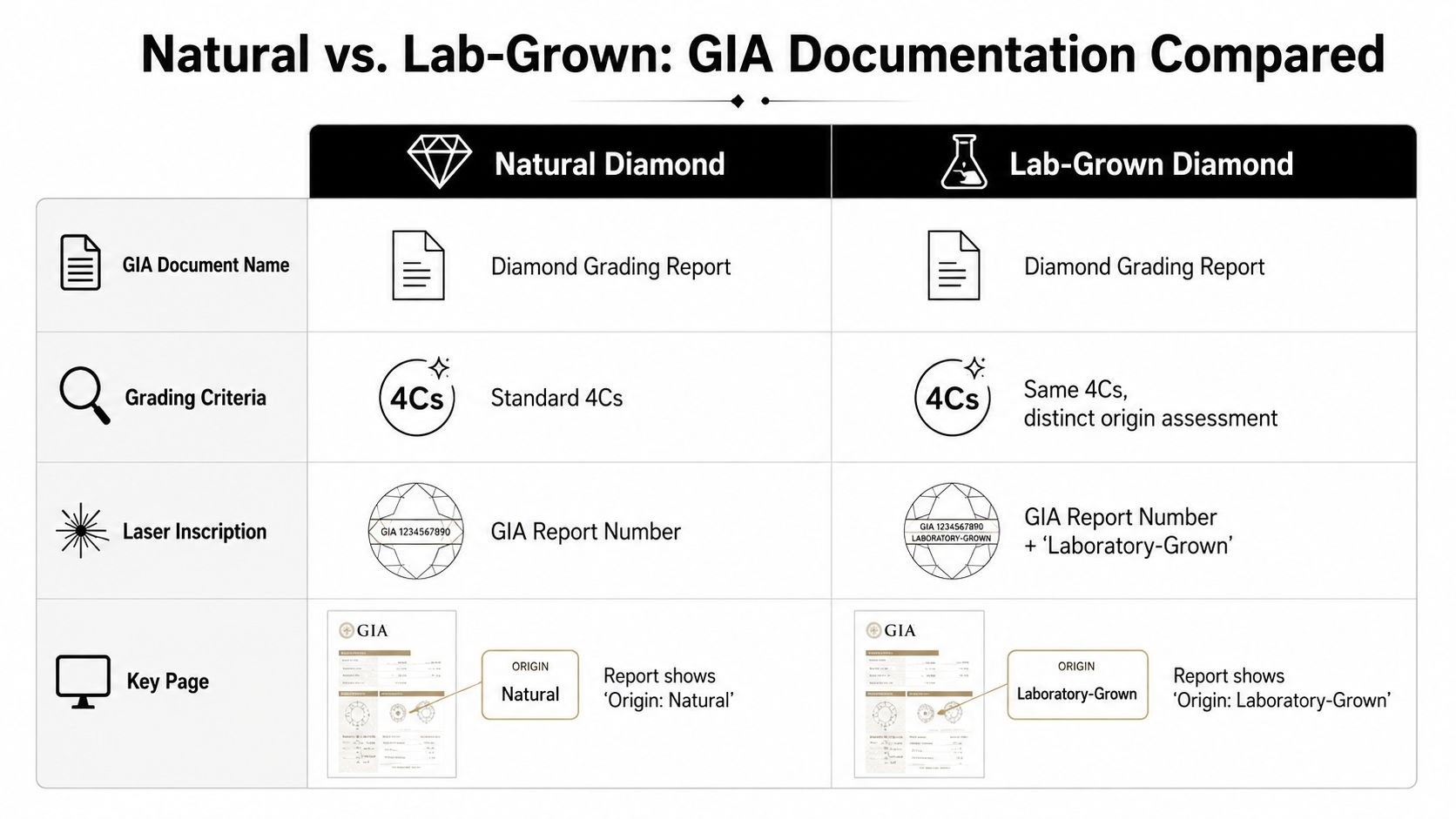
A GIA document can help identify a lab-grown diamond, but it doesn't make that stone economically interchangeable with a natural diamond. Buyers may use different comparable sales, inventory strategies, and resale assumptions for each category.
Question | Natural diamond | Lab-grown diamond |
|---|---|---|
Origin | Geological | Produced through laboratory technology |
Documentation | GIA documentation describes graded characteristics | GIA documentation identifies the laboratory-grown origin using distinct terminology |
Resale comparison | Compared with natural diamond inventory | Compared with lab-grown inventory |
Simulant status | Diamond material | Diamond material, unlike a non-diamond simulant |
Other documents and common mistakes
A report from another laboratory isn't automatically the same as a GIA report. The laboratory name, grading methodology, report type, origin language, and security features all matter. A buyer may verify the document with the issuing laboratory and still perform an independent examination.
Sellers should also avoid using “certified” as if it guarantees price. The key questions are more practical: Is the stone natural or lab-grown? Does the document match the stone? What does the physical examination show? How does the item compare with current resale inventory?
For readers comparing gemstone materials or jewelry categories, a lab grown gemstone jewelry sourcing guide can provide broader context. If you're deciding how natural and lab-grown diamonds may be treated differently during a resale evaluation, review this guide to lab-grown versus natural diamonds.
Next Steps for Selling a GIA-Graded Diamond
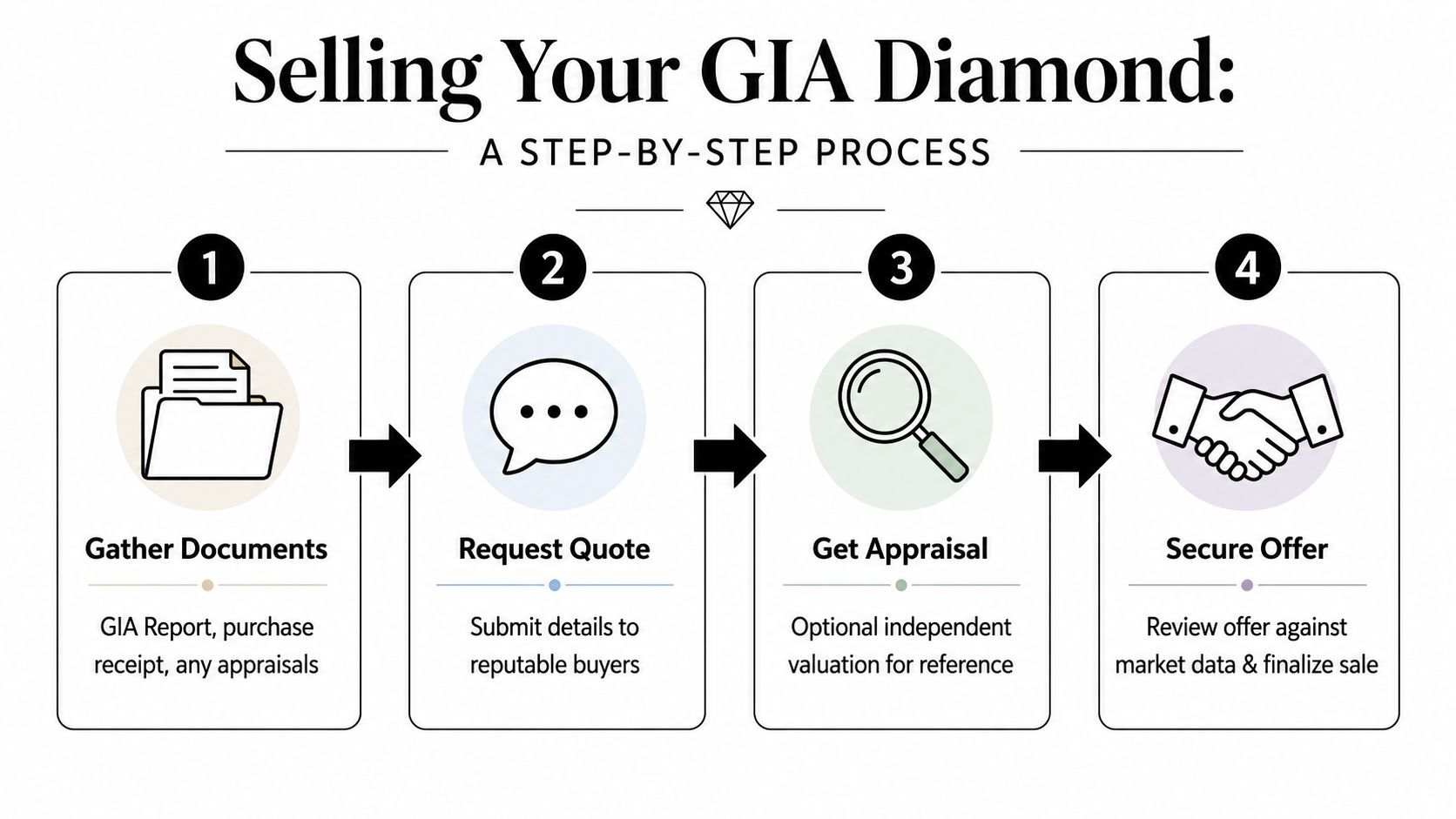
A GIA report makes preparation easier, but it isn't the entire selling package. Gather every document that helps a buyer understand the item's identity, history, condition, and ownership context.
Start with the original GIA report. Add any appraisal, purchase receipt, laboratory paperwork, repair records, and original packaging. If the diamond is mounted in a branded ring, include the box, warranty materials, and other documentation that came with the jewelry.
Prepare the item before evaluation
Clean the jewelry gently or have it professionally cleaned if appropriate, but don't alter the setting before an evaluation. A buyer needs to inspect prongs, metal condition, the mounting, and the stone. Bring the diamond or ring in its existing condition so the assessment reflects what you own.
Use this preparation list:
Organize documents: Keep the GIA report and supporting records together.
Record known details: Note where the item came from and whether it has undergone repairs or resetting.
Separate appraisal purposes: An insurance appraisal, estate valuation, loan assessment, and resale offer answer different questions.
Verify inconsistencies: If the report number, inscription, measurements, or stone characteristics don't match, resolve that issue before negotiating.
Ask for an explanation: Request a clear breakdown of how the evaluator considered the report, stone, setting, condition, and market demand.
Understand an uncertified diamond
A diamond without GIA documentation isn't automatically worthless or unsellable. A reputable buyer can perform an in-house assessment, or you can explore independent grading when the likely benefit justifies the time and expense. The right path depends on the stone's characteristics, setting, documentation, and intended use.
An in-person appointment in Buckhead, Roswell, or another convenient Georgia location lets an evaluator inspect the actual item rather than rely only on photographs. For a remote evaluation, provide clear images and accurate details, then ask what additional examination is required before accepting an offer.
Antwerp Diamond evaluates loose diamonds and diamond jewelry using supporting documentation alongside physical inspection, authentication, condition, demand, and current pricing information. You can also review GIA-certified engagement ring guidance before deciding whether your ring should be evaluated as a complete piece or primarily as a diamond.
Frequently Asked Questions About GIA Reports
Can a GIA report be transferred to a new owner?
Yes. The report describes the diamond, not the person who purchased it. Keep the document with the stone and provide it to the next buyer, appraiser, insurer, or evaluator.
How long does a GIA grading report remain valid?
A report doesn't automatically expire because ownership changes. However, the diamond or setting may change, the stone may be damaged or treated, and grading standards or report formats may evolve. An older report can still provide useful historical documentation, but a buyer may request verification or updated examination.
What should I do if the laser inscription is missing?
Don't assume the diamond is fake. The stone may not have been inscribed, the inscription may be difficult to locate, or the diamond may need examination under suitable magnification. Compare the report with the stone's measurements, clarity plot, shape, and other characteristics, then ask a qualified gemologist or laboratory about the next step.
Does an older GIA report still matter?
Yes, an older report can help establish the stone's documented identity and characteristics. It isn't a guarantee that the diamond's present condition, treatment status, or market value is unchanged. An evaluator may verify the report and inspect the current stone before making a resale offer.
Is a GIA report enough for insurance?
No. GIA states that a grading report isn't a valuation certificate. Insurance decisions generally require a separate appraisal that addresses replacement or insurance value, while a resale evaluation addresses what a buyer may reasonably offer.
Does a GIA report guarantee a strong resale price?
No. It supports identification and quality comparison, but the offer also depends on the physical item, market demand, condition, setting, brand, and buyer economics.
If you have a GIA report, diamond ring, or loose stone, Antwerp Diamond can review the documentation alongside the actual item during a confidential evaluation. Visit Antwerp Diamond to begin with an online evaluation or arrange a private appointment in the Atlanta area.