

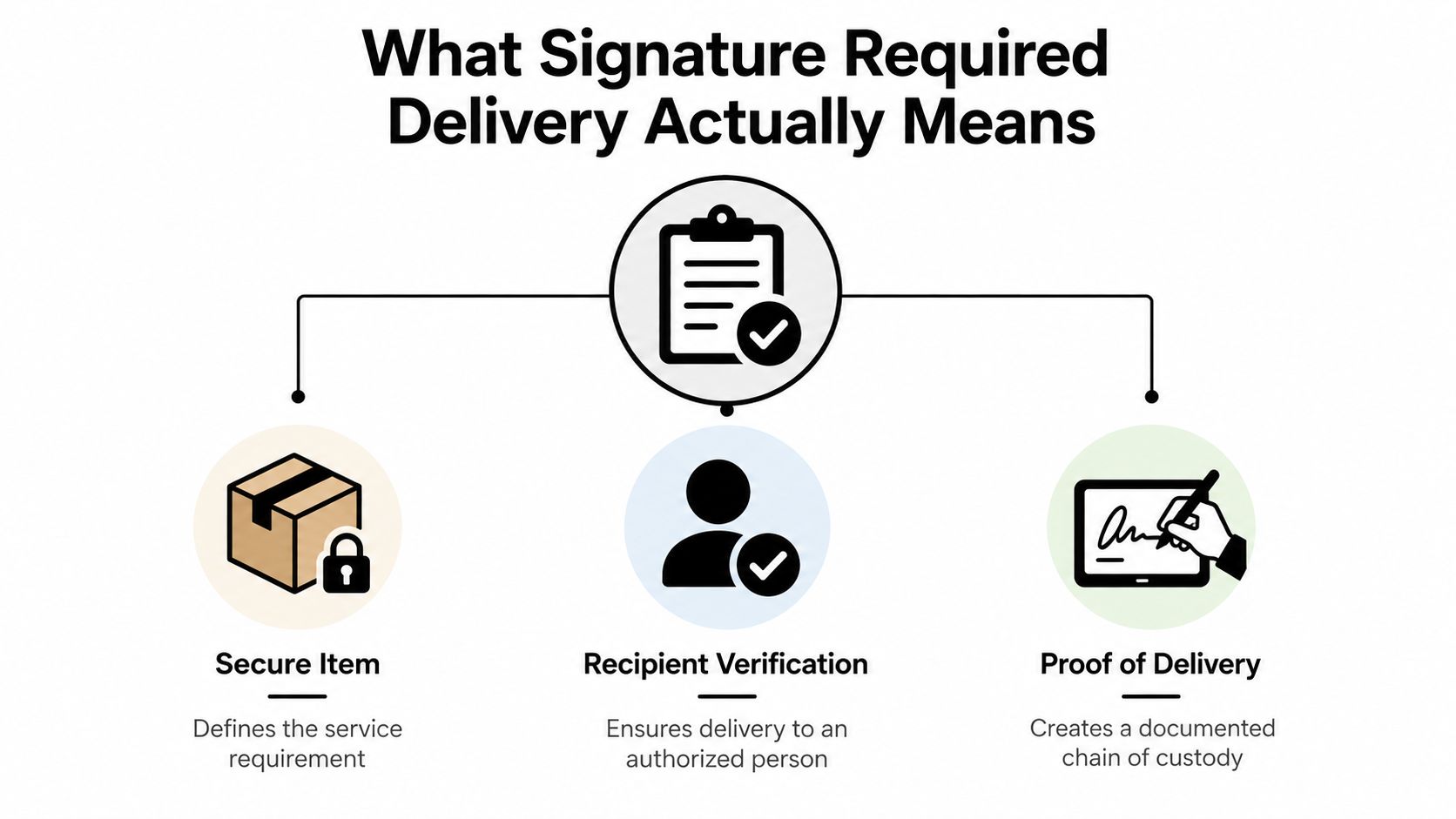
You've just packed a Rolex, diamond bracelet, or Hermès bag in Atlanta, printed a label marked signature required, and watched the courier scan the box at your door. What happens next determines whether you have a clean, defensible handoff or a tracking record that says “delivered.” Signature required delivery means the carrier must obtain an eligible recipient's signature before releasing the parcel, creating documented proof that the package reached a person rather than an unattended doorstep.
For luxury sellers, the signature is only one control. You also need accurate declared value, condition photographs, serial-number records, tamper-evident packaging, and a documented response plan if nobody answers the door. The workflow below is designed for high-value watches, fine jewelry, loose diamonds, precious metals, designer handbags, and other assets where a weak delivery record can undermine an otherwise valid claim.
Table of Contents
What Signature Required Delivery Actually Means
A seller in Atlanta seals a luxury watch inside a plain outer carton, hands it to the carrier, and checks the tracking page later that day. With signature required delivery, the driver generally won't leave the parcel at the door until an eligible recipient physically accepts it and signs. The carrier records the delivery event, usually with the time and signer information, as proof of handoff.
That differs from standard delivery, where a driver may place a parcel at a doorstep, in a mailbox, or with another person depending on the service and local practice. Signature service changes the delivery condition from unattended placement to an authenticated handoff. USPS describes signature-required mail as service initiated by the sender, with the addressee's signature collected before delivery is completed, and explains that accountable mail cannot be fully delivered until the signature, and any required fees, are obtained from the recipient or an authorized agent. USPS explains signature-required and accountable mail.
Why the handoff matters
A signature doesn't prove that the contents are genuine or undamaged. It proves that the carrier recorded acceptance by a qualifying person at the delivery point. That distinction matters when a buyer claims the parcel never arrived, when a carrier scan conflicts with the recipient's account, or when an insurer asks for evidence of delivery before reviewing a loss.
For a Rolex, a diamond necklace, or a Chanel handbag, the signature closes an important gap in the chain of custody. Pair it with an item description, serial number, packing photographs, and declared-value coverage. Antwerp Diamond Store's guidance on insured shipping for jewelry is useful for sellers building that record before the box leaves their hands.
USPS offers more restrictive options for regulated or especially sensitive shipments. Adult Signature Required allows a person at least 21 years old at the address to sign, while Adult Signature Restricted Delivery limits acceptance to the named addressee or an authorized agent, who must also be at least 21. Choose the narrowest recipient rule that fits the transaction, not merely the cheapest label option.
How Major Carriers Implement Signature Services
The carrier's terminology matters because “signature required” doesn't mean the same recipient rules across every service. Before buying the label, confirm whether the service requires any person at the address, the named addressee, an adult, or an adult who presents identification.
USPS uses Signature Confirmation with service variations commonly described as adult, direct, and indirect delivery. The exact eligibility rules depend on the selected product and mailing conditions. USPS separately defines Adult Signature Required as delivery to a person 21 or older, while Adult Signature Restricted Delivery requires the specific addressee or authorized agent and a minimum age of 21. Don't rely on a generic tracking checkbox when the item needs a named recipient.
UPS provides Signature Required and Adult Signature Required services. The ordinary tier is appropriate when you need a recorded acceptance but aren't limiting the handoff to an adult recipient. The adult tier adds age verification and can require government-issued photo identification under the carrier's service rules. Confirm availability for the route, package, and shipping platform before tendering the parcel.
FedEx distinguishes Direct Signature Required, Indirect Signature Required, and Adult Signature Required. FedEx says signature services help protect against fraud, misdelivery, and theft. Its adult-signature process can require a recipient who is 21 or older with valid photo identification, and when nobody is available, the package isn't left at the address and may be reattempted or held for pickup. FedEx outlines its signature service options.
Signature service tiers by major US carrier
Carrier | Service Tier | Minimum Age | Eligible Signer |
|---|---|---|---|
USPS | Signature Confirmation, standard option | Service dependent | Recipient or qualifying person under the selected USPS rule |
USPS | Adult Signature Required | 21 | Person at the delivery address |
USPS | Adult Signature Restricted Delivery | 21 | Named addressee or authorized agent |
UPS | Signature Required | Carrier rule dependent | Recipient or responsible party accepted under the service |
UPS | Adult Signature Required | 21 | Adult presenting qualifying identification where required |
FedEx | Direct Signature Required | Carrier rule dependent | Person at the delivery address |
FedEx | Indirect Signature Required | Carrier rule dependent | Eligible person accepted under the service terms |
FedEx | Adult Signature Required | 21 | Adult presenting valid photo identification |
Match the tier to the transaction
For a high-value handbag, adult signature is usually the sensible choice because it narrows the handoff and makes casual acceptance less likely. A valuable watch may need direct signature rather than the broadest adult restriction if the recipient is a trusted business office with controlled receiving procedures.
Before shipping to a buyer, verify the address, recipient name, delivery window, and carrier service. Sellers who are comparing buyer channels can also review online watch buyers, especially when the transaction involves authentication, documentation, and an insured handoff.
Why High-Value Shipments Depend on a Verified Handoff
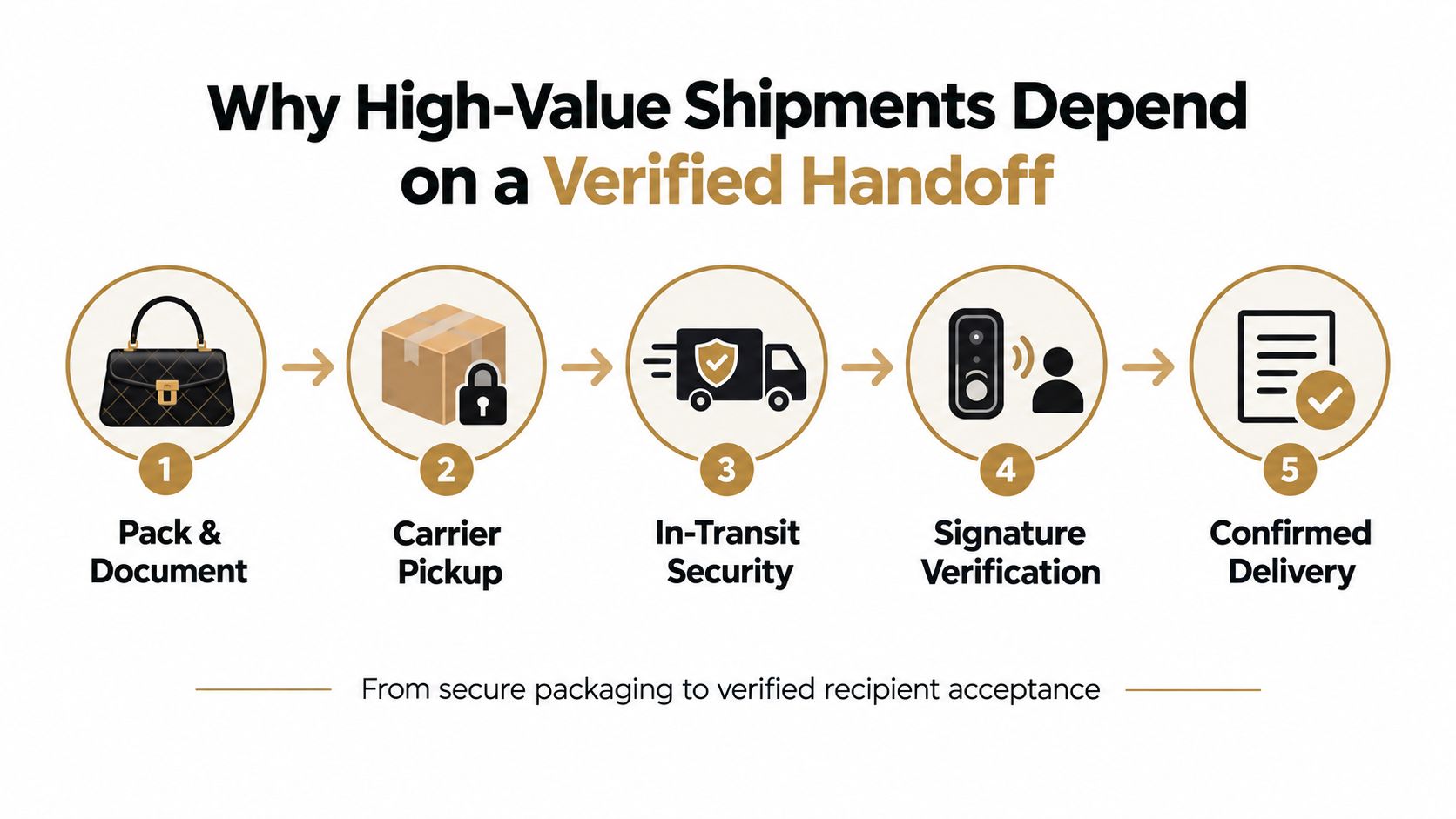
A vintage Rolex can leave your hands in perfect condition and still become difficult to defend once it reaches the buyer. Photograph the dial, case, bracelet, serial number, and packaging. Place the watch in a secured inner container, then seal the outer carton. The carrier's pickup scan begins the transport record, but it does not prove that the correct item arrived intact.
At delivery, an eligible adult signs at the intended address. That record supports a verified handoff to a real person. It does not insure the contents, authenticate the watch, or establish that no damage occurred. Those issues depend on declared-value coverage, packaging, condition evidence, the shipping policy, and the claim terms.
Build the chain before the parcel moves
A limited-edition Hermès bag requires the same discipline. Record its date code or other identifying details where applicable. Photograph the corners and hardware, list every included accessory, and retain the packing record. Use tamper-evident packaging so an opened carton creates a visible event that can be documented.
Signature service reduces exposure to unattended delivery. The U.S. Postal Service Office of Inspector General reported at least 58 million packages stolen in the United States in 2024. Consumer Reports found that 15% of Americans who receive packages said at least one item was stolen from their home in the previous year, compared with 11% in 2021. The USPS Office of Inspector General's package-theft report provides security context for requiring an in-person handoff.
Practical rule: A signature is evidence of acceptance, not a substitute for insurance, authentication records, or careful packaging.
Keep the carrier receipt, declared-value confirmation, packing photographs, and final proof-of-delivery record in the buyer's transaction file. The DPP Grid traceability guide explains how to maintain an auditable item history, while Antwerp Diamond Store's chain-of-custody documentation guidance helps organize custody records for a luxury sale. Pair those documents with the signature service and declared-value coverage before the parcel leaves your facility.
The Real Pros and Cons of Requiring a Signature
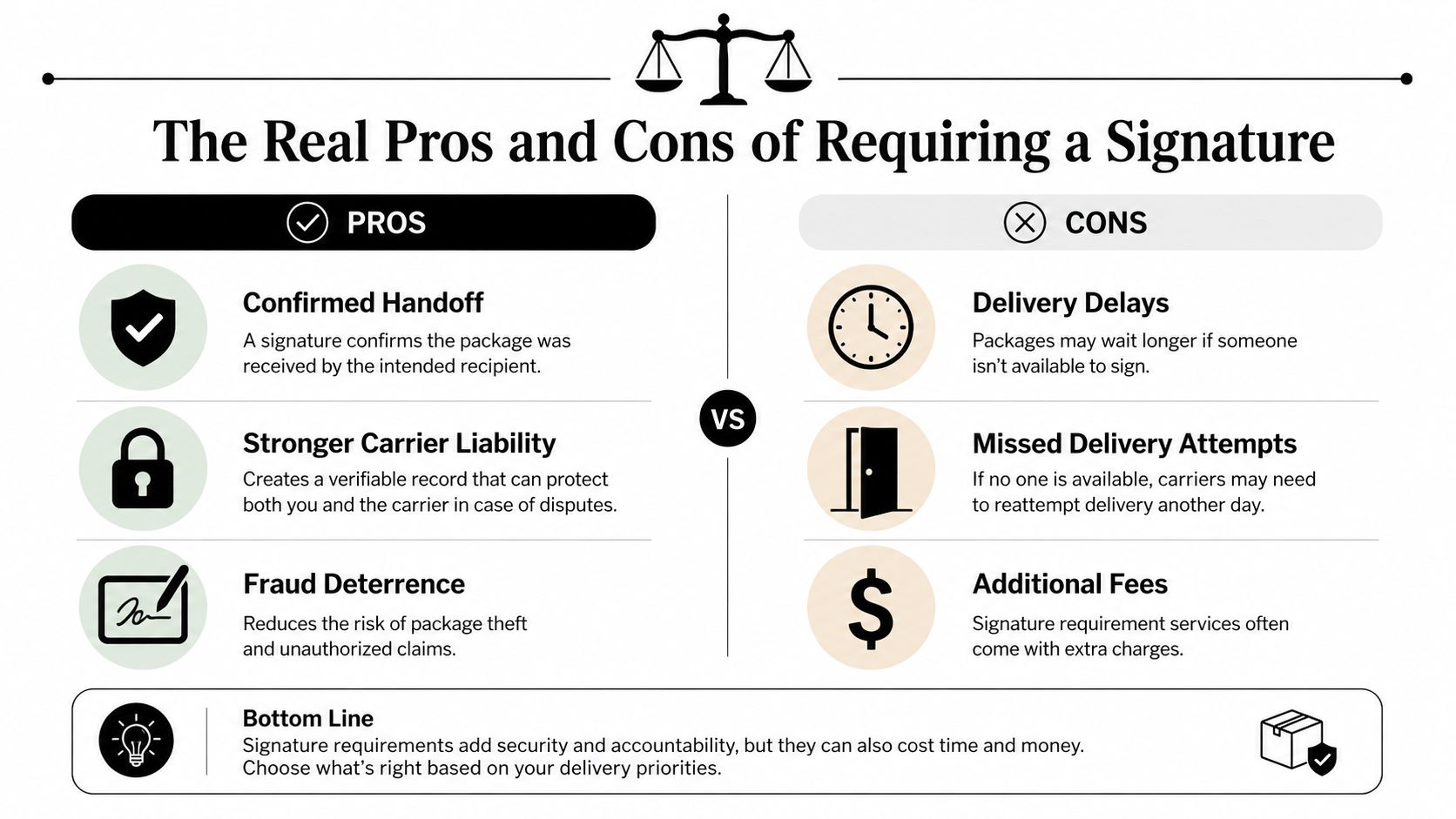
Signature service is not a magic shield. It is a deliberate tradeoff between stronger handoff evidence and more delivery friction.
The advantages
Confirmed handoff: The carrier records acceptance by an eligible person instead of relying only on a doorstep scan.
Lower porch exposure: The parcel generally won't be released for unattended placement when the service requires a signature.
Stronger dispute file: A signature, delivery time, signer information, photographs, and declared-value record give the seller a more coherent claim package.
Better chain of custody: The handoff creates a documented transition from carrier possession to recipient possession.
Improved buyer confidence: A buyer receiving a premium watch or diamond item can arrange to be present and inspect the package at delivery.
The costs and limitations
Missed attempts: Nobody may be home, especially when an adult or named recipient must sign.
More friction: The recipient may need to rearrange work, collect the parcel, or coordinate with a building receiving desk.
Extra service cost: Signature options add a charge to the shipment, and the exact amount depends on the carrier and service.
Weak evidence remains possible: A blurry proof-of-delivery image, an incomplete name, or an improperly obtained signature can leave questions unanswered.
Forgery and bypass risk: A signature can be omitted, copied, or collected from someone who wasn't properly authorized.
USPS reported approximately 253 million failed first delivery attempts in fiscal 2018, illustrating why missed handoffs create operational work even apart from theft risk. USPS delivery-attempt data and package-theft context supports a practical conclusion: use signature service when the item's risk justifies recipient inconvenience, and plan for the failed attempt before the parcel ships.
Preparing a Luxury Item for Insured Mail-In Shipping
The safest package starts with a seller who treats documentation as part of the item, not as an afterthought. Complete the record before the courier arrives, while the watch, jewelry, or handbag is still in your possession.
Start with evidence
Photograph the item from multiple angles under consistent lighting. Capture serial numbers, hallmarks, diamond reports, distinctive marks, clasp condition, corners, hardware, and any existing scratches or repairs. Add a packing slip that lists the contents without exposing unnecessary luxury branding on the outer carton.
Write down what goes inside the box. For a watch, that may include the timepiece, bracelet links, box, papers, and service records. For a handbag, record the bag, strap, lock, keys, dust bag, receipt, and authenticity materials. Keep copies of the photographs and packing record outside the parcel.
Set the value before you buy the label
The declared value should match the transaction invoice, appraisal, or other defensible valuation record. Don't declare a figure that understates the item merely to reduce shipping cost, and don't assume a carrier's declared-value program covers every category of jewelry, watches, gemstones, or designer goods.
Read the carrier's exclusions and limits, then confirm whether separate jewelry insurance is needed. Signature required delivery documents the handoff, but it doesn't automatically create coverage for loss, theft, damage, authenticity disputes, or market-value differences.
Package for inspection and tamper evidence
Use a secure inner container and a strong outer carton. A watch needs immobilization so the case and bracelet don't shift during transit. Fine jewelry should sit in a protective pouch or rigid presentation container, with padding that prevents movement without placing pressure on delicate settings.
Seal the package with tamper-evident or security tape and photograph the sealed carton. For broader packing principles, this guide on how to safely move fragile items explains why internal movement control and appropriate cushioning matter.
Select the service and prepare the recipient
Choose direct, adult, or restricted delivery according to the item and the buyer's availability. For an especially valuable shipment, require an adult signature and confirm the recipient's full name, contact details, and delivery window in advance.
Don't casually email an unredacted identity document unless the carrier, insurer, or transaction process specifically requires it and you can handle it securely. Ask the recipient to have valid identification available at delivery when the selected service requires it. Before sending an item for appraisal or sale, learn how to appraise jewelry so your declared value reflects condition, materials, documentation, and market demand rather than an unsupported guess.

Handling Missed Deliveries and Redirecting Parcels
A missed signature attempt isn't a failed transaction. It becomes a risk when the seller or buyer responds informally, asks the driver to leave the parcel, or redirects it to an address that nobody can verify.
Start with the carrier's official tracking page and the notice left by the driver. Depending on the carrier and service, the parcel may be held at a nearby facility for a defined period, commonly three to fifteen business days, but the actual hold period must be confirmed in the tracking record or service terms. FedEx states that a package requiring an adult signature isn't left when nobody is available and may be reattempted or held for pickup. FedEx's delivery-options guidance explains that process.
Keep the redirect controlled
Use only the carrier's official redirect, hold, or rescheduling tools. A secure sequence looks like this:
Confirm the tracking status and notice details.
Request a hold for pickup or an approved delivery change through the carrier.
Require identification at pickup where the service calls for it.
Save the request confirmation and reference number.
Confirm final proof of delivery after acceptance.
Don't reroute a luxury parcel to a different residential doorstep or an unsecured location. A service counter or controlled receiving location is preferable because the carrier can record the person collecting the item.
If the hold period expires, the package returns to the sender. Inspect the outer carton, security tape, and contents before reshipping, then photograph any change in condition. When selecting packaging for a replacement shipment, a purpose-built shipping carton for home relocation can provide useful general guidance, but always follow the carrier's requirements for luxury goods and declared-value coverage.
When the Signature Step Itself Becomes the Weak Link
A signed delivery can still leave a luxury shipment exposed. The signature may be missing, unreadable, collected by an unauthorized person, or entered after a driver leaves the parcel where the service did not allow it. For a Rolex or Hermès bag, that weak handoff can undermine both a carrier claim and a marketplace dispute.
The European Consumer Centre network says a parcel delivered without the required signature should not be treated as delivered. FedEx's adult-signature policy requires a recipient aged 21 or older with valid photo identification and states that no additional personal data is stored. The European Consumer Centre report on delivery signatures shows why sellers must assess the delivery evidence itself, not just a completed tracking scan.
Preserve the evidence before disputing the scan
Keep the carrier receipt showing the acceptance date. Save the declared-value confirmation, insurance certificate, packing slip, serial-number record, exterior and interior photographs, buyer messages, payment records, and every tracking event. This file connects the item's identity, condition, coverage, and handoff.
Review the proof of delivery as soon as the parcel shows delivered. If it is incomplete, contact the carrier or insurer promptly through the formal claims channel. State the facts precisely: the service required a signature, the proof-of-delivery record does not identify an authorized recipient or show a valid signature, and the package was not knowingly accepted by the named buyer.
Request the delivery record, signature image, address confirmation, and available event notes. Do not accuse the driver or recipient without evidence. Ask the carrier to preserve the records while the claim is reviewed.
A seller shipping a high-value item needs an audit trail that can withstand a marketplace dispute. Antwerp Diamond Store's guidance on how to sell jewelry online supports the same workflow, keeping item records, buyer communications, shipping evidence, and payment documentation aligned.
The signature is one link in the chain. Secure packaging, accurate valuation, declared-value coverage, reliable tracking, and documented delivery must support it.
Bringing Your Item In Instead of Shipping It
For local sellers, in-person evaluation often removes the largest risks at once. You don't need a signature, declared-value shipping coverage, carrier liability analysis, or porch-theft planning when the luxury item travels directly from your possession to a professional buyer or jeweler in a controlled setting.
A typical visit starts with an appointment or walk-in intake, followed by an on-site review. Specialists may authenticate a Rolex, Cartier, Patek Philippe, or Audemars Piguet watch; inspect a Hermès, Chanel, Louis Vuitton, Goyard, or Gucci handbag; or assess a diamond, gold, silver, or fine-jewelry piece. They examine condition, serial numbers, documentation, metal purity, diamond characteristics, brand demand, model demand, and current resale conditions before presenting an offer.
Payment procedures vary by business and transaction. Ask how the evaluator handles identification, ownership documentation, payment method, returns, and any loan or pawn terms before agreeing to a transaction. An appraisal isn't the same as a purchase offer, and a loan isn't the same as a sale, so confirm which service you're receiving.
When in-person service makes more sense
In-person evaluation is the stronger default when:
The item is irreplaceable: Family heirlooms and sentimental pieces may be impossible to replace even when insurance is available.
The category has shipping restrictions: Some luxury goods, gemstones, or watches may face carrier or insurance limitations.
You dislike releasing possession: A private appointment lets you observe the intake rather than handing the parcel to a courier.
You live near a qualified buyer: Sellers in Buckhead, Atlanta, Sandy Springs, Alpharetta, Roswell, Brookhaven, Midtown Atlanta, Marietta, Decatur, and nearby Georgia communities may be able to drive rather than ship.
The documentation is incomplete: An in-person specialist can explain what affects authentication, valuation, and resale without placing the item in transit first.
For Georgia sellers outside Atlanta, mail-in service can still work when the shipment is properly documented, insured, sealed, and sent with an appropriate signature requirement. For everyone else, treat insured shipping as a deliberate exception, not an automatic default.
Antwerp Diamond offers evaluations and purchase discussions for luxury watches, fine jewelry, precious materials, and designer handbags, with local appointments and remote shipping options. If you want to avoid courier exposure, visit Antwerp Diamond to request an evaluation or arrange a private review of your item before deciding whether to sell, ship, or explore another option.


