
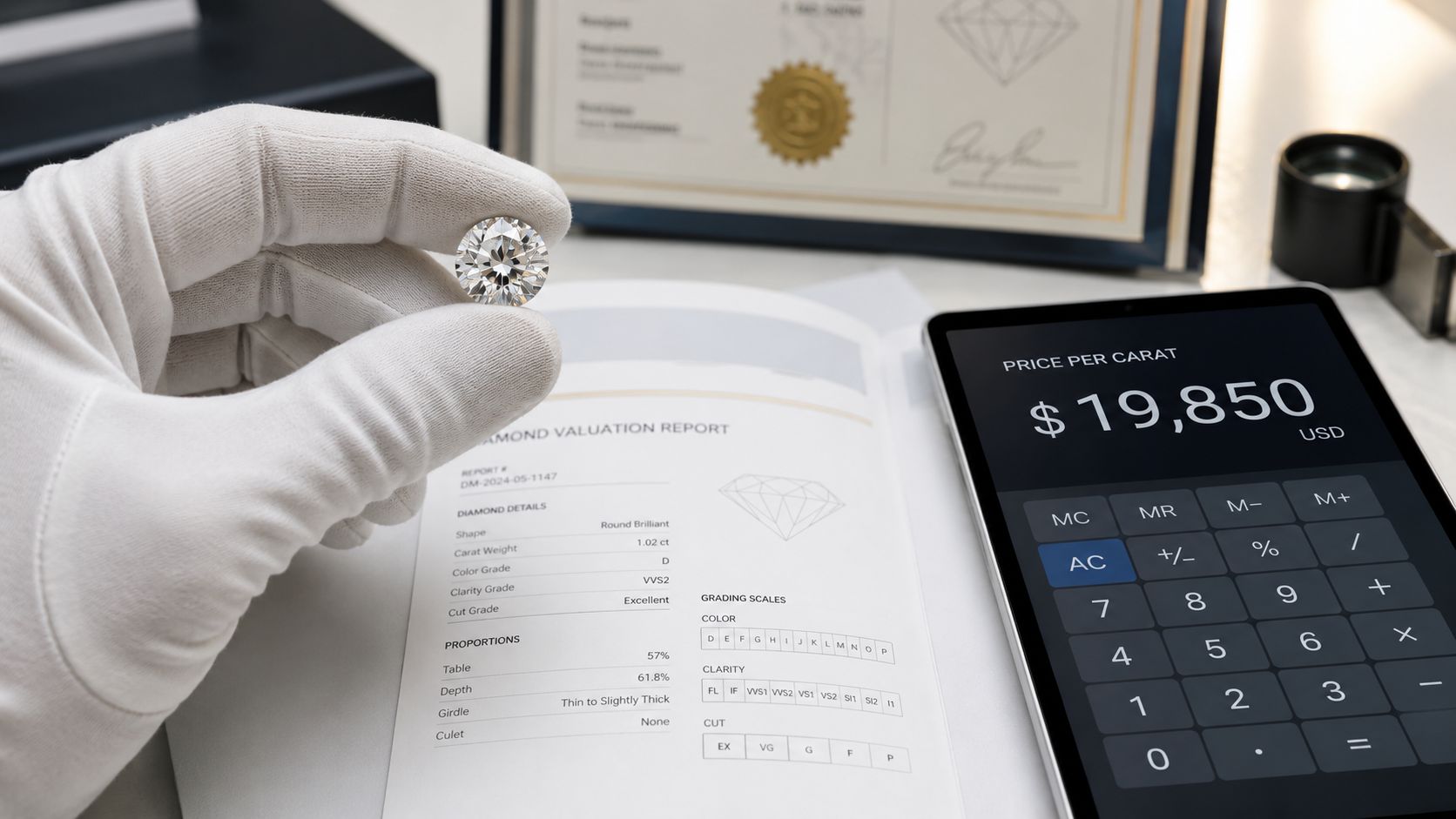
You're holding a diamond ring from an inheritance, a former relationship, or a jewelry box you haven't opened in years, and you want one practical answer: how much is my diamond worth? The resale value usually isn't the number on an insurance appraisal. A diamond's real cash value depends on what qualified buyers will pay in the secondary market today, after accounting for its origin, 4Cs, certification, condition, and selling channel.
Table of Contents
Understanding Your Diamond's Real Market Value
The most important distinction is between replacement value and resale value. An insurance appraisal estimates what it may cost to replace your diamond with a comparable item through retail channels. A cash buyer evaluates what the stone can realistically bring in the trade, where buyers care about liquidity, demand, verification costs, and their own resale risk.
That's why an insurance document can feel disconnected from a jeweler's offer. Replacement coverage includes retail overhead, design work, inventory costs, and the expense of sourcing a comparable diamond. A buyer purchasing your stone isn't reimbursing those expenses. They're assessing how quickly and confidently they can resell the diamond.
For a practical benchmark, natural diamonds often resell for about 25% to 50% of original retail price, while lab-grown diamonds generally recover about 10% to 30%, according to a 2026 diamond resale value report. That same reference gives a simple illustration: a natural diamond purchased at retail for $5,000 might resell for roughly $1,250 to $2,500, with certification and condition affecting the final offer.
Practical rule: Treat an insurance appraisal as a replacement-cost document, not a promise of what you'll receive in cash.
A GIA report can strengthen the offer because it gives buyers an independent description of the diamond's characteristics. In the same resale benchmark, a GIA certification can add roughly 15% to 25% to an offer compared with an uncertified equivalent, although the final number still depends on the stone and buyer.
The four questions that establish value
A disciplined valuation starts by answering four questions:
Is the diamond natural or lab-grown? Origin must be identified before comparable prices are selected.
What are the 4Cs? Carat, cut, color, and clarity determine how the stone compares with other inventory.
Does the report match the stone? A report number, measurements, inscription, and physical characteristics should align.
Where will you sell? A dealer offer, consignment result, auction result, and private sale are different outcomes.
Use a resale-focused tool such as the diamond resale value calculator for an initial estimate, then obtain a professional inspection before treating any figure as actionable. If you're trying to understand the difference between insurance figures and market figures, this replacement value coverage guide offers useful context.
How the 4Cs and Certification Shape Every Offer
The 4Cs don't function as four isolated scores. Buyers evaluate how the combination performs visually, how easily the stone can be resold, and how confidently the grading can be defended to the next buyer.
Carat weight and market thresholds
Carat weight measures mass, not visual appeal by itself. Two diamonds with the same weight can show different face-up sizes because proportions and depth distribute the weight differently.
Cut, color, and clarity also change the price materially. The Gemological Institute of America explains that diamonds with equal carat weight can have very different values when those characteristics differ, as reflected in GIA's diamond cut grading materials.
Cut, color, and clarity
Cut controls brightness, fire, and how effectively the stone returns light. GIA's round brilliant system uses five grades, from Excellent to Poor. A diamond with attractive proportions and strong light performance generally has broader buyer appeal than a heavier stone that looks dark or dull.
Color affects the appearance and demand for white diamonds. Near-colorless stones can offer a useful balance between appearance and marketability, but the right comparison depends on the shape, setting, fluorescence, and buyer preferences.
Clarity describes internal and surface characteristics. An inclusion that's invisible without magnification may have little practical effect on a buyer's decision, while a visible cloud, fracture, or dark inclusion can narrow demand and reduce confidence.
Quality Factor | Premium Tier | Standard Tier | Discount Tier | Value Impact |
|---|---|---|---|---|
Carat | Strong marketability with documented measurements | Saleable weight and proportions | Weight that doesn't translate into visible size | Larger weight can help, but only when cut and appearance support it |
Cut | Excellent light performance | Attractive commercial appearance | Dark, leaky, or poorly proportioned appearance | Cut can materially change demand even at identical carat weight |
Color | Strong appearance with broad buyer appeal | Near-colorless or commercially acceptable appearance | Noticeable tint or undesirable undertone | Color affects comparison shopping and resale liquidity |
Clarity | Eye-clean appearance with credible grading | Minor characteristics accepted by the market | Visible inclusions, fractures, or distracting clouds | Clarity affects both appearance and buyer confidence |
Documentation | Matching, respected grading report | Complete supporting records | Missing, inconsistent, or questionable documentation | Verification risk usually pushes offers lower |
Certification and physical verification
Certification matters because the buyer isn't relying only on your description. A matching report helps establish the stone's identity and makes comparable-sale analysis more precise. A GIA laser inscription is a microscopic mark on the girdle that can include the unique GIA report number, a logo, symbol, or personal message. It helps match the diamond to its report, as explained in GIA's laser inscription guidance.
Fluorescence, a milky appearance, brown or gray tinges, poor polish, and unusual proportions can affect the final offer even when the report appears strong. The right question isn't, “What grade is this diamond?” It's, “How will this exact stone perform against competing inventory?”
For a plain-English explanation of why documentation changes buyer confidence, review what a GIA diamond certification means.
Comparing Selling Channels and Expected Returns
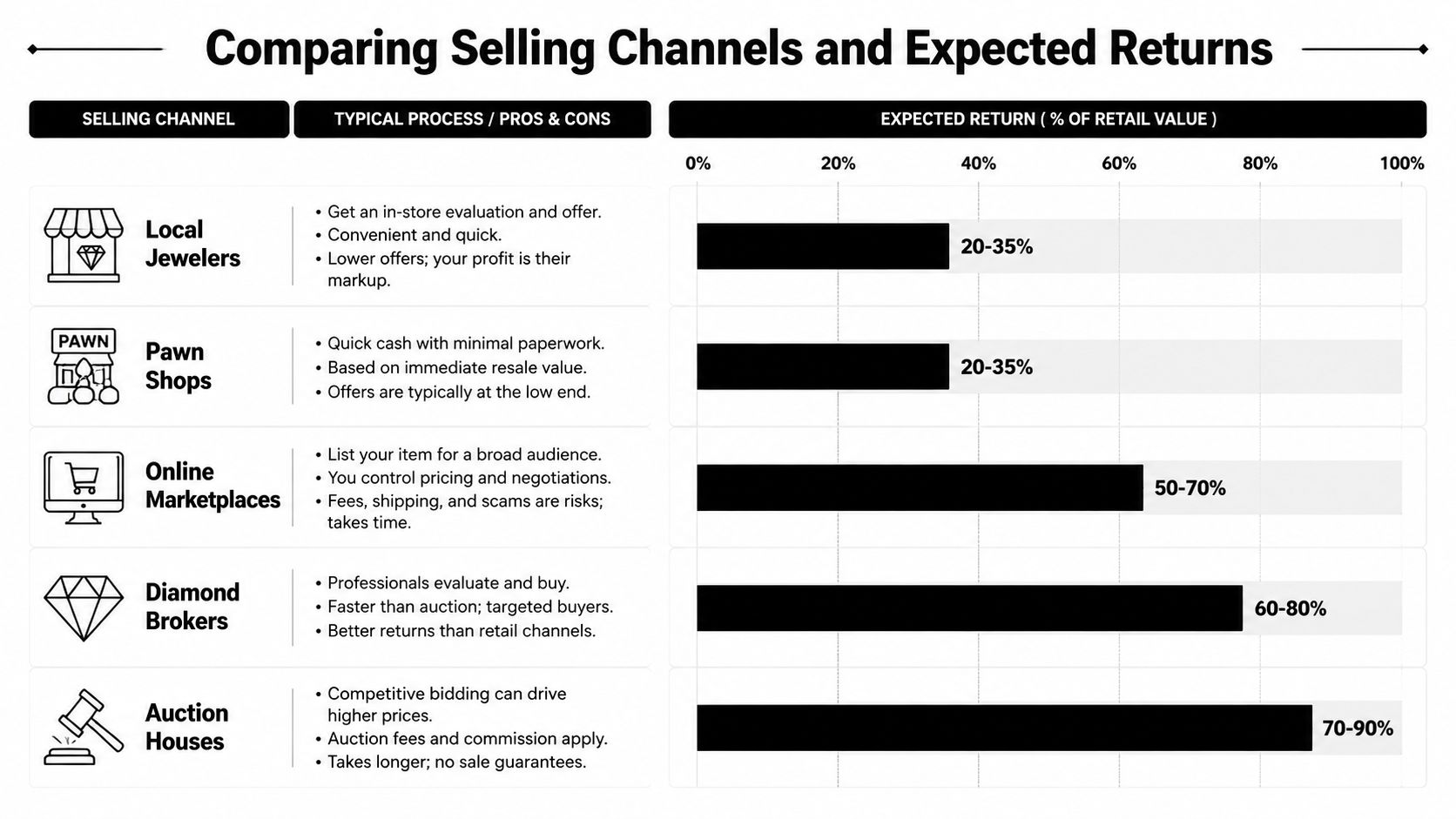
The selling route can change the result as much as the diamond itself. A local dealer prioritizes speed and inventory risk. A private buyer may pay more but expects you to handle marketing, trust, authentication, meetings, and payment security.
The figures below come from an industry guide that reports cash offers from jewelers and dealers around 20% to 40% of retail, consignment or online auction around 40% to 60%, and peer-to-peer sales around 50% to 70%. Those ranges are not guarantees. They describe different levels of effort, risk, and time.
Selling channel | Likely priority | What helps | Main drawback |
|---|---|---|---|
Local jeweler or dealer | Speed and simplicity | GIA report, accurate specifications, clean condition | Offer reflects inventory and resale risk |
Pawn transaction | Immediate liquidity | Portable, identifiable collateral | Terms, repayment obligations, and interest require careful review |
Online buyer | Convenience and broader reach | Clear photos, report, insured shipping | Remote assessment can create disputes or delays |
Consignment or online auction | More time to seek a better match | Strong documentation and desirable stone | Payment depends on finding the right end buyer |
Private sale | Control over asking price | Strong presentation and buyer screening | Safety, authentication, negotiation, and payment become your responsibility |
The same diamond can produce different outcomes depending on who has access to the next buyer. A dealer may make a direct offer after inspection. A consignment specialist may wait for a retail customer, but the diamond remains tied up while the item is marketed.
Before choosing a route, decide what matters most. If you need funds quickly, a local evaluation is usually more practical. If you can wait and handle more complexity, consignment or a carefully managed private sale may create additional upside, but it also creates more points of failure.
Read where to sell loose diamonds before sending a stone anywhere. The right channel is the one that matches your urgency, documentation, privacy expectations, and willingness to manage the transaction.
Preparing Your Diamond for a Professional Appraisal
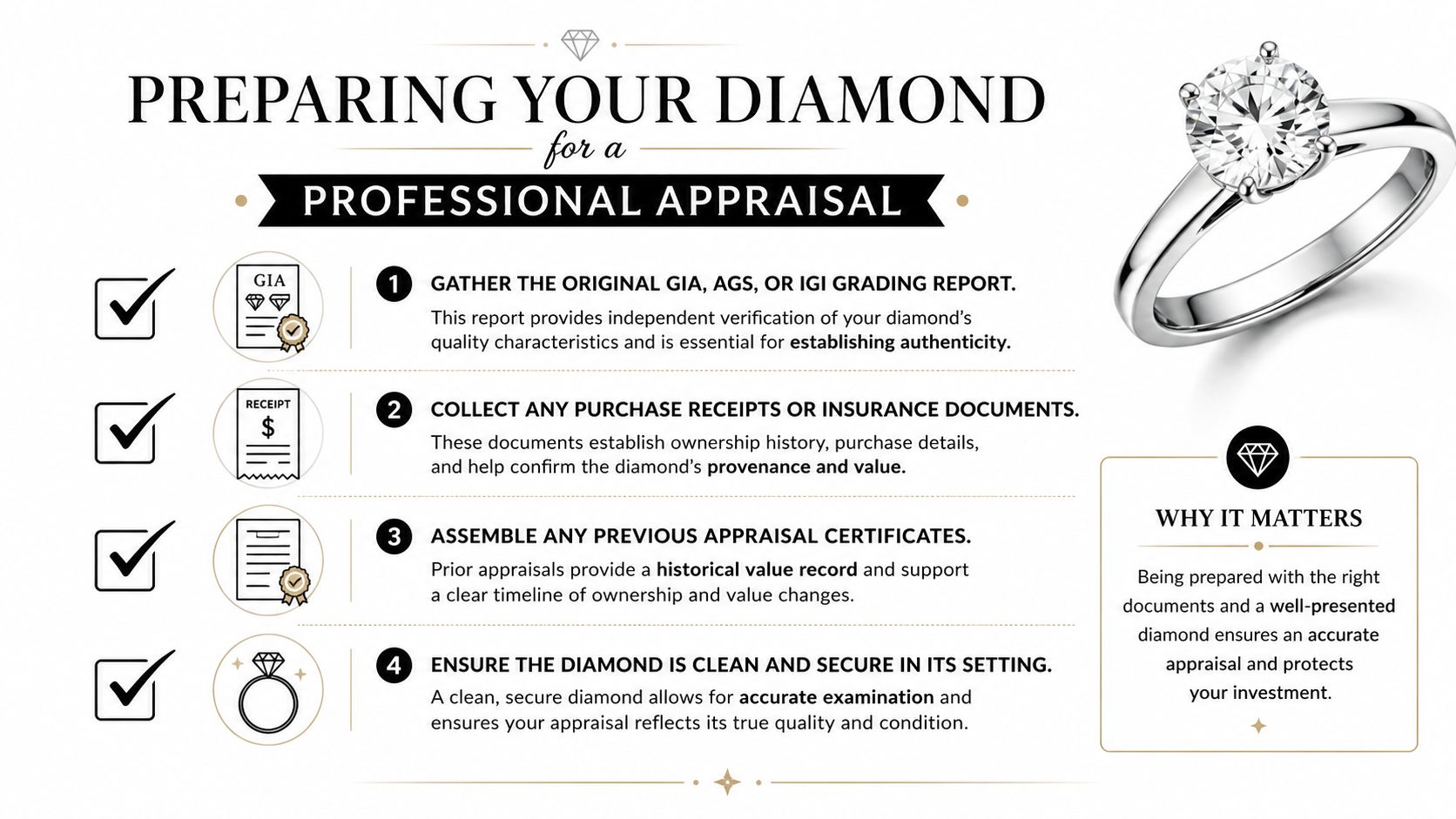
A professional appraisal starts before you walk into the office. Bring the documents that establish what the diamond is, where it came from, and how it has been represented in the past.
Build the documentation file
Gather the original GIA, AGS, or IGI grading report, purchase receipt, previous appraisal, insurance paperwork, and any repair records. If the report is missing, tell the evaluator immediately. The buyer may need to allow for independent verification, and that uncertainty can weaken the offer.
Check whether the report number corresponds with a laser inscription on the diamond's girdle. The inscription doesn't establish value by itself, but it helps confirm that the stone being evaluated matches the report.
Photographs can support the preliminary review. Capture the ring or loose diamond from several angles in natural daylight, including the setting, hallmarks, visible inclusions, and any inscription that can be photographed clearly. Don't rely on dramatic phone-camera images taken under jewelry-store lighting.
Clean carefully and ship conservatively
A gentle cleaning with mild soap, water, and a soft brush can remove surface film that interferes with visual inspection. Avoid aggressive cleaning methods if the diamond has fractures or if you aren't sure how secure the setting is.
For remote evaluations, use insured and trackable shipping with signature confirmation. Keep copies of the report, photographs, packing details, tracking number, and every message exchanged with the buyer. Don't place an irreplaceable stone in ordinary packaging and assume the carrier will resolve a loss.
For an in-person appointment, bring the original documents in a protective sleeve and ask how the evaluator will inspect the stone. You should understand whether the assessment is a resale offer, a formal appraisal, an insurance document, or a starting opinion based on photographs.
The jewelry appraisal tips for 2026 provide additional preparation ideas. Disclose repairs, damage, treatments, missing stones, and changes to the setting. A buyer who discovers a problem after making an initial offer will revise the number.
Negotiating With Confidence Using Market Data
Don't negotiate from the original purchase price or the insurance appraisal. Negotiate from a matched comparison, a credible grading report, and a clear explanation of the buyer's deductions.
A useful benchmark must normalize the stone by carat, cut, color, and clarity, then separate natural from lab-grown inventory. One tracked index reported a June 2026 median transacted price of $4,850 for a 1-carat, round, G color, VS2 clarity, Excellent cut natural diamond. The same benchmark placed the equivalent lab-grown stone at $1,060, demonstrating why origin must be identified before comparing prices. See the 2026 diamond price index for that benchmark.
That dataset also reported 1.4% 30-day volatility and a price 2.1% below the start of 2026 for the natural benchmark. Those figures reinforce a practical point: current transaction data is more useful than a stale list price.
Ask the buyer to show the math
Request a written explanation of the offer. It should identify the stone's specifications, whether the diamond is natural or lab-grown, the basis for the comparable, and any deductions for recutting, certification, setting removal, repairs, or verification.
A low offer isn't automatically dishonest. It may reflect weak cut quality, fluorescence, visible inclusions, a report mismatch, slow demand, or a setting that must be removed. The problem is an unexplained offer, especially when the buyer uses urgency or vague claims about defects to prevent comparison shopping.
Diamond Category | Typical Offer (% of Rapaport) | Key Demand Factors |
|---|---|---|
Natural, documented, liquid category | Qualitative comparison required | Exact 4Cs, report quality, cut, shape, and current demand |
Natural, unusual or difficult-to-resell category | Qualitative comparison required | Visual appeal, fluorescence, color, clarity, and buyer pool |
Lab-grown diamond | Qualitative comparison required | Origin, report, current supply, condition, and buyer demand |
Mounted diamond jewelry | Qualitative comparison required | Setting quality, metal, design, repair needs, and center stone |
Uncertified diamond | Qualitative comparison required | Verification cost, report risk, and confidence in stated grades |
I'm not assigning unsupported percentages to these categories because Rapaport is a pricing benchmark, not a guaranteed resale formula. Use this diamond price calculation resource to organize the specifications, then compare the resulting offer with at least one independent evaluation.
Next Steps for a Secure and Fair Transaction
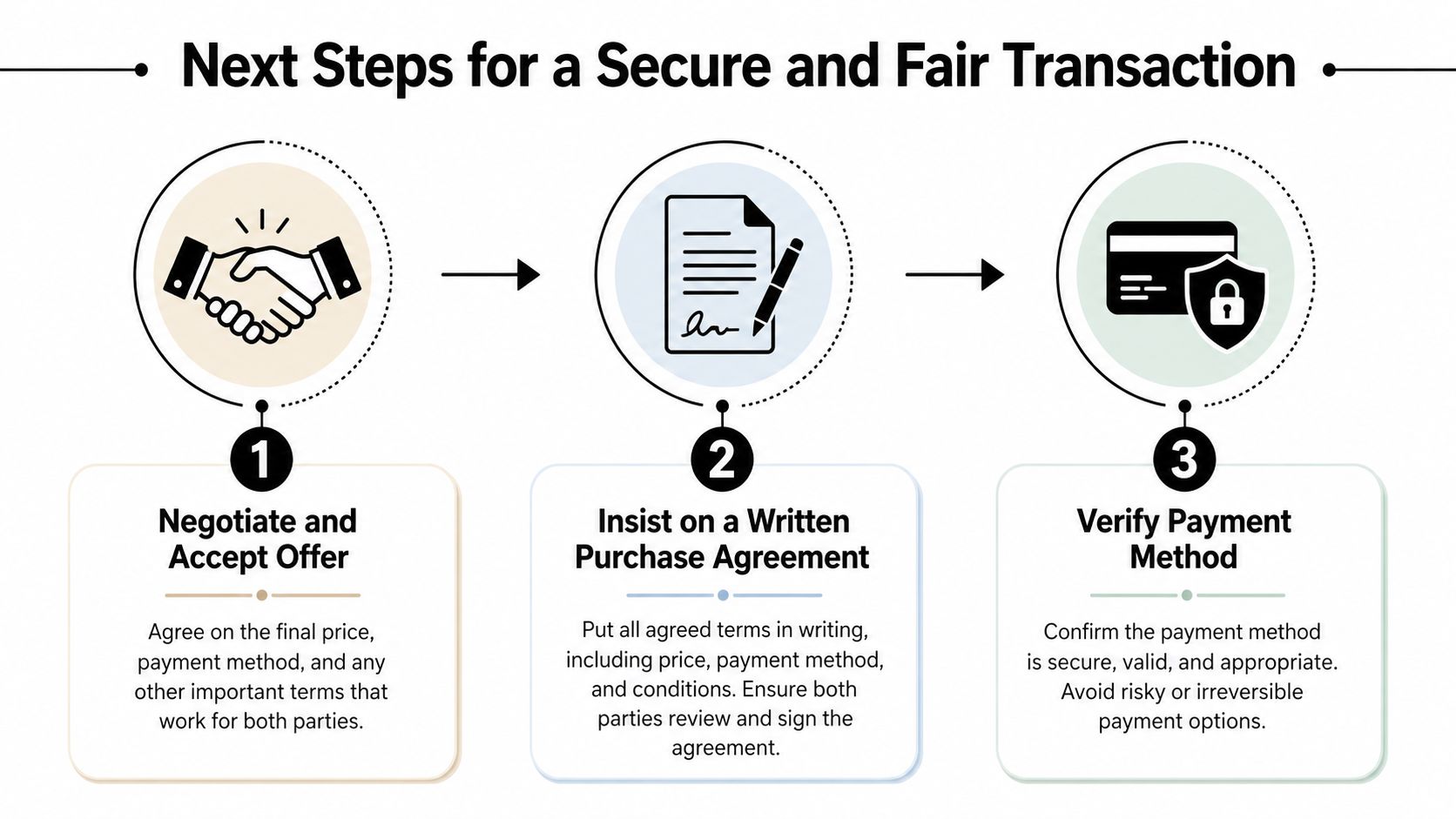
A fair valuation can still lead to a bad transaction if the closing process is careless. Once you accept an offer, require a written purchase agreement that states the item, final price, payment method, inspection status, and transfer date.
Don't release the diamond based on a text message or verbal promise. Confirm the payment has cleared through your bank before handing over the stone, particularly when the buyer is remote or the transaction involves shipping.
Use a closing checklist
Confirm the buyer: Review the company's identity, physical presence, public reputation, and professional affiliations before shipping or transferring ownership.
Confirm the paperwork: Keep the signed agreement, report, photographs, correspondence, shipping records, and final bill of sale.
Confirm the payment: Verify that a wire, cashier's check, or other agreed method has fully cleared. Don't treat a payment screenshot as proof.
Confirm the return process: If you decline the offer after an evaluation, request insured return shipping with tracking and signature confirmation.
Confirm your own records: Ask a tax professional about recordkeeping or reporting questions relevant to your circumstances. An appraisal or purchase agreement isn't tax advice.
If you're considering a loan or pawn transaction instead of a sale, read the repayment terms, interest, fees, collateral rules, and consequences of nonpayment before signing. A loan can preserve ownership, but it creates obligations that differ from an outright purchase.
Antwerp Diamond offers resale-oriented evaluations for diamonds and fine jewelry, including online starting assessments and private in-person reviews in the Atlanta area. If you want a documented opinion before deciding whether to sell, visit Antwerp Diamond to request an evaluation or arrange a confidential appointment.


