

You're probably sitting on a chain, ring, bracelet, or broken piece and wondering if it's worth selling today or if you're about to get lowballed. The direct answer is simple, sell gold jewelry for cash by pricing it against either melt value or resale value, then pressure-testing the offer against the piece's weight, purity, and the buyer's deductions. If you know those three things, you can spot a fair offer fast and walk away from a bad one.
Table of Contents
Understanding How Cash Offers for Gold Jewelry Are Built
A real cash offer starts with one question, is the buyer paying for metal or for the piece as a sellable item. If it's scrap, the offer tracks melt value. If the item has brand appeal, design value, or a strong retail market, the buyer may price it for resale value instead.
The math behind the number
Melt pricing is straightforward. The buyer weighs the jewelry, confirms the karat, converts that karat into a pure-gold fraction, then multiplies the fine-gold weight by the live spot price. That's why a chain's original retail tag doesn't control the offer, the actual gold content does. CNBC's explanation of the basic formula is still the cleanest plain-English reference for this process, especially for sellers who want to check a quote against intrinsic value before saying yes, and you can compare it with Gold IRA Association breaks down ounces if you want the ounce-to-gram conversion made very clear.
Practical rule: If the buyer won't show you the weight, the karat, and the math, you're not getting a serious evaluation.
A simple example makes the logic obvious. A 14K chain is about 58.5% pure gold according to the karat-to-purity figures in the market guidance, so a 24-gram piece contains roughly 14.04 grams of pure gold. If spot is $74 per gram, the intrinsic gold value is about $1,039 before any buyer margin, refining cost, or testing fee. The point isn't the exact final number, the point is that you can do the same check on any quote and see whether it makes sense.
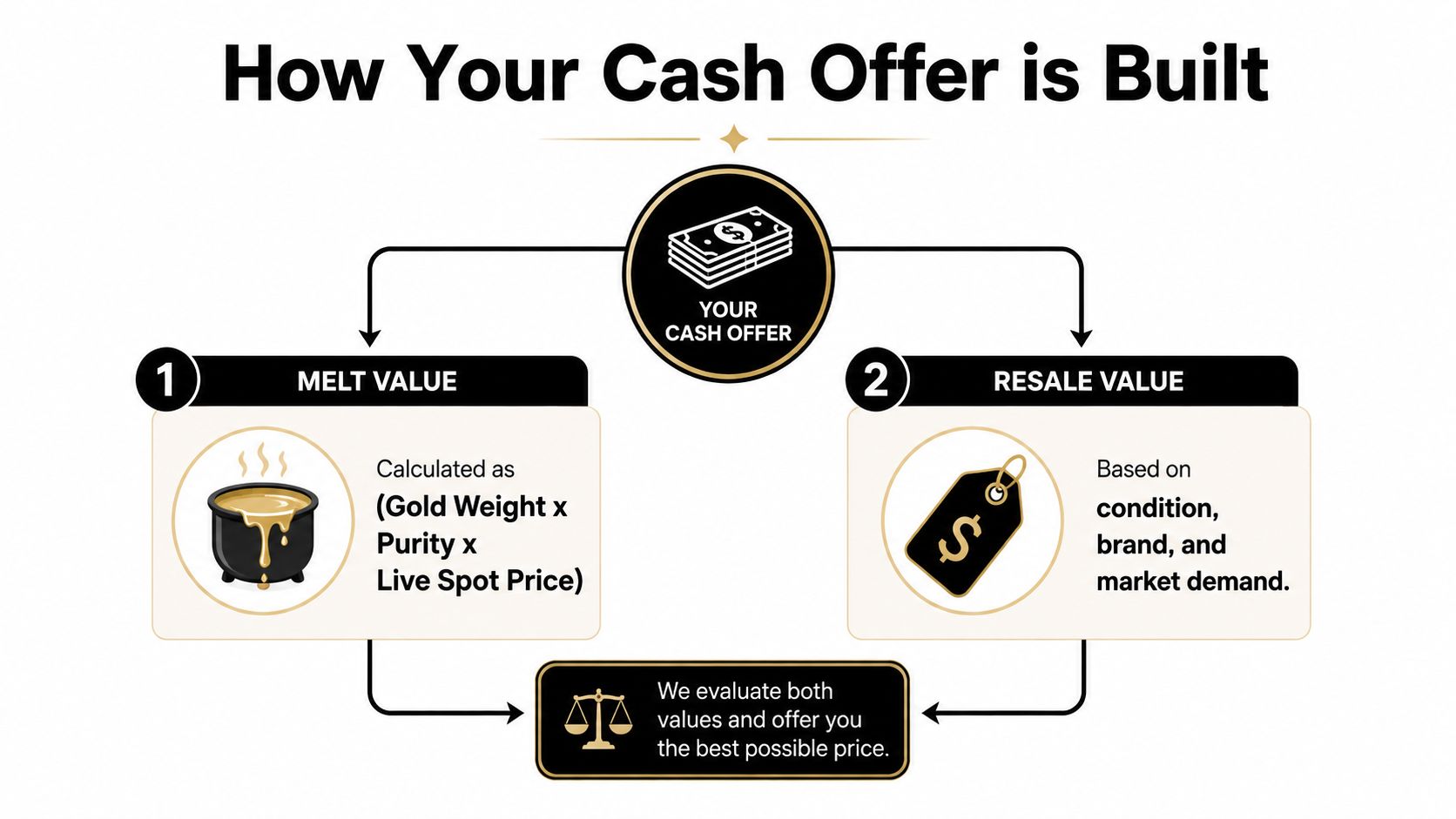
The deductions are where buyers make their money. Some subtract for refining, some for assay testing, and some build a wider spread between what they buy at and what they resell at. The smartest sellers treat every quote as a formula, not as a favor, and compare it against the same math the buyer is using. If you want a local pricing reference, the guide on how 14K gold is priced by weight is a useful benchmark before you accept any number.
Reading Hallmarks, Karats, and Fineness Marks Before You Sell
If you skip the tiny stamp, you might wonder why the offer came in low. Don't do that. The mark on the clasp, inside the ring band, or on the back of a pendant tells the buyer what they think they're holding, and it tells you whether their claim matches the metal in your hand.
What the stamp is really saying
In the U.S., you'll usually see 10K, 14K, 18K, 22K, or 24K. In international markets, the same purity can appear as 375, 585, 750, 916, or 999, which is the fineness system sellers see on European and Asian pieces. A 750 stamp means 75% gold, which lines up with 18K. A 585 stamp means about 58.5% gold, which lines up with 14K. For a cross-check on how sellers identify purity marks, the guidance at how to determine gold purity is worth reading before you walk into any shop.
Karat | Purity % | Fineness Stamp | Common Millesimal |
|---|---|---|---|
10K | 41.67% | 417 | 417 |
14K | 58.53% | 585 | 585 |
18K | 75.00% | 750 | 750 |
22K | 91.67% | 916 | 916 |
24K | 99.90% | 999 | 999 |
What to look for and what to ignore
Solid-gold marks matter. So do maker's marks, because a signed piece can sometimes have more than melt value if it belongs to a collectible brand or design line. But plating marks tell a different story. GP, GF, HGE, and similar abbreviations usually signal plated or filled jewelry, not solid gold, so you shouldn't let a buyer talk you into pricing it like a heavy gold chain.
Buyer's habit to copy: check the stamp first, weigh second, and only then talk price.
If you're unsure, use a loupe and verify the stamp before the first offer is even discussed. That small step keeps you from handing a buyer control of the conversation. It also gives you a clean answer when a shop tries to group everything into one pile without telling you which items are solid, plated, or potentially collectible.
Comparing Where You Can Sell Gold Jewelry for Cash
The place you choose matters almost as much as the gold itself. Buyers don't all price from the same floor, and they definitely don't all keep the same amount of the spread. If you want the cleanest answer, compare channels by payout logic, speed, and hidden costs, not by the friendliness of the person behind the counter.
The main channels and how they differ
Local cash-for-gold stores are fast, but they usually price aggressively because they need room for refining and resale. Pawn shops are even more convenience-driven, and they're often the least attractive option for a seller who already knows the piece is solid gold. Mail-in buyers are easier to access from anywhere, but the final number can shrink after testing, shipping, and processing deductions. Direct refiners can pay better on larger lots, but they're not always the right fit for a single ring or a small chain. Auction or consignment is only worth considering when the piece has real resale appeal beyond metal content.
Payout Comparison by Selling Channel | Typical Payout (% of melt) | Speed | Fees | Best For |
|---|---|---|---|---|
Pawn shop | About 40% to 75% of melt | Fast | Spread built into offer | Emergency cash |
Local jeweler or coin shop | About 65% to 88% of melt | Fast to moderate | Possible testing or overhead spread | Walk-in sellers |
Mail-in buyer | About 75% to 85% of melt | Moderate | Shipping, testing, processing | Remote sellers |
Direct refiner | About 90% to 98% for larger lots | Slower | Assay and refining fees | Larger scrap lots |
Auction or consignment | Varies by item, not by melt alone | Slow | Commission and consignment costs | Signed or designer pieces |
These ranges line up with neutral buyer guidance that shows how much the channel changes the outcome. One practical takeaway is simple, if the piece is only valuable for its metal, the buyer's spread matters more than any polished pitch. If the piece has a designer name, wearable condition, or a strong secondary market, you need a buyer who can recognize resale value instead of automatically melting it.
For sellers in Atlanta, Buckhead, Sandy Springs, Alpharetta, Roswell, Brookhaven, and Midtown Atlanta, the right shop is the one that explains its pricing in writing and doesn't rush you past the math. The broader Georgia market has plenty of buyers, but the best move is still the same, compare offers on the same day, on the same weight basis, and with the same karat confirmation.
What Happens During a Professional Gold Evaluation
A serious buyer does not start by blurting out a number. They start by deciding what the item is, what it contains, and what parts of it can be valued separately. That process is the difference between a clean offer and a guess dressed up as expertise.
The sequence behind the counter
First comes visual inspection. A trained buyer looks for hallmarks, wear patterns, solder points, broken links, and signs that plating is hiding underneath the surface. Then comes testing. Professional buyers often use a tiered approach, starting with an acid scratch test on a touchstone, then moving to XRF for a more detailed alloy readout. XRF can identify composition quickly, while a lab or fire assay is reserved for disputes or high-value material because it is the most definitive method according to technical testing guidance.
Next comes weighing. Gold is normally weighed in grams on a calibrated jewelry scale, and some buyers convert from troy ounces when they're working through larger lots. After that, the buyer separates anything that shouldn't be counted as raw gold weight, such as stones, removable clasps, or non-gold components. The final offer should reflect the metal result, any resale premium, and any deductions the buyer applies.

What you should expect on paper
A proper evaluation sheet should not be vague. It should show the item description, the weight used, the karat or fineness result, the pricing basis, and any deduction the buyer says applies. If a buyer can't write that down, they're asking you to trust memory instead of evidence.
A quick clean can help a buyer see detail, but don't overdo it. Heavy polishing can blur hallmarks and alter surface evidence, and that can complicate the evaluation rather than improve it. If a piece includes a diamond or colored stone, ask how the buyer is treating it before you agree to a gold-only quote.
To see how professional appraisal logic extends beyond gold alone, the guide on how jewelry is appraised is a useful companion read for sellers who want to understand the full process.
Shipping Gold Jewelry Safely for an Online Offer
Remote selling works, but only if you treat the package like something worth stealing. The biggest mistake is sending jewelry in a way that advertises what's inside or leaves you unable to prove what you shipped. Documentation and packaging matter just as much as the buyer's quote.
Pack it like a valuable, not a gift
Photograph each piece from multiple angles before you touch a box. Capture the front, back, clasp, hallmark, and any damage so you have a record if a claim ever needs to be disputed. Then secure the item to a rigid backing card inside a small pouch, place that pouch inside a plain outer mailer, and make sure nothing jewelry-related is visible on the outside. The two-envelope method keeps the package discreet and reduces unnecessary attention.
Insured shipping is not optional for valuables. Use a carrier and service level that provides tracking, insurance, and signature confirmation, and check the carrier's declared-value rules before you mail anything. Standard post is a bad fit for this job because the seller needs a paper trail from handoff to delivery, not a vague promise that the box will “probably” arrive.
Paperwork to keep in the file
You should expect to keep copies of the signed invoice, your ID if required by the buyer, the terms of sale, and the insured label or receipt. If the buyer doesn't provide those items clearly, pause. A serious mail-in offer should leave you with enough records to show what was sent, when it was sent, and what the agreement said at the time.
Keep the tracking number and the shipment receipt until payment clears.
That habit sounds basic, but it saves people from messy disputes. A buyer who works professionally will not object to careful paperwork. They'll encourage it.
Common Scams, Hidden Fees, and Pressure Tactics to Avoid
Most bad offers do not look like scams on the front end. They look ordinary, maybe even polished. The problem shows up in the deductions, the urgency, or the way the buyer changes the story once your jewelry is already on the counter.
The tactics that cut your payout
Some buyers hide refinery charges behind vague labels like processing or handling. Others make a melt-only offer on a piece that has legitimate resale appeal, then keep the premium for themselves. Stone deductions can also be abused if the buyer removes gems, undervalues them, and gives you little or nothing back in writing. A buyer should explain every deduction before you agree, not after.
Pressure tactics are just as common. One of the biggest red flags is a “today only” price window that expires before you can compare offers. Another is a verbal quote that gets downgraded after the piece is weighed. If a buyer wants your ID photocopied, they should be able to explain why and show a clear privacy practice. Mail-in sellers should be especially careful about any quick deposit or repayment demand that appears before the final settlement is fully agreed.
Common Scams and Red Flags When Selling Gold Jewelry | What to Verify |
|---|---|
Hidden processing fee | Ask for the fee in writing before you hand over the piece |
Melt-only quote on a branded or wearable item | Confirm whether the buyer is pricing for scrap or resale |
Stone removal without explanation | Ask how stones are valued and whether they're returned |
Urgent same-day expiration | Compare at least one other written offer |
Weight shown without a scale reading | Watch the item being weighed on a calibrated scale |
Vague ID request | Confirm the privacy policy and purpose |
Verbal offer changes at the counter | Require a written breakdown before acceptance |
The easiest defense is to slow the transaction down. Ask for the weight, the karat result, the basis of pricing, and the net amount you'll receive. If the buyer resists those questions, the offer is weak even if the smile is strong.
Getting a Private Offer From Antwerp Diamond
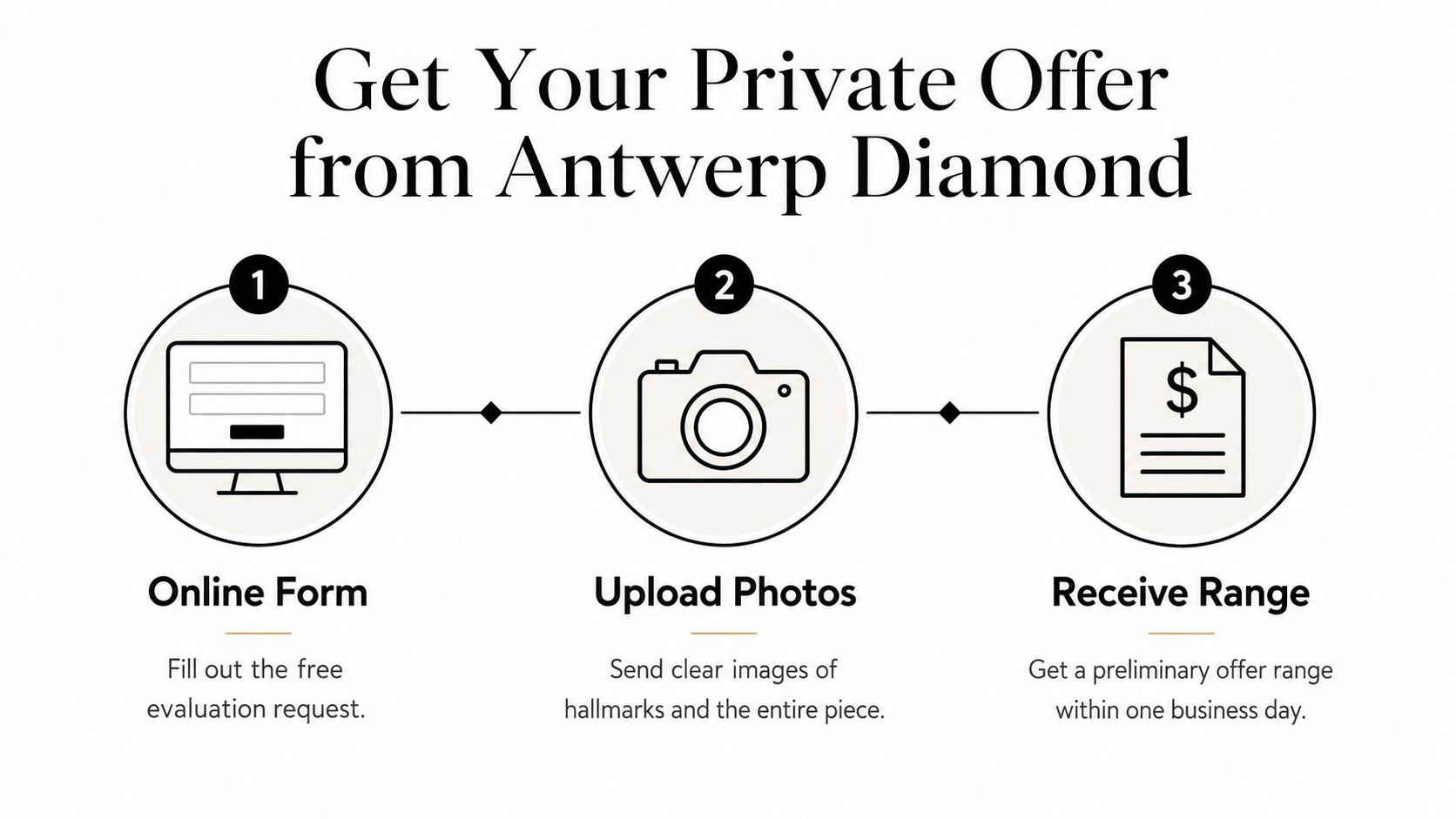
The cleanest process is the one that shows its work. Start with the free online evaluation form, upload clear photos of the hallmarks and the full piece, and you'll get a preliminary range back without having to leave home. For Atlanta-area sellers who want a private in-person evaluation, Antwerp Diamond also handles appointments with a more detailed review once the piece is in hand.
How the evaluation usually unfolds
The first pass is remote. Clear photos help identify the karat mark, the style, the condition, and whether the piece looks like scrap or something with resale value. If the initial range makes sense, a private appointment can tighten the number through on-site testing and weighing. That includes scale verification and XRF testing when needed, plus stone removal when a gem needs to be separated from the gold weight.
Bring any documentation you have, even if it's incomplete. Old receipts, brand cards, appraisal papers, and service records can help clarify what the piece is and whether it should be treated as metal value or resale value. Remote clients can also use insured shipping or arrange drop-off, which keeps the process workable for sellers outside the immediate Atlanta area.
The consultation is no-obligation, and final payment timing depends on the sale route chosen. For in-person transactions, payment can be handled by cash or wire depending on the deal structure, while remote transactions use secure transfer methods after the evaluation is complete. If you want to start with a simple first step, the main site is Antwerp Diamond, and the online form is the fastest way to get a first read before you decide whether to visit.
If you want a straight answer on your gold jewelry, bring it to Antwerp Diamond for a private evaluation and see how the weight, karat, and condition translate into a real cash offer. You can start online, compare the number to your own estimate, and then visit the Atlanta office if the range looks right. That's the cleanest way to sell without guessing, and it gives you a professional benchmark before you commit.