

Typical watch polishing cost runs $40 to $400, with basic local work often near $30 to $100 and luxury pieces climbing much higher, including $250 to $450 for a Rolex Submariner and $500 to $900 for many Patek Philippe models depending on metal and complexity (watch polishing cost guide). The blunt truth is that the cheapest polish can become the most expensive mistake if it hurts resale value, because the wrong finish work can erase originality that collectors pay for.
Most owners ask the wrong question. They want to know what polishing costs, but the primary question is whether the watch should be polished at all, especially if it's a collectible, a precious-metal piece, or something you may sell soon.
Table of Contents
Actual Price Range for Watch Polishing
The market splits into two clear tiers. Independent polishing is usually the lower-cost route, while authorized service polishing costs more because it is folded into broader service work and finished to brand standards (Rolex service and polishing pricing). If you are comparing quotes, start with that distinction. A “polish” on a luxury watch can mean a quick cosmetic refinish, a deeper case restoration, or a full mechanical overhaul with cosmetic work attached.
For a standard watch, polishing can still sit in the low hundreds, and in some cases below that, at a local shop. Once the watch has a precious-metal case, an integrated bracelet, or a mix of brushed and polished surfaces, the bill climbs fast. A simple stainless-steel sports watch and a gold or platinum dress watch are not the same job, even if both need the outside cleaned up.
Practical rule: If the watch is common and modern, polish it only if you want it to look better now. If the watch is collectible, compare the fee against the value you may lose.
That resale question matters more than the service bill. On higher-value pieces, a modest cosmetic improvement can be outweighed by the discount caused by over-polishing, especially when sharp case geometry and original finishing are part of the appeal. The cheapest polish can become the most expensive mistake if it removes the edges buyers are paying for.
A broad pricing reference from EU DPP compliance pricing shows the same basic pattern, service scope and technical complexity drive cost more than a single flat fee. If you are deciding whether to keep a watch, sell it, or refresh it before listing, our guide to used luxury watches for sale shows why condition and originality matter so much in the secondary market.
What Drives the Cost of Polishing a Watch
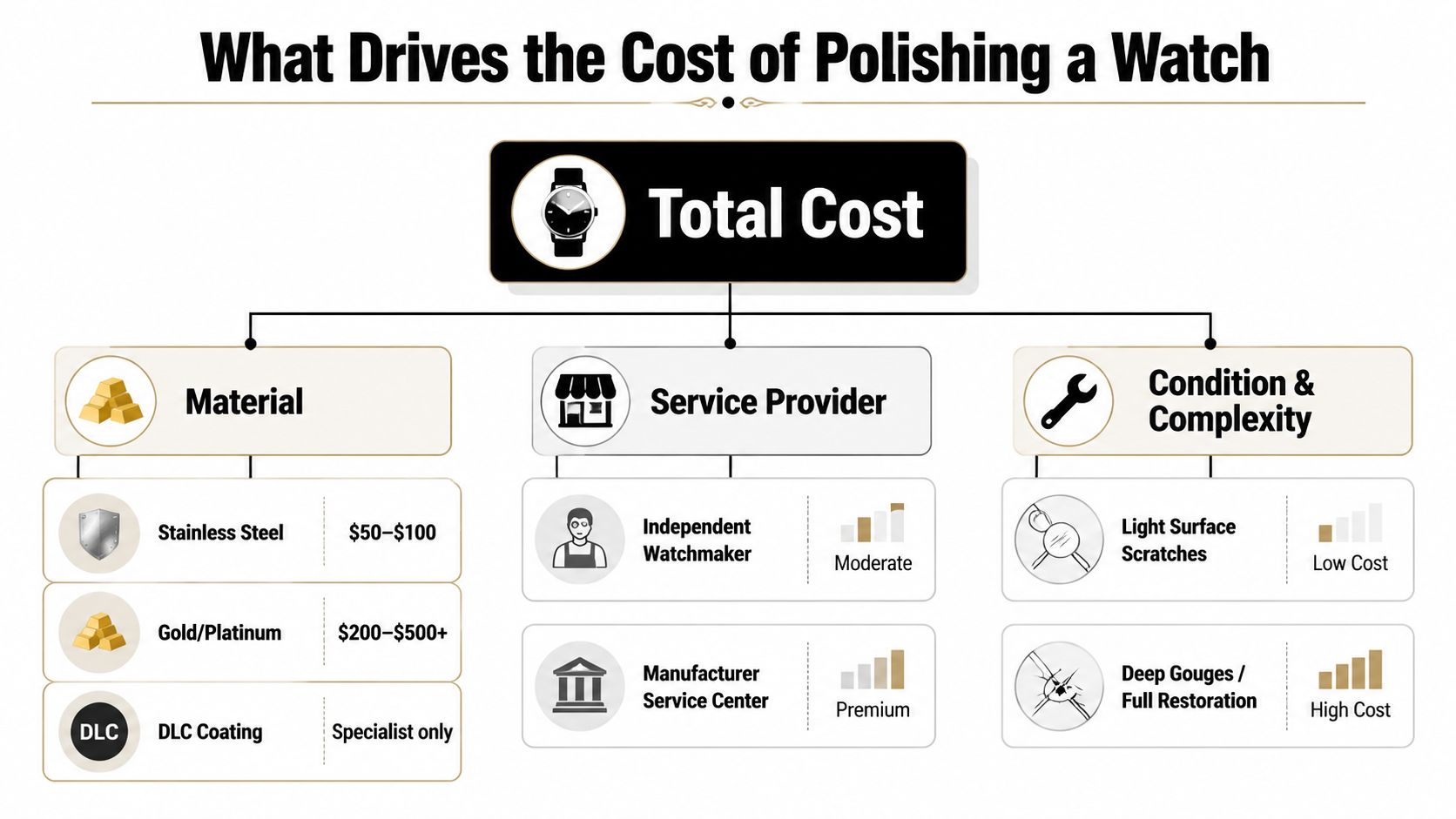
Material changes the job immediately
Steel is usually the easiest case to refinish. Gold and platinum demand more controlled work, and that's why luxury pricing climbs into ranges like $250 to $450 for a Rolex Submariner, $450 to $750 for a Rolex Day-Date, and $500 to $900 for Patek Philippe models such as the Nautilus or Calatrava (material and model pricing). The reason isn't hype, it's labor and risk. Softer, precious metals show mistakes more quickly, so a watchmaker has to move slower and preserve edges with more discipline.
Mixed finishes cost more than plain mirror surfaces. A watch with brushed flanks and polished bevels needs multiple abrasive steps, and the technician has to keep each surface visually distinct. That's why polished work on integrated bracelets and complicated case geometry often lands higher than a simple cosmetic buff.
Service level and damage depth matter
A light refresh is not the same thing as scratch removal after years of wear. The deeper the gouges, the more metal has to be managed, and the more chance there is of softening the original shape. Some guides show polishing packages starting around £70, while heavy restoration can run much higher when the watch needs serious exterior correction (service pricing examples).
A good polisher protects geometry first and shine second.
That's where service provider choice matters. Independent watchmakers tend to be more flexible on routine cosmetic work, while manufacturer service centers charge a premium for brand-aligned finishing and more formal procedures. If your watch has a diamond bezel or other decorative element, the finishing demands can become more specialized, which is why a piece like a diamond watch bezel needs a more careful quote than a standard steel case.
For general production budgeting, the same pattern shows up in save on production with RemotionAI, where complexity and precision work push the final price up. Watches are no different.
Polishing Cost by Brand and Model
Luxury watch polishing is priced by model as much as by labor. A steel sports watch with an Oyster-style bracelet is one thing. An integrated-bracelet icon in gold or platinum is another. The mistake is shopping for the cheapest quote without asking what the polish will do to the case shape, because that is where the resale damage starts.
Brand and Model | Independent Polish | Authorized Service Polish | Key Cost Factors |
|---|---|---|---|
Rolex Submariner | About $250 to $450 (polishing price reference) | Often bundled into broader service, with Rolex service references commonly cited at $800 to $1,200 for standard service (Rolex service pricing reference) | Steel case, sports geometry, brushed and polished surfaces |
Rolex Day-Date | About $450 to $750 (polishing price reference) | Often part of a higher full-service package, which can exceed standard service pricing (Rolex service pricing reference) | Gold case, President bracelet, more delicate finishing |
Patek Philippe Nautilus | About $500 to $800 in one guide, with broader luxury ranges reaching $500 to $900 (polishing price reference, market range) | Authorized or boutique-level refinishing can run materially higher when included with service (service-bundle guidance) | Integrated bracelet, sharp lines, high collector sensitivity |
Patek Philippe Calatrava | About $500 to $900 (market range) | Usually tied to service-level work rather than a cheap standalone polish (service-bundle guidance) | Precious metal, dress-watch finishing, originality concerns |
Audemars Piguet Royal Oak | Official full case-and-bracelet refinishing can be 450 CHF, with other quotes around 300 CHF for leather-strap models, 150 CHF for buckle-only work, and boutique pricing around 900 SGD in some markets (AP pricing examples) | Boutique or manufacturer-refinish work tends to be premium | Integrated bracelet, mixed finishes, sharp architecture |
The market reality is simple. A mainstream steel piece can justify independent work if the case lines are still strong. A collectible Patek Philippe or an AP Royal Oak needs a harder question, whether any polishing belongs on the watch at all.
That decision gets sharper when the watch is due for service anyway. Rolex service references commonly sit around $800 to $1,200 for standard work and can exceed $2,000 on complex models, which means polishing often gets folded into a much larger bill (service reference). For a reference like the Rolex GMT-Master II Blue Black, the model itself helps determine whether a light cosmetic touch or a broader service quote makes sense.
One more point matters for resale. A watch that is easy to polish is not always a watch worth polishing. If the piece has collector demand, a restrained quote from a careful independent is often the better path than a bargain job that wipes out the factory edges. The cheapest polish can become the most expensive mistake once the watch hits the resale market.
A rare piece with visible wear can still be the smarter hold. That is especially true for unusual references, including pieces that appeal to niche buyers, where the safer question is often how to sell jump hour watches rather than how hard to chase a mirror finish.
Why Polishing Can Hurt Your Resale Value
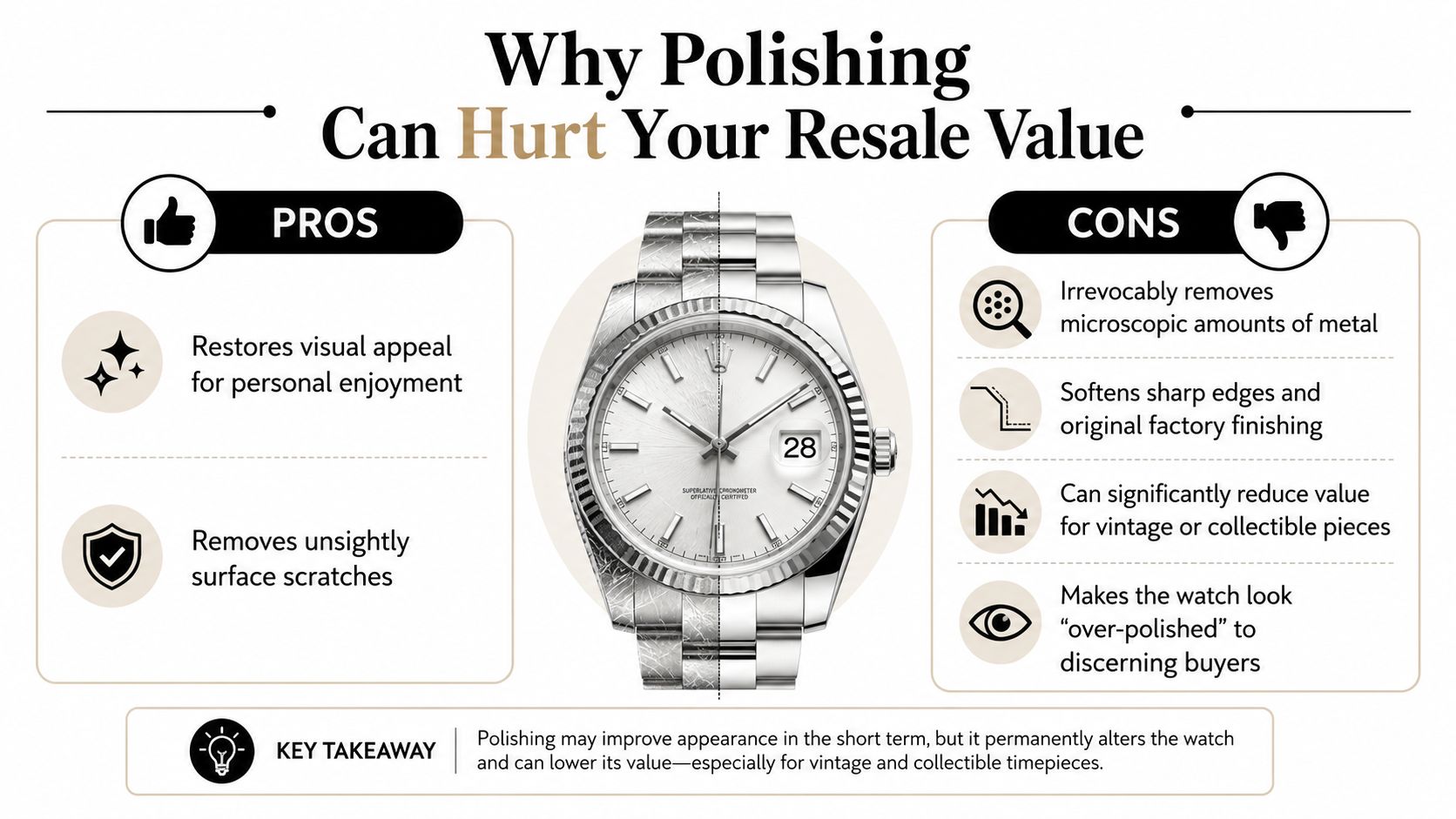
Polishing removes metal. That sounds obvious, but buyers still underestimate what it means on a high-end watch. Each pass can soften lug edges, thin case lines, and blur the crisp factory geometry that collectors look for, especially on vintage and iconic references.
Collectors pay for originality
A watch that looks untouched often carries more credibility than one that looks freshly buffed. Over-polished cases can be spotted by experienced buyers through rounded lugs, uneven brushing, and a loss of sharp transitions between surfaces. That's why some resale and restoration guides warn that the fee for polishing is small compared with the value lost when a collectible piece is refinished too aggressively (restoration pricing and value trade-off).
This matters even more if the watch already has collector interest. A rare piece with visible wear can be preferable to a “perfect” example that no longer looks factory correct. That's not sentimentality, it's market behavior.
The resale penalty can outrun the service fee
The polishing fee may be a few hundred dollars. The value loss on a collectible watch can be much more. That's why owners should think in terms of net value, not cosmetic satisfaction. If a buyer is likely to discount the watch because the finishing has been altered, the polish was expensive even if the invoice looked reasonable.
For owners selling unusual or niche pieces, the same logic applies to how to sell jump hour watches, where originality and condition can matter more than a shiny case. Our vintage watch valuation guide goes deeper into why untouched condition often supports better offers than aggressive restoration.
When to Polish and When to Skip It
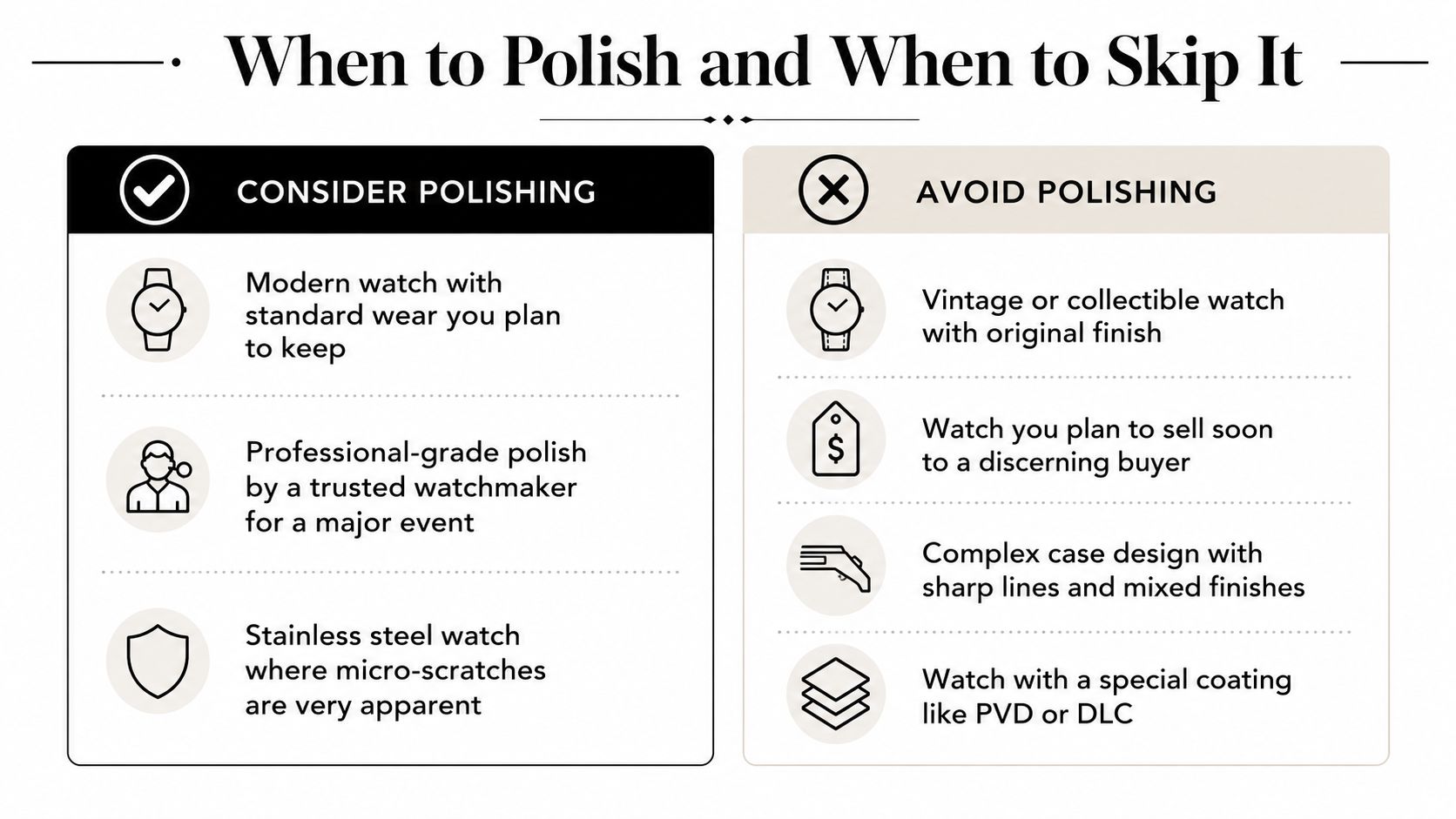
Polish it if the watch is a modern wearer
A stainless-steel daily watch with obvious surface marks is a good candidate. If you plan to keep wearing it, a careful polish from a qualified watchmaker can restore the look without changing your resale math much. That's especially true when the watch isn't rare and the finish is already heavily worn from everyday use.
Best use case: modern watch, clear scratches, personal wear, and no collector premium attached to originality.
Polishing also makes sense when the watch is being prepared for an event, a gift, or a private sale where presentation matters more than long-term collectibility. The key is to keep the work conservative.
Skip it if resale or originality drives the decision
If the watch is vintage, limited, or strongly collector-focused, leave it alone unless a trusted specialist says the case already needs restoration. That applies to precious-metal icons, integrated-bracelet models, and watches where the original brushing pattern is part of the value. It also applies to any piece with special coatings, because aggressive work can do more harm than good.
For owners in Atlanta, Buckhead, Sandy Springs, Alpharetta, Roswell, Brookhaven, and Midtown Atlanta, the smartest move is often to get the watch evaluated in its current state before spending anything on cosmetics. Antwerp Diamond Store works from the same principle, condition first, market reality second, and a polish only when it supports the outcome.
How to Get a Reliable Polishing Quote
Start with an in-person inspection. A decent quote should reflect the exact case shape, metal, bracelet type, and existing wear, not a generic price from a website. If a shop gives you a number without seeing the watch, treat that as a starting point, not a serious estimate.
Ask direct questions. You want to know whether the polisher handles brushed and polished surfaces separately, whether they preserve sharp case lines, and whether they can show examples of similar models. If they can't explain how they'll protect the geometry, they're not the right shop for a luxury piece.
Ask for the scope: Is this a light cosmetic refresh or a full refinish?
Ask about metal removal: How do they avoid rounding edges or thinning lugs?
Ask about finish matching: Can they preserve brushed, polished, or mixed surfaces correctly?
Ask for model experience: Have they polished your exact brand or case style before?
Ask about before-and-after examples: Can they show comparable work on similar watches?
Red flags are easy to spot. A shop that promises to remove every scratch should worry you, because perfect scratch removal can mean too much metal comes off. A quote that sounds cheap but ignores the watch's case architecture can be more expensive in the long run than a carefully priced specialist job.
For owners comparing service providers in the greater Atlanta area, a professional watch appraisal process should always include condition, originality, and resale impact, not just a cosmetic estimate. Our watch appraisal NYC guide also shows why a proper evaluation always starts with what the watch is, not just how shiny it looks.
Your Next Step for a Fair Watch Evaluation
Watch polishing cost is only part of the decision. The smarter question is whether polishing improves your personal enjoyment enough to justify the risk, or whether originality matters more because you may sell the watch later. If resale is on the table, skip guesswork and get the watch evaluated as it sits.
A confidential review gives you a clearer answer than any online rule of thumb. In many cases, the best move is not polishing at all, it's understanding the market value first and deciding from there.
Antwerp Diamond gives you a straightforward, in-person evaluation of luxury watches in their current condition, so you can see the trade-off before you spend money on polishing. If you're in Atlanta or nearby and want a discreet opinion on whether your watch should be polished, sold, or left untouched, visit Antwerp Diamond for a professional review and a no-pressure offer.


