
A 14k solid gold Figaro chain is a durable piece of jewelry made from 58.5% pure gold, recognized by its pattern of three short links followed by one long link and a 14k or 585 hallmark. Its value is based on gold weight, craftsmanship, and condition.
If you're holding a Figaro chain and trying to figure out what you have, the first things to check are simple: the stamp, the link pattern, the feel in the hand, and whether the weight makes sense for the size. Those details tell you far more than appearance alone, and they can help you avoid confusing a solid chain with a hollow or plated one before you ever ask for a formal appraisal.
Table of Contents
Understanding the 14k Solid Gold Figaro Chain
A 14k solid gold Figaro chain combines three important qualities: gold purity, solid construction, and a link pattern that has both visual identity and practical strength. When those three line up, you get a chain that's wearable, durable, and easier to value accurately.
What 14k means in real terms
14k gold means the metal is 58.5% fine gold, which is why genuine pieces are often stamped 585. The remaining 41.5% is made up of alloy metals such as copper, silver, or zinc, which are added to improve durability and tensile strength. That's one reason 14k works so well for daily-wear chains, especially link styles that need to hold shape over time. The gold content also ties directly to underlying material value, and 14k gold traded at about $50 to $60 per gram in 2024 according to current 14k gold spot price results.
That balance between precious metal content and strength is what makes 14k different from softer, higher-karat options. A chain isn't just a gold object. It's a mechanical object, with dozens of moving contact points.
For anyone comparing karat levels, 14k vs. 18k gold differences are worth understanding before you judge color, durability, or resale expectations.
Practical rule: If a seller describes a chain as solid gold but can't point to a 14k or 585 mark, that's a reason to slow down and inspect more carefully.
Why the Figaro pattern matters
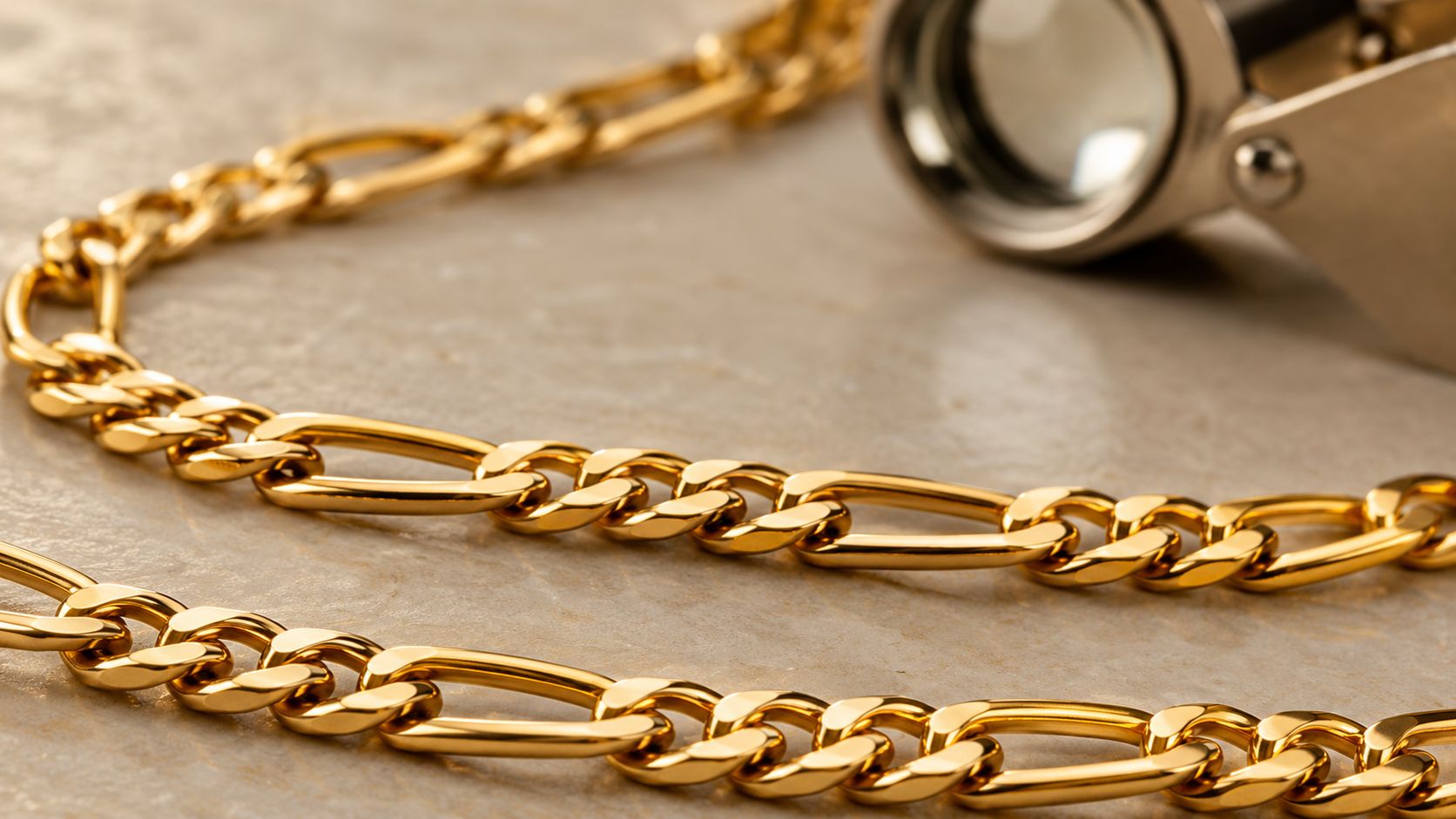
A Figaro chain isn't just any link chain. Its classic look comes from an alternating pattern, commonly three shorter links followed by one elongated link. That sequence is what gives the style its rhythm and makes it easy to identify at a glance.
The pattern also affects wear. Alternating links create a different visual flow than a uniform curb or rope chain, and they distribute movement across the necklace in a way that can feel flexible without looking flimsy. In practice, a well-made Figaro chain tends to sit flat and wear comfortably, which is one reason it remains popular in both men's and women's jewelry.
Solid construction matters just as much as style. A solid chain has real metal throughout the links, not a thin outer shell around empty space. That's why a genuine solid Figaro usually feels more substantial in the hand than photos suggest.
How to Identify a Genuine Figaro Chain
Most owners can do a meaningful first-pass authentication at home. You won't replace a professional jeweler's testing equipment, but you can rule out obvious problems and spot red flags before spending time on an appraisal.
Start with the marks and the pattern
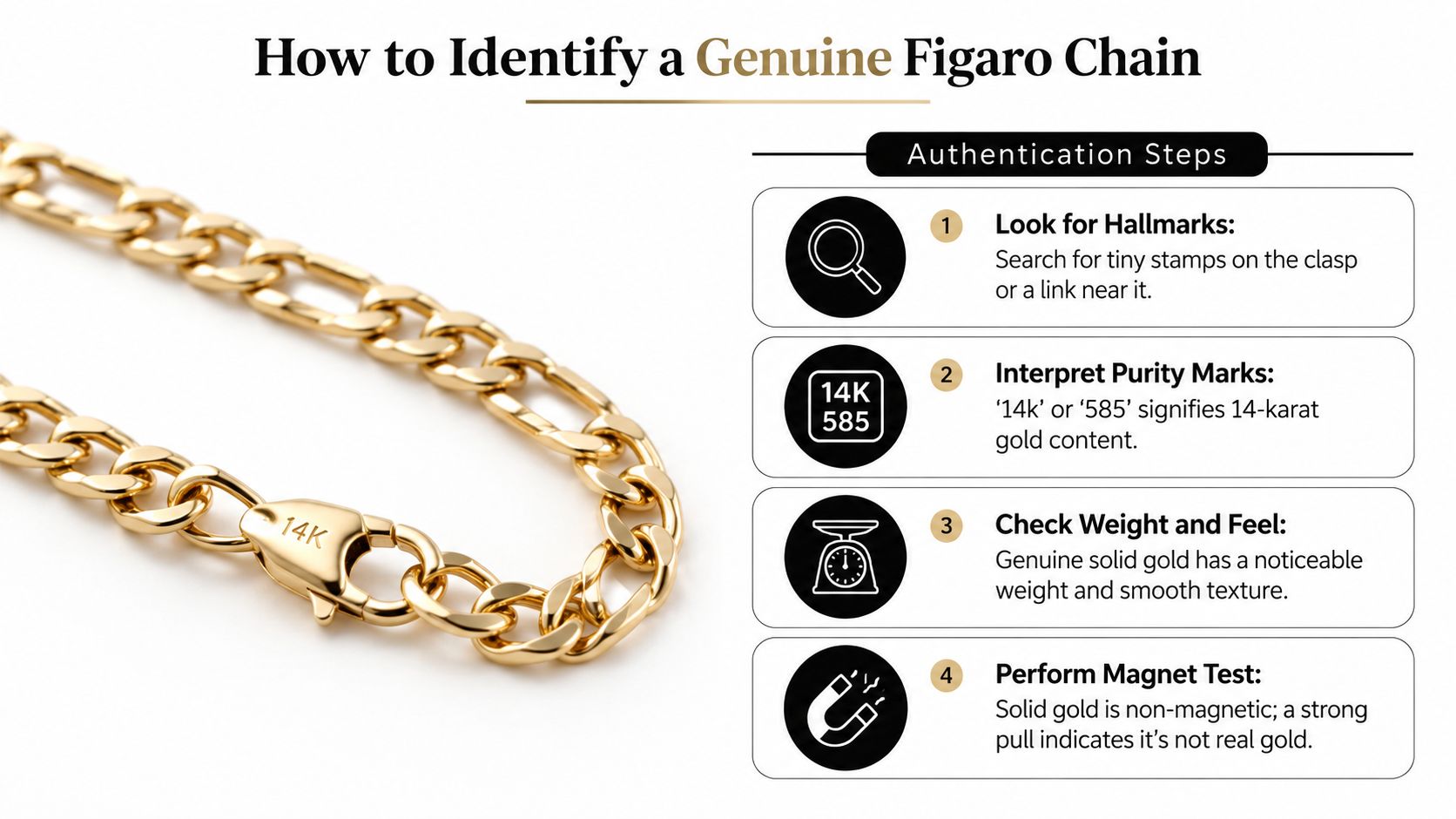
Check the clasp, the end tab, or the link nearest the clasp. That's where you'll usually find the most useful marks.
Use this checklist:
Look for purity marks: You want to see 14k or 585.
Check the link sequence: A proper Figaro should show the familiar short-link and long-link pattern.
Inspect the finish: Genuine gold chains usually have a consistent surface and color, not patchy wear exposing a different metal underneath.
Try a basic magnet test: Gold is non-magnetic, so a strong magnetic pull is a bad sign.
A magnet test isn't final proof by itself. Clasps can contain small non-gold components in some jewelry categories, and home testing always has limits. But if the chain reacts strongly, that usually tells you to investigate further.
A professional opinion becomes much more useful once you've already done these basic checks. If you need help understanding what an evaluator does, this guide to an independent jewelry appraiser gives useful context.
Use weight as a reality check
Many owners miss the strongest clue at this point.
A genuine 22-inch, 3.0mm 14K solid gold Figaro chain should weigh about 12 to 14 grams, and a noticeably lower weight is a strong warning sign for hollow construction, especially in the secondary market, as noted in this Figaro chain buying guide with weight benchmark.
That doesn't mean every authentic chain must match that exact number unless it has that exact size. It means weight should make sense for the chain's length and width. If a chain looks substantial but feels unusually light, that's when sellers should be cautious.
Weight doesn't replace hallmark inspection, but it often exposes hollow chains faster than the eye does.
A short visual guide
If you want a quick overview before inspecting your own chain, this video shows the kinds of details buyers and owners tend to focus on:
One more practical benchmark helps when judging thickness by eye. A 2.5mm 14k solid gold Figaro chain is about the thickness of two U.S. dimes stacked together, based on this product reference for a 2.5mm Figaro chain. That kind of physical comparison is useful when you're trying to decide whether a chain's visual size matches its stated specs.
How to Estimate Your Chain's Value
A chain's value starts with metal content, but it doesn't end there. Buyers look at gold weight first, then construction quality, wear, repair history, and whether the piece is solid or hollow.

What drives price first
For self-assessment, start with four questions:
What does it weigh: Weight is the backbone of value because gold content is measurable.
Is it solid or hollow: Construction changes both retail pricing and resale confidence.
What are the dimensions: Width and length change total gold content fast.
What condition is it in: Bent links, solder repairs, thinning near the clasp, and worn hallmarks can all affect offer quality.
A good working method is to separate melt value from market value. Melt value is based on the recoverable precious metal. Market value includes craftsmanship, wearable condition, and whether the chain can be resold as jewelry rather than only purchased for scrap.
If you're trying to follow live metal movement before selling, gold and silver price trends can help you understand timing and buyer behavior.
Valuation note: A chain in clean, wearable condition often gets evaluated differently from a chain that's only useful for melt, even when the gold purity is the same.
A practical value comparison
The market shows a steep jump as chains get wider and longer. 14K solid gold Figaro chains at 4mm and 20 inches are often priced between $800 and $1,200, while 6mm and 22-inch solid versions can range from $1,500 to $2,200, according to recent price comparisons for 14k solid gold Figaro chains.
Here's a simple comparison:
Chain type | Typical market reference |
|---|---|
14k solid Figaro, 4mm, 20-inch | $800 to $1,200 |
14k solid Figaro, 6mm, 22-inch | $1,500 to $2,200 |
Hollow Figaro versions | Typically 30% to 50% cheaper than solid |
That last line matters. Hollow chains can look impressive in photos and still carry much less intrinsic value.
Why solid and hollow don't trade the same
A solid chain contains more gold, wears more confidently over time, and usually gives both buyers and pawnbrokers more confidence during evaluation. A hollow chain may still be genuine gold, but it often dents more easily and doesn't hold value the same way because there's less metal in the links.
That's one reason experienced buyers don't price chains by style name alone. They verify structure, weight, and condition.
Gold also carries significance beyond jewelry. If you're interested in the broader relationship between gold and value systems, Insights into Bhutan's sovereign token initiative offers an interesting example of how gold-backed thinking can extend into economic modernization. It's a different context, but it reinforces why tangible gold content still matters.
A useful real-world note on customization: a 4mm 14k solid gold Figaro chain is available in 24-inch length, shown in this 24-inch Figaro listing. That matters because non-standard lengths can affect both wearability and valuation when you're comparing your piece to more common market listings.
Proper Care and Cleaning for Your Gold Chain
Condition affects resale, and chain condition is often lost through neglect rather than dramatic damage. Figaro links collect skin oils, lotion residue, and dust, especially around the clasp and the inner curves of the longer links.
Safe cleaning at home
Use a mild approach:
Start with warm water: Add a small amount of mild soap to a bowl.
Let the chain soak briefly: This helps loosen residue without aggressive scrubbing.
Use a soft brush carefully: A very soft toothbrush can clean between links.
Rinse and dry fully: Pat it dry with a soft cloth and let it air dry before storing.
Don't use harsh chemicals, abrasive pastes, or rough paper towels. They can dull the finish or create fine scratches that make the chain look older than it is.
If you're comparing different gold items in your collection, a practical read on 24 carat gold ring considerations can help clarify why softer high-purity gold needs different handling than wearable 14k chain styles.
Storage habits that protect value
Store the chain flat or loosely laid in a soft pouch or lined jewelry box compartment. That reduces tangling and lowers the chance of one link rubbing hard against another piece.
Don't toss it into a mixed drawer with watches, loose rings, or cufflinks. The chain may survive that treatment, but the finish usually won't.
Clean metal and intact links don't guarantee a higher offer, but damage and heavy wear almost always complicate one.
Selling Your 14k Figaro Chain Safely and for a Fair Price
Selling a Figaro chain goes better when you treat it like an asset, not just a piece of old jewelry. Buyers who know what they're doing will separate gold value, wearable resale value, and repair risk. You should too.

What a serious buyer checks
A proper evaluation usually includes:
Hallmark verification: The buyer checks for 14k or 585 marks and looks at wear around those areas.
Accurate weighing: Fine differences in weight matter because they affect precious metal value directly.
Construction review: Solid, hollow, repaired, or altered construction changes pricing.
Condition assessment: Kinked links, stretched sections, clasp replacement, and solder work all matter.
Resale potential: Some chains are purchased for immediate resale as jewelry, others more as gold value.
Bring any original box, receipt, or prior appraisal if you have it, but don't worry if you don't. For plain gold chains, the item itself usually tells the story.
How to prepare before you sell
Before visiting a buyer or shipping a piece for review, do these basic steps:
Clean it gently: Dirt can hide marks and make condition harder to judge.
Measure length and width: Even a simple ruler helps you speak accurately about the piece.
Weigh it if you can: A digital gram scale gives you a useful baseline.
Photograph the hallmark and clasp: That creates a record and helps if you're seeking preliminary feedback.
Note any repairs: Be honest about breaks, soldering, or clasp replacement.
If you're exploring selling options, this guide on the best place to sell gold is a useful framework for comparing local buyers, jewelers, and gold specialists.
What sellers in Atlanta should keep in mind
In the Atlanta market, especially in Buckhead, Sandy Springs, Alpharetta, Roswell, Brookhaven, Midtown Atlanta, and the greater Georgia area, the biggest advantage of an in-person evaluation is transparency. You can watch the weighing process, point out hallmarks, and ask direct questions about how the offer is being calculated.
That's especially useful if you're deciding between selling outright, seeking an appraisal, or exploring whether the chain has enough value to borrow against. Loan structures, repayment terms, and ownership rights vary by business and transaction type, so it's smart to ask for plain-English explanations and review all terms carefully before agreeing to anything.
A fair process should feel straightforward. The buyer should be able to explain what they're paying for, whether that's wearable resale, gold content, or both.
Frequently Asked Questions
Is a 14k Figaro chain a good store of value
It can be, especially if it's solid gold and in good condition. The gold content gives it intrinsic value, while solid construction and wearable style can support resale appeal beyond scrap value. It's still jewelry first, so offers depend on condition, demand, and how the buyer intends to resell it.
How is a Figaro chain different from curb or rope
A Figaro chain uses an alternating pattern of short links and elongated links, which gives it a more recognizable rhythm than a standard curb chain. Rope chains twist visually and reflect light differently. In day-to-day wear, those styles also differ in flexibility, cleaning ease, and how clearly damage shows.
Should you repair a broken chain before selling
Not always. A clean professional repair can help in some cases, but poor solder work can hurt appearance and buyer confidence. If the chain is broken, ask for an evaluation first and find out whether repair would improve resale value enough to justify the cost.
Can you tell if a chain is hollow at home
Sometimes, yes. If the chain feels unusually light for its size, that's an important clue. Hallmarks, overall feel, and weight benchmarks are your best home checks, but a professional inspection is still the reliable way to confirm construction.
Does chain length affect value
Yes. Longer chains generally contain more gold, assuming width and construction are comparable. But length alone doesn't determine value. Width, total weight, condition, and whether the chain is solid or hollow matter just as much.
Should you keep the box or paperwork
Yes, if you have them. Plain gold chains are usually valued from the metal and the piece itself, but original paperwork can still support buyer confidence and help document what you own.
If you want a professional, low-pressure review of your chain, Antwerp Diamond offers evaluations for gold jewelry, luxury assets, and other high-value items. You can request an assessment, visit the Atlanta location, or bring your piece in for an in-person review if you're in Buckhead, Roswell, or the greater Georgia market.