
Natural diamond prices typically range from $750 to $1,150 for a 0.50-carat stone, $2,630 to $4,031 for a standard 1.00-carat stone (with a median benchmark of $3,250), and $14,500 to $21,000 for a 2.00-carat gem. Lab-grown diamonds generally cost 60% to 76% less, with 1.00-carat stones averaging $680. Beyond carat weight, the exact diamond price depends on cut precision, color grade, clarity grade, and independent certification.
Understanding diamond pricing requires looking closely at how independent gemological laboratories evaluate gems. When gemologists grade a stone, they evaluate an intricate set of physical and optical properties that directly dictate its wholesale and retail worth.
Every diamond's valuation rests on several foundational pillars:
The 4 Cs: Carat weight, cut precision, color grade, and clarity grade.
Grading Integrity: Independent validation, primarily understanding what is GIA diamond certification and how it protects consumers from inflated quality grades.
Proportions and Symmetry: The exact angles, depth percentages, and table ratios that control how light refracts and returns to the viewer's eye.
Secondary Characteristics: Features such as polish quality, facet alignment, and ultraviolet fluorescence.
The 4 Cs and Cut Quality Hierarchy
While many buyers prioritize weight, cut quality is the single most important factor determining a diamond’s sparkle and visual beauty. Cut does not refer to the diamond's perimeter shape (such as round, oval, or pear), but rather how skillfully its facets are angled and proportioned.
A poorly cut diamond allows light to leak out of the sides or bottom of the stone, leaving the center looking dark, lifeless, or glassy. Conversely, an Excellent or Ideal cut diamond reflects light through the top table facet, creating brilliant fire (colored light flashes) and scintillation (sparkle).
To ensure optimal light performance, look for these proportions on a round brilliant diamond:
Depth Percentage: 59.5% to 62.5%
Table Percentage: 54% to 58%
Crown Angle: 34.0° to 35.0°
Pavilion Angle: 40.6° to 41.0°
Because master cutters must sacrifice significant rough material to hit these precise parameters, diamonds with top-tier cut grades command a 10% to 15% price premium over stones with mediocre proportions.
Certification, Clarity Inclusions, and Color Premiums
Color grading evaluates the absence of color on a scale from D (completely colorless) to Z (light yellow or brown). As you move down the scale, prices drop significantly. A D-color diamond commands roughly a 46% price premium over an equivalent G-color stone. Yet, once mounted in a precious metal setting, the visual difference between D and G is virtually undetectable to the untrained eye. Reviewing a diamond color grades chart shows why the near-colorless G–H range is considered the sweet spot for maximum value.
Clarity measures the presence of internal inclusions and surface blemishes. When identifying what is an inclusion in a diamond, gemologists inspect the gem under 10x magnification.
Clarity grades span from Flawless (FL) down to Included (I1–I3):
Flawless / Internally Flawless (FL/IF): Completely free of visible inclusions under magnification. These carry a 72% markup over eye-clean stones.
Very, Very Slightly Included (VVS1/VVS2): Minute characteristics that are difficult for skilled graders to see under magnification.
Very Slightly Included (VS1/VS2): Minor inclusions invisible to the naked eye ("eye-clean"). VS2 represents the prime value benchmark.
Slightly Included (SI1/SI2): Noticeable inclusions under magnification that may occasionally be visible face-up without magnification.
Fluorescence—a soft glow emitted when exposed to ultraviolet light—also influences market price. While faint to medium blue fluorescence can improve the face-up appearance of lower color stones (I–K), strong fluorescence in colorless diamonds (D–F) often results in a 5% to 15% discount due to the risk of a hazy or milky appearance.
2026 Market Benchmarks: Natural, Lab-Grown, and Fancy Colored Stones
Diamond values shift alongside global macroeconomic conditions, production capacities, and changing consumer tastes. Tracking tools like the Diamond Price Index tracking daily median diamond prices provide transparency across specific quality tiers.
If you already own fine jewelry and are determining how much is my diamond worth, understanding the current spread between natural, lab-grown, and rare fancy colored stones provides an accurate estimate of how much is a diamond in today's secondary and retail markets.
Diamond Category | Carat Weight | Typical Quality Benchmark | Fair Market Price Range (Sept 2026) | Median Price |
|---|---|---|---|---|
Natural Round | 0.50 ct | G–H / VS1–VS2 / Excellent | $750 – $1,150 | $808 |
Natural Round | 1.00 ct | G–H / VS1–VS2 / Excellent | $2,630 – $4,031 | $3,250 |
Natural Round | 2.00 ct | G–H / VS1–VS2 / Excellent | $14,500 – $21,000 | $17,730 |
Natural Round | 3.00 ct | G–H / VS1–VS2 / Excellent | $35,000 – $48,000 | $40,898 |
Lab-Grown Round | 1.00 ct | E–F / VS1–VS2 / Ideal | $590 – $770 | $680 |
Lab-Grown Round | 2.00 ct | E–F / VS1–VS2 / Ideal | $1,600 – $2,400 | $1,950 |
Lab-Grown Round | 3.00 ct | E–F / VS1–VS2 / Ideal | $2,800 – $4,100 | $3,450 |
Treated Natural Blue | 1.00 ct | VS2 Clarity Base Material | $2,000 – $6,000+ | $3,800 |
Fancy Vivid Blue (Natural) | 1.00 ct | Natural Origin / GIA Certified | $50,000 – $500,000+ | Auction-Determined |
Natural vs. Lab-Grown Diamond Price Comparison
The price spread between mined diamonds and synthetic alternatives continues to widen. As chemical vapor deposition (CVD) and high-pressure high-temperature (HPHT) manufacturing capacities have scaled globally, lab-grown diamond prices have fallen 30.1% since early 2025.
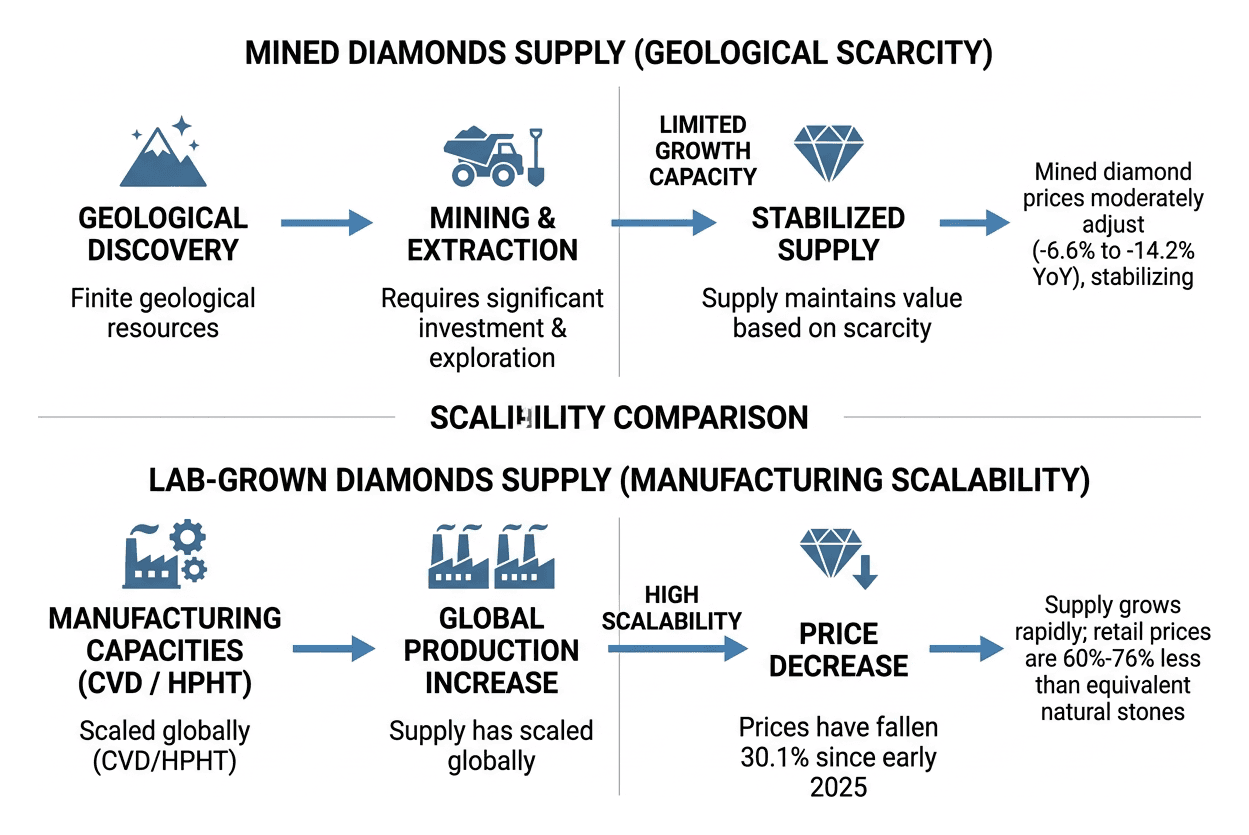
Today, lab-grown stones retail for 60% to 67% less than equivalent natural stones at the 1-carat mark, with discounts reaching 76% or higher at 3 carats. Detailed analysis of lab grown vs natural diamond cost dynamics shows that while lab-grown options offer low initial retail costs, mined gems maintain value based on finite geological scarcity. Mined round diamonds experienced a moderate 6.6% to 14.2% year-over-year adjustment, stabilizing after multi-year market corrections as tracked in historical diamond market data and price indexes.
Average 1-Carat Diamond Price by Shape, Color, and Clarity
A standard 1-carat round natural diamond centers on a fair market value of $3,250, though specifications cause substantial variance. For a premium benchmark stone (VS2 clarity, G color, Excellent cut), the median retail price settles near $5,350.
If you step down to an SI1 clarity and I color stone, listings drop toward $2,600. Moving up to an investment-grade D-color, Flawless 1-carat round can push asking prices beyond $20,000. These principles scale upward: reviewing a 3 carat round diamond price reveals how premium color and clarity parameters compound into five-figure differences.
Colored Diamond Valuation: Natural Fancy, Treated, and Lab Blue Diamonds
Natural fancy colored diamonds represent the rarest segment of the gemstone world. Natural blue diamonds get their hue from boron atoms trapped in the carbon lattice during formation billions of years ago. Fewer than 0.02% of all mined diamonds display any natural blue coloration.
Valuations for natural fancy blue diamonds depend entirely on color intensity and purity:
Natural Fancy Vivid Blue: These stones trade between $50,000 and $500,000+ per carat. Historic auction stones like the 14.62-carat Oppenheimer Blue set records at $3.9 million per carat, while museum-caliber stones illustrate how much is a 100 ct diamond worth when color and extreme carat weight combine.
Treated Natural Blue Diamonds: Mined diamonds with lower initial color that have undergone controlled laboratory irradiation and annealing. Starting with VS2 clarity base material ensures even color saturation without dark zoning, resulting in quality ring-ready stones priced between $2,000 and $6,000+ per carat.
Lab-Grown Blue Diamonds: Factory-grown synthetic diamonds infused with boron or treated post-growth, retailing between $500 and $2,000 per carat.
Smart Buying Strategies: Shapes, Magic Sizes, and Pricing Curves
Navigating the jewelry market requires looking past standard marketing terms to spot pricing inefficiencies. By adjusting shape preferences and weight thresholds, buyers can secure larger, higher-performing stones without inflating their budgets.
When it comes time to evaluate an existing ring or prepare for a trade-in, an accurate diamond resale value calculator and a comprehensive diamond ring selling guide 2026 can help you verify market spreads before making a transaction.
Understanding the Exponential Carat Weight Curve and Magic Sizes
Diamond rough is priced by weight, but diamond value scales exponentially rather than linearly. Large, gem-quality rough crystals are significantly rarer in nature than small ones.
Because of this rarity, a 2.00-carat diamond is not simply double the price of a 1.00-carat diamond; it costs roughly 3.6 times more for identical color and clarity grades.
This steep price curve creates sharp spikes at "magic sizes"—popular benchmark weights such as 0.50 ct, 0.75 ct, 1.00 ct, 1.50 ct, and 2.00 ct. Diamond cutters will preserve weight at all costs to cross these numbers.
By purchasing just below these thresholds—such as choosing a 0.90 to 0.95-carat stone instead of a full 1.00-carat diamond—you can save 10% to 15% on the stone. Because diamonds are cut to specific millimeter proportions, a 0.95-carat stone (around 6.3mm) looks identical to a 1.00-carat stone (6.4mm–6.5mm) when set in a ring. A foundational knowledge of the understanding types of rough diamonds helps explain why these natural yield variations occur during cutting.
Best Value Diamond Shapes: Round vs. Fancy Cuts
The round brilliant diamond remains the most popular cut, but it is also the most expensive per carat. Cutting a round diamond from rough octahedral crystal wastes up to 50% to 60% of the original stone.
Fancy shapes (all non-round cuts) follow crystal structures more efficiently, reducing cutting waste and yielding lower per-carat prices:
Oval Cuts: Save roughly 21% compared to rounds. Due to their elongated surface spread, ovals appear 10% to 15% larger face-up than a round diamond of identical carat weight.
Marquise & Radiant Cuts: Offer exceptional value, pricing 33% to 36% below equivalent round stones.
Emerald & Cushion Cuts: Provide distinctive vintage aesthetics while maintaining a 20% to 30% savings relative to round cuts.
Loose Stone Costs vs. Finished Engagement Ring Budgeting
A common mistake when budgeting for fine jewelry is assuming the loose diamond represents the total final cost. A finished engagement ring combines the certified center stone, the precious metal mounting, setting labor, and any accent stones.
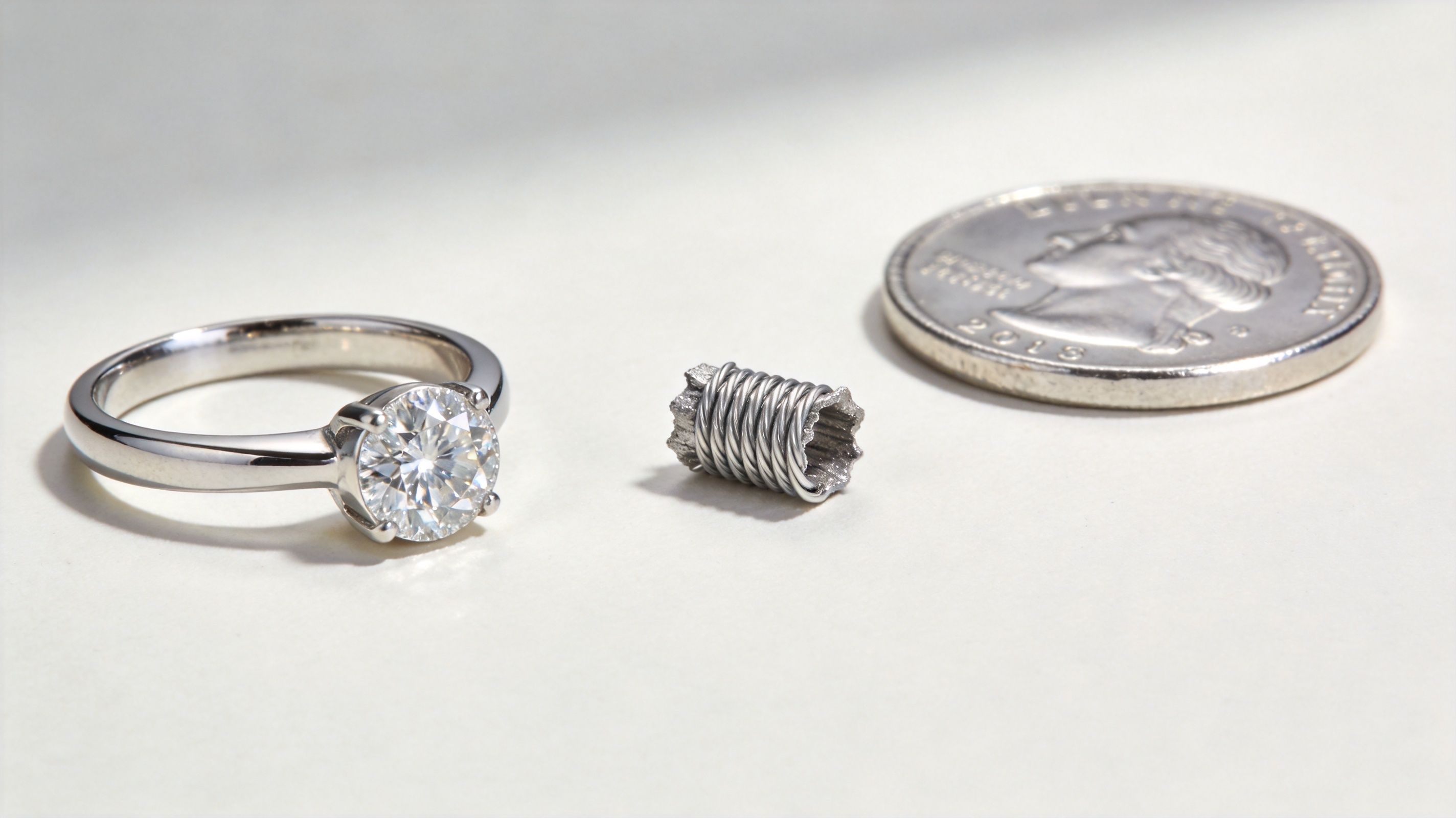
When reviewing a 1 carat diamond gold ring price breakdown, buyers should separate component expenses to see how mounting selections influence the total determining a complete diamond ring price. Choosing a GIA certified engagement ring guarantees that the center stone's specifications are independently verified.
Budgeting for Settings, Metals, and Custom Labor
Ring mountings vary widely depending on metal weight and design complexity:
Solitaire Settings: Simple 4-prong or 6-prong solitaire mountings in 14k gold generally run between $350 and $900.
Precious Metals: 18k gold adds a richer color profile and costs between $600 and $1,400. Platinum, prized for its natural density, hypoallergenic qualities, and durability, typically adds $900 to $2,200 for the setting alone.
Side Stones & Intricate Pavé: Settings featuring micro-pavé diamonds, hidden halos, or three-stone designs require extra bench labor and accent stones, ranging from $1,200 to over $3,500.
Avoiding Common Buying Mistakes and Navigating Retail Discrepancies
Identical loose diamonds often show an average price dispersion of 22% between different jewelers. On a typical 1.5-carat diamond, this retail spread can exceed $1,200 for the exact same stone.
To ensure a smooth, transparent transaction:
Always Match Exact Dimensions: Look at the physical measurements (length × width × depth in millimeters), not just carat weight. Deeply cut stones hide weight beneath the girdle where it cannot be seen.
Differentiate Appraisals from True Market Value: High-street retail insurance appraisals are often inflated for replacement cost scenarios. Understanding the details of navigating a GIA ring appraisal helps clarify how much to value a diamond ring in actual cash-equivalent terms.
Understand the Secondary Market: If you ever plan to liquidate or trade up, review best practices on how to sell diamonds, identify where to sell loose diamonds, or consult regional resources like our guide to sell diamonds Houston.
Frequently Asked Questions About Diamond Valuation
What is the fair market price for a 1-carat round diamond in 2026?
As of September 2026, a 1-carat round natural diamond carries a fair market benchmark price of $3,250, with most eye-clean, commercially viable stones falling between $2,630 and $4,031. Premium color and clarity tiers (such as G color and VS2 clarity with an Excellent cut) carry a median price around $5,350.
Why do natural diamonds cost significantly more than lab-grown diamonds?
Natural diamonds are a finite geological resource formed deep within the earth over billions of years, requiring extensive mining operations. Lab-grown diamonds are produced in controlled manufacturing facilities using advanced technological processes. Because manufacturing capacity scales continuously while production costs fall, lab-grown diamonds do not carry the natural scarcity that supports mined diamond values.
How much can you save by purchasing just below a major carat benchmark?
Purchasing a diamond at an "under-size" weight—such as a 0.90 to 0.95-carat stone instead of a full 1.00-carat stone—can save you between 10% and 15%. Because millimeter dimensions differ by fractions of a millimeter, these stones look identical once set in a ring mounting.
Conclusion
Navigating diamond prices in 2026 comes down to understanding the relationship between origin, cut quality, and market-driven pricing tiers. By choosing eye-clean VS2 clarities, near-colorless G–H grades, and well-proportioned fancy shapes or under-size carat weights, you can maximize your visual impact and overall value.
At Antwerp Diamonds, we believe diamond transactions should always be transparent and straightforward. If you are looking to sell fine jewelry, certified diamonds, luxury watches, or designer handbags, we offer private, appointment-only consultations at our Atlanta, GA offices. We provide free professional evaluations, transparent market-based offers, and instant cash payouts without hidden fees or consignment delays.
Ready to check the current market value of your fine jewelry? Use our free tool to calculate diamond price and discover what your luxury assets are worth today.