

Calculate Your 14K Gold Scrap Value Per Gram
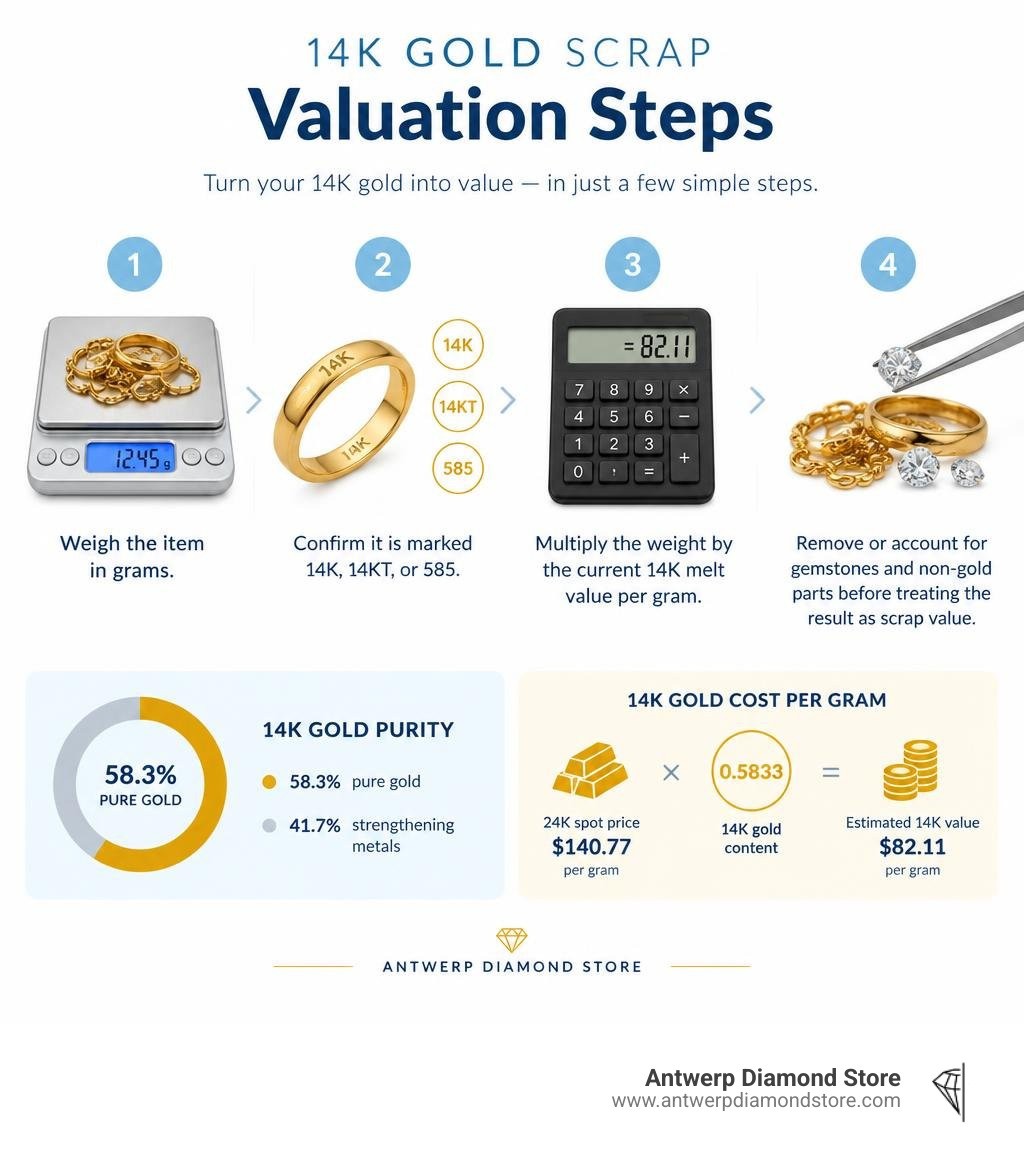
To estimate the 14K gold cost per gram, multiply the current pure-gold spot price per gram by 0.5833. That is the gold content in 14K jewelry.
For example, if 24K gold is $140.77 per gram, 14K gold's estimated melt value is about $82.11 per gram:
Weigh the item in grams.
Confirm it is marked 14K, 14KT, or 585.
Multiply the weight by the current 14K melt value per gram.
Remove or account for gemstones and non-gold parts before treating the result as scrap value.
This number is the melt value, not necessarily the cash offer. Pawn shops may pay roughly 50-70% of melt value, while stronger gold buyers and refiners can pay more depending on testing, weight, and the size of your lot.
A 14K piece is real gold: it contains about 58.3% pure gold and 41.7% strengthening metals. Knowing that difference helps you spot a fair offer before you sell.
Understanding 14K Gold Cost Gram Rates and Purity
When assessing scrap jewelry, gold value comes down to one fundamental principle: the actual weight of the pure elemental gold contained within the alloy. Gold in its natural state is soft and malleable. To turn it into durable jewelry that withstands daily life, master jewelers mix pure 24-karat gold with complementary metals such as copper, silver, nickel, and zinc.
A 14-karat alloy contains 14 parts pure gold out of 24 total parts. Mathematically, 14 divided by 24 gives us 0.5833, meaning 14K gold is 58.3% pure gold by weight. The remaining 41.7% consists of strengthening base metals. When calculating the baseline 14k gold cost gram value, we look strictly at this 58.3% pure gold content against the live precious metals market.
Understanding these ratios is essential when evaluating estate pieces or broken chains. You can explore our guide on how to determine gold purity to understand how different alloy compositions affect fineness. Before making financial decisions, checking live melt value metrics allows you to see real-time scrap market fluctuations.
"585" Stamp vs. 14K Markings
You will frequently encounter jewelry stamped with "585" rather than "14K" or "14KT." This marking represents millesimal fineness, the standard European numbering system denoting precious metal purity in parts per thousand.
A "585" stamp indicates 585 parts pure gold per 1,000, which works out to 58.5% purity. While mathematically 14K is 58.33%, European and international standards round to 58.5% to ensure the piece meets minimum legal purity thresholds. For everyday scrap valuation, a 14K and 585 stamp represent the same category of gold alloy.
Look closely at clasps, inner ring bands, and earring posts using a jeweler's loupe. Be cautious if you see stamps accompanied by letters like "GF" (Gold Filled), "GP" (Gold Plated), or "HGE" (Heavy Gold Electroplate). These items only carry a microscopically thin layer of gold over base metal and do not have solid 14K scrap value.
The Durability and Composition of 14K Alloy
Pure 24K gold scores roughly 25 on the Vickers hardness scale (HV), making it soft and prone to bending or scratching. By contrast, standard 14K gold measures between 120 and 150 HV. This alloy provides exceptional structural integrity, which is why 14K dominates roughly 70% of the United States bridal and fine jewelry market.
The alloy blend determines the final color of your 14K gold:
14K Yellow Gold: 58.3% pure gold, ~25% silver, and ~16.7% copper. This preserves the warm, classic golden hue while adding structural strength.
14K White Gold: 58.3% pure gold alloyed with nickel, zinc, or palladium, often finished with a rhodium plating for a bright mirror shine.
14K Rose Gold: 58.3% pure gold combined with ~32.7% copper and ~9% silver. The higher copper concentration delivers a rich, reddish-pink tone.
Regardless of whether your 14K jewelry is yellow, white, or rose, the pure gold weight remains identical.
How to Accurately Calculate 14K Scrap Melt Value at Home
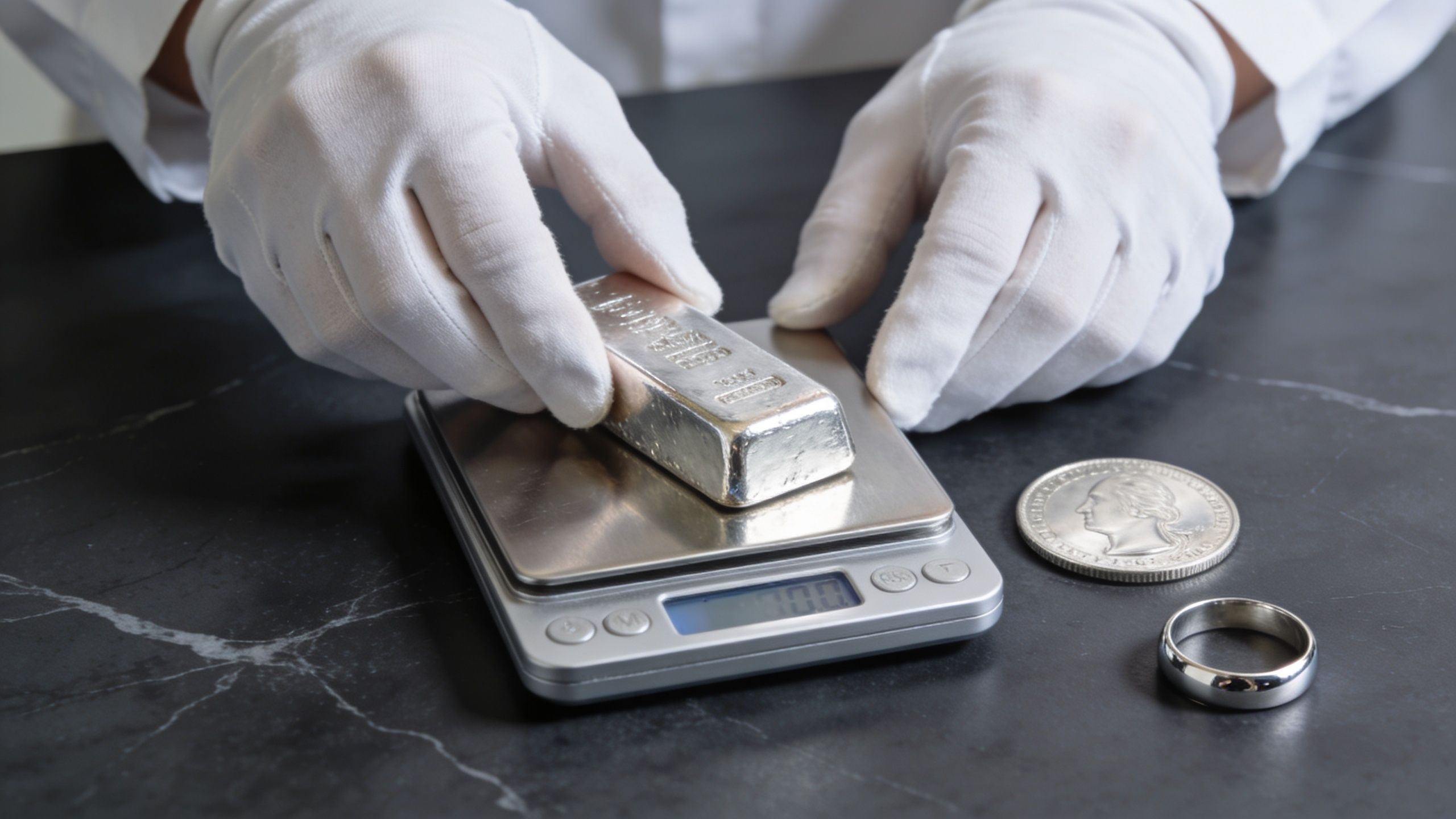
Calculating the scrap value of your jewelry at home requires three pieces of information: the weight of your item in grams, its karat purity, and the current gold spot price per troy ounce.
Commodity exchanges trade gold in troy ounces rather than standard avoirdupois ounces. One troy ounce equals 31.1035 grams (compared to a standard kitchen ounce of 28.3495 grams). Keeping track of broader market dynamics by reviewing gold and silver price trends gives you helpful context on market highs and lows.
Step-by-Step Formula to Calculate 14K Gold Cost Gram Value
To find your scrap value, follow this direct formula:
Find the 24K spot price per gram: Divide the current spot price per troy ounce by 31.1035.
Find the 14K price per gram: Multiply that number by 0.5833 (or 0.585 for European pieces).
Multiply by total weight: Multiply your 14K per-gram rate by your jewelry's weight in grams.
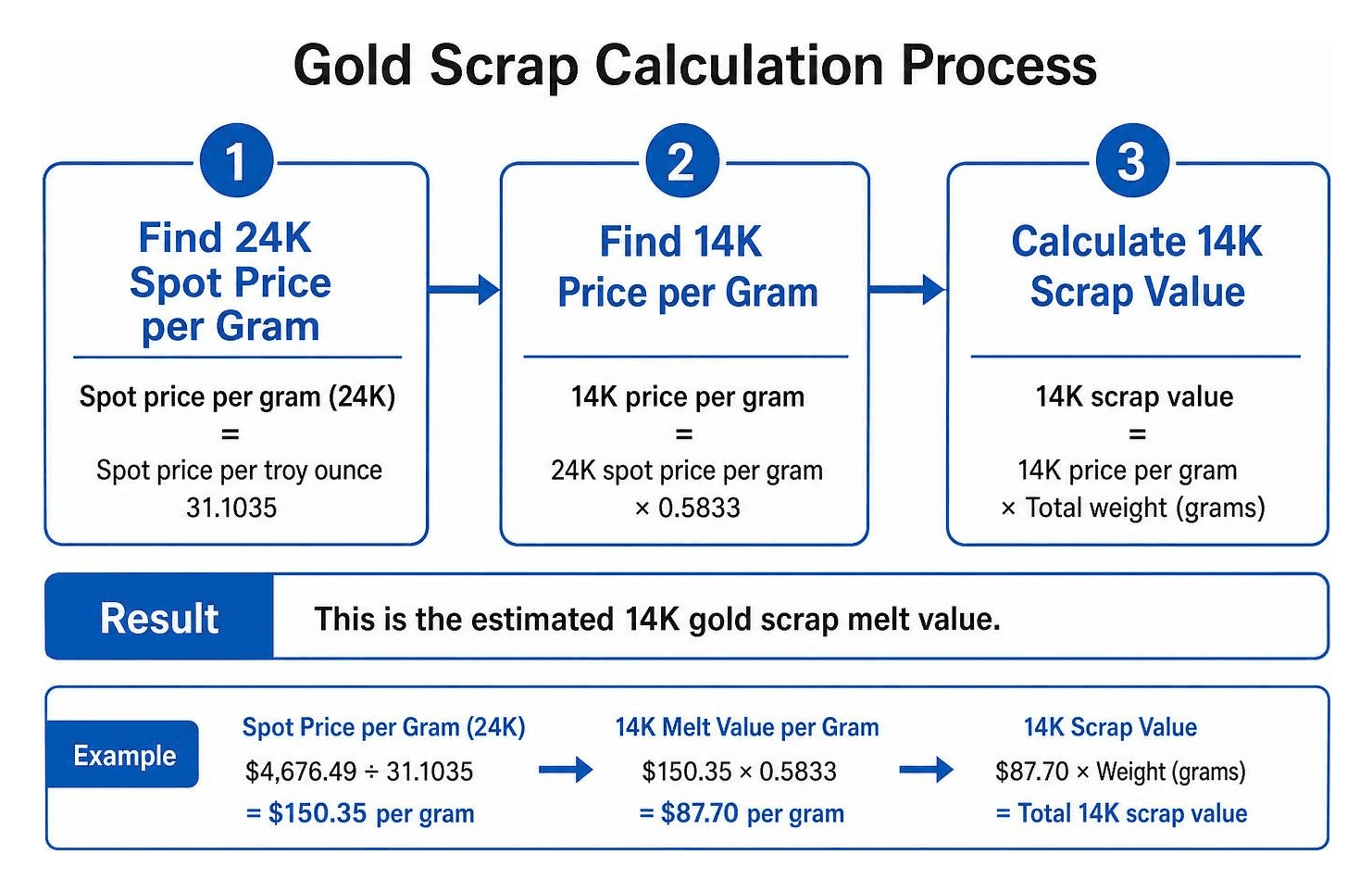
Let us walk through an example. Assume the pure gold spot price is trading at $4,676.49 per troy ounce:
Spot Price per Gram: $4,676.49 ÷ 31.1035 = $150.35 per gram of 24K gold
14K Melt Value per Gram: $150.35 × 0.5833 = $87.70 per gram of 14K gold
If you have a broken solid 14K gold rope chain weighing 18.5 grams:
Total Melt Value: 18.5 grams × $87.70 = $1,622.45
If your scale measures in pennyweights (DWT)—a unit frequently used by traditional American bench jewelers—remember that 1 pennyweight = 1.55517 grams, or 20 DWT per troy ounce. You can always cross-reference your figures with live gold pricing benchmarks.
Deductions for Gemstones, Findings, and Non-Gold Elements
Melt value applies strictly to solid gold. When calculating your raw scrap weight, account for non-gold components:
Precious & Semi-Precious Stones: Diamonds, sapphires, cubic zirconia, and glass stones add weight on a scale but do not contribute to gold scrap melt weight.
Internal Steel Springs: Lobster claw clasps and spring rings often house tiny steel springs that ensure the mechanism closes securely.
Enamel & Resin Inlays: Decorative coatings add bulk without adding precious metal value.
Before weighing your pieces, either safely remove larger stones or mentally deduct their estimated weight from the total.
Karat Comparisons: 14K vs. 10K, 18K, and 24K
Every karat designation reflects a different ratio of gold to alloy metals. Understanding how karats differ helps you identify why different items in your jewelry box yield entirely different scrap values.
Karat Rating | Gold Purity % | Millesimal Fineness | Vickers Hardness (HV) | Relative Melt Value per Gram | Primary Practical Uses |
|---|---|---|---|---|---|
10K | 41.7% | 417 | ~120 | Lowest | High-durability budget jewelry, class rings |
14K | 58.3% | 585 | ~120 - 150 | Moderate-High | Everyday fine jewelry, bridal rings, chains |
18K | 75.0% | 750 | ~120 - 150 | Higher (+28.6% vs 14K) | High-end luxury jewelry, designer pieces |
24K | 99.9% | 999 | ~25 | Highest (100% Spot) | Investment bullion, coins, traditional Asian jewelry |
For detailed breakdowns on purity benchmarks, explore our overview of pure 24K gold. If you are weighing the benefits of mid-tier versus higher-tier luxury metals, read our analysis on the key differences between 14K and 18K gold.
Comparing 10K, 18K, and 24K to 14K Gold Cost Gram Pricing
The pricing difference between karats is directly proportional to their pure gold content. At a 24K gold price of $140.77 per gram:
10K Gold (41.7% pure) has a melt value of $58.70/g.
14K Gold (58.3% pure) has a melt value of $82.11/g.
18K Gold (75.0% pure) has a melt value of $105.58/g.
24K Gold (99.9% pure) sits at the full $140.77/g spot value.
Because 18K contains significantly more pure gold per gram than 14K, it commands a higher price per gram. However, 14K remains the everyday favorite across North America due to its balance of resilience and affordability.
Solid vs. Hollow Jewelry Scrap Weight Differences
Two gold chains can look identical in link thickness and width while having dramatically different scrap values.
Solid Jewelry: Each link is solid metal throughout. A solid 6mm Miami Cuban link chain measuring 22 inches in 14K gold can easily weigh between 50 and 80 grams, representing thousands of dollars in intrinsic melt value.
Hollow Jewelry: The manufacturer creates a hollow inner chamber within the metal tube to reduce weight and retail production costs. That same 6mm chain in a hollow format might weigh only 12 to 18 grams.
When evaluating scrap, visual size does not determine price—the scale tells the true story.
Melt Value vs. Real Cash Payouts: Where and How to Sell

A common misconception among sellers is expecting a cash payout equal to 100% of the live melt value. Gold buyers, refiners, and jewelers are businesses that incur refining losses, assay charges, insurance overhead, and operational expenses.
Pawn shops typically pay 50% to 70% of melt value because jewelry is not their sole focus and their inventory turnover can be slow. High-volume gold buyers and reputable luxury specialists pay closer to 75% to 85%—and sometimes higher for substantial lots.
Knowing your numbers empowers you to decline low offers. Researching choosing the best place to sell gold will help you identify honest buyers. For an in-depth walkthrough of the resale process, consult our comprehensive guide to selling gold jewelry in 2026.
Testing Authenticity Before You Sell
Professional buyers verify the authenticity and karat purity of gold using standard testing methods:
Magnet Test: Gold is non-ferrous. If a chain sticks firmly to a strong neodymium magnet, it is either heavily plated base metal or counterfeit. (Note: clasps may show slight magnetic pull due to internal steel springs).
Acid Scratch Testing: Rubbing the metal across a touchstone and applying specific nitric acid concentrations tests whether the alloy resists dissolving at a 14K rating.
Electronic & XRF Analyzers: X-Ray Fluorescence (XRF) scanners read the exact elemental breakdown of your item in seconds without scratching or damaging the metal.
How to Maximize Payouts When Selling for Cash
To secure the highest return on your scrap gold:
Sort by Karat First: Never let a buyer weigh your 10K, 14K, and 18K pieces together in a single pile. Mixed lots are often purchased at the lowest common karat value.
Separate Designer or Resalable Pieces: If an item is undamaged and made by a luxury brand, it may carry resale value above its scrap melt value.
Obtain Multiple Written Quotes: Know your gram weight beforehand and compare offers based on their percentage of melt value.
Work with Direct Luxury Resellers: Choosing a direct buyer over a middleman ensures fewer fees are subtracted from your payout. Review our recommendations on selling gold jewelry for cash before parting with your valuables.
Frequently Asked Questions About 14K Gold Scrap Value
How much do gold buyers typically pay per gram for 14K gold?
Payouts depend on the buyer and the total quantity being sold. Pawn shops usually pay between 50% and 70% of the live melt value. Dedicated gold buyers, jewelers, and reputable refiners generally offer between 70% and 85% of melt value. For instance, if 14K melt value is $82.11 per gram, expect realistic scrap offers between $57.48 and $69.79 per gram depending on buyer overhead.
Does broken or damaged 14K jewelry lose scrap value?
No. Scrap value is determined solely by pure gold weight and alloy fineness. Broken chains, bent rings, mismatched earrings, and tangled bracelets are sent to a refinery to be melted down and purified. Their physical condition does not decrease their raw melt worth.
Is 14K gold considered real gold?
Yes. 14K gold is genuine gold composed of 58.3% pure elemental gold. Under Federal Trade Commission (FTC) guidelines in the United States, items containing at least 10 karats of pure gold are legally recognized and marketed as real gold jewelry.
Conclusion
Understanding how to calculate your scrap gold's true melt value gives you confidence and clarity when selling unworn jewelry. By weighing your items in grams, verifying karat hallmarks, and tracking the live spot market, you can calculate your jewelry's baseline worth before sitting down with an appraiser.
At Antwerp Diamond Store, we buy fine gold jewelry, luxury watches, and estate pieces for immediate cash. Located in Atlanta, GA, we offer private, appointment-only consultations with transparent evaluations based directly on live market rates—ensuring you receive a fair, competitive payout with zero hidden fees.
If you are ready to turn your scrap jewelry into immediate funds, take a look at our current breakdown on evaluating 14K gold scrap prices and book an appointment with our team today.


