
What Is the 1kg Diamond Price in Indian Rupees?
In the Indian market, the realistic 1kg diamond price in Indian rupees ranges between ₹25 crore and ₹500+ crore for natural diamonds, while a 1kg parcel of lab-grown diamonds costs roughly ₹10 crore to ₹25 crore.
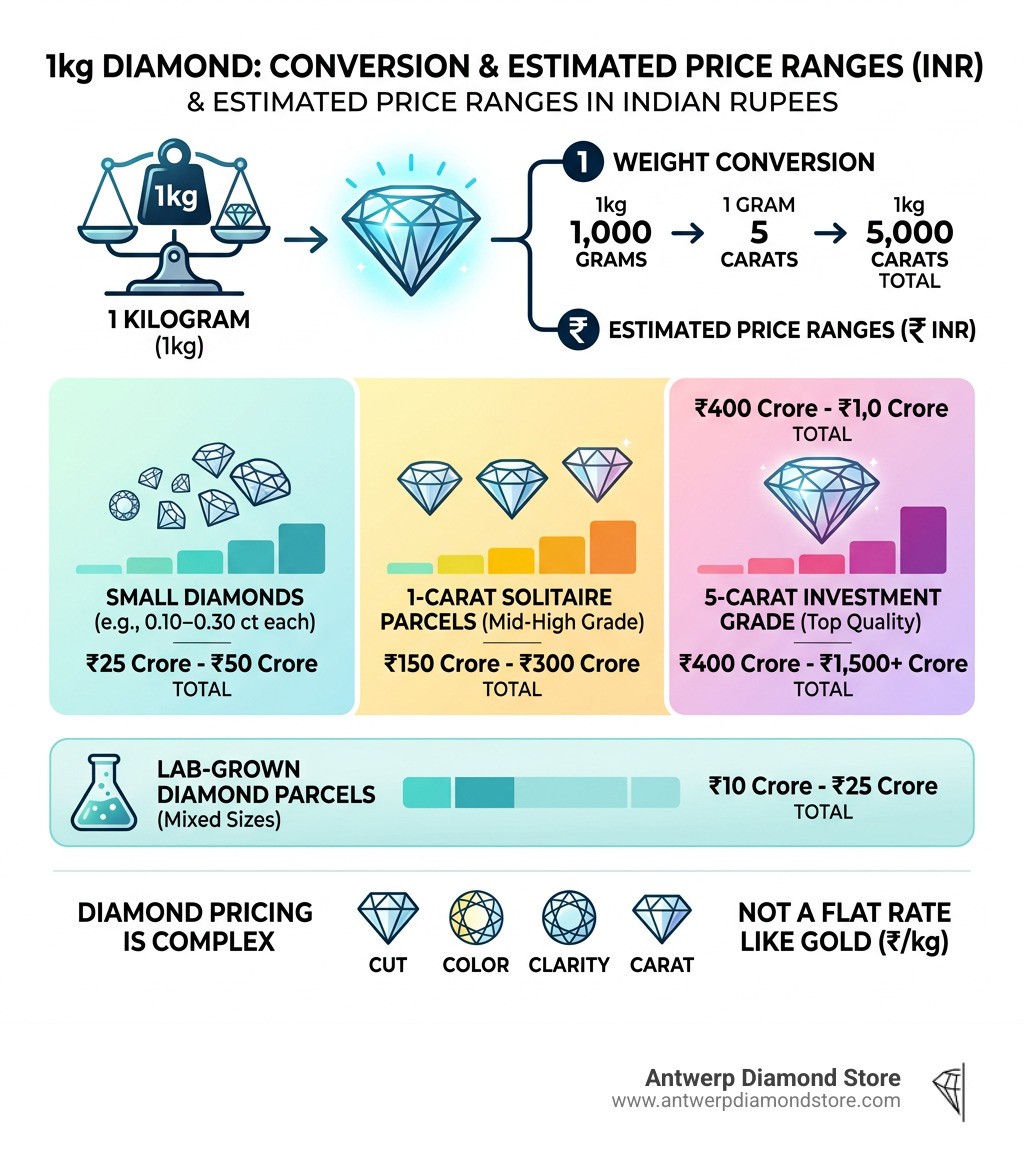
There is no fixed price per kilogram for diamonds. One kilogram equals exactly 1,000 grams or 5,000 carats (1 gram = 5 carats). Because diamond value scales exponentially based on individual stone size and quality, the total cost depends entirely on how that 1kg is divided:
Commercial Small Diamonds (0.10–0.30 ct each): ~₹25 crore to ₹50 crore total
1-Carat Natural Solitaire Parcels (Mid-to-High Grade): ~₹150 crore to ₹300 crore total
5-Carat Natural Diamonds (Investment Grade): ~₹400 crore to ₹1,500+ crore total
Lab-Grown Diamond Parcels (Mixed Sizes): ~₹10 crore to ₹25 crore total
Unlike gold—which trades at a flat standard rate of roughly ₹1.54 crore per kilogram—diamonds are priced per individual stone using the 4Cs: cut, color, clarity, and carat weight. A single, unbroken 5,000-carat rough diamond would be a priceless museum-grade asset worth thousands of crores, whereas one kilogram of tiny melee stones costs a fraction of that amount.
Understanding the Math: Converting 1kg of Diamonds to Carats
In the precious metals world, trading happens in grams and kilograms. In gemology, the metric system takes a back seat to the carat. To evaluate diamond value at scale, we first need to translate standard metric weight into international gemstone units.
1 Carat = 200 Milligrams (0.20 grams)
1 Gram = 5 Carats
1 Kilogram (1,000 Grams) = 5,000 Carats
This basic math reveals an essential reality: buying 1kg of diamonds means buying 5,000 carats of precious carbon. While 1kg of sugar or gold is uniform throughout, 5,000 carats of diamond can exist in countless physical configurations.
Why the 1kg diamond price in indian rupees depends on stone size and total carat weight
The most common misconception about wholesale gemstones is that weight alone determines value. When buyers review jewellery pieces or bulk lots, understanding what total diamond weight means helps clear up immediate confusion. Total carat weight measures the combined mass of all stones in an ensemble, not individual stone size.
A parcel containing 50,000 tiny pavé melee diamonds weighing 0.10 carats each totals 5,000 carats (1kg). Because small melee diamonds are relatively abundant byproducts of the cutting process, their cost per carat is modest—often ranging from ₹40,000 to ₹70,000 per carat in wholesale trade.
In contrast, if that same 1kg consists of 1,000 individual 5-carat gems, the pricing jumps exponentially. A single, high-quality 3 carat round diamond commands a substantial premium over three 1-carat stones, and that per-carat multiplier accelerates rapidly as individual stone size increases. Finding natural rough crystals capable of yielding finished 5-carat solitaires requires sifting through hundreds of tons of kimberlite ore. The aggregate weight may be identical at 1,000 grams, but the extreme rarity of large individual crystals transforms the financial equation.
Factors Determining the 1kg Diamond Price in Indian Rupees
Diamond valuation does not follow a flat per-gram rate. Every single stone within a 1kg collection must be evaluated against the globally recognized 4Cs framework established by the Gemological Institute of America (GIA), alongside grading integrity and market liquidity.
The 4Cs, certification, and non-linear carat pricing
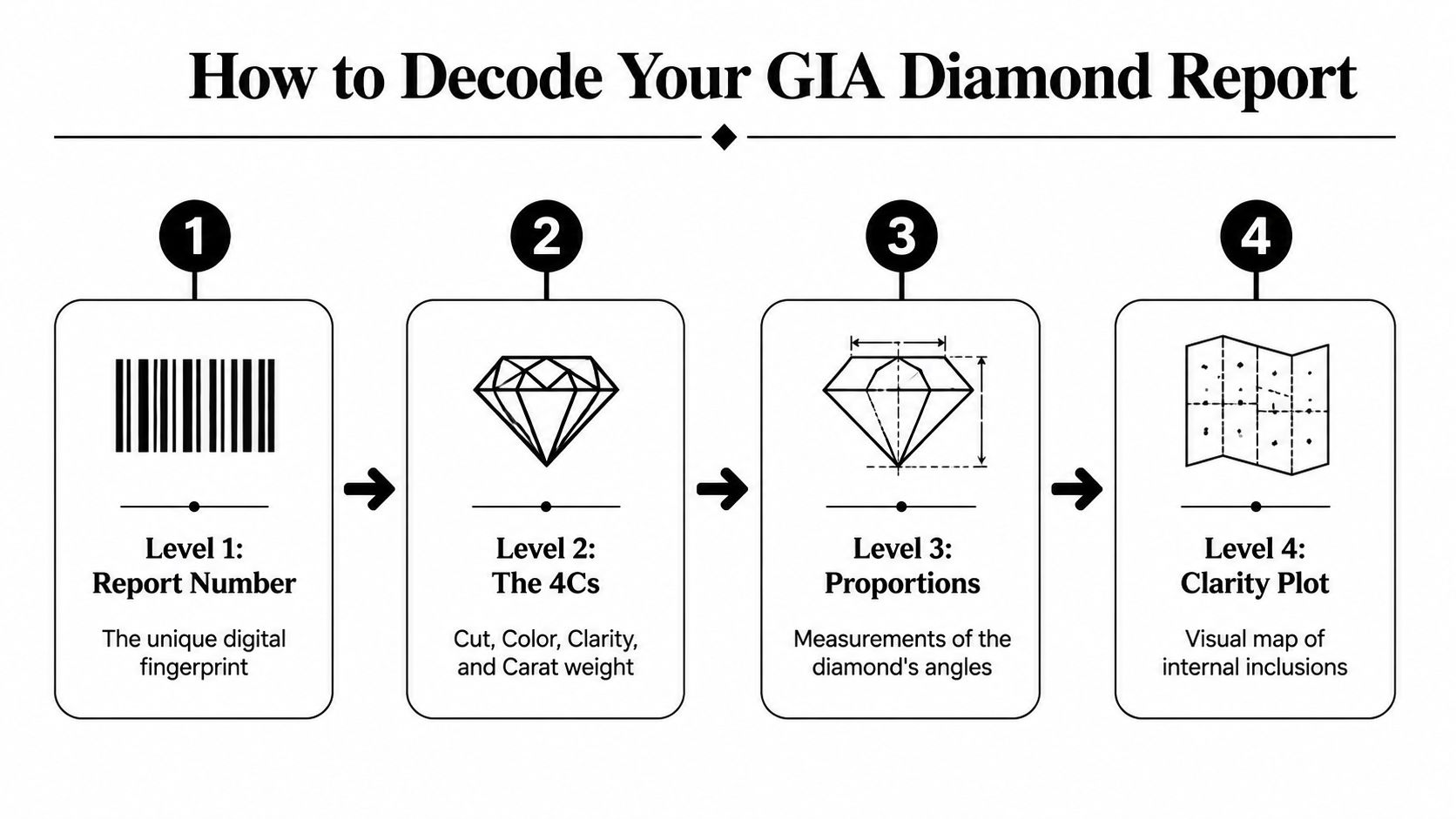
The baseline formula for natural diamonds relies on four core pillars:
Cut: A stone's proportions, symmetry, and polish determine its fire and brilliance. An "Excellent" or "Ideal" cut commands top market pricing, while poor cuts trade at steep discounts.
Color: Graded from D (colorless) down to Z (light yellow or brown). Stones graded D through F command premium prices, whereas stones in the G through J range offer balanced commercial value.
Clarity: Ranging from Flawless (FL) to Included (I1–I3). Eye-clean stones (VS1–VS2) provide strong liquidity, while flawless gems carry collector premiums.
Carat Weight: As stones cross key weight boundaries (such as 1.00 ct, 3.00 ct, and 5.00 ct), their price per carat leaps upward rather than increasing at a linear rate.
Independent certification from respected laboratories like GIA or IGI guarantees these parameters. When rare gems reach historical proportions—such as assessing what a 100-carat diamond is worth—standard pricing matrices give way to bespoke private treaty and international auction valuations. For reference on complete finished pieces, exploring diamond ring price models or the specific 1 carat diamond gold ring price illustrates how retail markup, precious metal mountings, and certification fees layer on top of raw diamond value.
For an overarching view of loose stone economics, our guide on how much a diamond costs explores these baseline retail and wholesale dynamics in detail.
Natural diamonds vs lab-grown diamonds at bulk scale
The rise of advanced diamond synthesis methods (such as Chemical Vapor Deposition and High Pressure High Temperature) has created two distinct market tracks. When evaluating lab-grown versus natural diamonds, the structural and visual properties are identical: both are pure crystalline carbon.
However, their economic trajectories diverge completely:
Natural Diamonds: Formed billions of years ago under extreme geological conditions, natural diamonds are finite assets. High-grade natural solitaires retain value well on the secondary market due to limited global supply.
Lab-Grown Diamonds: Because synthetic production is scalable in commercial facilities, technological efficiencies continue to lower manufacturing costs. A 1-carat lab-grown diamond in India costs roughly 70% to 85% less than a mined counterpart of identical visual grade.
At a 1kg (5,000-carat) scale, this difference is substantial. A 1kg parcel of commercial lab-grown diamonds costs around ₹10 crore to ₹25 crore, whereas a 1kg collection of natural solitaires starts in the hundreds of crores.
Realistic Price Ranges: What 1kg of Diamonds Actually Costs in INR
To understand what 5,000 carats of diamonds look like in financial terms, we can compare how different parcel compositions trade within the Indian wholesale and retail sectors.
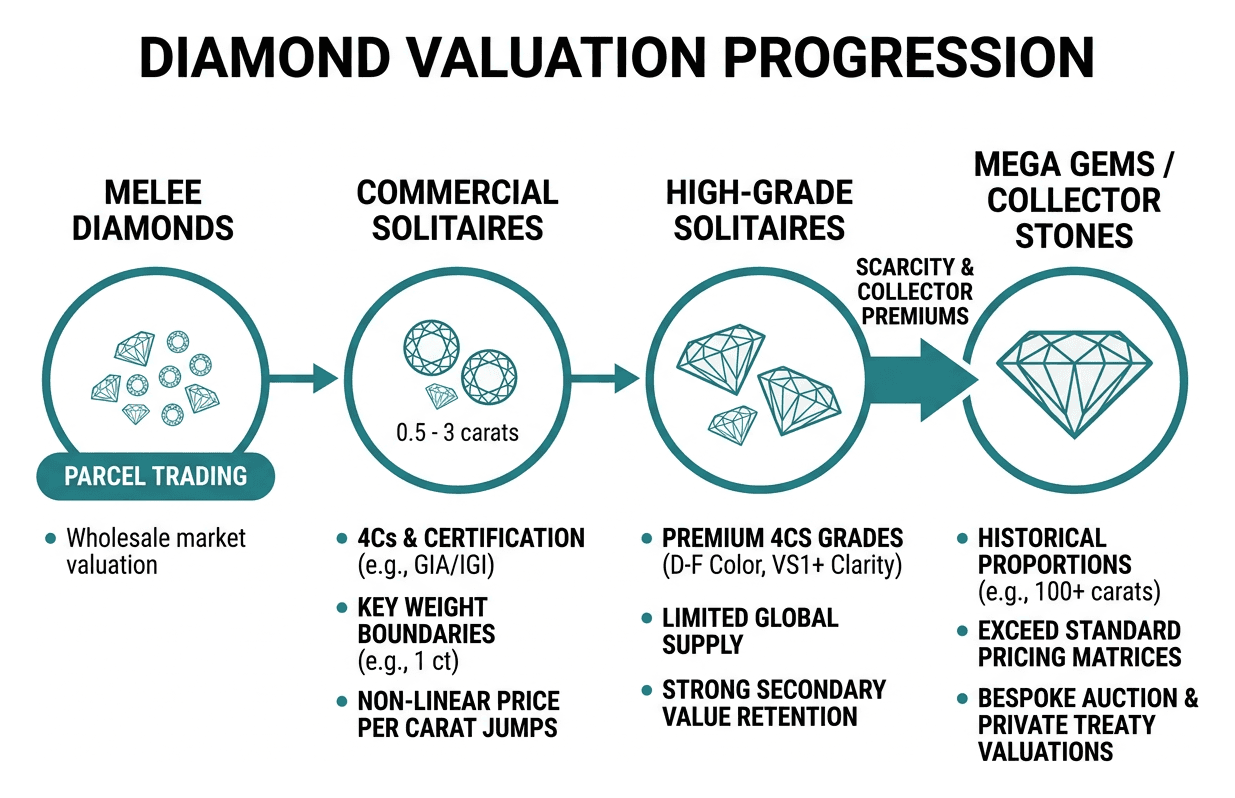
Estimating the 1kg diamond price in indian rupees for commercial parcels vs single mega stones
The table below outlines approximate valuations in Indian rupees for 1kg (5,000 carats) of diamonds across various parcel configurations and qualities:
Diamond Configuration | Average Stone Size | Total Stones in 1kg | Indicative Price per Carat (INR) | Total Estimated 1kg Cost (INR) |
|---|---|---|---|---|
Industrial / Drill Grade | < 0.05 ct rough | 100,000+ | ₹500 – ₹2,000 | ₹25 Lakh – ₹1 Crore |
Lab-Grown Commercial Parcel | 0.50 – 1.50 ct | 3,500 – 5,000 | ₹20,000 – ₹45,000 | ₹10 Crore – ₹22.5 Crore |
Small Natural Melee (Pavé) | 0.05 – 0.20 ct | 25,000 – 50,000 | ₹50,000 – ₹90,000 | ₹25 Crore – ₹45 Crore |
Natural Commercial Solitaires | 1.00 ct (G-H / SI) | 5,000 | ₹2,50,000 – ₹4,00,000 | ₹125 Crore – ₹200 Crore |
Natural Premium Solitaires | 1.00 ct (D-F / VVS) | 5,000 | ₹5,50,000 – ₹9,00,000 | ₹275 Crore – ₹450 Crore |
Natural Investment Solitaires | 5.00 ct (Exceptional) | 1,000 | ₹12,00,000 – ₹30,00,000+ | ₹600 Crore – ₹1,500+ Crore |
Hypothetical 1kg Single Crystal | 5,000 ct (One gem) | 1 | Priceless / Auction Grade | ₹3,000+ Crore (Theoretical) |
As shown above, the range is vast. A single natural 5,000-carat gem-quality rough diamond—surpassing even the legendary Cullinan diamond (3,106 carats)—would represent a historic discovery worth thousands of crores. Conversely, the same weight in small commercial diamonds remains within standard wholesale reach.
1kg of Diamonds vs 1kg of Gold in India: A Value and Investment Comparison
Gold and diamonds often share space in Indian wealth preservation, but they operate under completely different market mechanics.
The 1kg gold benchmark in India trades at approximately ₹1.54 crore per kilogram for 24K bullion (based on the spot price of roughly ₹15,403 per gram). Gold is fully fungible: one kilogram of 24K gold bar produced by an accredited refinery holds the exact same intrinsic market value as any other 1kg 24K bar worldwide. It can be melted down, recast, or sold instantly at spot-linked bullion prices with minimal transaction spreads.
Diamonds, however, are non-fungible assets:
Fungibility: Gold has standard purity metrics (22K, 24K). Diamonds require individual certification for every facet, inclusion, and tint.
Liquidity: A 1kg bar of gold can be liquidated in any major city within minutes at live market rates. Selling a 1kg collection of diamonds requires finding specialized buyers, sorting parcels, verifying individual certificates, and negotiating dealer margins.
Value Density: 1kg of gem-quality natural diamonds is worth anywhere from 15 to 300 times more than 1kg of pure gold. While 1kg of gold fits easily into the palm of your hand, 1kg of fine diamonds represents a multi-generational treasury.
Taxes and Duties: Both commodities attract a baseline 3% Goods and Services Tax (GST) in India, alongside import tariffs on rough and polished stones.
Is Buying 1kg of Diamonds a Practical Investment?
While acquiring 1kg of diamonds might sound like the ultimate luxury hedge, practical asset management involves significant real-world challenges:
The Secondary Spread: Unlike bullion, where the gap between buy and sell rates is often under 2%, loose diamonds carry wider spreads. When private individuals sell high-carat stones back to the trade, dealers must account for holding costs, grading verification, and wholesale margins. Before making liquidity decisions, determining how much your diamond is worth on the secondary market is an essential first step.
Grading and Maintenance Overhead: Storing 5,000 carats of individual solitaires requires maintaining active, tamper-evident laboratory dossiers (GIA/IGI) for every stone. If grading reports are misplaced, re-certification costs across hundreds of stones can run into lakhs of rupees.
Appraisal Complexity: When estimating real-world returns, using a diamond resale value calculator helps establish grounded expectations based on wholesale demand rather than full retail replacement quotes.
For ultra-high-net-worth portfolios, diamonds work best when acquired as individual, exceptional collector stones (such as rare 5-carat to 10-carat natural solitaires or vivid fancy colored diamonds) rather than arbitrary bulk weight lots.
Frequently Asked Questions About Diamond Pricing in India
What is the exact price of a 1kg natural diamond in Indian rupees?
There is no single fixed price for 1kg of natural diamonds because 1kg equals 5,000 carats. Depending on whether that weight is composed of small commercial melee stones, 1-carat solitaires, or ultra-rare 5-carat gems, the total price ranges from ₹25 crore to over ₹500 crore. An unbroken, gem-quality single stone of 5,000 carats would be an extraordinary museum-grade artifact valued in the thousands of crores.
Why is diamond price not quoted per kilogram like gold in India?
Gold is a standardized, fungible metal traded by weight and purity percentage alone. Diamonds are crystalline minerals where value depends heavily on individual characteristics: cut quality, optical clarity, body color, and structural proportions. Because two diamonds of the exact same weight can differ in value by more than 1,000%, pricing must be calculated per individual stone rather than by bulk mass.
How much would 1kg of lab-grown diamonds cost in INR compared to natural?
A 1kg (5,000-carat) parcel of commercial-quality lab-grown diamonds in India typically costs between ₹10 crore and ₹25 crore. This represents a 60% to 85% discount compared to natural diamond parcels of similar carat weight and visual specifications, reflecting the difference between scalable laboratory production and natural rarity.
Conclusion: Evaluating High-Carat Diamond Values
Translating diamond mass from carats to kilograms highlights how unique gemstone pricing truly is. While weight sets the starting baseline, the real value of any diamond—whether a modest 0.50-carat engagement ring or a rare high-carat solitaire—is defined by its precision cut, internal clarity, natural color, and certified origin.
At Antwerp Diamond Store, we specialize in luxury-goods valuations, buying high-value diamonds, luxury watches, estate jewelry, and designer handbags with complete transparency. Operating on a private, appointment-only basis from Atlanta, GA, we offer clients discreet consultations, market-based offers, and immediate payouts without hidden fees.
Whether you are evaluating an individual solitaire or an extensive private collection, you can easily calculate accurate diamond valuations with our expert team today.