

Pawning a ring can get you cash quickly, but the loan is usually based on 25% to 60% of the ring's current resale value, not what you originally paid. That gap exists because the lender has to protect against resale risk, storage costs, and the chance that the loan won't be repaid.
If you're looking at your ring right now because a bill is due, a payment is late, or you need money before the week ends, that pressure is real. The biggest mistake first-timers make is walking in expecting the offer to reflect retail price, insurance paperwork, or sentimental value. It won't. A pawn offer is a short-term collateral decision built on what the item can realistically resell for in today's market.
That doesn't mean pawning a ring is always a bad move. It means you need to understand the math before you hand over the piece. If you know how buyers evaluate metal, diamonds, brand, condition, and resale demand, you'll be in a much stronger position to judge whether a pawn loan makes sense or whether selling is the smarter path.
Table of Contents
Pawning a Ring A Step by Step Guide
Pawning a ring means using it as collateral for a short-term loan. You're not selling it outright. If you repay the loan under the agreed terms, you get the ring back. If you don't, the shop keeps the item.
That distinction matters because many people walk in thinking a pawn transaction works like a jewelry sale. It doesn't. The lender is trying to decide how much cash they can safely advance against an item they may have to store and later resell.
What the basic process looks like
Bring in the ring and identification: The shop inspects the piece, confirms the metal and stones, and checks condition.
Receive a valuation-based offer: The offer is tied to resale potential, not your original receipt.
Review the loan ticket: This should outline the principal, charges, timing, and what happens if you don't redeem the item.
Leave the ring as collateral: The ring stays with the lender until the loan is repaid.
In the United States, pawn transactions are common for short-term cash needs. The average U.S. pawn loan is around $150, and approximately 85% of these loans are repaid, which suggests many borrowers do intend to reclaim the item they pawned, including rings, according to pawn industry market data.
Practical rule: Pawn the ring only if you have a realistic plan to repay the loan on time. If you don't, you're not solving a short-term problem. You're delaying a sale.
Why people choose this option
A ring is portable, easy to store, and often valuable enough to produce immediate funds. For someone facing a near-term cash squeeze, that speed is the appeal. If keeping the ring matters, a pawn loan can be the least disruptive option.
Still, go in with the right expectation. A pawn counter is not where you'll capture full jewelry value. It's where you trade some value for speed, privacy, and the possibility of getting the piece back. If you want to compare that route with a dedicated jewelry loan option, review the terms with the same care you'd give any secured transaction.
How to Prepare Your Ring for the Best Offer
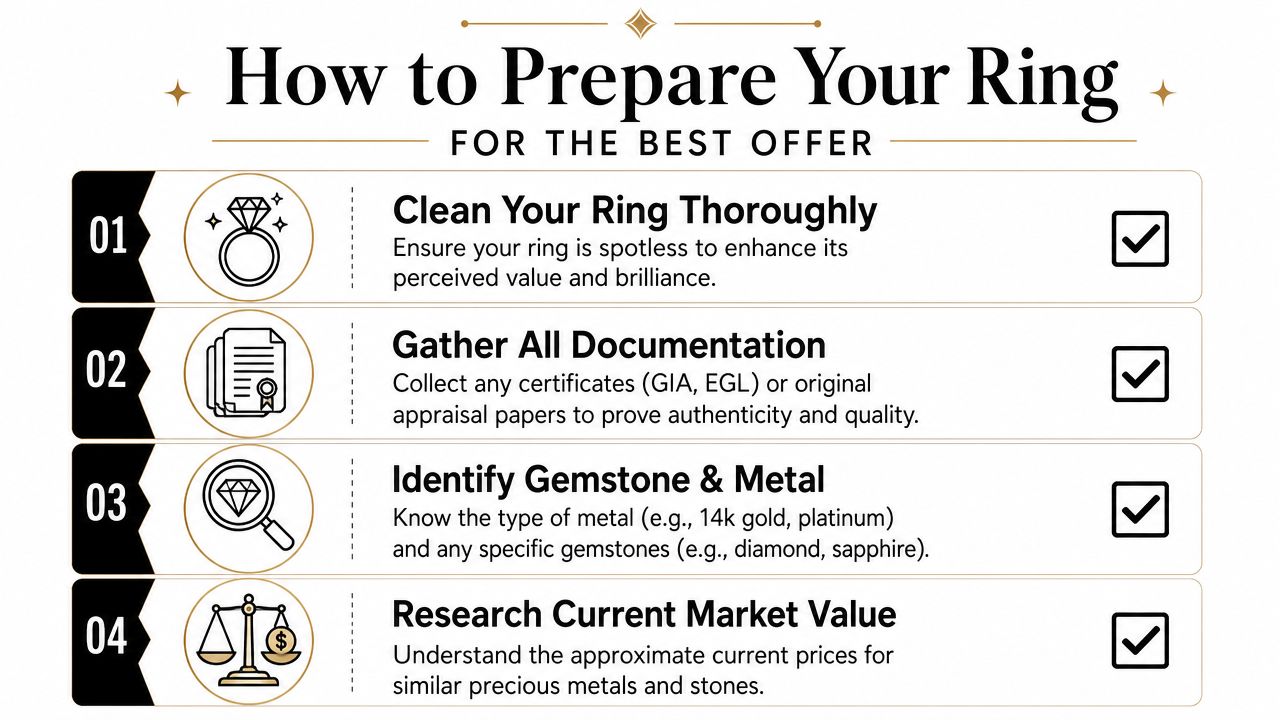
Preparation won't turn a modest ring into a rare one, but it can prevent an unnecessarily low offer. A clean presentation, complete paperwork, and a basic understanding of what you own can make the conversation more efficient and more credible.
Start with presentation and paperwork
If the ring is dirty, cloudy, or covered in lotion residue, the evaluator has to work harder to inspect it. Clean it gently with safe jewelry methods, especially if it has diamonds, sapphires, or a plain gold setting. Avoid harsh chemicals and aggressive scrubbing if you're unsure about the stones or treatment history.
Gather anything that supports identification and quality:
Grading reports: A GIA report is especially useful for a diamond ring because it gives the buyer a standard reference point.
Original receipt or prior appraisal: These won't control the offer, but they can help establish what the piece is.
Brand packaging or paperwork: For rings from houses such as Cartier or Tiffany & Co., documentation can support buyer confidence.
A ring without documentation can still be evaluated. It just requires more testing, and that uncertainty can work against you.
Know the basics before you walk in
You don't need to become a gemologist overnight. You should know the metal, the karat if it's gold, whether the center stone is diamond or another gem, and whether the ring has any certificates or branded markings.
This does two things. First, it helps you catch obvious misunderstandings. Second, it signals that you're informed enough not to accept a vague explanation.
For diamond jewelry, pawn shops typically offer 20% to 50% of the item's appraisal value, while gold jewelry without significant gems may receive 50% to 70% of its melt value, according to jewelry pawn guidance on diamond and gold offers. That's why paperwork matters so much. If the buyer can verify quality with less doubt, the offer discussion tends to be clearer.
Bring the ring exactly as you'd want it presented if someone were judging its value in five minutes. Because they usually are.
A simple pre-visit checklist
Clean it safely: Remove surface dirt so the stone and metal show properly.
Collect documents: Certificates, receipts, prior appraisals, and branded packaging all help.
Inspect condition: Note bent prongs, chipped stones, sizing seams, or heavy wear.
Research comparable pieces: Look at the resale market, not just retail listings.
Take clear photos for your records: If you need help documenting the piece well, this guide on how to photograph jewelry is useful before any appraisal, loan, or sale visit.
Understanding How Your Ring Is Valued
The valuation process confuses people because they're usually comparing the wrong numbers. In practice, there are three very different figures attached to a ring, and they almost never match.
Retail price is not resale value
The first number is the retail price, which is what you paid in a jewelry store. That number includes store overhead, branding, marketing, and markups that don't carry over into the secondary market.
The second is the insurance appraisal value. This is often designed for replacement, not resale. It can be useful for coverage purposes, but it doesn't tell you what a cash buyer will pay today.
The third number is the one that matters in a pawn transaction: current resale value. That's the realistic amount a professional buyer believes the ring could bring in the present market, after accounting for condition, demand, and the time it may take to sell.
When pawning a diamond ring, borrowers typically receive 25% to 60% of the item's actual resale value. One published example shows a ring with a $10,000 retail price but only a $3,000 resale value, leading to a possible pawn loan of about $2,250, according to Pawn America's explanation of diamond ring pawn offers.
That example is why so many first-time borrowers feel blindsided. They're comparing the offer to what they paid, while the lender is comparing the offer to what the ring could realistically sell for.
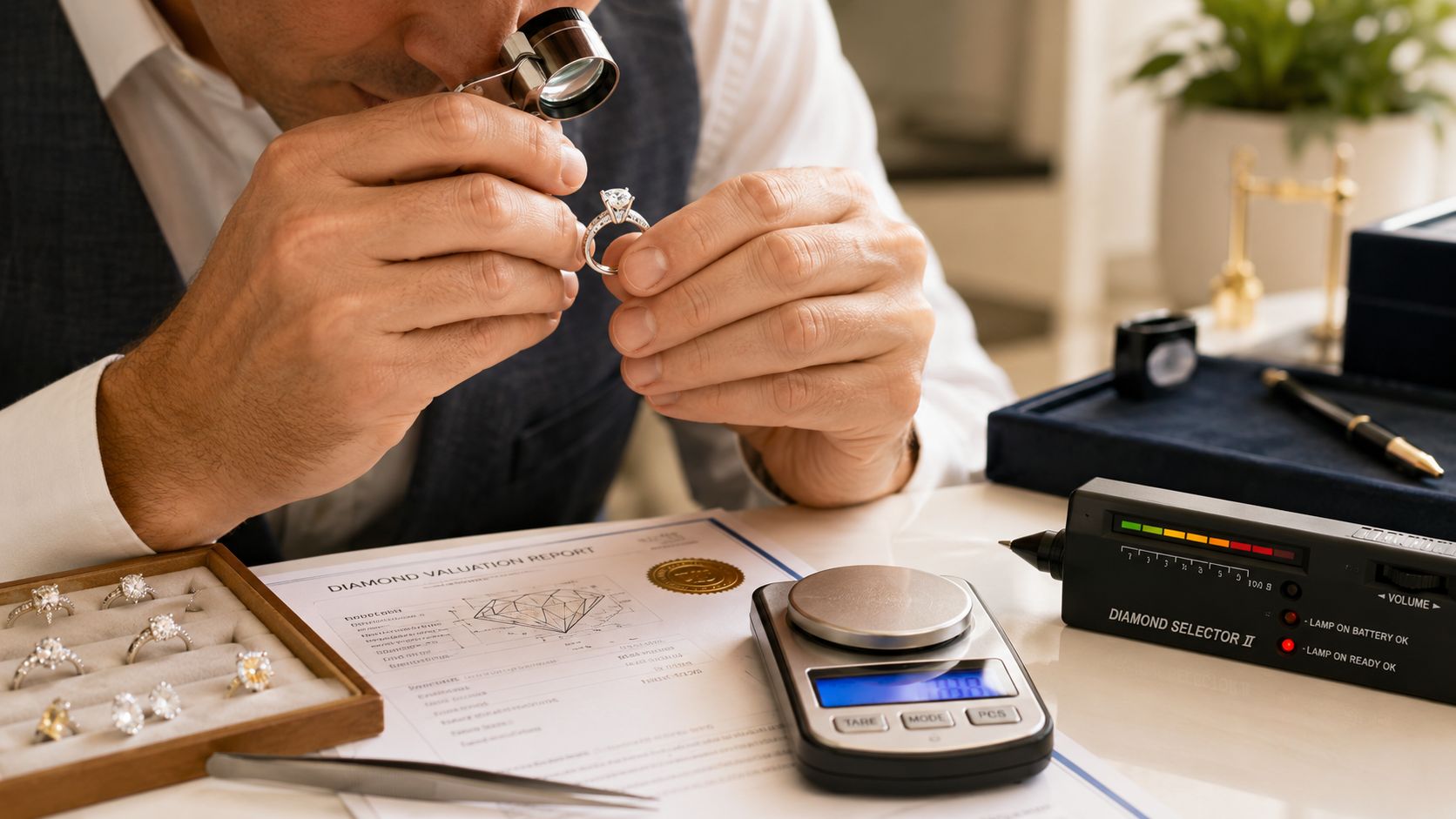
What an evaluator actually looks at
A trained evaluator usually works through the ring in layers.
Metal first: Is it platinum, 18k gold, 14k gold, or something else? Weight and purity matter.
Stone quality next: For diamonds, the 4Cs matter. Cut, color, clarity, and carat weight all affect marketability.
Condition: Worn prongs, chipped stones, misshapen shanks, or visible repairs can lower desirability.
Style and demand: Some settings resell easily. Others sit in inventory.
Brand signal: A ring from Cartier, Tiffany & Co., or Van Cleef & Arpels may carry added resale appeal if authenticity is clear.
A luxury ring is rarely valued as a simple sum of parts. Buyers weigh whether the piece should be resold intact, reset, or broken down for metal and stone value.
A pawn offer is a risk-adjusted resale decision. It is not a commentary on your taste, your relationship, or the meaning of the ring.
If you want to see how professionals break down these factors in more detail, this overview of how to appraise jewelry is a useful companion.
Why diamonds often disappoint owners at the counter
Many people are surprised that diamonds don't always hold value the way they expect. A beautiful ring can still produce a cautious offer if the diamond has weak resale demand, an unusual setting, or no report to support grading.
This short video gives a practical look at the appraisal mindset behind jewelry valuation.
A GIA-trained evaluator is usually asking a simple question: if this loan defaults, how easily can this ring be sold, and at what confidence level? The more uncertainty around that answer, the lower the offer tends to be.
Decoding the Pawn Loan Agreement and Its Terms
Once the offer is on the table, the paperwork matters as much as the valuation. At this point, many borrowers focus only on the cash amount and ignore the cost of getting the ring back.
What the paperwork is really telling you
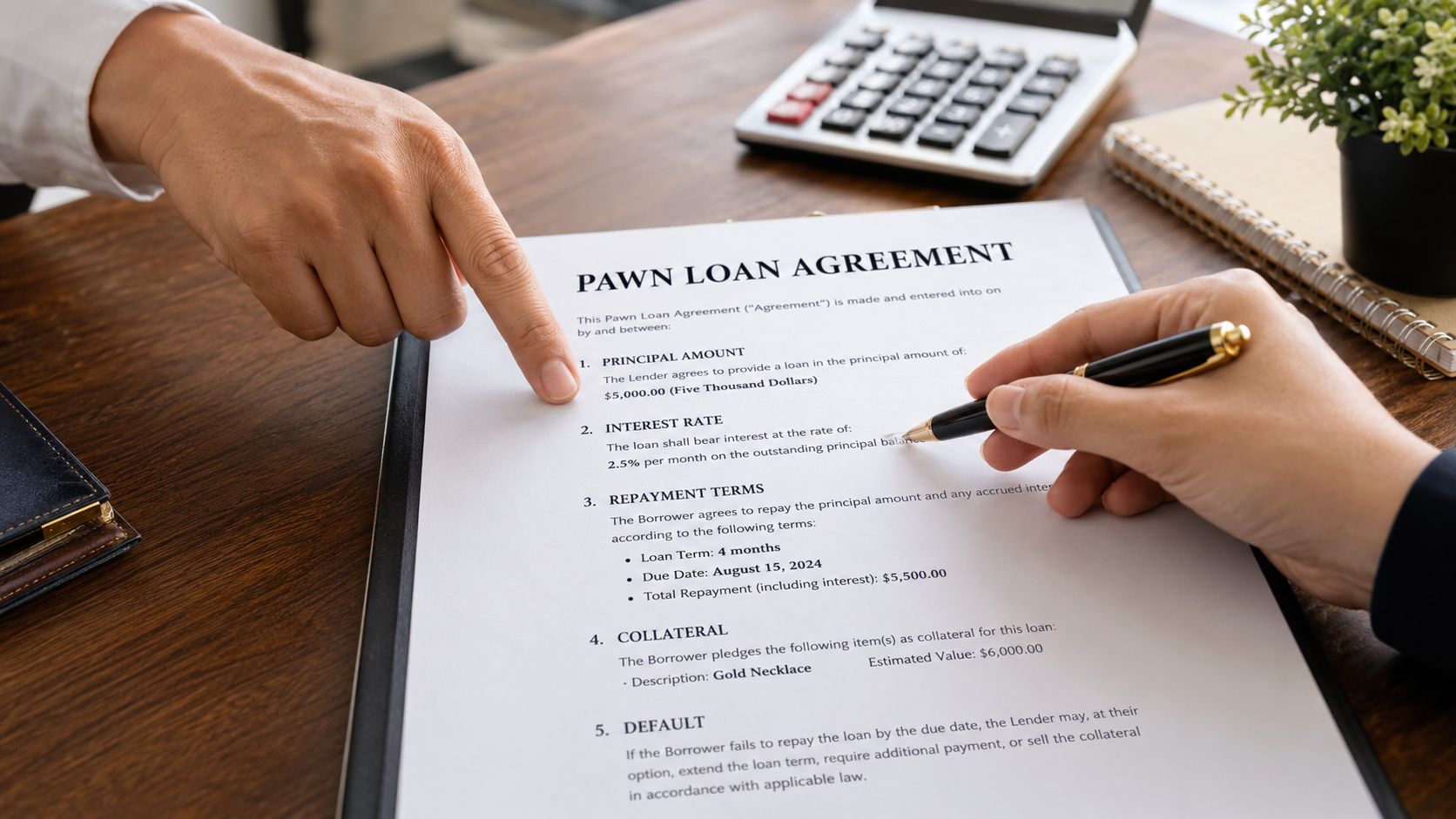
Look for four things immediately:
Principal: This is the amount you receive.
Interest charge: This is what you pay for the loan.
Fees or renewal terms: These can change the true cost fast.
Redemption period: This is the deadline for getting your ring back.
Pawn shop loan interest rates often convert to annual percentage rates between 60% and 240% or even higher, while personal loans average around 12.49% APR, according to AmeriSave's discussion of pawnshop loan costs. That doesn't automatically make every pawn loan wrong. It does mean you should treat it as expensive money.
In New Jersey, for example, the regulated limit on pawn interest is 4.5% per month, which means a $1000 loan would cost $45 per month in interest charges, according to Palisade Jewelers' guide to pawning in New Jersey. Rules vary by location, so borrowers in Atlanta, Buckhead, Sandy Springs, Alpharetta, Roswell, Brookhaven, Midtown Atlanta, and the broader Georgia market should verify local terms directly with the lender.
Questions worth asking before you sign
Ask these plainly and get clear answers in writing if possible:
What to Ask | Why It Matters |
|---|---|
What is the total amount due to redeem the ring? | You need the full payoff number, not just the loan amount. |
When is the exact due date? | Missing the date can put the ring at risk. |
Are there renewal charges? | Extensions can make a short-term loan much more expensive. |
What happens if I'm late? | Don't assume there's flexibility. |
Is there any grace period? | Policies differ and should never be guessed. |
Read the pawn ticket like a buyback contract. If you wouldn't feel comfortable signing it under mild stress, don't sign it under financial stress.
What works and what usually doesn't
What works is borrowing only against a ring you can realistically redeem. What doesn't is taking the loan because the ring feels too emotional to sell, while having no clear way to repay.
If the ring has deep sentimental value, the repayment plan should already exist before the transaction. If the plan is uncertain, selling may be the cleaner and less costly decision. That is especially true when the loan starts to accumulate interest and renewals.
Should You Pawn or Sell Your Ring
This is the key decision. Understanding what a pawn loan is isn't usually the challenge. Instead, the difficulty lies in deciding whether pawning a ring is financially smarter than selling it.
When pawning makes sense
Pawning can make sense if the ring matters to you and the cash need is temporary. Maybe the item is a wedding band, family heirloom, or a ring you fully expect to reclaim once a short-term cash gap passes.
It also makes sense when speed is more important than maximizing proceeds, and when you already know where repayment will come from. In that situation, you're paying for short-term access to cash while preserving the option to keep the ring.
When selling is usually the better move
If you have no realistic plan to redeem the ring within the loan window, selling is often the more rational move. You avoid rolling costs, avoid deadline pressure, and close the transaction cleanly.
Published guidance in this area points to an overlooked risk. Some borrowers extend loans long enough that charges consume a large share of the original advance, and a substantial portion fail to redeem within the initial term, as noted in Diamond Banc's analysis of pawning a diamond ring in the U.S.. The practical takeaway is simple: if repayment is doubtful, don't frame the transaction as temporary.
Pawning vs. Selling Your Ring
Factor | Pawning a Ring | Selling a Ring |
|---|---|---|
Cash amount | Usually lower upfront because it's a secured loan | Often higher upfront because ownership transfers immediately |
Ownership | You keep the right to redeem if you repay on time | Ownership transfers permanently |
Cost after the transaction | Interest and possible fees apply | No future loan cost |
Risk | You can forfeit the ring if you don't repay | No forfeiture risk because the transaction is final |
Best for | Short-term cash need with a realistic payoff plan | Permanent liquidation or uncertain repayment ability |
One practical rule I give clients is this: if you're emotionally attached to the ring and financially organized enough to redeem it, pawning can work. If you're mainly trying to raise the most cash with the least ongoing cost, selling is usually stronger.
If you're comparing sale routes, this guide on where to sell jewelry for cash can help you think beyond the pawn counter.
Secure Alternatives and Local Options
For many people, the choice isn't just pawn or sell. It's also where to go, who to trust, and how private they want the process to be.
What to look for in Atlanta and the greater Georgia market
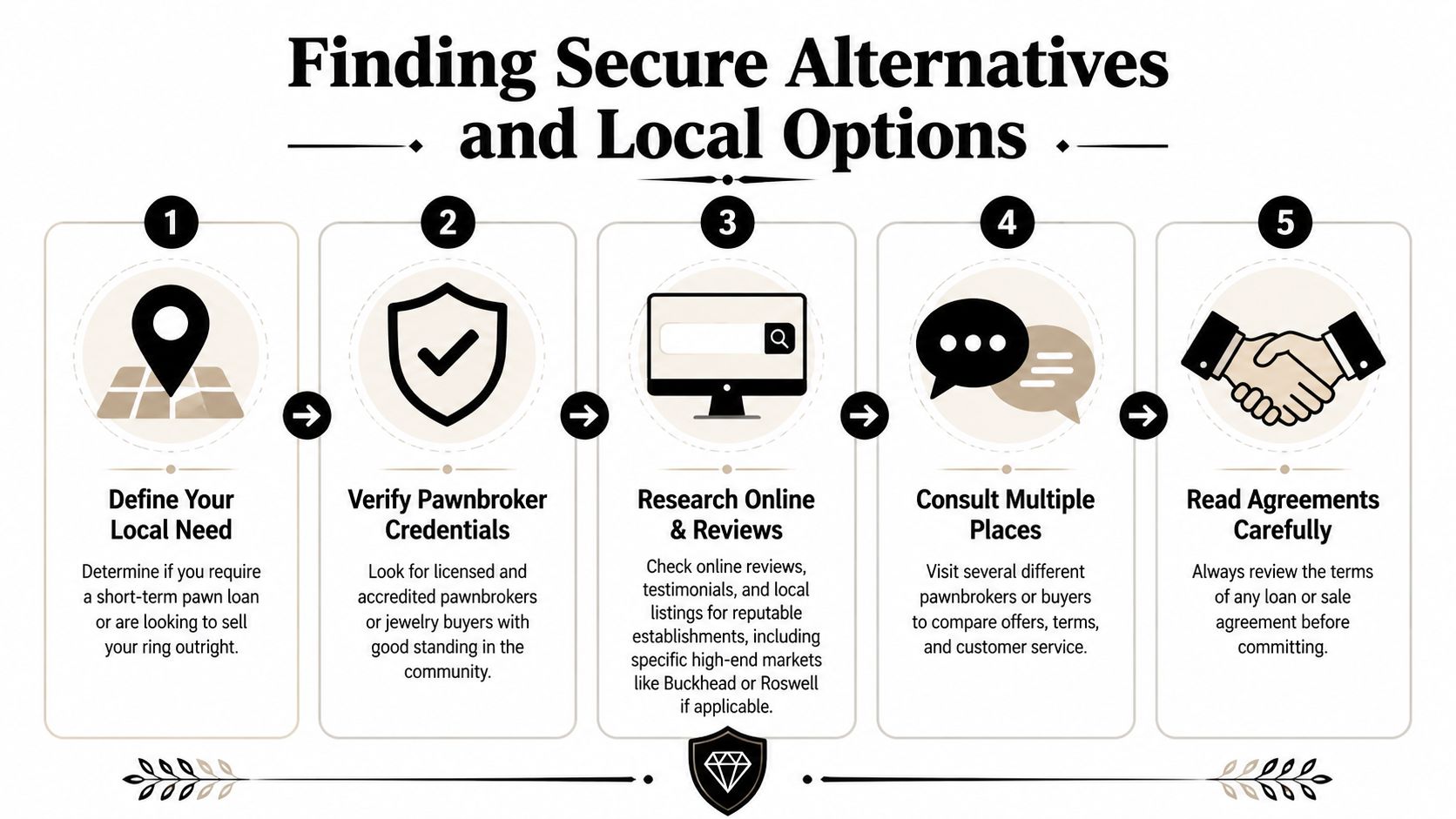
If you're searching in Atlanta, Buckhead, Sandy Springs, Alpharetta, Roswell, Brookhaven, Midtown Atlanta, or elsewhere in Georgia, focus on transparency more than marketing language. A reputable buyer or pawnbroker should inspect the ring in front of you, explain the basis of the offer, and answer questions without pressure.
Look for practical trust signals:
Clear testing methods: They should explain how they verify metal and stones.
Comfort with documentation: Serious buyers want grading reports, receipts, and brand paperwork.
Specific explanations: “This is what the center stone is trading like in resale” is useful. “That's just what it's worth” is not.
Written terms: Any loan or sale should be documented clearly.
A more secure route for higher value rings
For a higher-value diamond ring, designer ring, or branded piece, a specialist buyer can be a better fit than a general pawn environment. That's especially true if the ring includes a strong center diamond, important paperwork, or a luxury brand signature.
Remote evaluation is also more common now. Many established buyers offer a preliminary review from photos and documentation, followed by insured shipping or a private appointment. That can be a more discreet option for clients who don't want to carry a valuable ring into multiple storefronts.
For a meaningful ring, the safest process is the one that combines clear valuation logic, documented terms, and secure handling from start to finish.
If you want to compare local sale options before choosing a pawn route, this page on selling my diamond ring near me is a practical place to start.
Frequently Asked Questions About Pawning a Ring
Can I pawn a ring without paperwork
Yes. Most buyers can still test the metal and inspect the stones. But documentation usually helps reduce uncertainty and can support a stronger offer.
Will a jewelry appraisal guarantee the pawn amount
No. An appraisal and a pawn offer are different things. The pawn offer is based on what the lender believes the ring can realistically resell for, plus their risk tolerance.
Is pawning better than selling for an engagement ring
It depends on your goal. If you want the chance to reclaim it, pawning may fit. If you need the most practical cash outcome and don't expect to redeem it, selling is often the better choice.
Do branded rings get better offers
Sometimes, yes. Brand, authenticity, condition, and original documentation can improve buyer confidence, especially for names like Cartier or Tiffany & Co.
Should I get more than one offer
Yes. Even when you're in a hurry, comparing offers can reveal major differences in valuation approach, loan terms, and overall professionalism.
If you want a professional, low-pressure evaluation before deciding whether to pawn or sell, Antwerp Diamond is a trusted option for ring, diamond, jewelry, watch, and luxury asset reviews. You can request a confidential assessment, visit the Atlanta area location, or start with an online evaluation to understand what your ring may be worth in today's resale market.


