

Top Sales Channels: Finding the Best Place to Sell Handmade Jewelry
When deciding where to showcase your handcrafted designs, comparing channels side-by-side helps clarify the trade-offs between built-in audience size, ongoing operating expenses, and technical effort.
Platform Type | Example Channels | Audience Reach | Key Fees & Costs | Technical Setup |
|---|---|---|---|---|
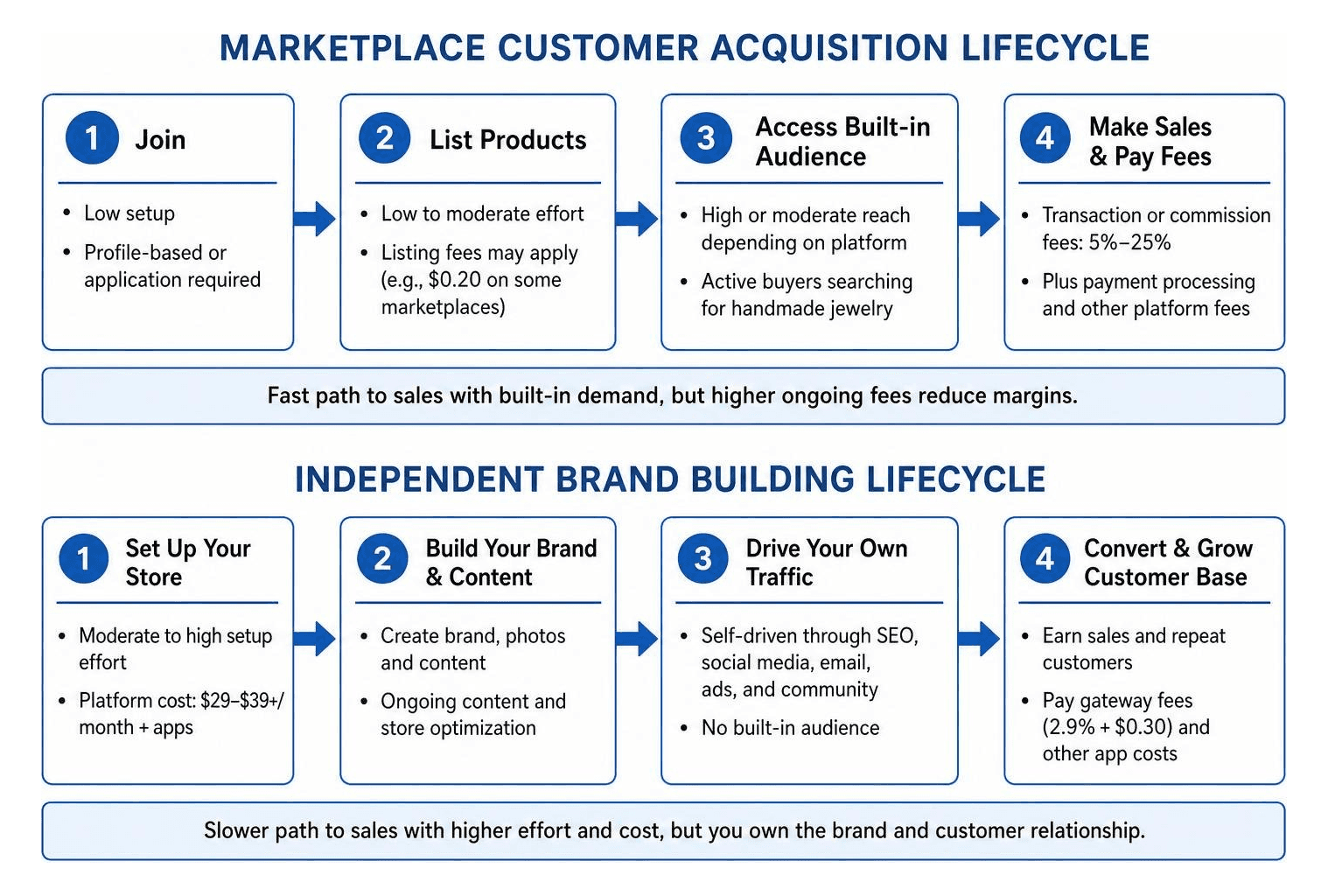
Global Marketplaces | Etsy, Amazon Handmade | High (90M+ active buyers) | $0.20 listing fee, 6.5%–15% transaction/referral fee | Low; profile-based |
Curated & Niche Craft | Folksy, Soulawa, GoImagine | Moderate (Niche, eco-conscious) | 5%–13% commission, optional monthly subscription | Low to Moderate; application required |
Wholesale B2B | Faire | High (700k+ global retailers) | 15%–25% first order, 0% reorders | Moderate; catalog approval |
Independent Web Stores | Shopify, WooCommerce | None (Self-driven) | $29–$39+/month + apps + gateway fees (2.9% + $0.30) | Moderate to High |
Social Commerce | Instagram, TikTok Shop | Moderate to High (Algorithm-based) | Variable transaction fees (1.65%–5%) + ad spend | Low to Moderate |
Assessing Global Marketplaces as the Best Place to Sell Handmade Jewelry
Global marketplaces represent the fastest way to put artisan pieces in front of active buyers without spending thousands on advertising. Platforms like Etsy command over 90 million active buyers worldwide who specifically visit the site looking for bespoke craftsmanship, personalized gifts, and vintage treasures. Similarly, Amazon Handmade taps into Amazon's wider pool of over 300 million active customer accounts, offering approved makers a waived monthly subscription fee (saving $480 annually compared to a standard Professional selling account) in exchange for a flat 15% referral fee per unit sold.
For artisans exploring where to sell jewelry online, these platforms remove the immediate burden of digital marketing. However, convenience comes at a measurable cost. Beyond standard $0.20 listing fees that renew every four months, transaction cuts, payment processing percentages, and mandatory offsite advertising fees can quickly eat into thin margins. Following a comprehensive guide on scaling artisan jewelry sales often reveals that a shop doing $50,000 annually on a major marketplace will easily surrender upwards of $3,250 just in baseline transaction fees.
Curated and Niche Artisan Marketplaces
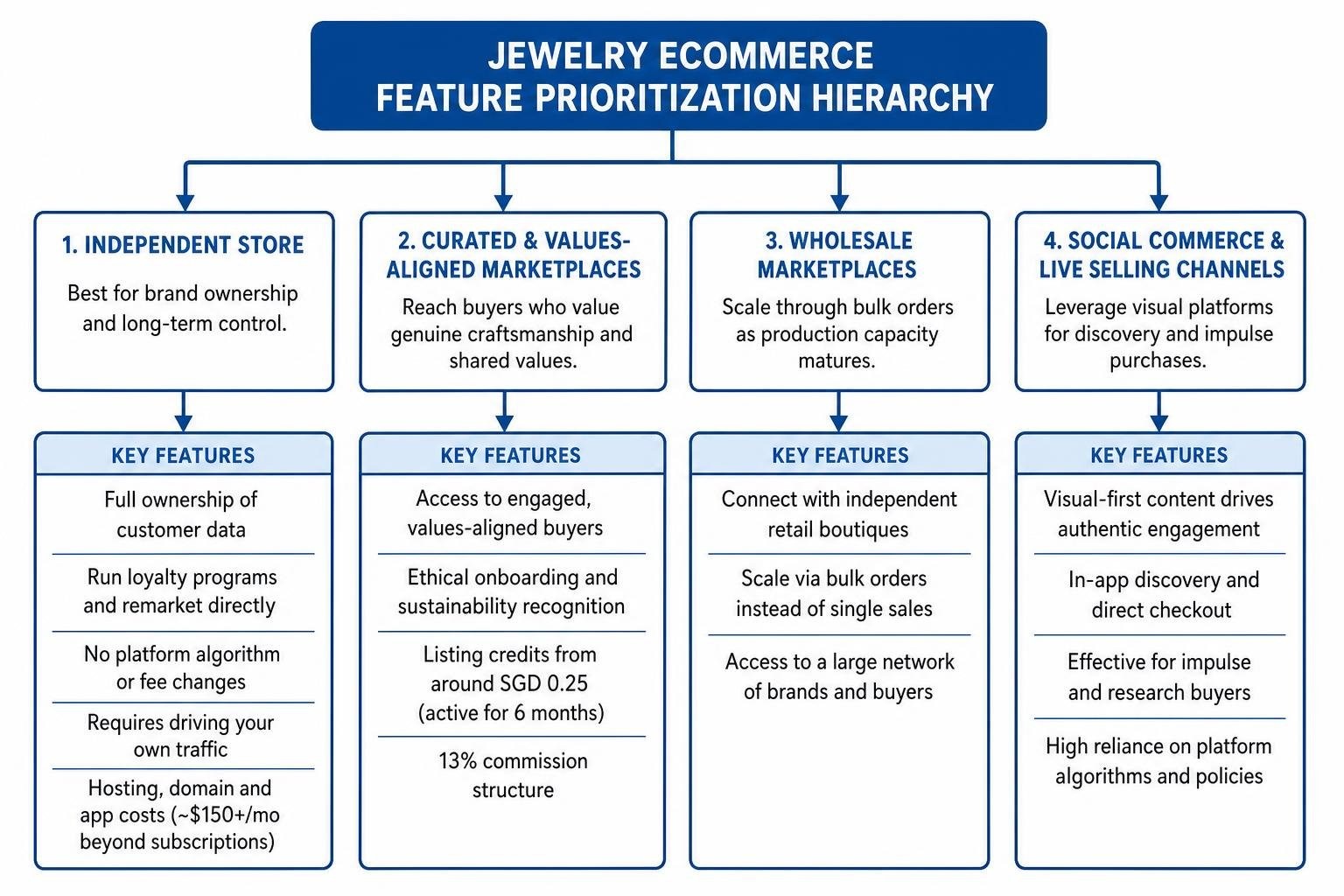
If you want to escape the race-to-the-bottom pricing often found on massive generalist platforms, curated and values-aligned marketplaces offer an attractive alternative. Venues such as Folksy in the UK (with around 250,000 to 300,000 registered users) or GoImagine in the US cater to buyers who value genuine, verified craftsmanship over mass production.
Eco-conscious venues have also emerged to champion sustainable production and cultural heritage. For example, completing an ethical artisan vendor onboarding allows creators to reach conscious consumers with listing credits starting around SGD 0.25 (active for six months), a 13% commission structure, and recognition through eco-friendly initiatives like plastic-free shipping badges.
When your production capacity matures, wholesale marketplaces like Faire—which hosts over 100,000 brands connecting with 700,000+ independent retail boutiques—let you scale by securing bulk orders rather than fulfilling one single necklace at a time.
Why an Independent Store Might Be the Best Place to Sell Handmade Jewelry
Building a dedicated online store via platforms like Shopify, WooCommerce, or Big Cartel is the gold standard for brand longevity. Owning your digital storefront protects you from sudden marketplace algorithm shifts, changes in platform fee schedules, and direct competitor ads appearing alongside your product listings.
When studying how to sell jewelry online, the primary advantage of an independent store is total ownership of your customer data. You can collect customer emails, run loyalty programs, and remarket directly to past buyers at zero incremental acquisition cost.
The main drawback? You start with zero foot traffic. Running an independent store means you are entirely responsible for driving every visitor through search engine optimization (SEO), content marketing, social media, or paid ads. Additionally, monthly hosting fees, custom domains, and recurring ecommerce app costs (which can easily add $150 per month on top of base platform subscriptions) require steady sales volume to remain cost-effective.
Social Commerce and Live Selling Channels
Social platforms like Instagram, TikTok Shop, and Pinterest have evolved from visual discovery tools into complete commerce ecosystems. Visual-first mediums are naturally suited for jewelry. Video reels demonstrating wire-wrapping techniques, gemstone setting, or styling tips create authentic engagement that polished studio shots cannot match.
Pinterest operates largely as a visual search engine where users actively research purchases, making shoppable product pins an effective bridge between discovery and checkout. Meanwhile, direct checkouts on TikTok and Instagram allow impulse buyers to complete purchases without leaving the app.
The main risk is platform vulnerability. Relying entirely on social commerce leaves your revenue exposed to sudden reach suppression, shifting feed algorithms, or unexpected account suspensions.
Key Financial and Technical Factors When Selecting a Platform
Choosing where to sell requires analyzing both direct costs and the backend tools that protect your sales conversion rates.
Understanding True Fee Structures
Calculate your platform costs beyond the headline commission rate. A sustainable financial assessment must incorporate:
Listing Fees: Upfront costs per product (e.g., $0.20 every 4 months on open marketplaces vs. flat monthly subscriptions on custom sites).
Payment Processing: Merchant gateway fees typically averaging 2.9% to 4% + $0.30 per transaction.
Mandatory Advertising: Platform-driven offsite advertising fees that take an extra 12% to 15% on qualifying sales.
Essential Platform Features That Recover Sales
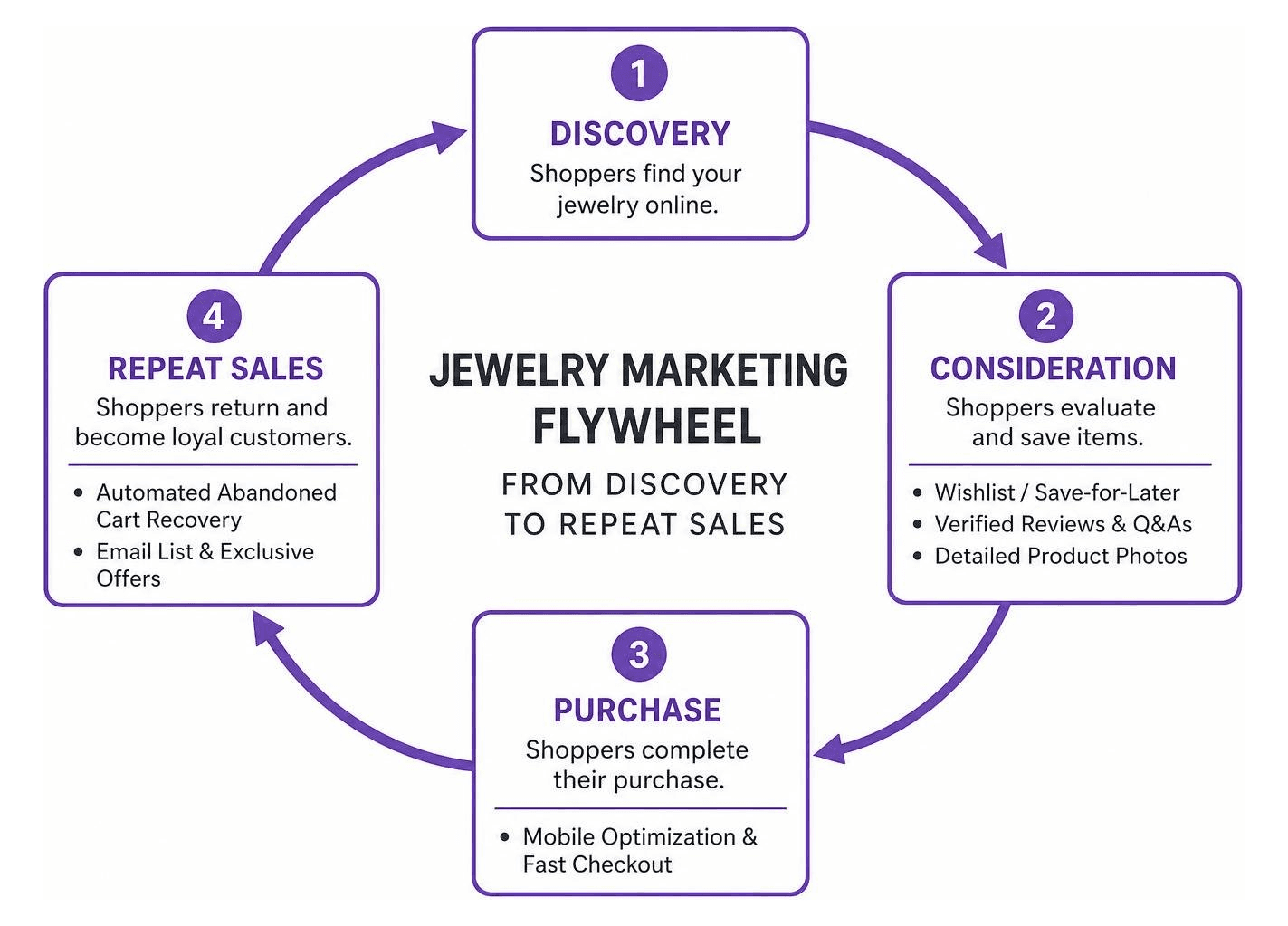
Because roughly 70% of online shopping carts are abandoned—with jewelry seeing even higher rates due to thoughtful, high-consideration purchasing—your sales channel needs specific technical capabilities:
Automated Abandoned Cart Recovery: Automated emails reminding shoppers of items left behind recover significant lost revenue.
Wishlist and Save-for-Later Tools: Critical for jewelry gift-giving seasons like holidays, anniversaries, and birthdays.
Verified Customer Reviews & Media Q&As: Visual social proof showing real buyers wearing pieces directly overcomes hesitation regarding size and finish.
Mobile Optimization & Page Speed: Heavy image galleries must load instantly to prevent visitors from bouncing.
Understanding the difference between costume pieces and what is fine jewelry is also essential when configuring platform settings. Fine jewelry requires explicit disclaimers regarding precious metal hallmarks, karat purity, natural gemstone grading, and insured shipping options to meet international compliance laws.
Essential Strategies to Maximize Online Jewelry Sales
1. Master Accurate Pricing Formulas
Underpricing is the most common mistake handmade jewelry makers make. Artisans frequently tally raw bead and wire costs while completely ignoring their hourly labor and workshop overhead.
Use this foundational formula:
$$\text{Base Cost} = \text{Materials Cost} + (\text{Labor Hours} \times \text{Fair Hourly Wage}) + \text{Overhead}$$
$$\text{Wholesale Price} = \text{Base Cost} \times 2$$
$$\text{Retail Price} = \text{Wholesale Price} \times 2$$
If a pair of sterling silver earrings uses $8 in raw materials, requires 45 minutes of fabrication at $24/hour ($18 labor), and incurs $4 in allocated overhead (packaging, studio supplies, tools), your base cost is $30. Your wholesale rate should be $60, resulting in a sustainable retail price of $120.
2. High-Converting Product Photography
Online jewelry shoppers cannot touch or try on your work, making visual accuracy essential. When refining how to photograph jewelry, focus on three core setups:
Diffused Natural Light: Place a table 90 degrees next to a bright window with a simple white foam board opposite the window to bounce soft light into shadows.
Scale and Proportion Shots: Always photograph pieces on a human model (neck, ear, or wrist) so customers instantly understand the scale.
Macro Detail Shots: Capture close-ups of clasps, metal textures, backings, and gemstone facets to prove craftsmanship quality.
3. Build an Owned Audience
Start capturing customer email addresses from your very first sale. Offer an immediate 10% discount incentive on initial orders in exchange for an email signup. An owned subscriber list protects your business from marketplace algorithm changes and gives you an immediate audience whenever you launch new seasonal collections.
Frequently Asked Questions About Selling Handmade Jewelry
What is the best platform for a beginner selling handmade jewelry?
For most beginners, an established marketplace like Etsy or Amazon Handmade is the most accessible starting point. These platforms eliminate the technical learning curve of web development and provide immediate access to active buyers searching for handmade designs. Starting domestically on a single platform lets you streamline production times, master packaging, and establish reliable shipping workflows before managing complex multi-channel operations.
How do marketplace fees impact handmade jewelry profit margins?
Marketplace fees compound quickly across listing renewals, transaction cuts, payment processing, and mandatory promotional programs. If a platform claims a 6.5% transaction fee, adding payment processing (3%–4%) and per-item listing costs can push total deductions past 12% to 15% of your gross sale. If your pricing structure only covers materials without factoring in labor and platform commissions, marketplace fees can easily eliminate your operating profit entirely.
Should artisan jewelers transition from marketplaces to an independent website?
Yes, transitioning to a hybrid model is the most effective way to scale. Use high-traffic marketplaces to discover new buyers, but use branded package inserts, care cards, and warranty registration to encourage those buyers to make their repeat purchases on your independent website. This strategy allows you to build direct brand equity and retain 100% of your retail margins over time.
Conclusion
Building a thriving handmade jewelry brand requires matching your current business stage with the right sales channel. Beginners benefit most from the instant footfall of established marketplaces, while scaling designers maximize their profits by launching dedicated, independent online stores. Diversifying across social commerce, curated craft markets, and direct web storefronts ensures long-term resilience and sustained growth.
While building your artisan jewelry brand, you or your clients may also possess vintage heirlooms, estate diamonds, luxury timepieces, or high-end designer accessories that fall outside your handcrafted collections. When looking to liquidate high-value fine assets, we at Antwerp Diamonds provide private, discreet, appointment-only evaluations in Atlanta, GA. We offer transparent, market-based offers and immediate cash payouts without hidden consignment delays. To evaluate estate diamonds or luxury jewelry items, explore our Antwerp Diamond Store luxury evaluation services to schedule a private consultation.


