

The best place to sell a Rolex watch depends on what you want most from the deal. If you want the strongest mix of price, speed, and security, specialist buyers usually make the most sense, while online marketplaces can sometimes chase a higher final price but often leave sellers with 55% to 65% of value on private platforms versus 72% to 78% of current retail pricing from certified gray-market dealers in the U.S. in 2024, after fees and negotiation are factored in (Antwerp Diamond Store market overview).
If you're reading this, you're probably in one of two positions. You either need a clean, safe sale now, or you're trying to make sure you don't leave money on the table with a watch that may be worth far more than most casual buyers realize. Rolex sales look simple from the outside, but the right channel changes everything.
A seller with a modern Datejust, a full set, and a realistic time frame shouldn't use the same strategy as someone moving a worn Submariner quickly, or someone selling a rare vintage piece. The decision comes down to three trade-offs: speed, final price, and personal security.
Table of Contents
Where Should You Sell Your Rolex Watch
The best place to sell a Rolex watch isn't one universal destination. It's the channel that fits your watch, your timing, and your tolerance for risk.
Most sellers focus too narrowly on headline price. That's a mistake. A high asking price on a marketplace doesn't mean a high net result once you account for seller fees, buyer premiums, negotiation pressure, returns risk, shipping exposure, and the simple fact that many online inquiries never become funded transactions.
The three priorities that matter most
Start by deciding which of these matters most to you:
Speed: You want a prompt offer, a short inspection timeline, and payment without weeks of back and forth.
Price: You're willing to wait, field questions, and possibly accept more uncertainty to chase the highest outcome.
Security: You want a professional transaction, authenticated handling, and minimal exposure to scams, swaps, or chargebacks.
A lot of owners searching for the best place to sell a Rolex watch mean something more specific: where can I sell it without being underpaid or put at risk. That's why specialist buyers and established dealers so often win in real-world transactions.
Practical rule: If the watch is a standard modern Rolex and you value certainty, a specialist buyer is usually the cleanest path.
Private sales, consignment, and auction can all work, but they work best in narrower situations. Rare vintage watches may benefit from the right auction audience. Commodity-like modern references often perform better in direct sale channels where pricing is based on current demand and the buyer can fund immediately.
If you're selling in Atlanta, Buckhead, Sandy Springs, Alpharetta, Roswell, Brookhaven, Midtown Atlanta, or elsewhere in Georgia, local in-person evaluation also adds something online platforms can't: controlled handling and immediate clarity. For a broader overview of local selling routes, this guide on where to sell a luxury watch near you is a useful starting point.
Comparing Your Rolex Selling Options Head to Head
A seller with a Submariner can have three very different outcomes from the same watch: cash in hand today from a dealer, a higher gross price after weeks of listing and negotiation, or a premium result months later if the piece is rare enough for auction. The best place to sell a Rolex depends on which compromise you can live with.
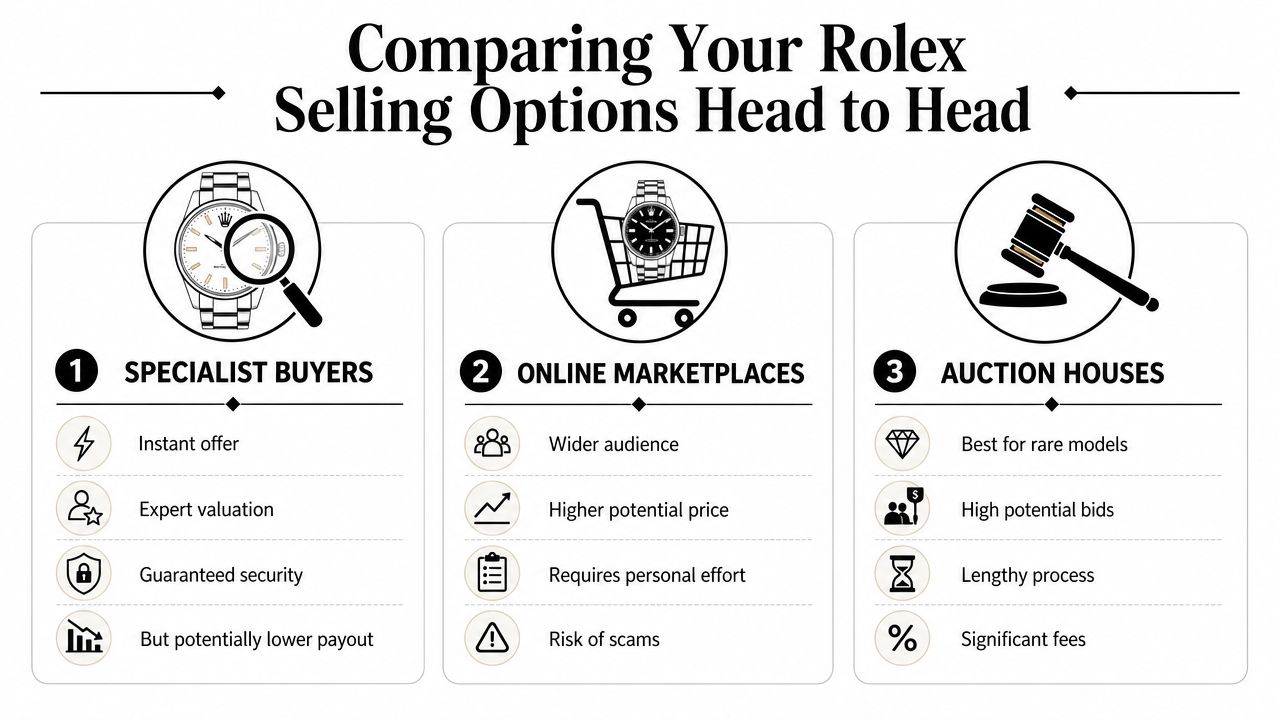
Comparison table
Selling channel | Typical payout profile | Time to payment | Fees and deductions | Security profile | Best fit |
|---|---|---|---|---|---|
Specialist buyers | Strong immediate offers, usually tied to current wholesale and dealer demand | Often same day or after a short inspection period | Usually straightforward. Sellers often avoid listing fees and long selling costs | High, if you use a reputable office or insured shipping process | Modern Rolex models, sellers who want speed, low friction, and clear execution |
Online marketplaces | Higher asking-price potential, but net proceeds vary widely | Often slow and unpredictable | Platform fees, payment processing, shipping, insurance, and negotiation all reduce net | Moderate to low, depending on buyer quality and payment method | Sellers willing to manage the entire process and accept more risk |
Auction houses | Strong upside for rare, vintage, or provenance-heavy watches | Slow | Seller commissions and related sale costs vary by house | High institutional handling, but timing and final result are uncertain | Rare references that need collector exposure |
Consignment dealers | Can reach retail buyers and sometimes beat a direct dealer offer | Slow to moderate | Commission reduces final payout | Safer than a private sale in many cases | Sellers who can wait and want a hands-off retail-facing process |
Pawn shops | Immediate liquidity, usually at the lowest price point | Immediate | Offers are often conservative | Varies sharply by operator and local expertise | Emergency cash situations |
The main pricing mistake is simple: sellers compare gross headline price to net money received. Fees, delays, shipping exposure, chargeback risk, and renegotiation all affect the actual outcome.
What each channel is really good at
Specialist buyers fit standard modern Rolex references better than any other channel if your priority is speed, security, and a clean close. The process is direct. The watch is inspected, condition is verified, originality is checked, and the offer is based on what that model can trade for in the current market. For Datejusts, Submariners, GMT-Master IIs, Explorers, and newer Oyster Perpetuals, this route is often the most efficient balance of price and certainty.
Online marketplaces can produce a stronger gross price, but they ask the seller to do real work and accept real exposure. You need accurate photos, a correct description, prompt communication, insured shipping, and a payment method that cannot be reversed after the watch is delivered. Lower seller fees do not always lead to a better result. A weak listing, a hesitant buyer, or a dispute after delivery can erase the advantage quickly.
The highest advertised price is not always the highest realized value.
Auction houses are best reserved for the right watch, not just an expensive watch. A rare dial variant, unusual provenance, strong vintage condition, or a reference with active collector demand may justify the longer timeline. Dawsons' guide to where to sell a Rolex notes that specialist auction houses can bring out stronger bidding on rare models, but the seller gives up control over timing and waits much longer to get paid.
Consignment dealers sit in the middle. They can be a good choice when the watch has retail appeal and you do not want to handle buyer contact yourself. The trade-off is patience. Your capital is tied up until the watch sells, and the final number still has to absorb commission.
Pawn shops solve one problem well: immediate cash. They are rarely the best answer for maximizing a Rolex sale because offers are usually built around quick resale margin and limited model-specific expertise. For a seller under time pressure, that may still be acceptable. It is a speed decision, not a value decision.
For a wider look at how professionals price, sort, and buy premium pieces, this guide to selling high-end watches is a useful reference.
How to Prepare Your Rolex to Maximize Its Value
Preparation changes the tone of the entire transaction. A watch that arrives as a complete, organized asset gets treated differently from one that arrives loose, dirty, undocumented, and vaguely described.
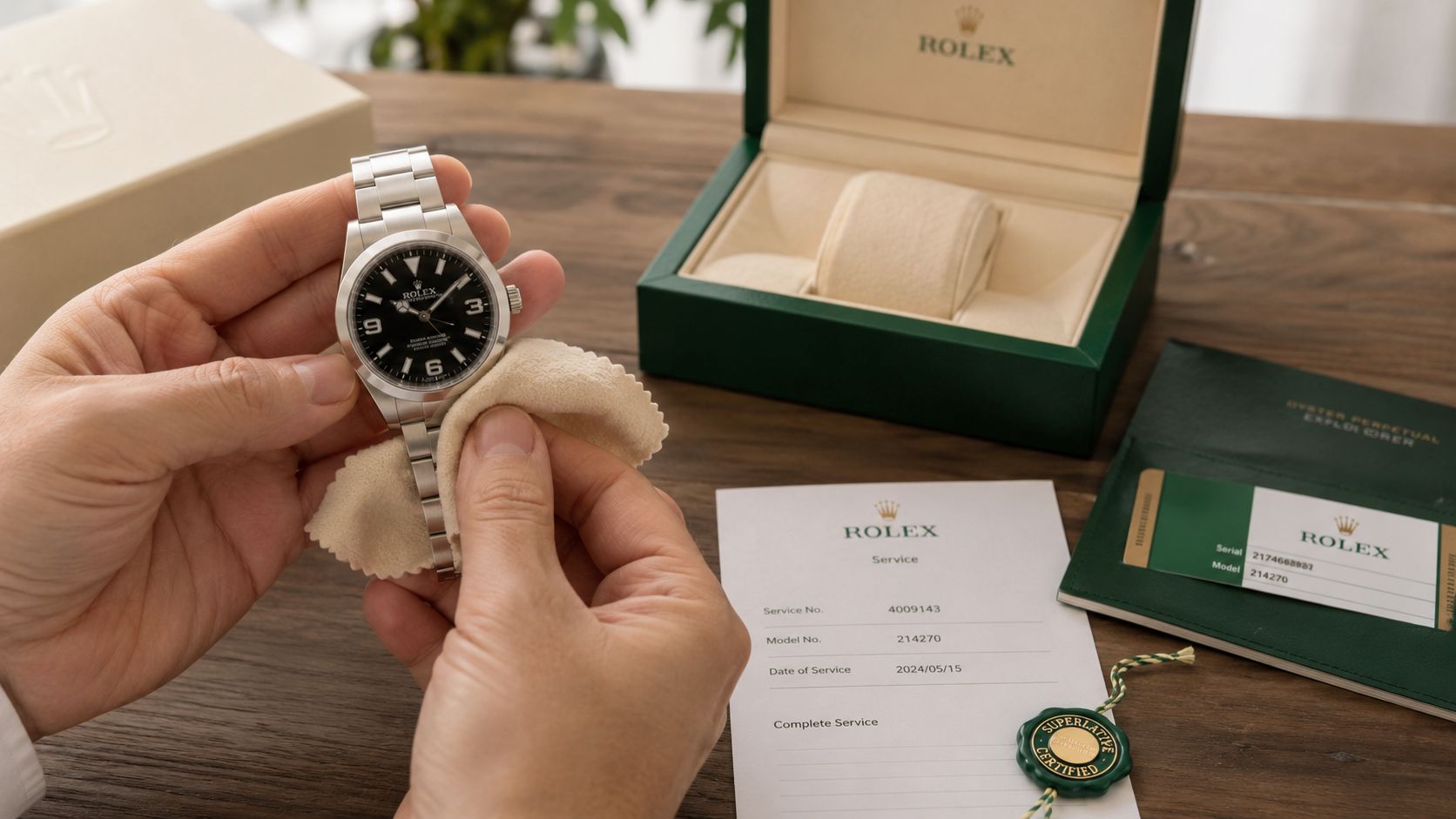
Gather everything before asking for offers
The first task is simple: collect every original item you still have.
Box and papers: This includes warranty card, booklets, tags, receipts, and service documents.
Extra links: Missing bracelet links can affect fit and buyer appeal.
Service history: Any documented Rolex service or respected independent watchmaker work matters.
Model details: Know the reference, approximate purchase year, and whether any parts were replaced.
The value difference between selling a Rolex with full documentation versus without can exceed 25% to 30%, and documented Rolexes sell 18% faster and at 27% higher prices on average (Rolex seller discussion on box and papers premium). For many sellers, that's the single easiest way to protect value before the watch ever leaves home.
Checklist mindset: Don't ask for an offer until you've checked drawers, safes, old file folders, and deposit boxes for paperwork.
Present the watch properly
Don't polish the watch yourself. Don't open the case. Don't let a local jeweler "freshen it up" unless you understand exactly what they're doing. Amateur polishing rounds edges, softens lugs, and can weaken collector appeal.
Do this instead:
Wipe it gently with a clean microfiber cloth.
Photograph it in natural light if you're seeking remote offers.
Show honest condition including scratches, stretch, dents, and clasp wear.
Lay out the full set in one photo so the buyer sees completeness immediately.
If you aren't sure whether parts are original, handle that before negotiation. A changed dial, aftermarket bezel, replacement bracelet, or service component can alter how the watch is priced. For this reason, basic authentication knowledge helps, and this guide on how to know if your Rolex is real is useful before you approach buyers.
A final practical point: don't spend money on cosmetic work just because you're selling. Some repairs help. Some reduce value. Get the watch evaluated first, then decide whether any work is worth doing.
The Rolex Authentication and Appraisal Process Explained
A serious Rolex buyer doesn't value your watch by guesswork. The process is technical, model-specific, and rooted in buyer confidence.
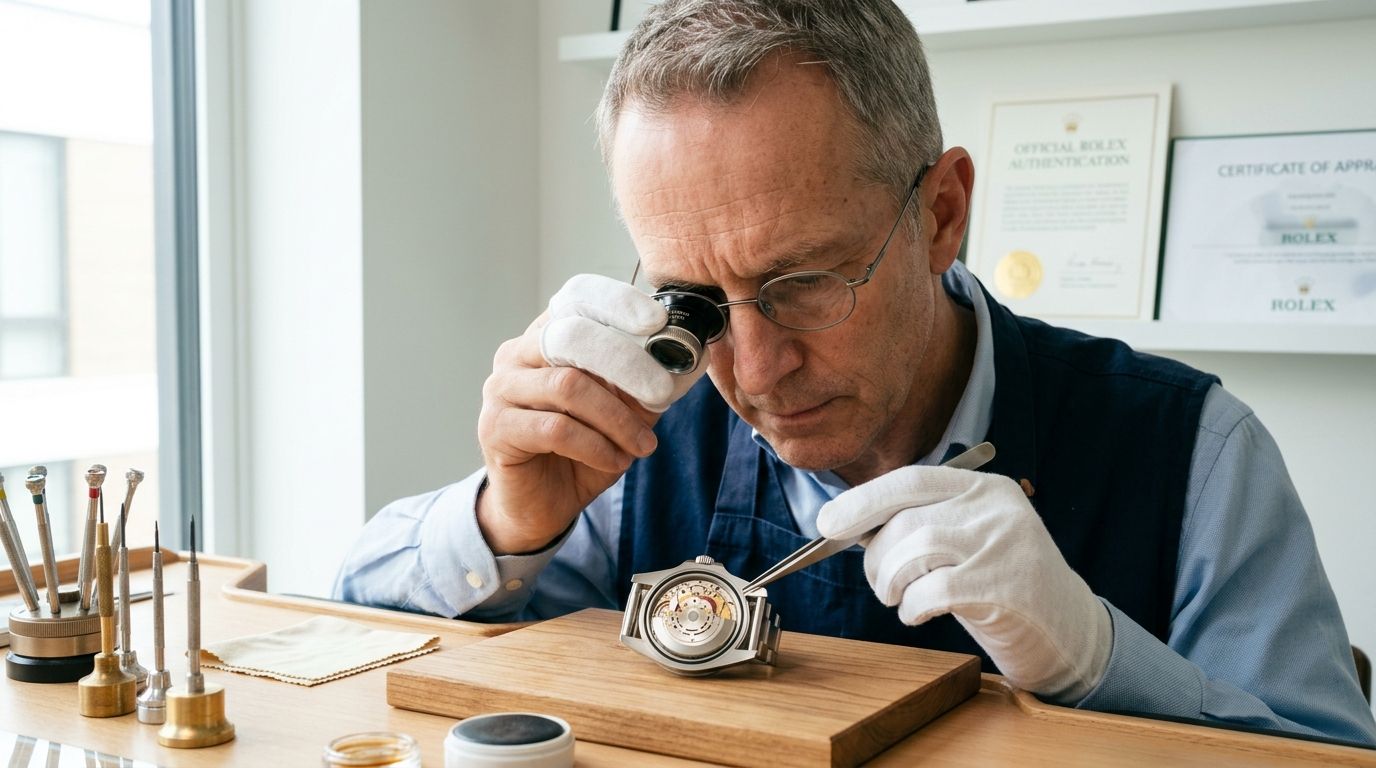
What an expert checks
Authentication usually starts with the fundamentals: reference, serial, case construction, dial printing, bracelet, clasp, crown, movement, and overall consistency. On a Rolex, tiny mismatches matter. The wrong handset, incorrect rehaut engraving, aftermarket diamond setting, or an inconsistent clasp code can shift a watch from straightforward to problematic very quickly.
A proper inspection may include:
Movement review: The internal caliber should match the reference and period.
Engraving and numbers: Serial and reference details must align with the watch's production era.
Dial and hands: Lume, typography, markers, and finish are checked for originality.
Case and bracelet condition: Over-polishing, replacement parts, and damage affect value.
Function test: Timekeeping, crown action, bezel action, and date change all matter.
Professional authentication isn't just for peace of mind. It directly affects return. A verified genuine Rolex can command a final sale price that's 20% to 30% higher than an unverified counterpart because it removes buyer risk (Rolex authentication and pricing discussion).
What actually drives the offer
A Rolex appraisal isn't just about whether it's real. It's about how desirable that exact example is today.
Here are the factors that move the offer most:
Reference and configuration: A steel sports model trades differently from a two-tone Datejust.
Condition: Honest wear is acceptable. Damage, polishing, replacement parts, and bracelet stretch change the number.
Completeness: Full set presentation improves buyer confidence.
Market demand: Some references trade quickly. Others are slower and require more spread.
Liquidity: A common modern Rolex can be priced more aggressively because resale is more predictable.
The fairest appraisals are the ones you can follow step by step. You should understand why the offer is what it is.
If you're seeking a professional valuation before a sale, it helps to understand how an appraiser separates insurance value, resale value, and immediate cash value. This overview of a watch appraisal process explains those differences clearly.
How to Negotiate and Secure Payment Safely
Even a strong offer can turn into a bad transaction if the payment process is sloppy. Luxury watch sales attract serious buyers, but they also attract people who exploit urgency, inexperience, and informal meeting setups.
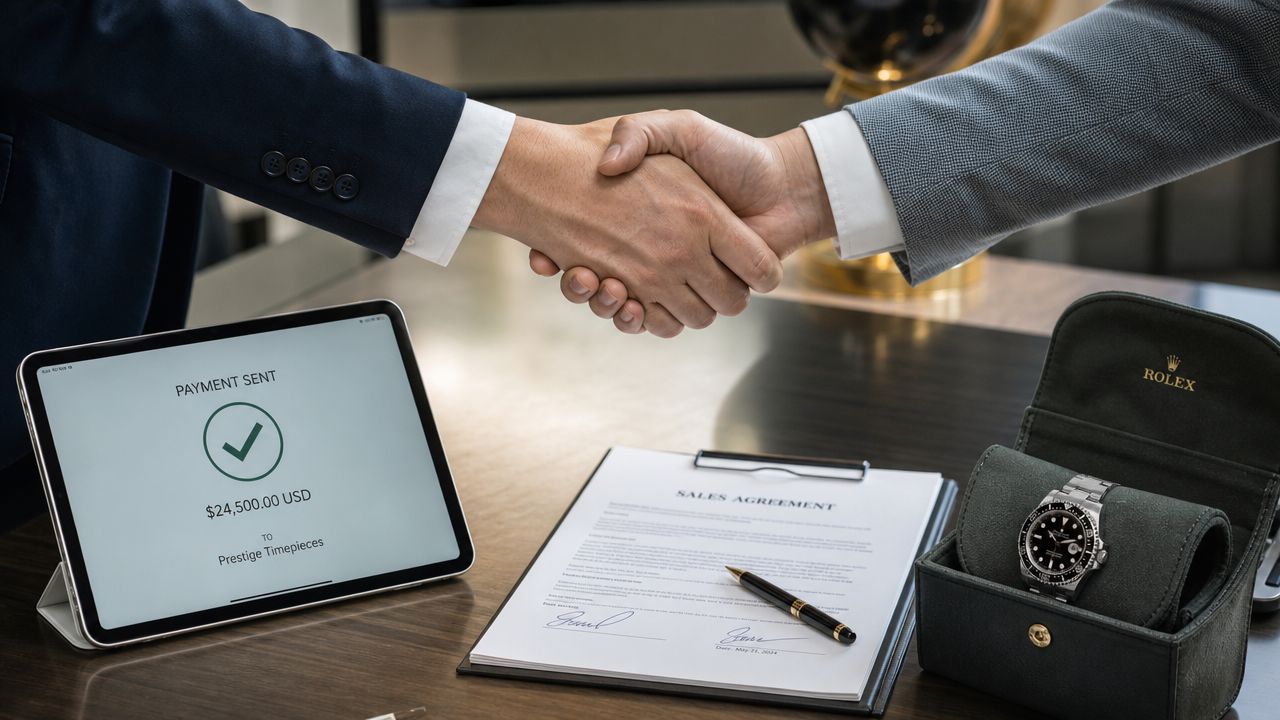
How to handle offers without getting trapped
The right way to negotiate is to compare net proceeds, not promises. Ask what the buyer is deducting, whether the offer is subject to movement inspection, whether paperwork changes the number, and how long the offer remains valid.
A good offer usually has three traits:
It's specific: The buyer names the reference, condition assumptions, and what's included.
It's explainable: You can see why the watch was priced that way.
It's executable: Payment method and timing are clear.
Be careful with vague language like "we can probably get more" or "list it higher and see what happens." That may sound appealing, but it often means delay and uncertainty, not a better result.
If the buyer won't explain how they'll pay, where you'll meet, or what happens after inspection, stop there.
How to protect yourself at payment and delivery
For in-person sales, use a professional office, not a parking lot, coffee shop, or random lobby. A controlled setting protects both the watch and the seller. That's especially relevant in markets like Atlanta, Buckhead, Sandy Springs, Alpharetta, Roswell, Brookhaven, Midtown Atlanta, and across Georgia, where local in-person evaluations can be arranged without handing the watch to an unknown private party.
For remote transactions:
Use fully insured shipping
Confirm who bears shipping risk
Photograph the watch before packing
Keep all serial and reference records
Wait for confirmed payment, not just a screenshot
Payment method matters. Bank wire is often preferred for high-value transactions because funds can be confirmed cleanly. Cash may be appropriate in some local settings, but only in a professional environment with proper documentation. Cashier's checks require verification, and personal checks shouldn't be part of a Rolex sale.
If you're comparing remote options, this guide to online watch buyers is a practical reference for evaluating shipping, inspection, and payout procedures.
Which Selling Method Is Best for You
A seller walks in with two goals that often conflict. Get the most money possible, and get the deal done quickly without taking unnecessary personal risk.
You usually get to optimize for two out of three: speed, final price, and convenience. The best place to sell a Rolex watch depends on which trade-off you can live with.
Choose the channel that matches the watch
A modern Submariner, Datejust, or GMT-Master II in honest used condition usually does best with a specialist buyer or established dealer. These watches have a known resale market, pricing is easier to pin down, and the main question is often how much certainty you want in exchange for giving up some upside.
A rare reference, strong vintage piece, full-set collector example, or watch with unusual provenance belongs in a different conversation. In those cases, waiting longer can make sense if the right audience is likely to compete for it.
Private marketplaces sit in the middle. They can produce a higher headline number, but the seller does the work and carries more of the risk. That includes buyer screening, price negotiation, shipping, payment verification, and the possibility that a deal falls apart after inspection.
A practical decision framework
Choose a specialist buyer if:
You want a firm offer and a clear closing timeline
Your Rolex is a common modern reference with steady demand
You prefer a lower-risk process over chasing the top possible number
You want one inspection, one decision, and one payment process
Choose an online marketplace if:
You are comfortable handling inquiries, low offers, and difficult buyers
You can afford to wait for a retail-minded buyer
You understand that listing price, selling price, fees, and net proceeds are different numbers
You are prepared to manage more fraud exposure and more transaction friction
Choose an auction house if:
The watch has rarity, originality, or collector appeal that could trigger bidding competition
You are not relying on fast payment
You can accept that the final result is not guaranteed
You understand that fees and timing matter as much as the hammer price
Choose consignment if:
You want dealer exposure without running the sale yourself
You are comfortable waiting until the watch sells
You have reviewed the commission structure and payout terms carefully
You trust the dealer to represent the watch accurately and price it well
For most first-time sellers with a modern Rolex, a reputable specialist buyer is the most balanced answer. It usually gives the best mix of strong market value, fast completion, and controlled risk.
For a standout vintage or collector-grade watch, I would slow down and test whether auction or a high-quality consignment partner can justify the extra time. For sellers who are experienced, patient, and comfortable managing strangers and payment risk, a marketplace can return more. It can also cost more in time, stress, and failed deals.
The wrong selling method does not just reduce your payout. It can leave you stuck with a watch tied up for weeks, exposed to avoidable security issues, or pressured into accepting a weaker deal after the process drags on.
Frequently Asked Questions About Selling a Rolex
Is it better to sell a Rolex locally or online
Local sales are usually better for security and convenience if you have access to a reputable buyer. Online sales can broaden the audience, but they add shipping, fraud screening, and payment risk.
Should I service my Rolex before selling it
Not automatically. Some service work helps, but unnecessary polishing or non-original replacement parts can hurt value. Get the watch evaluated first.
Do I need the original box and papers to sell my Rolex
No, but they help materially. A complete set usually attracts stronger buyer confidence and smoother offers.
Are vintage Rolex watches better at auction
Sometimes, yes. Auction works best when rarity, originality, condition, and collector demand can create competitive bidding. It isn't always the best route for common modern references.
Can I sell a damaged Rolex
Yes. Buyers may still purchase a Rolex with cosmetic wear or mechanical issues, but the offer will reflect repair risk, originality concerns, and resale demand.
What's the safest payment method when selling a Rolex
For most high-value sales, bank wire is the cleanest method when handled through a reputable buyer. In-person cash can work in a professional setting, but informal payment arrangements increase risk.
Is selling in Atlanta a good option for Georgia Rolex owners
Yes. Sellers in Atlanta, Buckhead, Sandy Springs, Alpharetta, Roswell, Brookhaven, Midtown Atlanta, and the greater Georgia market often benefit from in-person evaluation because it reduces shipping risk and allows immediate inspection and discussion.
If you're ready to sell a Rolex, borrow against a luxury watch, or get a professional evaluation before making a decision, Antwerp Diamond is a trusted local option with private appointments, insured remote service, and clear no-obligation offers. If you're in Atlanta or nearby areas like Buckhead, Sandy Springs, Alpharetta, Roswell, Brookhaven, or Midtown Atlanta, bringing the watch in for review is often the fastest way to understand its real market value and your best next move.


