
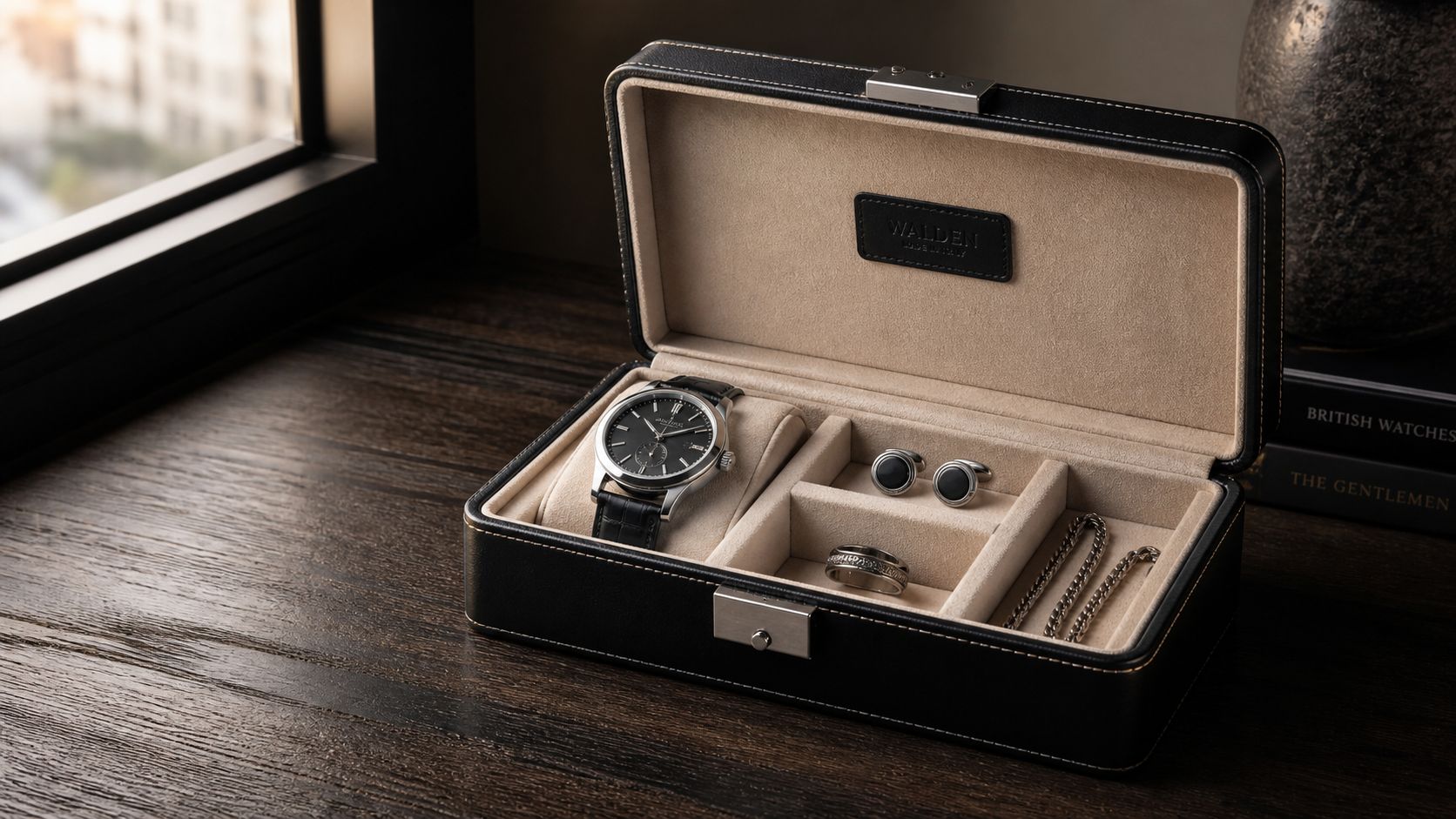
Most men pick the wrong travel jewelry solution. A soft pouch or toiletry bag is not protection, it's just loose storage. If you travel with a watch, cufflinks, rings, or chains, a mens travel jewelry case is a practical asset tool, not a style accessory.
The point is simple, a structured case keeps valuables immobilized, separated, and harder to lose. That matters because modern travel packing has moved toward organized storage, and the luggage market itself reflects sustained demand for compact accessories, with the global luggage industry valued at about US$20.1 billion in 2022 and projected to reach roughly US$35.3 billion by 2030 according to the reference in the provided market milestone.
Table of Contents
Why a Dedicated Mens Travel Jewelry Case Matters
A generic pouch is the wrong answer for high-value travel. Jewelry and watches do not behave well when they bounce against keys, chargers, cufflinks, or toiletries in a carry-on, and item-to-item contact is what causes most of the abrasion and tangling problems travelers complain about. A proper mens travel jewelry case solves that by creating structured separation, which is exactly what you want for rings, chains, cufflinks, and watches.
Structured storage is the real value
A purpose-built case does one job very well. It immobilizes pieces, limits movement, and gives each item a defined place, so a chain does not knot around a ring and a watch does not rub against a metal tie bar. That is why luxury packaging guidance favors compact, dedicated layouts instead of improvised storage. The better the internal organization, the less likely a piece is to arrive scratched, tangled, or missing.
Practical rule: if a piece has real resale value or sentimental value, it should not travel loose.
This matters even more for men who travel with fewer but more expensive items. A single watch, a wedding band, or a pair of cufflinks can justify protective storage because the loss is not just inconvenient, it can be expensive and difficult to replace. For readers who are still defining what counts as fine jewelry and why condition matters, this guide to fine jewelry is a useful starting point.
Why the category exists at all
Men's travel jewelry cases are a relatively recent mainstream accessory because organized packing goods have grown across the modern luggage market. They fit the shift from loose storage to specialized compartments for compact valuables. That's the core difference between an actual travel case and a soft pouch, one is designed to protect assets, the other is just a container.
For premium travel, the distinction is blunt. If you're carrying a Rolex, Cartier, Patek Philippe, or a few substantial pieces of jewelry, a structured case is the more professional choice. It's also the more discreet one, because it keeps everything in one small place instead of spreading value across multiple pockets.
Types of Travel Jewelry Cases for Men
Different case types solve different problems. If you travel with one watch and a few rings, you need something else entirely from a traveler who brings several cufflinks, a chain, and a second watch. The right choice depends on how much you carry, how often you move, and whether your priority is maximum protection or minimum bulk.
The main case forms
Roll-up organizers are best for compact packing with mixed items. They usually fold flat, which makes them easy to slide into a carry-on, but they don't always give watches the same rigid protection as a hard case.
Hard-shell watch boxes are the strongest choice for high-value watches. They're the better fit for a Rolex, Audemars Piguet, or similar piece if you want a defined cushion and a firm exterior that resists crushing.
Zippered folios work well for cufflinks, a wedding band, tie bars, and a chain or two. They're slim, discreet, and easy to carry in a business bag.
Modular insert cases are for travelers who want flexibility. They let you rearrange compartments, which is useful if one trip calls for only a watch and a ring, while another includes multiple small pieces.
Travel jewelry case types compared
Case Type | Best For | Protection Level | Portability |
|---|---|---|---|
Roll-up organizer | Mixed small pieces, short trips | Moderate | High |
Hard-shell watch box | Luxury watches, fragile pieces | High | Moderate |
Zippered folio | Cufflinks, rings, tie bars | Moderate | High |
Modular insert case | Flexible packing needs | Moderate to high | Moderate |
The smartest approach is not to buy the biggest or most expensive case. It's to match the format to the actual item mix. A bulky organizer is a bad trade if you only need room for one watch and two rings, while a thin folio is not enough if you're packing pieces that can't afford to rattle around.
A bigger case can be a worse travel solution if it attracts attention and wastes carry-on space. Minimal, understated storage often wins.
That's especially true for business travel, where discretion matters. If your jewelry case looks like a display box, it's advertising value. If it looks like a simple travel accessory, it does its job effectively.
Materials and Interior Linings That Protect Value
The outside of a travel case matters less than most buyers think. What protects value is the interior, because that's where metals, straps, pearls, and gemstones sit for hours inside a bag. A well-chosen lining can reduce surface abrasion, while the wrong material can hold moisture and create the exact condition that leads to tarnish or wear.
What the interior should do
For men's travel jewelry, the interior should be soft, structured, and isolated by compartment. Independent luxury-packaging guidance recommends compact layouts that keep contents immobilized, and that's the right standard. The goal isn't just softness, it's controlled contact, so a watch case doesn't let the bracelet shift and a ring slot doesn't let stones rub against another piece.
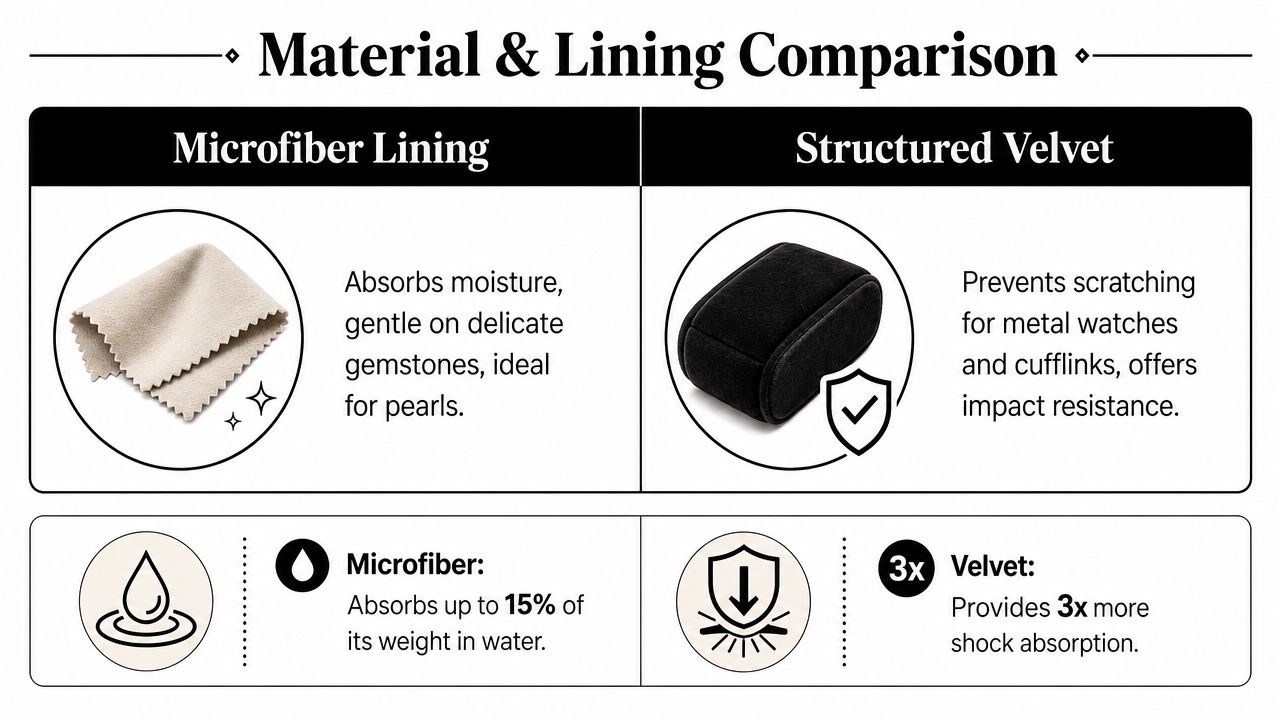
Microfiber is a strong choice when moisture control matters, especially for trips where humidity or sweat are part of the equation. Velvet is useful when the priority is scratch resistance for metal watches and cufflinks. Untreated suede can feel luxurious, but it's not automatically the safest option if it traps humidity. Silicone-treated cloth may improve surface protection, but you still want separate compartments and a low-friction fit.
The bigger mistake is assuming more padding means better protection. Sometimes it does the opposite. A case that looks plush can still hold damp air or let items move too much, while a more restrained interior with controlled moisture and firm separation may preserve condition better over repeated trips.
Here's a resource worth reading if tarnish prevention is a concern, especially for silver and mixed-metal pieces, Evo Dyne Products' comprehensive guide for jewelry owners.
What to choose for specific pieces
For polished gold or platinum pieces, a soft low-friction lining is the safer default. For watches with leather straps, breathing room matters because trapped moisture is a real risk during travel. For pearls and other organic materials, gentler storage is better than overstuffed padding.
If you own pieces that may later be sold or appraised, interior choice affects more than convenience. Condition affects confidence, and confidence affects resale. A case that preserves surface quality is a small but real part of protecting value.
For readers comparing metal quality and why some pieces deserve more careful storage than others, this gold guide is worth reviewing.
Security Features and Airport Packing Strategies
Security should drive your packing decision, not aesthetics. If a case looks premium enough to attract attention, it can become a liability in airports, hotels, and rideshares. Keep the goal simple, make the valuables harder to notice, harder to access, and easier for you to control.
Pack for carry-on only
Never put high-value watches or jewelry in checked luggage. Travel-security guidance consistently pushes valuables into carry-on bags, and that advice is correct. A checked bag introduces too many points of failure, from loss to rough handling to delayed retrieval. Keep the case in the bag that stays with you.
A watch is usually safer in a padded travel case than in its original box if the original box adds bulk or invites attention. The original box may be good for storage at home, but it's not always the best travel format. A small, discreet, padded case is usually the better carry option because it disappears into a carry-on more easily.
Use closures that resist casual access
Zippers, snaps, and magnetic fasteners each have a place. A zipper is the most reliable all-around choice because it closes the contents fully. Snaps are fine for slim folios when speed matters. Magnetic fasteners are convenient, but they should not be your only defense if the case will sit in a hotel room or business bag.
Keep the case understated. A large, luxury-looking organizer can draw more attention than the items inside it.
At airport screening, keep the case easy to access. If you need to remove it for inspection, place it in a separate bin and repack it immediately after screening. That reduces the chance of pieces being scattered across the checkpoint. The attached video gives a quick visual reminder of how a compact packing workflow helps in real travel conditions.
For fragile packing principles that translate well to travel jewelry, these fragile-item packing tips from Get n Go Removals Melbourne are a useful parallel. The core idea is the same, isolate, cushion, and keep movement to a minimum.
Insured shipping guidance for jewelry is relevant if you're mailing a piece before or after travel, especially when a trip overlaps with a sale or appraisal.
Insurance, Appraisals, and Secure Shipping for High-Value Items
A travel case protects the item physically, but it does not protect the value on paper. If you own investment pieces, you should know what they're worth, what condition they're in, and how you'd prove that if something goes wrong. That's where appraisals, photos, and shipping controls come in.
Documentation before departure matters
Before travel, photograph each piece clearly, front, back, clasp, serial number, hallmarks, and any visible wear. Keep receipts, certificates, and prior appraisal documents separate from the jewelry itself. That gives you a baseline if you need to discuss a claim, a repair, or a resale later.
A current appraisal also matters because it establishes a professional condition snapshot. That is useful whether you're carrying a Rolex, diamond ring, or branded cufflinks. It helps separate pre-existing wear from any damage that happens on the road.
If you're comparing how different valuation bases affect recovery, this explanation of actual cash value versus agreed value is a helpful reference point. Policy wording matters, and so does the documentation you already have on file.
Secure shipping is part of the same system
Not every traveler wants to carry valuables personally. Some people prefer to ship items to a buyer or appraiser before a trip, or after one, instead of bringing them through airports at all. In those cases, insured shipping and proper tracking become part of the protection strategy.
That's where professional evaluation helps. A trained eye can confirm authenticity, assess condition, and give you a clean starting point for a sale, loan discussion, or insurance update. For readers who want a more formal overview of the process, this guide to appraising jewelry is a sensible next read.
What an in-person review gives you
An in-person evaluation can catch details a photo won't show, like bracelet stretch, stone setting wear, clasp issues, or polishing history. That matters for high-value assets because condition affects confidence. It also gives you a more realistic sense of what should be packed for travel and what should stay home.
Pre-Trip Packing Checklist for Mens Jewelry
A good case is only one layer of protection. The packing routine around it matters just as much, because the wrong habit can undermine even the best organizer. Use this checklist before any trip where you're carrying a watch, ring, chain, or cufflinks.
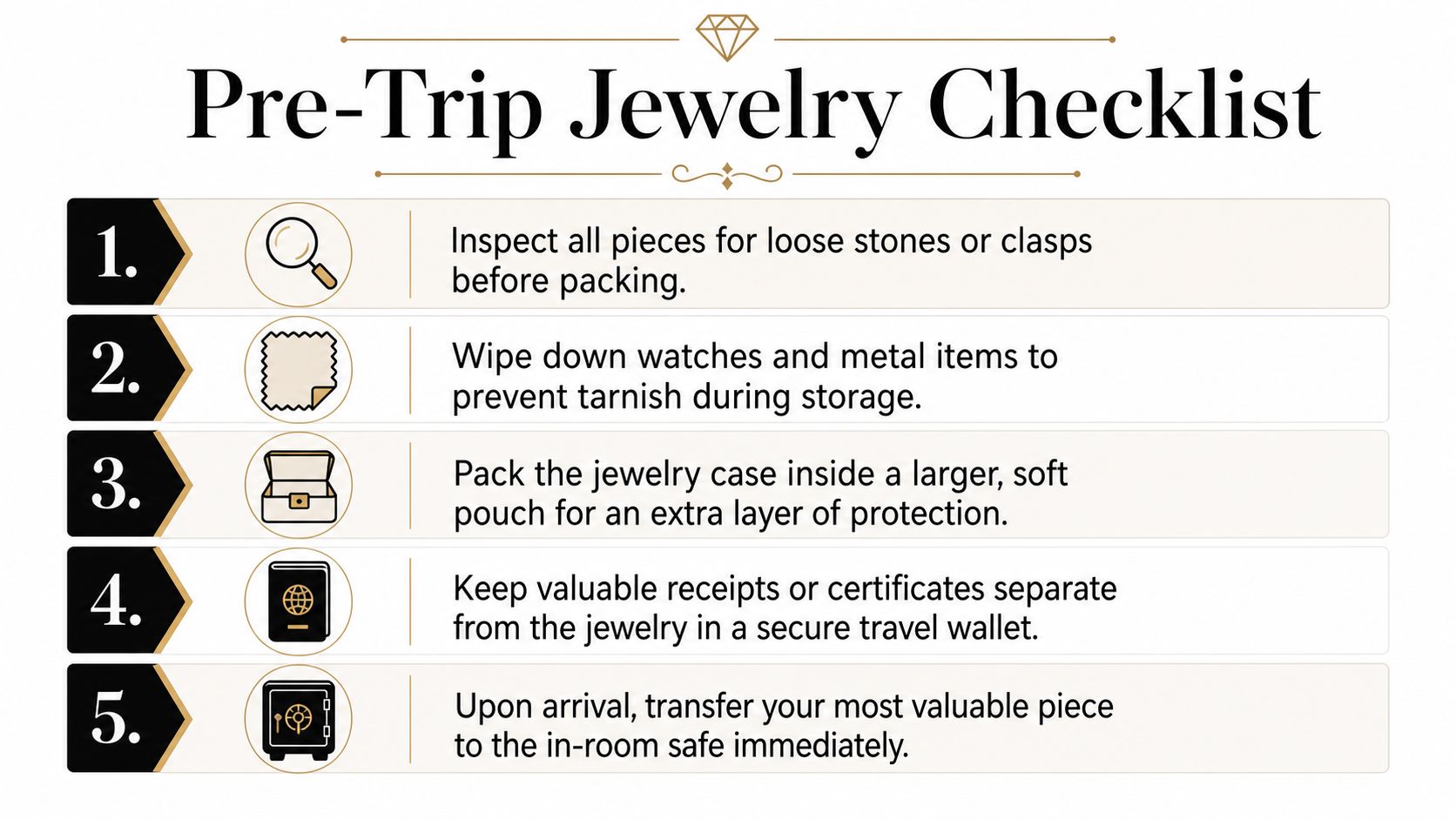
Inspect every piece first. Check clasps, settings, and bracelet integrity before anything goes into the case.
Wipe down metals and watches. Remove oils and surface residue so moisture or residue doesn't sit in storage.
Use a larger soft pouch around the case. That adds one more layer of impact protection inside the carry-on.
Separate documents from the jewelry. Keep receipts, certificates, and photos in a secure travel wallet, not in the case itself.
Move the most valuable piece to the hotel safe immediately. Do it as soon as you arrive, not after dinner.
A few habits that prevent avoidable losses
Do not leave jewelry in a gym locker, rental car, or open hotel drawer. Those are all bad temporary storage locations. If you remove a ring or watch, put it back in the case or into the safe right away.
Pack the case where you can reach it, but not where someone else can spot it easily.
That means inside a carry-on compartment, not an exterior pocket. It also means keeping the case small enough that it doesn't become a visible target. A business traveler in Midtown Atlanta or Buckhead has the same basic problem as someone flying out of Atlanta for a weekend trip, the less attention the case draws, the better.
Protect Your Investment with Expert Evaluation
Travel protection and asset protection are connected. A mens travel jewelry case reduces physical risk, but it doesn't answer the bigger questions, what is the piece worth today, what condition is it in, and what would happen if you needed to sell, borrow against, or insure it after a trip? Those questions deserve a professional evaluation, not guesswork.
If you travel with a watch or jewelry often, get the item reviewed before the next trip. A confidential appraisal can give you a clearer sense of value, confirm authenticity, and help you decide whether the piece should travel at all. For a broader explanation of why independent review matters, this guide to independent jewelry appraisal is a useful reference.
Antwerp Diamond Store works well for this kind of review because it handles luxury watches, fine jewelry, and other high-value assets with a discreet, market-aware process. If you're in Atlanta, Buckhead, Roswell, Sandy Springs, Alpharetta, Brookhaven, Midtown Atlanta, or elsewhere in Georgia, an in-person evaluation is the most direct way to understand condition and current market context. Remote clients can also use insured shipping when an in-person visit isn't practical.
If you're traveling with a watch, ring, or other valuable piece, don't leave its protection to a soft pouch and good luck. Antwerp Diamond can evaluate your jewelry or luxury watch, help you understand condition and value, and discuss the safest next step for sale, loan, or insurance purposes. Visit Antwerp Diamond to arrange a confidential evaluation or stop by for an in-person review.


